Contrahist
Poland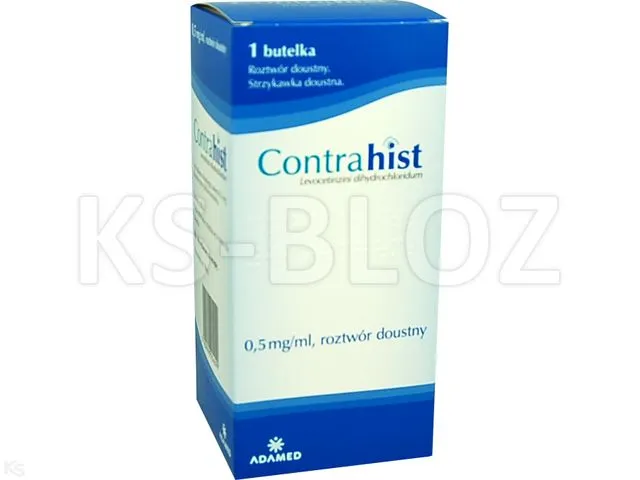
Table of Contents
Package leaflet: Information for the patient
Contrahist, 0.5 mg/ml, oral solution
Levocetirizini dihydrochloridum
For adults and children aged 2 years and older
Read the entire leaflet carefully before using this medicine, because it contains
important information for the patient.
- Keep this leaflet. You may need to read it again.
- If you have any further questions, please consult your doctor or pharmacist.
- This medicine has been prescribed for a specific individual. Do not pass it on to others. This medicine may harm other people, even if their symptoms are the same.
- If you experience any adverse reactions, including any not listed in this leaflet, inform your doctor or pharmacist. See section 4.
Table of contents of the leaflet:
- What Contrahist is and what it is used for
- Important information before taking Contrahist
- How to take Contrahist
- Possible side effects
- How to store Contrahist
- Contents of the pack and other information
1. What Contrahist is and what it is used for
The active substance in Contrahist is levocetirizine dihydrochloride.
Contrahist is an antiallergic medicine.
Contrahist is used to treat symptoms associated with:
- Allergic rhinitis (including perennial allergic rhinitis);
- Urticaria (hives)
2. Important information before taking Contrahist
When not to take Contrahist
Do not take Contrahist if the patient is allergic to levocetirizine dihydrochloride, cetirizine, hydroxyzine, or
any of the other ingredients of this medicine (listed in section 6).
Do not take Contrahist if the patient has severe renal impairment (severe kidney failure
with creatinine clearance less than 10 ml/min).
Warnings and precautions
Before starting treatment with Contrahist, discuss it with your doctor or pharmacist.
If the patient has difficulty emptying the bladder (e.g. due to spinal cord injury or benign prostatic hyperplasia), consult a doctor.
Contrahist may increase the frequency of epileptic seizures; therefore, consult a doctor if the patient has epilepsy or is at risk of seizures.
If the patient is scheduled for allergy testing, ask the doctor whether the patient should stop taking Contrahist several days before the test. Contrahist may affect the results of allergy tests.
Children
Contrahist is not recommended for infants and young children under 2 years of age.
Contrahist with other medicines
Tell your doctor or pharmacist about all medicines the patient is currently taking, has recently taken, or plans to take.
Taking Contrahist with food, drink and alcohol
Exercise caution when taking Contrahist together with alcohol or other substances affecting brain function.
In sensitive patients, concomitant use of Contrahist with alcohol or other substances affecting brain function may additionally reduce alertness and reaction ability.
Contrahist may be taken during or between meals.
Pregnancy, breastfeeding and fertility
If the patient is pregnant, breastfeeding, suspects she may be pregnant, or is planning to have a baby, she should consult her doctor or pharmacist before using this medicine.
Driving and using machines
Some patients treated with Contrahist may experience drowsiness, fatigue, or exhaustion. Exercise caution when driving or operating machinery until the patient's response to the medicine is known. However, specific tests conducted in healthy volunteers taking levocetirizine at the recommended dose did not show any effect of the medicine on attention, reaction ability, or driving performance.
Contrahist contains maltitol liquid, sodium benzoate and sodium
- This medicine contains liquid maltitol. If the patient has previously been diagnosed with intolerance to certain sugars, consult a doctor before using this medicine.
- This medicine contains 4 mg of sodium benzoate per 1 ml of solution.
- This medicine contains less than 1 mmol (23 mg) of sodium per 1 ml of solution, i.e. the medicine is considered "sodium-free".
3. How to use the medicine Contrahist
This medicine should always be used as directed by a doctor or pharmacist. If you have any doubts,
you should consult your doctor or pharmacist.
Recommended dose:
Adults and adolescents over 12 years of age: 10 ml of solution once daily.
Dosing in special patient groups:
Renal and hepatic impairment
In patients with impaired renal function, a dose reduction may be necessary depending on the severity of kidney disease. In children, the dose should also be adjusted according to body weight; the dose will be determined by the doctor.
Contrahist must not be used in patients with severe renal impairment.
Patients with hepatic impairment alone should usually receive the recommended dose.
In patients with both hepatic and renal impairment, a lower dose may be required depending on the severity of renal disease; in children, the dose should also be adjusted according to body weight; the dose is determined by the doctor.
Elderly patients (65 years and older)
No dose adjustment is necessary in elderly patients if renal function is normal.
Use in children
Children aged 6 to 12 years: 10 ml of solution once daily.
Children aged 2 to 6 years: 2.5 ml of solution twice daily.
Use of Contrahist is not recommended in infants and young children under 2 years of age.
How and when to take Contrahist
This medicine is for oral use only.
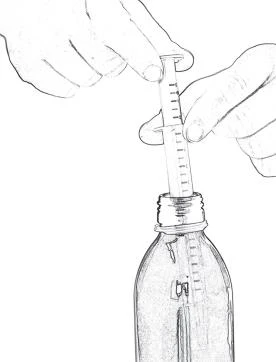
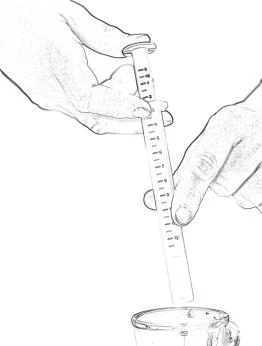
An oral syringe is provided with the package (see figure on administration). The solution may be taken undiluted or diluted in a glass of water.
Contrahist may be taken during or between meals.
Instructions for using the oral syringe
Insert the oral syringe into the bottle and pull the plunger to the mark on the scale corresponding to the prescribed dose in millilitres (ml). For children under 6 years of age, the daily dose of 5 ml given in two divided doses should be measured by drawing 2.5 ml of solution from the bottle twice daily (the dose must be accurately measured using the syringe with scale).
Remove the oral syringe from the bottle and empty its contents onto a spoon or into a glass of water by pressing the plunger. The medicine should be taken orally immediately after dilution.
After each use, rinse the plunger with water.
How long should Contrahist be used?
The duration of treatment depends on the type, duration and severity of the symptoms and is determined by the doctor.
Overdose of Contrahist
In adults, taking more than the recommended dose of Contrahist may cause drowsiness. In children, initial excitation and restlessness, especially motor restlessness, may occur, followed by drowsiness.
If an overdose of Contrahist is suspected, seek medical advice immediately. The doctor will decide what actions should be taken.
Missed dose of Contrahist
If a dose of Contrahist is missed or a lower than recommended dose is taken, do not take a double dose to make up for the missed dose. Take the next dose at the usual time.
Stopping Contrahist treatment
Stopping treatment with Contrahist earlier than recommended should not cause harmful effects. However, symptoms of the disease may gradually return, but their severity should not be greater than before starting treatment with Contrahist.
If you have any further questions about the use of this medicine, consult your doctor or pharmacist.
4. Possible adverse effects
Like any medicine, this medicine can cause adverse effects, although not everyone will experience them.
Common: may occur in less than 1 in 10 patients
Dry mouth, headache, fatigue, drowsiness/sleepiness.
Uncommon: may occur in less than 1 in 100 patients
Exhaustion and abdominal pain.
Frequency not known: cannot be estimated from the available data.
Other adverse effects reported include: palpitations, increased heart rate, convulsions, tingling, dizziness, fainting, tremor, taste disturbances (altered sense of taste), sensation of spinning or swaying, visual disturbances, rotatory eye movements (involuntary circular eye movements), blurred vision, painful or difficult urination, inability to completely empty the bladder, swelling, itching, rash, urticaria (skin swelling, redness and itching), skin eruptions, shortness of breath, weight gain, muscle pain, joint pain, restlessness and aggressive behaviour, hallucinations, depression, insomnia, recurring suicidal thoughts or interest in suicide, nightmares, hepatitis, abnormal liver function, vomiting, increased appetite, nausea and diarrhoea. Itching (intense pruritus) after discontinuation of the medicine.
If the first symptoms of hypersensitivity reactions occur, stop taking Contrahist and inform your doctor immediately. Symptoms of hypersensitivity reactions may include: swelling of the lips, tongue, face and (or) throat, difficulty breathing or swallowing, accompanied by urticaria (angioedema), sudden drop in blood pressure leading to collapse or shock, which may result in death.
Reporting of adverse effects
If any adverse effects occur, including any not listed in this leaflet, inform your doctor or pharmacist. Adverse effects can be reported directly to the Department of Monitoring Adverse Drug Reactions at the Office for Registration of Medicinal Products, Medical Devices and Biocidal Products, Al. Jerozolimskie 181C, 02-222 Warsaw, tel: +48 22 49 21 301, fax: +48 22 49 21 309, website: https://smz.ezdrowie.gov.pl . Adverse effects can also be reported to the marketing authorisation holder.
Reporting adverse effects helps to provide more information on the safety of this medicine.
5. How to store Contrahist
Keep the medicine out of the sight and reach of children.
Do not use this medicine after the expiry date stated on the label and the carton after "EXP". The expiry date refers to the last day of the stated month.
Do not store above 25°C. Keep the bottle tightly closed.
Store in the original packaging to protect from light.
Do not use more than 3 months after first opening.
Medicines must not be disposed of via wastewater or household waste. Ask your pharmacist how to dispose of medicines no longer required. Such measures will help protect the environment.
6. Contents of the pack and other information
What Contrahist contains
- The active substance is levocetirizine dihydrochloride. 1 ml of oral solution contains 0.5 mg of levocetirizine dihydrochloride.
- The other ingredients are: maltitol liquid (E 965), glycerol (E 422), sodium saccharin, sodium acetate trihydrate, glacial acetic acid, sodium benzoate (E 211), strawberry flavour: flavouring substances, natural flavouring substances, propylene glycol (E 1520); purified water.
What Contrahist looks like and contents of the pack
The oral solution is a clear, colourless solution with a strawberry taste and odour, contained in a 200 ml bottle.
The bottle is placed in a cardboard carton which also contains an oral syringe and a patient leaflet.
Marketing Authorisation Holder and Manufacturer:
Marketing Authorisation Holder
Adamed Pharma S.A.
Pieńków, ul. M. Adamkiewicza 6A
05-152 Czosnów, Poland
Manufacturer
Zakłady Farmaceutyczne POLPHARMA S.A.
Medana Division in Sieradz
ul. W. Łokietka 10
98-200 Sieradz, Poland
Adamed Pharma S.A.
Pieńków, ul. M. Adamkiewicza 6A
05-152 Czosnów, Poland
This medicinal product is authorised in the European Economic Area member states under the following names:
Poland: Contrahist
Greece: Contrahist 0.5 mg πόσιμο διάλυμα