Contrahist allergy
Poland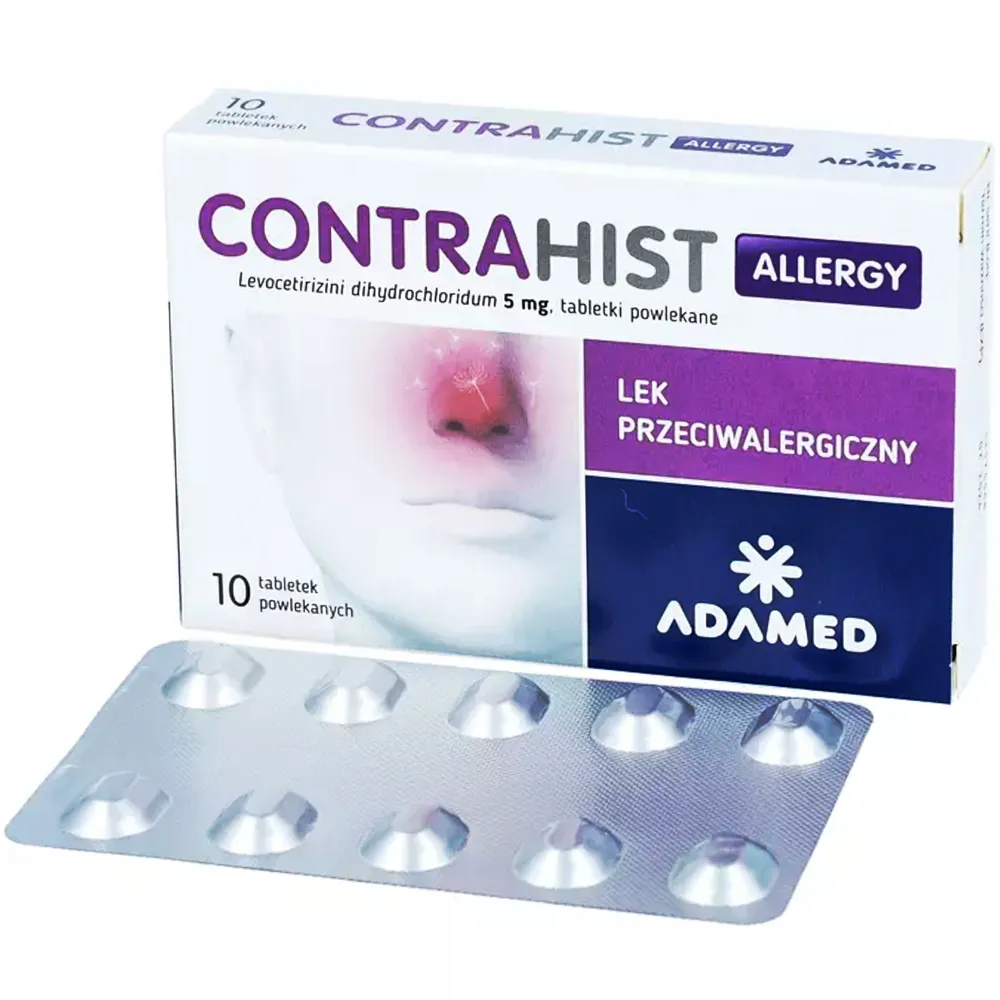
Table of Contents
Package leaflet: Information for the patient
Contrahist Allergy, 5 mg, film-coated tablets
Levocetirizini dihydrochloridum
For adults, adolescents and children aged 6 years and older
Please read all of this leaflet carefully before taking this medicine because it contains
important information for you.
This medicine should always be taken exactly as described in this patient leaflet or as directed by
your doctor or pharmacist.
Keep this leaflet as you may need to read it again.
If you need advice or further information, please consult your pharmacist.
If you experience any side effects, including any not listed in this leaflet, tell your doctor or pharmacist. See section 4.
If there is no improvement after 3 days or if you feel worse, contact your doctor.
Contents of the leaflet
- What Contrahist Allergy is and what it is used for
- Important information before taking Contrahist Allergy
- How to take Contrahist Allergy
- Possible side effects
- How to store Contrahist Allergy
- Contents of the pack and other information
1. What Contrahist Allergy is and what it is used for
The active substance in Contrahist Allergy is levocetirizine dihydrochloride.
Contrahist Allergy is an antihistamine medicine.
Contrahist Allergy is indicated for use in adults, adolescents and children aged 6 years and older for the treatment of symptoms associated with:
- allergic rhinitis (including chronic allergic rhinitis),
- chronic idiopathic urticaria.
If there is no improvement after 3 days or if you feel worse, contact your doctor.
2. Important information before taking Contrahist Allergy
When not to take Contrahist Allergy:
- if you are allergic to levocetirizine dihydrochloride, cetirizine, hydroxyzine or any of the other ingredients of this medicine (listed in section 6),
- if you have severe kidney function impairment (severe renal insufficiency with creatinine clearance less than 10 ml/min),
- if you have hereditary galactose intolerance, lactase deficiency or glucose-galactose malabsorption. See also the subsection: "Contrahist Allergy contains lactose".
Warnings and precautions
Talk to your doctor or pharmacist before taking Contrahist Allergy.
If you have impaired kidney function, consult your doctor before taking this medicine; a lower dose may be required. Your doctor will determine the appropriate dose.
If you have difficulty passing urine (e.g. due to spinal cord injury or enlarged prostate gland), consult your doctor.
Contrahist Allergy may increase the frequency of epileptic seizures; therefore, consult your doctor if you have epilepsy or are at risk of seizures.
Contrahist Allergy may affect the results of skin allergy tests. If you have planned skin allergy testing, ask your doctor whether you should stop taking Contrahist Allergy a few days before the test.
Children
Contrahist Allergy film-coated tablets are not recommended for children under 6 years of age, as appropriate dose adjustment is not possible with this formulation.
Other medicines and Contrahist Allergy
Tell your doctor or pharmacist about all medicines you are currently taking, have recently taken or plan to take.
Contrahist Allergy with food, drink and alcohol
Exercise caution when taking Contrahist Allergy together with alcohol or other substances affecting brain function.
In sensitive patients, concomitant use of Contrahist Allergy with alcohol or other central nervous system depressants may additionally reduce alertness and reaction ability.
Contrahist Allergy may be taken with or without food.
Pregnancy, breastfeeding and fertility
If you are pregnant, breastfeeding, think you may be pregnant or are planning to have a baby, consult your doctor or pharmacist before using this medicine.
Driving and using machines
Some patients treated with Contrahist Allergy may experience drowsiness, fatigue, tiredness or weakness. If you intend to drive, perform potentially dangerous activities or operate machinery, you should first assess your response to the medicine.
However, specific tests conducted in healthy volunteers taking levocetirizine at the recommended dose showed no effect on attention, reaction ability or driving performance.
Contrahist Allergy contains lactose
If you have been previously diagnosed with an intolerance to certain sugars, consult your doctor before taking this medicine.
3. How to use Contrahist Allergy
This medicine should always be taken exactly as described in this patient leaflet or as directed by your doctor or pharmacist. If in doubt, consult your doctor or pharmacist.
This medicine may only be used by individuals who have been diagnosed by a doctor with allergic rhinitis or chronic idiopathic urticaria, and only according to the doctor's instructions.
The recommended dose for adults, adolescents, and children aged 6 years and older is 1 film-coated tablet (5 mg) per day.
It is recommended to take a single dose once daily.
How and when to take Contrahist Allergy
For oral use only.
The tablet should be swallowed whole with water. This medicine may be taken with or without food.
How long to take Contrahist Allergy
The duration of treatment depends on the type, duration, and severity of the disease symptoms and should be determined by the doctor.
Do not use this medicine for longer than 10 days without consulting a doctor.
If there is no improvement or if symptoms worsen after 3 days of treatment, consult your doctor.
Dosage in special patient groups:
Renal and hepatic impairment
In patients with impaired renal function, a dose reduction may be necessary depending on the severity of kidney disease. In children, the dose should also be adjusted according to body weight. The dose should be determined by a doctor.
Contrahist Allergy must not be used in patients with severe renal impairment (see section "When not to use Contrahist Allergy").
Patients with hepatic impairment alone should usually receive the recommended dose.
In patients with both hepatic and renal impairment, a lower dose may be required depending on the severity of renal impairment. In children with both hepatic and renal impairment, the dose should also be adjusted according to body weight. In such cases, the dose should be determined by a doctor.
Elderly patients (65 years and older)
No dose adjustment is necessary in elderly patients (65 years and older) if renal function is normal.
Use in children
Contrahist Allergy tablets are not recommended for children under 6 years of age.
Use of a higher than recommended dose of Contrahist Allergy
If an adult takes a higher than recommended dose of Contrahist Allergy, drowsiness may occur. In children, initial excitation and restlessness, especially motor restlessness, may occur, followed by drowsiness.
In case of suspected overdose, seek medical advice immediately. A doctor will decide what actions should be taken.
Missed dose of Contrahist Allergy
If a dose of Contrahist Allergy is missed or a lower than recommended dose is taken, do not take a double dose to make up for the missed dose. Instead, wait until the next scheduled dose and take the recommended dose at that time.
Stopping treatment with Contrahist Allergy
Stopping treatment with Contrahist Allergy should not cause harmful effects.
Disease symptoms may gradually return, but their severity should not exceed that observed before starting treatment with Contrahist Allergy.
However, in rare cases, itching (intense pruritus) may occur after discontinuation of Contrahist Allergy, even if such symptoms were not present before starting treatment. These symptoms may resolve spontaneously. In some cases, symptoms may be severe and treatment may need to be resumed. Symptoms should resolve upon resumption of treatment.
If you have any further doubts concerning the use of this medicine, consult your doctor or pharmacist.
4. Possible adverse reactions
Like any medicine, this medicine can cause adverse reactions, although not everybody experiences them.
If you notice the first signs of hypersensitivity reactions, stop taking
Contrahist Allergy and inform your doctor.
Symptoms of hypersensitivity reactions include: swelling of the lips, tongue, face and (or) throat, difficulty
breathing or swallowing (chest tightness or wheezing), urticaria, angioedema, sudden drop in blood pressure leading to collapse or shock, which
may lead to death.
Common ( occur in fewer than 1 in 10 people but more than 1 in 100 people ) adverse reactions reported
include dry mouth, headache, fatigue, drowsiness, somnolence.
Uncommon ( occur in fewer than 1 in 100 people but more than 1 in 1000 people )
adverse reactions observed include feeling of exhaustion and abdominal pain.
Frequency not known (cannot be estimated from the available data) other adverse reactions reported include: palpitations, increased heart rate, convulsions,
tingling, dizziness, fainting, tremor, taste disturbances (altered taste perception),
sensation of spinning or swaying, visual disturbances, blurred vision, rotatory eye movements (involuntary circular eye movements), painful or difficult urination,
inability to completely empty the urinary bladder, oedema, itching, rash, urticaria
(swelling, redness and itching of the skin), skin eruptions, shortness of breath, weight gain, muscle pain, joint pain, agitation or aggressive behaviour, hallucinations, depression, insomnia,
recurrent suicidal thoughts or suicidal ideation, nightmares, hepatitis, liver function abnormalities, increased appetite, nausea, vomiting and diarrhoea,
itching (intense pruritus) after discontinuation of the medicine.
Reporting of adverse reactions
If any adverse reactions occur, including any adverse reactions not listed
in the leaflet, inform your doctor, pharmacist or nurse. Adverse reactions can be reported directly to the Department of Monitoring Adverse Drug Reactions of the Office for Registration of Medicinal Products, Medical Devices
and Biocidal Products
Al. Jerozolimskie 181C, 02-222 Warsaw,
Tel.: + 48 22 49 21 301
Fax: + 48 22 49 21 309
Website: https://smz.ezdrowie.gov.pl
Adverse reactions can also be reported to the marketing authorisation holder.
By reporting adverse reactions, more information on the safety of the medicine can be collected.
5. How to store Contrahist Allergy
Keep this medicine out of the sight and reach of children.
Do not use this medicine after the expiry date stated on the blister after "EXP" and
on the cardboard package after "Expiry date (EXP)". The expiry date refers to the last day of the stated month.
No special storage instructions apply for this medicine.
Medicines must not be disposed of via wastewater or household waste. Ask your pharmacist how to dispose of medicines you no longer use. Doing so helps protect the environment.
6. Contents of the pack and other information
What Contrahist Allergy contains
- The active substance is levocetirizine dihydrochloride. Each coated tablet contains 5 mg of levocetirizine dihydrochloride, equivalent to 4.2 mg of levocetirizine.
- The other ingredients are: microcrystalline cellulose (type 102), lactose monohydrate, magnesium stearate, hypromellose, titanium dioxide (E 171), polyethylene glycol 400.
What Contrahist Allergy looks like and contents of the pack
Contrahist Allergy tablets are white, coated, biconvex, elongated tablets, marked
‘^ 11’ on one side.
The pack contains 7 or 10 coated tablets.
Not all pack sizes may be marketed.
Marketing Authorisation Holder:
Adamed Pharma S.A.
Pieńków, ul. M. Adamkiewicza 6A
05-152 Czosnów
tel.: +48 22 732 77 00
Manufacturer:
Adamed Pharma S.A.
Pieńków, ul. M. Adamkiewicza 6A
05-152 Czosnów
Importer:
Adamed Pharma S.A.
ul. Marszałka J. Piłsudskiego 5
95-200 Pabianice
Poland