Colchicine dispert
Poland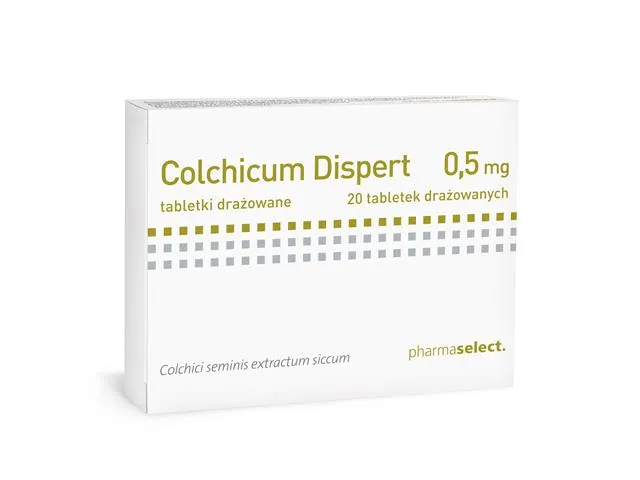
Table of Contents
Colchicum Dispert, 0.5 mg, film-coated tablets
Colchici seminis extractum siccum
Please read the following information carefully before using the medicine, as it contains
important information for the patient.
- Keep this leaflet, as you may need to read it again.
- If you have any further questions, please consult your doctor or pharmacist.
- This medicine has been prescribed for a specific person. Do not pass it on to others. The medicine may harm other people, even if their symptoms are similar.
- If you experience any adverse reactions, including any not listed in this leaflet, inform your doctor or pharmacist. See section 4.
Contents of the leaflet:
- What Colchicum Dispert is and what it is used for
- Important information before taking Colchicum Dispert
- How to take Colchicum Dispert
- Possible side effects
- How to store Colchicum Dispert
- Contents of the package and other information
1. What Colchicum Dispert is and what it is used for
Colchicum Dispert contains colchicine – an extract from the seeds of autumn crocus (Colchicum autumnale L.). Colchicum Dispert is an anti-inflammatory medicine used in the treatment of acute gout attacks in adults. It may also be used to prevent acute gout attacks when initiating treatment with uricosuric agents.
2. Important information before using Colchicum Dispert
When not to use Colchicum Dispert
- if the patient is allergic to the active substance or to any of the other ingredients of this medicine (listed in section 6),
- in pregnant women, women planning pregnancy, and women who are breastfeeding,
- in patients undergoing hemodialysis,
- if the patient has severe liver disease,
- if the patient has severe renal impairment,
- if the patient has severe gastrointestinal disorders.
Warnings and precautions
Before starting treatment with Colchicum Dispert, discuss this with your doctor or pharmacist.
Exercise particular caution:
- if the patient has heart, kidney, liver, or gastrointestinal problems,
- if the patient has blood disorders.
Before using Colchicum Dispert, the patient should inform the doctor if they are taking cyclosporine or macrolide antibiotics.
Treatment of elderly patients
Exercise caution when determining the dose in elderly patients, considering the higher frequency of impaired kidney and liver function. The dose should be adjusted based on the patient's kidney and liver function. In case of concomitant use with other medicines that may increase the risk of cumulative toxicity, the doctor will adjust the appropriate dose of Colchicum Dispert.
Children and adolescents
This medicine is not recommended for use in children under 18 years of age due to insufficient data on safety and efficacy.
Colchicum Dispert and other medicines
Tell your doctor about all medicines the patient is currently taking or has recently taken, as well as any medicines the patient plans to take.
Taking other medicines during treatment with Colchicum Dispert may affect their action. Concomitant use of Colchicum Dispert with medicines such as: cyclosporine, statins (cholesterol-lowering agents, e.g. simvastatin, lovastatin), or macrolide antibiotics (erythromycin, clarithromycin), especially if the patient has renal impairment, may increase the risk of adverse effects. Concomitant use of colchicine with erythromycin or clarithromycin is contraindicated.
Cimetidine (a medicine used in the treatment of peptic ulcers) or excessive consumption of grapefruit juice (1000 ml/day) may cause a life-threatening increase in blood concentration of the drug.
The medicine may impair absorption of vitamin B. In case of high-dose treatment or long-term therapy, vitamin B supplementation should be considered.
Pregnancy, breastfeeding, and effects on fertility
If the patient is pregnant or breastfeeding, suspects she may be pregnant, or is planning to have a child, she should consult her doctor or pharmacist before using this medicine.
Colchicum Dispert should not be used in breastfeeding women, as colchicine passes into breast milk.
Driving and operating machinery
No studies have been conducted on the effects of Colchicum Dispert on the ability to drive or operate machinery.
Due to the possibility of dizziness after taking the medicine, patients should not drive or operate machinery.
Colchicum Dispert contains lactose and sucrose
If the patient has previously been diagnosed with intolerance to certain sugars, the patient should consult a doctor before taking this medicine.
The medicine contains a colouring agent: Opalux AS 250000, which may cause allergic reactions.
3. How to use Colchicum dispert
This medicine should always be used according to the instructions given by your doctor or pharmacist. If in doubt, consult your doctor or pharmacist.
Treatment of acute gout attacks
The recommended initial dose for the treatment of acute gout attacks is 2 coated tablets, followed by 1–2 coated tablets after 1 hour. Do not take more than 3–4 coated tablets per day. If necessary, treatment may be continued for several more days until pain subsides, taking 1–2 coated tablets per day.
Prophylaxis of acute gout attacks during initiation of treatment with diuretic medicines:
1 coated tablet 1–2 times daily.
Your doctor will determine the duration of treatment based on the frequency of attacks, the duration of the disease, and the presence and size of tophi.
If severe gastrointestinal adverse reactions occur, discontinue use of Colchicum dispert immediately.
Elderly patients or patients with hepatic or renal impairment
In elderly patients or patients with impaired liver or kidney function, dose reduction may be necessary according to the doctor's instructions.
Method of administration
Oral use.
The coated tablet should be swallowed whole with an adequate amount of water. Do not break or divide the tablets.
Use of a higher than recommended dose of Colchicum dispert
If a higher than recommended dose of Colchicum dispert is taken, contact your doctor immediately.
The first symptoms of overdose may appear 2 to 12 hours after ingestion.
Missed dose of Colchicum dispert
Do not take a double dose to make up for a missed dose. Consult your doctor to determine when to take the next dose.
Discontinuation of Colchicum dispert
If you have any further questions about the use of this medicine, consult your doctor or pharmacist.
4. Possible adverse reactions
Like all medicines, this medicine can cause adverse reactions, although not everyone will experience them.
The following adverse reactions have been reported during treatment with colchicine, which usually resolve
after discontinuation of the medicine or reduction of the dose.
Common (≥1/100 to <1/10):
- nausea, vomiting, diarrhoea, abdominal cramps, abdominal pain.
Uncommon (≥1/1,000 to <1/100):
- blood cell disorders;
- bone marrow function disorders: aplastic anaemia (a condition in which the bone marrow does not produce any blood cells), haemolytic anaemia (reduced lifespan of red blood cells);
- changes in liver enzyme activity (detected in laboratory tests);
- hair loss and nail disorders;
- increased creatine kinase blood levels (detected in laboratory tests);
- muscle weakness and muscle pain, muscle breakdown (rhabdomyolysis);
- kidney function disorders.
Rare (≥1/10,000 to <1/1,000):
- marked decrease in the number of white blood cells called granulocytes (agranulocytosis);
- urticaria, purpura (purplish skin rash), itchy skin rash, erythema, swelling;
- absence or reduced number of spermatozoa in semen.
Very rare (<1/10,000):
- neuropathy (nerve disease), dizziness, hypersensitivity.
Reporting of adverse reactions
If any adverse reactions occur, including any not listed in this leaflet, inform your doctor or pharmacist. Adverse reactions can be reported directly to the Department for Monitoring Adverse Drug Reactions, Office for Registration of Medicinal Products, Medical Devices and Biocidal Products
Al. Jerozolimskie 181C
02-222 Warsaw
Tel.: +48 22 4921 301
Fax: +48 22 4921 309
e-mail: [email protected]
Adverse reactions may also be reported to the Marketing Authorisation Holder.
Reporting adverse reactions helps provide more information on the safety of the medicine.
5. How to store Colchicum dispert
Store below 25°C.
Keep the medicine in a place out of sight and reach of children.
Do not use this medicine after the expiry date stated on the carton after: Expiry (EXP). The expiry date refers to the last day of the stated month.
Medicines should not be disposed of via wastewater or household waste. Ask your pharmacist how to dispose of medicines no longer required. These measures help protect the environment.
6. Contents of the packaging and other information
What Colchicum Dispert contains
Each coated tablet contains 12.71 mg to 15.86 mg of dry extract from seeds of autumn crocus (Colchicum autumnale L.), corresponding to 0.5 mg of alkaloids calculated as colchicine.
Other ingredients of the medicine are:
Core: monohydrate lactose, corn starch, talc, copovidone K 28, stearic acid, magnesium stearate.
Coating: talc, povidone K 25, titanium dioxide, gum arabic, macrogol 6000, light magnesium oxide, sodium carmellose, sucrose, shellac, Opalux AS 250000 (sucrose, carmine red (E 124), quinoline yellow (E 104), titanium dioxide (E 171), povidone), Carnauba wax.
Excipients used to adjust the primary extract to a defined content of therapeutically active substance: monohydrate lactose, microcrystalline cellulose.
What Colchicum Dispert looks like and contents of the pack
Colchicum Dispert is available in aluminium/PVC/PVDC blisters, packed in cardboard boxes containing 20 or 50 tablets.
Marketing Authorisation Holder and Manufacturer
Pharmaselect International Beteiligungs GmbH
Ernst – Melchior Gasse 20
1020 Vienna, Austria