Coldrex junior c
Poland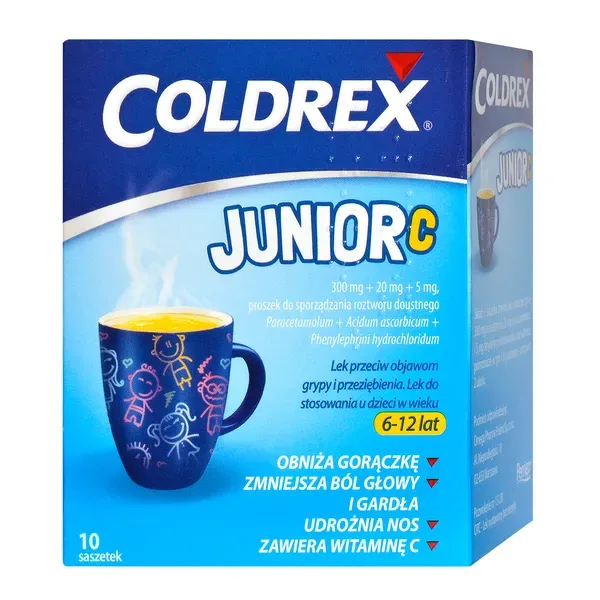
Table of Contents
Package leaflet: Information for the user
Coldrex Junior C
300 mg + 5 mg + 20 mg, effervescent powder for oral solution
Paracetamolum + Phenylephrini hydrochloridum + Acidum ascorbicum
Please read this leaflet carefully before using this medicine, as it contains
important information for the patient.
This medicine should always be used exactly as described in this patient leaflet or as directed by a
doctor, pharmacist, or nurse.
- Keep this leaflet, so that you can read it again if necessary.
- If you need advice or further information, please consult your pharmacist.
- If you experience any adverse reactions, including any possible adverse reactions not listed in this leaflet, inform your doctor, pharmacist, or nurse. See section 4.
- If there is no improvement after 3 days or if you feel worse, consult a doctor.
Table of contents
- What Coldrex Junior C is and what it is used for
- Important information before taking Coldrex Junior C
- How to take Coldrex Junior C
- Possible side effects
- How to store Coldrex Junior C
- Contents of the pack and other information
1. What Coldrex Junior C is and what it is used for
Coldrex Junior C is a medicine with analgesic and antipyretic properties, which constricts blood vessels in the nasal mucosa, reduces nasal congestion, and consequently helps clear nasal passages. The medicine contains vitamin C.
Coldrex Junior C is indicated for short-term, symptomatic treatment of influenza or colds associated with fever, chills, headache, sore throat, and nasal catarrh in children aged 6 to 12 years.
If there is no improvement after 3 days or if you feel worse, consult a doctor.
2. Important information before using Coldrex Junior C
When not to use Coldrex Junior C
- if the patient is allergic to paracetamol, phenylephrine, ascorbic acid or any of the other ingredients of this medicine (listed in section 6),
- in patients taking monoamine oxidase inhibitors (MAO inhibitors) and within 2 weeks after their discontinuation,
- in patients with hypertension,
- in patients with cardiovascular diseases,
- in patients with hyperthyroidism,
- in patients with diabetes,
- in patients with pheochromocytoma,
- in patients simultaneously taking tricyclic antidepressants or beta-blockers,
- in patients simultaneously using antihypertensive drugs (guanethidine, reserpine, methyldopa),
- in patients with closed-angle glaucoma,
- in patients with severe ischemic heart disease,
- in patients simultaneously taking other sympathomimetic drugs (such as nasal decongestants, appetite suppressants, amphetamine-like psychostimulants),
- in patients with hepatic insufficiency or severe renal insufficiency,
- in patients with alcoholic liver disease,
- in patients taking zidovudine,
- in children under 6 years of age.
Warnings and precautions
This medicine contains paracetamol.
Do not use together with other medicinal products containing paracetamol
or products used for cold and flu.
Paracetamol overdose can lead to irreversible liver damage.
The risk of overdose is higher in patients with alcoholic liver disease without cirrhosis.
Patients diagnosed with impaired liver or kidney function must consult a physician before taking this medicinal product. The use of paracetamol-containing medicinal products additionally increases the risk of liver damage in patients with liver disease.
Read the package leaflet carefully before use and follow the instructions provided.
Consult a doctor before using the medicine in the following cases:
- hepatic parenchymal insufficiency (Child-Pugh score < 9),
- regular alcohol consumption,
- renal insufficiency,
- Gilbert's syndrome (mild jaundice),
- concomitant use of other drugs affecting liver function,
- glucose-6-phosphate dehydrogenase deficiency,
- hemolytic anemia,
- glutathione deficiency,
- dehydration,
- chronic malnutrition,
- elderly patients, adults and adolescents with body weight below 50 kg,
- urinary retention or prostate enlargement,
- thromboembolic disorders (e.g. Raynaud's syndrome).
During treatment with Coldrex Junior C, inform the doctor immediately if the patient develops severe conditions, including severe kidney dysfunction or sepsis (when bacteria and their toxins circulate in the blood, leading to organ damage), malnutrition, chronic alcoholism, or if the patient is also taking flucloxacillin (an antibiotic). In these situations, patients have been reported to develop a serious condition called metabolic acidosis (an imbalance in blood and body fluids) when taking paracetamol regularly over a prolonged period or when paracetamol is taken together with flucloxacillin. Symptoms of metabolic acidosis may include: severe breathing difficulties, including rapid deep breathing, drowsiness, nausea and vomiting.
Liver damage is possible in individuals who have ingested 10 g or more of paracetamol in a single dose.
Intake of 5 g of paracetamol may lead to liver damage in patients with the following risk factors:
- Patients taking long-term carbamazepine, phenobarbital, phenytoin, primidone (medicines used e.g. in epilepsy), rifampicin (medicines used e.g. in tuberculosis), St. John's wort (used e.g. in depression), or other drugs inducing liver enzymes.
- Patients who regularly abuse alcohol.
- Patients in whom glutathione deficiency may occur, e.g. due to eating disorders, cystic fibrosis, HIV infection, malnutrition or cachexia.
Chronic use of various types of painkillers for headache may lead to worsening of headache. If this occurs or is suspected, consult a doctor and discontinue treatment.
Exercise caution in patients with asthma who are also taking acetylsalicylic acid, as minor bronchospasms associated with paracetamol use (cross-reaction) have been observed.
Keep the medicine out of sight and reach of children.
Children
Do not give this medicine to children under 6 years of age.
Coldrex Junior C and other medicines
Inform your doctor or pharmacist about all medicines the patient is currently taking or has recently taken, as well as any medicines the patient plans to take.
Consult a doctor if taking any of the following medicines:
- anticoagulants (e.g. warfarin), especially if long-term pain relief is needed,
- cholestyramine (used to reduce high blood cholesterol levels),
- probenecid,
- chloramphenicol,
- metoclopramide, domperidone (used for nausea and vomiting),
- non-steroidal anti-inflammatory drugs (including acetylsalicylic acid),
- digoxin and cardiac glycosides,
- monoamine oxidase inhibitors,
- other sympathomimetic amines,
- beta-adrenolytics and other antihypertensive drugs (including guanethidine, reserpine, methyldopa),
- tricyclic antidepressants (e.g. amitriptyline),
- ergot alkaloids (e.g. ergotamine and methysergide),
- flucloxacillin (an antibiotic), due to the serious risk of blood and body fluid disturbances (called metabolic acidosis) which require urgent treatment (see section 2). Concurrent use of paracetamol and drugs increasing hepatic metabolism, such as certain sedatives or antiepileptics (e.g. phenobarbital, phenytoin, carbamazepine, St. John's wort) and rifampicin, may lead to liver damage even when recommended doses of paracetamol are used. Salicylamide prolongs the elimination time of paracetamol. Caffeine enhances the analgesic effect of paracetamol.
Paracetamol use may cause false results in certain laboratory tests (e.g. blood glucose measurement).
Phenylephrine may enhance the blood pressure-raising effect of drugs used to accelerate labor.
Ascorbic acid increases iron absorption and enhances aluminum absorption from aluminum-containing antacid preparations.
Alcohol consumption with Coldrex Junior C
Do not drink alcohol while taking this medicine due to increased risk of liver damage.
Pregnancy, breastfeeding and fertility
If the patient is pregnant, breastfeeding, suspects she may be pregnant, or is planning to become pregnant, she should consult a doctor or pharmacist before using this medicine.
This medicine should not be used during pregnancy. Administration of phenylephrine hydrochloride during pregnancy may cause congenital developmental abnormalities and may also induce fetal hypoxia.
Do not use during breastfeeding without consulting a doctor. Phenylephrine may pass into breast milk.
There are no data on the effect of Coldrex Junior C on fertility.
Driving and operating machinery
Coldrex Junior C may cause dizziness. If dizziness occurs after taking the medicine, do not drive or operate machinery.
The medicine contains 1.9 g of sucrose and 3.325 g of glucose per dose. This should be taken into account in patients with diabetes. If a patient has previously been diagnosed with intolerance to certain sugars, the patient should consult a doctor before taking the medicine.
The medicine contains 56.5 mg of sodium (the main component of table salt) in each sachet. This corresponds to 3% of the maximum recommended daily intake of sodium in the diet for adults.
The medicine contains sulphites. Rarely, it may cause severe hypersensitivity reactions and bronchospasm.
3. How to use Coldrex Junior C
This medicine should always be used according to the recommendations of a doctor or pharmacist. If in doubt,
consult a doctor or pharmacist.
Use in children aged 6 to 12 years
One sachet, which may be repeated after 4 hours if necessary, up to 4 times daily.
Do not use more frequently than every 4 hours or more than 4 sachets per day.
Always use the lowest effective dose of the medicine.
Children and adolescents
Use in children under 6 years of age is contraindicated. Over-the-counter medicines containing phenylephrine used for the treatment of cold and cough should not be given to children under 6 years of age.
Elderly patients
Elderly patients, especially frail or immobilized individuals, may require reduced dosage or less frequent administration.
Renal function disorders
Patients diagnosed with impaired renal function must seek medical advice before taking this medicine. In patients with renal insufficiency receiving paracetamol, a reduced dose and an increased minimum interval between doses to at least 6 hours are recommended.
Hepatic function disorders
Patients diagnosed with impaired liver function or Gilbert's syndrome must seek medical advice before taking this medicine.
Method of administration
Before administration, dissolve the powder in hot water.
Empty the contents of one sachet into a glass, add half a glass of hot water, stir well and drink. Cold water may be added if needed, or sweetened to taste.
Do not use this medicine in children under 6 years of age.
Without consulting a doctor, do not use this medicine regularly for longer than 3 days.
If symptoms persist for longer than 3 days or worsen, or if any other symptoms occur, discontinue treatment and consult a doctor.
If symptoms of illness persist, seek medical advice.
If you feel the effect of the medicine is too strong or too weak, consult your doctor.
Do not exceed the recommended daily dose or the specified number of doses due to the risk of liver damage.
Use of a higher than recommended dose of Coldrex Junior C
If more than 4 sachets are taken within 24 hours, seek immediate medical attention, even if no adverse symptoms are present, due to the risk of delayed, irreversible liver damage.
Missed dose of Coldrex Junior C
Do not take a double dose to make up for a missed dose.
4. Possible adverse reactions
Like all medicines, this medicine may cause adverse reactions, although not everyone experiences them.
You should stop using the medicine immediately and consult a doctor if any of the following occur:
- Allergic reaction (hypersensitivity) such as: skin rash or skin itching, sometimes associated with breathing difficulties or swelling of the lips, tongue, throat or face,
- Skin hypersensitivity reactions such as: sweating, purpura, urticaria,
- Severe skin reaction (acute generalized exanthematous pustulosis, drug-induced skin inflammation, bullous erythema multiforme (Stevens-Johnson syndrome), and toxic epidermal necrolysis (Lyell's syndrome)) manifested by blistering rash all over the body, erosions in the oral cavity, eyes, genital organs and on the skin, red spots on the trunk, often with central blisters, rupturing large blisters, peeling off large sheets of epidermis, weakness, fever and joint pain,
- Breathing problems, if similar problems occurred previously during use of acetylsalicylic acid or other non-steroidal anti-inflammatory drugs,
- Bruising or bleeding of unknown cause,
- Loss of vision, which may be caused by abnormally high intraocular pressure. This is very rare, but there is a possibility of such an event in patients with glaucoma,
- Unusual rapid heartbeat or sensation of irregular heart rhythm,
- Difficulty in urinating, urinary retention. Urinary retention is most likely in men with benign prostatic hyperplasia,
- Cloudy appearance of urine,
- Liver function disorders (which may be indicated by yellowing of the skin and eyes, liver tenderness). The above reactions occur rarely (more than 1 in 10,000 but less than 1 in 1,000 patients) or very rarely (less than 1 in 10,000 patients).
Coldrex Junior C may also cause the following adverse reactions, the frequency of which
is unknown (cannot be estimated from available data):
- Headache,
- Dizziness,
- Insomnia,
- Nervousness,
- Increased blood pressure,
- Nausea and vomiting,
- Serious condition that may cause blood acidification (so-called metabolic acidosis), in patients with severe disease taking paracetamol (see section 2).
Reporting of adverse reactions
If any adverse effects occur, including any adverse effects not listed
in this leaflet, inform your doctor, pharmacist or nurse. Adverse reactions
can be reported directly to the Department of Monitoring Adverse Drug Reactions of the Office for Registration of Medicinal Products, Medical Devices and Biocidal Products: Al. Jerozolimskie 181 C, 02-222 Warsaw, tel.: + 48 22 49 21 301,
fax: + 48 22 49 21 309, Website: https://smz.ezdrowie.gov.pl
Adverse reactions can also be reported to the marketing authorization holder. Reporting
adverse reactions helps to provide more information on the safety of the medicine.
5. How to store Coldrex Junior C
Keep this medicine out of sight and reach of children.
Do not use this medicine after the expiry date stated on the packaging after: (EXP).
The expiry date refers to the last day of the stated month.
Store below 25°C.
Medicines must not be disposed of via wastewater or household waste. Ask your pharmacist how to dispose of medicines no longer required. This will help protect the environment.
6. Contents of the pack and other information
What Coldrex Junior C contains
- The active substances are: paracetamol, phenylephrine hydrochloride, ascorbic acid (Acidum ascorbicum)
- Other ingredients are: sodium saccharin, sodium cyclamate, anhydrous citric acid, sodium citrate, maize starch, sucrose, colloidal anhydrous silica, lemon flavour PHS-163671, colouring agent - turmeric 5% (curcumin E100, glucose).
What Coldrex Junior C looks like and contents of the pack
The cardboard box contains 5 or 10 sachets.
Marketing Authorisation Holder:
Perrigo Poland Sp. z o.o.
ul. Domaniewska 48
02-672 Warsaw
tel.: +48 (22) 852 55 51
Importer:
Omega Pharma International NV
Venecoweg 26
Nazareth, 9810
Belgium
Perrigo Supply Chain International Designated Activity Company
The Sharp Building
Hogan Place
Dublin 2
Dublin, D02 TY74, Ireland
Detailed information on this medicinal product is available on the website of the Office for Registration of Medicinal Products, Medical Devices and Biocidal Products.