Coffepirine tablets for headache
Poland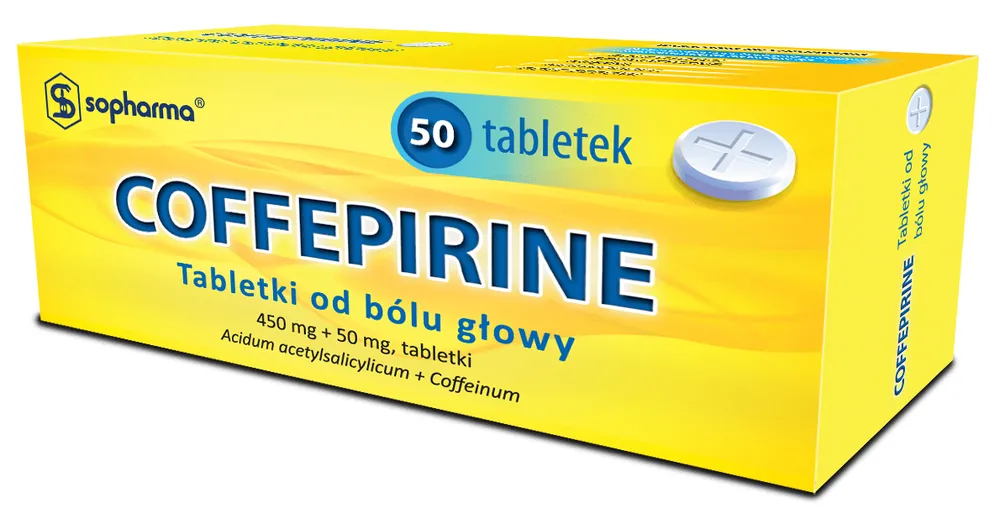
Table of Contents
- Package leaflet: Information for the patient
- 1. What Coffepirine Headache Tablets are and what they are used for
- 2. Important information before using Coffepirine Headache Tablets
- 3. How to use Coffepirine Tabletki od bólu głowy
- 4. Possible adverse reactions
- 5. How to store Coffepirine Tabletki od bólu głowy
- 6. Contents of the packaging and other information
Package leaflet: Information for the patient
COFFEPIRINE Headache Tablets, 450 mg + 50 mg, tablets
Acetylsalicylic acid + Caffeine
Please read all of this leaflet carefully before taking this medicine, because it contains
important information for you.
This medicine should always be taken exactly as described in this patient information leaflet or as directed by your doctor or pharmacist.
- Keep this leaflet so that you can read it again if necessary.
- If you need advice or further information, please consult your pharmacist.
- If you experience any adverse reactions, including any possible side effects not listed in this leaflet, inform your doctor or pharmacist. See section 4.
- If there is no improvement in adults after 3 days or in adolescents over 12 years of age after 1 day, or if symptoms worsen, consult a doctor.
Contents of the leaflet:
- What Coffepirine Headache Tablets are and what they are used for
- Important information before taking Coffepirine Headache Tablets
- How to take Coffepirine Headache Tablets
- Possible side effects
- How to store Coffepirine Headache Tablets
- Contents of the pack and other information
1. What Coffepirine Headache Tablets are and what they are used for
Coffepirine Headache Tablets contain two active substances: acetylsalicylic acid, which has analgesic, antipyretic and anti-inflammatory properties, and caffeine, which acts on the vasomotor centre in the brain, causing contraction of smooth muscles in blood vessels, thereby reducing blood flow through brain tissue. It also has a stimulating effect on the respiratory centre.
Coffepirine Headache Tablets are used to treat mild to moderate pain of various origins (e.g. headache, rheumatic pain, muscle pain, neuralgia, toothache).
2. Important information before using Coffepirine Headache Tablets
When not to use Coffepirine Headache Tablets:
- during pregnancy and breastfeeding;
- if the patient is allergic to acetylsalicylic acid, caffeine, or any of the other ingredients of this medicine (listed in section 6) or to salicylates;
- in case of peptic ulcer of the stomach and (or) duodenum, gastrointestinal bleeding, haemorrhagic diathesis, gout, severe renal or hepatic impairment;
- in children under 12 years of age;
- in patients who previously experienced bronchial asthma attacks induced by salicylates or substances with similar effects, particularly nonsteroidal anti-inflammatory drugs;
- concomitantly with methotrexate at doses of 15 mg per week or higher, and similarly with other medicines containing acetylsalicylic acid on the day the patient receives a dose of methotrexate;
- in severe heart failure;
- for pain relief following coronary artery bypass graft surgery.
Warnings and precautions
Use with caution in:
- patients with hypersensitivity to nonsteroidal anti-inflammatory and antirheumatic drugs or other allergenic substances, and in patients with allergic diseases (bronchial asthma, hay fever, nasal polyps);
- patients taking anticoagulant medicines;
- patients who previously experienced peptic ulcer disease or gastrointestinal bleeding;
- patients with glucose-6-phosphate dehydrogenase deficiency;
- patients with hyperthyroidism;
- patients with hypertension;
- patients with epilepsy;
- patients prior to surgical procedures;
- patients with impaired liver and (or) kidney function;
- women using intrauterine contraceptive devices or during heavy menstrual bleeding.
The medicine may adversely affect fertility in women (see below).
Taking medicines such as Coffepirine Headache Tablets may be associated with a small
increased risk of heart attack (myocardial infarction) or stroke. This risk increases with
long-term use of high doses. Do not use higher doses or for longer than recommended.
If you have heart problems, have had a stroke, or suspect you may be at risk of these
conditions (e.g. high blood pressure, diabetes, high cholesterol, smoking), discuss your treatment with your doctor or pharmacist.
Consult your doctor, even if the above warnings relate to conditions that occurred in the past.
Children
This medicine should not be used in children and adolescents under 12 years of age.
Due to the risk of Reye's syndrome—a rare but serious condition causing liver and brain damage—this medicine should only be used during viral infections with or without fever under medical supervision.
Coffepirine Headache Tablets and other medicines
Tell your doctor or pharmacist about all medicines you are currently taking, have recently taken, or plan to take, especially if you are taking:
- methotrexate at doses of 15 mg per week or higher—concomitant use of Coffepirine Headache Tablets is contraindicated;
- methotrexate at doses less than 15 mg per week—increased risk of methotrexate bone marrow toxicity;
- ticlopidine—concomitant use increases the risk of bleeding; if simultaneous administration of acetylsalicylic acid-containing medicines and ticlopidine is necessary, bleeding time should be monitored;
- drugs increasing uric acid excretion—the effectiveness of diuretics (e.g. spironolactone, furosemide) and antihypertensive drugs may be reduced when used concomitantly with acetylsalicylic acid;
- furosemide—acetylsalicylic acid may enhance the harmful effects of this drug on the ears;
- glucocorticosteroids—during systemic use of these drugs, blood levels of salicylates decrease. After discontinuation of steroids, there is a risk of salicylate overdose. Salicylate dosage should be adjusted separately during concomitant use with steroid medicines and again after their discontinuation;
- fluoroquinolone antibiotics—concomitant use of medicines containing fluoroquinolones (e.g. ciprofloxacin) may lead to caffeine accumulation in the body;
- cimetidine or disulfiram—these slow down caffeine metabolism;
- oral contraceptives—these slow down caffeine metabolism;
- barbiturates—these accelerate caffeine metabolism;
- isoprenaline—caffeine may enhance its effects;
- oral antidiabetic sulfonylureas—acetylsalicylic acid enhances their effect;
- anticoagulant medicines, including coumarin derivatives—acetylsalicylic acid enhances their effect;
- certain antibiotics—acetylsalicylic acid enhances their effect;
- other nonsteroidal anti-inflammatory drugs—concomitant use with acetylsalicylic acid increases the risk of gastrointestinal mucosal damage and kidney injury;
- sedatives and hypnotics—caffeine reduces their effect;
- drugs causing tachycardia, e.g. sympathomimetics, thyroxine—caffeine enhances their effect. Concomitant use of ibuprofen may inhibit the antiplatelet effect of low-dose acetylsalicylic acid.
Coffepirine Headache Tablets with food, drink or alcohol
See section 3 of the leaflet.
Warning! Alcohol increases the risk of mucosal irritation and gastrointestinal bleeding.
Pregnancy, breastfeeding and effects on fertility
If you are pregnant, breastfeeding, think you may be pregnant, or are planning to have a baby, consult your doctor or pharmacist before using this medicine.
The use of Coffepirine Headache Tablets during pregnancy and breastfeeding is contraindicated.
This medicine belongs to a group of medicines that may adversely affect female fertility. This effect is reversible and resolves after discontinuation of therapy.
Driving and operating machinery
Coffepirine Headache Tablets have no effect or negligible effect on the ability to drive and operate machinery.
3. How to use Coffepirine Tabletki od bólu głowy
This medicine should always be taken exactly as described in the patient information leaflet or as advised by a doctor or pharmacist. If in doubt, consult a doctor or pharmacist.
Adults and adolescents over 12 years of age
The usual dose is 1 tablet (450 mg acetylsalicylic acid and 50 mg caffeine), if necessary, 2 to 6 times daily, no more frequently than every 4 hours.
No more than 6 tablets should be taken in a 24-hour period (corresponding to 2700 mg acetylsalicylic acid and 300 mg caffeine).
This medicine should not be used for longer than 3 days in adults or 1 day in adolescents over 12 years of age without consulting a doctor.
Use with caution in adolescents over 12 years of age due to the caffeine content.
Method of administration
Do not take on an empty stomach. Swallow the tablet with a large amount of liquid.
Use in children and adolescents
Do not use in children and adolescents under 12 years of age.
If you feel the effect of the medicine is too strong or too weak, consult a doctor.
Overdose of Coffepirine Tabletki od bólu głowy
Symptoms of overdose usually appear within 2 hours.
Following an overdose, symptoms may include hand tremors, diarrhea, drowsiness, tinnitus, headache and dizziness, disorientation, rapid breathing, disturbances in acid-base balance, metabolic acidosis, vomiting, abdominal pain, elevated body temperature, decreased prothrombin levels, and seizures. In cases of severe overdose, hyperventilation (accelerated and deepened breathing), respiratory disturbances, fever, metabolic acidosis, and coma may occur.
Symptoms of caffeine overdose include central nervous system disturbances such as anxiety, restlessness, racing thoughts, insomnia, seizures, palpitations, abdominal pain, diarrhea, nausea, and vomiting.
Management in case of overdose
The patient should be taken to hospital immediately.
Management depends on the amount ingested, stage of intoxication, and clinical symptoms. Measures should be taken to reduce absorption of the active substances: gastric lavage, administration of activated charcoal, and monitoring of acid-base balance.
If renal function is normal, alkaline diuresis may be induced until urine pH reaches 7.5–8. In cases of severe poisoning, forced alkaline diuresis, hemodialysis, or peritoneal dialysis should be considered.
Fluid replacement and general symptomatic treatment should be provided.
Missed dose of Coffepirine Tabletki od bólu głowy
Do not take a double dose to make up for a missed dose.
4. Possible adverse reactions
Like all medicines, this medicine can cause adverse reactions, although not everyone will experience them.
The frequency of adverse reactions to Coffepirine Headache Tablets depends on
the dose of the medicine, the patient's condition and sensitivity, and concomitant therapy.
The frequency of adverse reactions is unknown (frequency cannot be estimated from available data).
Discontinue the medicine and immediately consult a doctor if any of the following occur:
- coffee-ground vomiting, black tarry stools,
- sudden severe abdominal pain,
- urticaria, rash, cardiac disturbances, nasal mucosal inflammation, facial, eyelid or laryngeal swelling, shortness of breath,
- bleeding,
- oliguria or anuria and edema. In rare cases, prolonged use of high doses of acetylsalicylic acid has been associated with renal papillary necrosis and interstitial nephritis.
- myocardial infarction: chest pain, shortness of breath, nausea, profuse sweating,
- stroke; use of certain NSAIDs (especially long-term and at high doses) may be associated with a small increased risk of arterial thrombosis (e.g. myocardial infarction or stroke), see Warnings and precautions in section 2.
Other adverse reactions:
Blood and lymphatic system disorders
prolonged bleeding time, prolonged prothrombin time, thrombocytopenia (reduced platelet count).
Immune system disorders
bronchial asthma, angioedema.
Nervous system disorders
dizziness, tinnitus; caffeine contained in the medicinal product may cause insomnia, restlessness.
Prolonged use of a medicine containing acetylsalicylic acid may cause headaches that worsen with each subsequent dose.
Cardiac disorders
Caffeine may cause cardiac arrhythmias.
Frequency unknown: occurrence of edema, hypertension, and heart failure.
Gastrointestinal disorders
abdominal pain, heartburn, nausea, vomiting; occult gastrointestinal bleeding which may lead to iron-deficiency anemia; peptic ulcer disease of the stomach and duodenum.
Hepatobiliary disorders
Rarely, liver function abnormalities (increased aminotransferase activity) have been observed.
Reporting of adverse reactions
If any adverse effects occur, including any adverse effects not listed in this leaflet, inform your doctor, pharmacist, or nurse.
Adverse reactions can be reported directly to the Department of Monitoring Adverse Reactions of Medicinal Products, Office for Registration of Medicinal Products, Medical Devices and Biocidal Products:
Al. Jerozolimskie 181C, 02-222 Warsaw, tel.: 22 49-21-301, fax: 22 49-21-309,
Website: https://smz.ezdrowie.gov.pl.
Adverse reactions can also be reported to the marketing authorization holder.
Reporting adverse reactions helps to provide more information on the safety of the medicine.
5. How to store Coffepirine Tabletki od bólu głowy
Store below 25°C.
Keep the medicine out of sight and reach of children.
Do not use this medicine after the expiry date stated on the packaging.
The expiry date refers to the last day of the stated month.
Medicines must not be disposed of via wastewater or household waste. Ask your pharmacist how to dispose of medicines no longer required. This will help protect the environment.
6. Contents of the packaging and other information
What Coffepirine Headache Tablets contain
- The active substances are Acetylsalicylic acid and Caffeine.
- The other components are: Potato starch and Talc.
What Coffepirine Headache Tablets look like and contents of the pack
Coffepirine Headache Tablets are white, round, flat or biconvex tablets, marked on one side with "od bólu głowy" and a cross on the other side.
The packaging contains:
6, 8, 12, 18 tablets packed in PVC/Aluminum blisters or cellophane and polyethylene-laminated paper in cardboard boxes
or 20, 50 tablets packed in PVC/Aluminum blisters in cardboard boxes.
Not all pack sizes may be marketed.
Marketing Authorisation Holder
Sopharma Warszawa Sp. z o.o.
Al. Jerozolimskie 136
02-305 Warsaw
Manufacturer
Medicofarma S.A.
ul. Tarnobrzeska 13
26-613 Radom