Coffecorn forte
Poland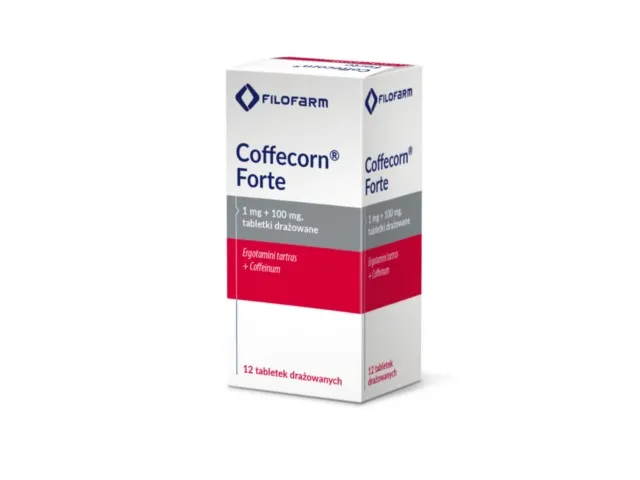
Instructions for Use
Package leaflet: Information for the patient
Coffecorn forte
1 mg + 100 mg, coated tablets
Ergotamine tartrate + Caffeine
Please read all of this leaflet carefully before taking this medicine, because it contains
important information for the patient.
- Keep this leaflet, as you may need to read it again.
- If you have any questions, please consult your doctor or pharmacist.
- This medicine has been prescribed for a specific individual. Do not pass it on to others. The medicine may harm another person, even if their symptoms are the same.
- If you experience any adverse reactions, including any not listed in this leaflet, inform your doctor or pharmacist. See section 4.
Table of contents of the leaflet
- What Coffecorn forte is and what it is used for
- Important information before taking Coffecorn forte
- How to take Coffecorn forte
- Possible side effects
- How to store Coffecorn forte
- Contents of the pack and other information
1. What Coffecorn forte is and what it is used for
Coffecorn forte contains ergotamine tartrate and caffeine.
Ergotamine strongly constricts blood vessels, but may also dilate vessels depending on vascular resistance. If vascular resistance is low, ergotamine causes vasoconstriction and increases arterial pressure; if vascular resistance is high, ergotamine produces the opposite reaction—vasodilation. Ergotamine primarily constricts cerebral blood vessels, reducing migraine symptoms and blood flow.
Ergotamine partially stimulates and partially inhibits alpha-adrenergic receptors in blood vessels. Ergotamine exerts a strong oxytocic effect (causes contraction of uterine muscles). The rationale for combining caffeine with ergotamine is that caffeine facilitates the absorption of this alkaloid.
Caffeine, when used in therapeutic doses, stimulates the activity of the cerebral cortex and autonomic centers. It enhances concentration, shortens reaction time, improves mental performance, alleviates symptoms of mental fatigue, and relieves drowsiness. Caffeine dilates extracranial and intracranial blood vessels. It accelerates cardiac activity, increases the force of heart contractions and cardiac output. Caffeine enhances the effect of analgesic drugs. Caffeine is used as an adjunctive treatment in vascular headaches, as a tonic in mental fatigue, hypotension, and fainting.
Indications
Coffecorn forte is indicated for migraine attacks and vascular headaches when analgesics are ineffective.
2. Important information before taking Coffecorn forte
When not to take Coffecorn forte
- if the patient is allergic to ergotamine tartrate, other ergot alkaloids, caffeine, or any of the other ingredients of this medicine (listed in section 6),
- in cases of uncontrolled hypertension,
- when taking drugs that inhibit the CYP3A isoenzyme of cytochrome P450 (e.g., azole antifungal agents, HIV protease inhibitors, clarithromycin, telithromycin, verapamil, diltiazem, indinavir, ciprofloxacin),
- when taking drugs that constrict blood vessels,
- if the patient currently has or has previously experienced fibrotic reactions (fibrosis) of the heart muscle, lungs, peritoneum, or retroperitoneal tissue,
- in peripheral vascular diseases such as Raynaud's disease, obliterative vasculitis, thrombophlebitis, advanced atherosclerosis, or after vascular surgery,
- in myocardial ischemia,
- after myocardial infarction,
- in peptic ulcer disease of the stomach or duodenum,
- in kidney or liver disease,
- in sepsis,
- in glaucoma,
- during pregnancy,
- during breastfeeding.
Warnings and precautions
Before starting treatment with Coffecorn forte, discuss it with your doctor.
Highly individual hypersensitivity reactions to ergotamine may occur during treatment.
The medicine may cause myocardial ischemia or myocardial infarction even when treating with small doses of ergotamine. Peripheral vascular disturbances may occur even after a single dose of ergotamine. The medicine should be used cautiously in patients with cardiac arrhythmias.
If tingling sensations occur in the fingers or toes, discontinue the medicine and contact your doctor immediately.
In patients who have been taking ergotamine long-term prior to starting treatment, the doctor will check whether heart, lung, and kidney functions are normal. During treatment, the doctor will pay special attention to any signs potentially associated with fibrosis. If necessary, appropriate tests will be performed. If fibrosis occurs, treatment will be discontinued.
Ergotamine may react with synthetic materials used in surgical reconstruction.
Consult your doctor, even if the above warnings refer to conditions experienced in the past.
Coffecorn forte is not intended for long-term therapy and should not be used for migraine prophylaxis.
Prolonged use of any analgesic drugs may lead to worsening of headaches.
If the patient has or is suspected of having such a cause of headache, the medicine should be discontinued and medical advice sought. In patients who experience frequent or daily headaches despite (or due to) regular use of headache medications, medication-overuse headache should be considered.
Concomitant use of drugs that inhibit the CYP3A isoenzyme of cytochrome P450 may enhance the effects of ergotamine and caffeine and increase the risk of adverse events. Severe, even life-threatening cerebral and/or peripheral ischemia may occur.
Children and adolescents
This medicine is not intended for use in children under 12 years of age.
Coffecorn forte and other medicines
Inform your doctor about all medicines you are currently taking, have recently taken, or plan to take.
Medicines containing ergotamine should not be taken together with sumatriptan (a migraine medication) due to the risk of additive vasoconstrictive effects.
Ergotamine should not be used during treatment with dihydroergotamine, bromocriptine, cabergoline (lactation-inhibiting drugs), or methysergide (a migraine medication) due to the risk of hypertension and myocardial infarction.
During ergotamine therapy and concomitant use of drugs blocking alpha-adrenergic receptors (tolazoline, prazosin—vasodilators) and beta-adrenergic receptors (atenolol, nadolol, oxprenolol, propranolol, timolol—used in hypertension and ischemic heart disease), increased arterial pressure and angina may occur.
Concomitant administration of ergotamine- and caffeine-containing products with inhibitors of the CYP3A isoenzyme of cytochrome P450 (e.g., azole antifungal agents, HIV protease inhibitors, clarithromycin, telithromycin, verapamil, diltiazem, indinavir, ciprofloxacin, grapefruit juice) may result in stronger and prolonged effects of ergotamine and caffeine.
Concomitant use of macrolide antibiotics (clarithromycin, roxithromycin, erythromycin) may impair ergotamine metabolism by inhibiting cytochrome P450, leading to increased alkaloid toxicity.
Antiviral drugs (delavirdine, indinavir, ritonavir, nelfinavir) used concomitantly with ergotamine increase the risk of serious adverse reactions.
Antidepressants (fluoxetine, fluvoxamine, paroxetine, sertraline) combined with ergotamine may cause motor coordination disturbances, general weakness, and diminished reflexes.
Dopamine and dobutamine (drugs increasing myocardial contractility) used simultaneously with ergotamine may cause peripheral ischemia and hypoxia leading to necrosis of hands and feet; therefore, these drugs should not be used concurrently with ergot alkaloids.
Caffeine contained in the medicine enhances the effect of central nervous system stimulants and drugs that increase blood pressure.
Taking Coffecorn forte with food, drink, and alcohol
See section 3. Do not drink grapefruit juice or alcohol while taking Coffecorn forte.
Pregnancy, breastfeeding, and fertility
If the patient is pregnant, breastfeeding, suspects she may be pregnant, or is planning to become pregnant, she should consult her doctor or pharmacist before using this medicine.
Coffecorn forte should not be used during pregnancy or breastfeeding.
Chronic use of ergotamine poses a risk to the fetus and may cause abortion due to its oxytocic effect.
Both ergotamine and caffeine pass into breast milk and may cause various disorders in breastfed infants.
Driving and operating machinery
There is no data in the literature regarding ergot alkaloids and their derivatives or caffeine affecting the ability to drive or operate machinery.
Coffecorn forte contains sucrose and lactose
One tablet contains 179.925 mg of sucrose and 33 mg of lactose (equivalent to 34.70 mg of monohydrated lactose). If the patient has previously been diagnosed with intolerance to certain sugars, they should consult their doctor before taking this medicine.
Coffecorn forte contains sodium
The medicine contains less than 1 mmol (23 mg) of sodium per tablet, meaning it is considered "sodium-free."
Coffecorn forte contains methyl parahydroxybenzoate (E 218) (nipagin M)
One tablet contains 0.00046 mg of methyl parahydroxybenzoate. This medicine may cause allergic reactions (including delayed-type reactions).
3. How to use Coffecorn forte
This medicine should always be used as directed by the physician. If in doubt, consult your doctor.
For maximum effectiveness, this medicine should be taken at the very onset of a migraine attack.
Usually, the medicine is used as described below.
Adults and children over 12 years of age:
The recommended dose is 1 to 2 coated tablets at the first signs of a migraine attack. Then, if necessary, take 1 coated tablet every half hour to stop the migraine attack (maximum 4 coated tablets per day or 8 coated tablets per week). At least a 4-day interval must be maintained between consecutive maximum doses.
For other vascular headaches, take 1 coated tablet twice daily, not longer than four days.
The medicine should be taken before meals; however, if gastrointestinal discomfort occurs, it may be taken during a meal.
(See also "Use of Coffecorn forte with food, drink and alcohol" in section 2).
Patients with impaired kidney and/or liver function
Use of Coffecorn forte is contraindicated in patients with impaired liver and/or kidney function.
If you feel that the effect of Coffecorn forte is too strong or too weak, consult your doctor.
Taking more Coffecorn forte than recommended
If you take more than the recommended dose, seek immediate medical advice from your doctor or pharmacist.
Symptoms of overdose:
Fatigue, disorientation, depression, drowsiness, hallucinations, severe dyspnea, decreased or elevated arterial blood pressure, rapid and weak pulse, limb numbness, loss of consciousness, shock, and death.
If the patient is conscious, induce vomiting and seek medical help immediately.
Missed dose of Coffecorn forte
Do not take a double dose to make up for a missed dose.
Stopping Coffecorn forte
If you have any further questions about the use of this medicine, consult your doctor or pharmacist.
4. Possible adverse effects
Like all medicines, this medicine can cause adverse effects, although not everyone experiences them.
Nervous system disorders
During treatment with ergotamine, disorders of the central nervous system may occur, such as: peripheral paresthesia, limb weakness, headache, confusion, dizziness, drowsiness.
The presence of caffeine may cause: insomnia, irritability, muscle tremors.
Cardiac and vascular disorders
When using this product, cardiac rhythm disturbances, fibrosis of the myocardium, heart valves, coronary vessels and aorta, as well as increased or decreased blood pressure may occur.
Long-term use of ergotamine, especially at higher doses, may lead to ergotism, which initially manifests as numbness and coldness of hands and feet, and subsequently progresses to impaired circulation in the limbs, prolonged vasoconstriction of the limbs, and ultimately gangrene of the limbs.
Gastrointestinal disorders
Ergotamine and caffeine contained in the product may cause: nausea, gastrointestinal discomfort, epigastric pain, constipation, gingival hyperplasia. Ergotamine may cause ischemia, irritation, bleeding and ulceration of the rectum due to vasoconstriction of blood vessels.
Hepatic and biliary disorders
Prolonged use of the product may lead to liver damage.
Renal and urinary disorders
Prolonged use of the product may lead to kidney damage.
Musculoskeletal and connective tissue disorders
Ergotamine and caffeine may induce muscle tension disorders preceded by paresthesia, cramps, and pain in the lower limbs.
Reporting adverse effects
If any adverse symptoms occur, including any adverse effects not listed in this leaflet, inform your doctor or pharmacist.
Adverse effects can be reported directly to the Department of Monitoring Adverse Drug Reactions at the Office for Registration of Medicinal Products, Medical Devices and Biocidal Products:
Al. Jerozolimskie 181C
02-222 Warsaw
tel.: 22 49-21-301
fax: 22 49-21-309
Website: https://smz.ezdrowie.gov.pl
Adverse effects can also be reported to the marketing authorization holder.
Reporting adverse effects helps to gather further information on the safety of using this medicine.
5. How to store Coffecorn forte
Keep the medicine in a place out of sight and reach of children.
Do not use this medicine after the expiry date stated on the packaging following EXP.
The expiry date refers to the last day of the specified month.
Store below 25°C.
Medicines must not be disposed of via wastewater or household waste. Ask your pharmacist how to dispose of medicines no longer in use. This will help protect the environment.
6. Contents of the pack and other information
What Coffecorn forte contains
- The active substances are: ergotamine tartrate and anhydrous caffeine. One coated tablet contains 1 mg of ergotamine tartrate and 100 mg of anhydrous caffeine.
- The other components are:
Core of the coated tablet: methylcellulose, potato starch, sodium carboxymethyl starch, monohydrate lactose, magnesium stearate, talc;
Coating of the coated tablet: sucrose, brilliant blue FCF (E 133), potato syrup;
Polishing agent: rapeseed oil, yellow beeswax, methyl parahydroxybenzoate (E218) (nipagin M), ethanol 96%.
What Coffecorn forte looks like and contents of the pack
Coffecorn forte is a coated tablet.
Pack:
One cardboard box contains one colourless glass bottle with 12 coated tablets.
Marketing Authorisation Holder and Manufacturer
Farmaceutyczna Spółdzielnia Pracy FILOFARM
ul. Pułaskiego 39
85-619 Bydgoszcz
For further information, please contact the Marketing Authorisation Holder:
Farmaceutyczna Spółdzielnia Pracy FILOFARM
ul. Pułaskiego 39, 85-619 Bydgoszcz
Tel.: (52) 342 67 88
Information for the blind and partially sighted: The package leaflet for Coffecorn forte is available in the Audio Leaflet system via the nationwide free telephone number 800 706 848.
Similar Medications
-
Coffecorn mite
Form: tablets, coated
Active substance Dosage ergotamine tartrate 0.5 mg caffeine 25 mg Manufacturer: Pharmaceutical Workers' Cooperative FILOFARM
This page has been machine-translated and may contain inaccuracies. The original data is available in the manufacturing country's language.
Last data check: June 04, 2026 · Data source: Rejestr Produktów Leczniczych (URPL)