Clostilbegyt
Poland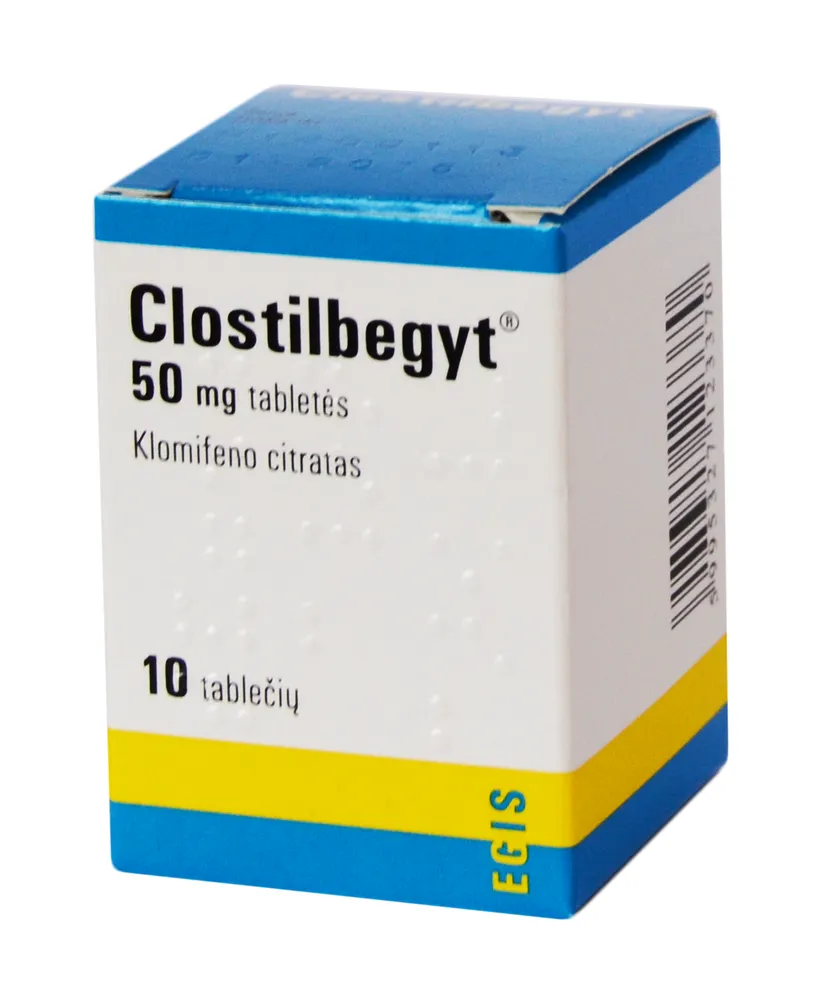
Table of Contents
Package leaflet: Information for the user
Clostilbegyt, 50 mg, tablets
Clomifeni citras
Please read all of this leaflet carefully before taking this medicine because it contains important information for you.
- Keep this leaflet. You may need to read it again.
- If you have any further questions, ask your doctor, pharmacist, or nurse.
- This medicine has been prescribed for you personally. Do not pass it on to others. It may harm them even if their symptoms are the same as yours.
- If you get any side effects, talk to your doctor, pharmacist, or nurse. This includes any side effects not listed in this leaflet. See section 4.
Contents of the leaflet
- What Clostilbegyt is and what it is used for
- What you need to know before taking Clostilbegyt
- How to take Clostilbegyt
- Possible side effects
- How to store Clostilbegyt
- Contents of the pack and other information
1. What Clostilbegyt is and what it is used for
The active substance in Clostilbegyt is clomifene – an anti-oestrogen.
Clostilbegyt is used in the treatment of infertility due to anovulation.
2. Information before using Clostilbegyt
When not to use Clostilbegyt
- If the patient is allergic to clomiphene (the active substance) or any of the other ingredients of this medicine (listed in section 6).
- If the patient is pregnant (see section Pregnancy and breastfeeding).
- If the patient has liver disease or impaired liver function.
- If the patient has an ovarian cyst (except polycystic ovary syndrome) or pituitary gland dysfunction.
- If the patient has thyroid or adrenal gland disorders.
- If the patient has uterine bleeding of unknown cause or undiagnosed bleeding.
- If the patient has visual disturbances (either long-standing or recent).
- If the patient has a hormone-dependent tumour (a tumour that may worsen under the influence of hormones).
- If the patient has early menopause or a history of infertility.
Warnings and precautions
Before starting treatment with Clostilbegyt, consult a doctor or pharmacist,
especially:
- if the patient has had amenorrhoea (absence of menstruation) due to weight loss,
- if the patient has a history of epileptic seizures,
- if the patient has uterine fibroids,
- if the patient has polycystic ovaries,
- if the patient has primary ovarian or pituitary insufficiency,
- if the patient has enlarged ovaries or cystic changes in the ovaries,
- if the patient has hypertriglyceridaemia (elevated blood fats) or a family history of hypertriglyceridaemia. Before starting treatment with Clostilbegyt, other possible causes of infertility should be excluded and/or treated.
Before using the medicine, discuss with your doctor the following possible
conditions:
- Multiple pregnancy (multiple gestation).
- Ectopic pregnancy (pregnancy developing outside the uterus).
- Possible increased risk of ovarian cancer.
- Ovarian hyperstimulation syndrome.
- Visual problems.
Any pregnancy may lead to fetal developmental abnormalities or miscarriage. This risk exists
regardless of whether Clostilbegyt is taken or not.
Children and adolescents
Clostilbegyt should not be used by children or adolescents.
Clostilbegyt with other medicines
Tell your doctor or pharmacist about all medicines you are currently taking, have recently taken, or plan to take.
Pregnancy and breastfeeding
Do not use this medicine if you are pregnant or suspect you may be pregnant.
A pregnancy test should be performed before using Clostilbegyt.
During breastfeeding, Clostilbegyt may be used only if the doctor determines that the potential benefits outweigh the risks to the infant.
Clomiphene may inhibit milk production.
Driving and operating machinery
This medicine may cause blurred vision or other visual disturbances, which may increase the risk of accidents while driving or operating machinery. This risk should be individually assessed by the doctor for each patient.
Clostilbegyt contains monohydrate lactose
One tablet of Clostilbegyt contains 100 mg of monohydrate lactose.
If the patient has previously been diagnosed with intolerance to certain sugars, the patient should contact a doctor before taking this medicine.
3. How to use Clostilbegyt
This medicine should always be taken exactly as prescribed by your doctor. If in doubt, consult your doctor or pharmacist.
The recommended dose should be taken once daily, before a meal.
Treatment should always be preceded by a thorough gynecological examination due to possible adverse effects. Clostilbegyt may only be used on prescription from a gynecologist and under continuous gynecological supervision.
The doctor will individually adjust the dosage according to ovarian sensitivity (responsiveness).
In cases of regular menstruation, treatment is recommended to begin on day 5 of the cycle (or on day 3 if early ovulation occurs (follicular phase lasting less than 12 days)). In the absence of menstruation, treatment may be started on any day.
Regimen I: 50 mg daily for 5 days. During this time, ovarian response to the drug should be monitored by gynecological examination or laboratory tests. Ovulation usually occurs between days 11 and 15 of the cycle. If ovulation does not occur, proceed to Regimen II.
Regimen II: A daily dose of 100 mg is administered for 5 days, starting on day 5 of the next cycle.
If ovulation is not induced, the doctor may repeat this regimen once (administering again a dose of 100 mg).
If ovulation still does not occur, after a three-month break, the doctor may decide to initiate another three-month treatment cycle. Further repetition of treatment is not recommended.
The daily dose should not exceed 100 mg, nor should the duration of administration exceed 5 days.
In polycystic ovary syndrome, due to the risk of hyperstimulation, the initial dose should be lower (25 mg per day).
In cases of absence of menstruation after contraception, a daily dose of 50 mg is used; five-day treatment is usually effective, even during the first treatment cycle.
Clostilbegyt should not be used in women who have already undergone menopause (ceased menstruating).
Use in children and adolescents
This medicine should not be used in children and adolescents.
Taking more Clostilbegyt than prescribed
If you take more Clostilbegyt than prescribed, contact your doctor immediately or go to the nearest hospital. Take the medicine packaging with you so the doctor knows which medicine has been taken. Ovarian overstimulation is likely (see section 4 below).
Symptoms of overdose may include: nausea, vomiting, vasomotor symptoms (hot flushes), episodic facial flushing, visual disturbances (blurred vision, sparkling scotomata, visual field defects), enlarged ovaries with lower abdominal or abdominal pain.
In case of overdose, after elimination of clomiphene from the body, only supportive treatment is recommended. In case of overdose, seek medical advice immediately.
If you forget to take Clostilbegyt
If you miss a dose, consult your doctor, as it may be necessary to adjust the treatment cycle. Do not take a double dose to make up for a missed dose.
Irregular intake of the medicine may result in failure to achieve the desired therapeutic effect (ovarian follicle maturation).
Stopping Clostilbegyt treatment prematurely
Clostilbegyt treatment lasts for 5 days. If treatment is discontinued before this time, the intended effect of the medicine may not be achieved.
If you have any further questions about the use of this medicine, consult your doctor, pharmacist, or nurse.
4. Possible adverse effects
Like all medicines, this medicine can cause adverse effects, although not everyone experiences them.
You should stop taking Clostilbegyt and immediately contact a doctor or
go directly to hospital if any of the following occur:
- Allergic reaction. Symptoms include, among others: rash, difficulty swallowing or breathing, swelling of the lips, face, throat or tongue (angioedema).
- Numbness, muscle weakness or paralysis on one side of the body, slurred speech, sudden worsening of vision, confusion and trembling. These may be symptoms of stroke.
- Vaginal bleeding and abdominal pain during pregnancy. These may be symptoms of ectopic pregnancy (see section 2. above).
The frequency of occurrence of the above adverse effects is unknown (cannot be estimated from available data).
You should stop taking Clostilbegyt and immediately contact a doctor
if any of the following serious adverse effects occur – urgent medical care may be required:
Common (may occur in up to 1 in 10 people)
- Visual disturbances, spots, flashing lights, afterimages. These are usually reversible adverse effects, but in some cases they may be permanent. Your doctor may recommend an eye examination. Frequency unknown (cannot be estimated from available data)
- Overstimulation of the ovaries. This may cause abdominal or pelvic pain, pain in the calves, sweating or bloating, reduced urine output, difficulty breathing or weight gain. In such cases, your doctor may recommend reducing the dose of Clostilbegyt.
- Liver disorders that may lead to yellowing of the whites of the eyes and skin (jaundice).
- Sudden and severe headaches.
- Psychiatric disorders such as paranoid psychosis.
You should inform your doctor or pharmacist if any of the following adverse effects
worsen or persist for longer than a few days:
Very common (may occur in more than 1 in 10 people)
- Skin redness
- Pain or discomfort in the lower abdomen, weight gain, swelling. This may be a sign of ovarian enlargement Common (may occur in up to 1 in 10 people)
- Nausea or vomiting
- Increased menstrual pain, heavy menstrual bleeding or bleeding during the cycle
- Breast tenderness
- Headaches
- Bloating sensation Uncommon (may occur in up to 1 in 100 people)
- Feeling more tense than usual
- Balance disorders or dizziness (spinning sensation)
- Feeling tired or difficulty falling asleep (insomnia)
- Feeling depressed Rare (may occur in up to 1 in 1,000 people)
- Seizures
- Clouding of the eye lens (cataract)
- Worsening vision, eye pain and difficulty seeing certain colors (optic neuritis) Very rare (may occur in up to 1 in 10,000 people)
- Hair loss or thinning
Frequency unknown (cannot be estimated from available data)
- Pain or discomfort in the lower abdomen, weight gain, swelling. This may be a sign of endometriosis (a condition in which cells lining the uterus are present in other organs, e.g. uterine muscles) or worsening of endometriosis, or ovarian cancer
- Massive ovarian enlargement
- Multiple pregnancies, e.g. twins
- Increased blood lipid levels (hypertriglyceridemia)
- Upper abdominal or left-sided abdominal pain. This may be a sign of pancreatitis, which may be triggered by high blood lipid levels
- Rapid or irregular heartbeat
- Skin lesions on legs, arms, hands, feet, and oral cavity changes (erythema multiforme)
- Vision problems
- Feeling faint or loss of consciousness
- Disorientation and speech disturbances
- Skin rash and itching
- Skin bruising
- Swelling of the face, around the eyes, lips or tongue
- Abnormal liver function test results
- Tumors related to the endocrine system or hormone-dependent tumors
- Increased liver enzyme levels in blood laboratory tests. This may indicate impaired liver function.
- Numbness or tingling (paresthesia)
- Feeling anxious
- Mood or behavioral changes
Hot flushes (hot flashes) observed during treatment usually resolve after treatment ends.
Ovarian cystic enlargement may occur, particularly in the rare condition known as Stein-Leventhal syndrome (polycystic ovary syndrome). Your doctor may recommend measuring body temperature and, depending on the results, may decide to discontinue treatment. The frequency of twin pregnancies during treatment may be higher than in the general population. Ectopic pregnancies may occur more frequently during clomiphene treatment.
There have been reports of ovarian cancer associated with the use of fertility-enhancing products. Some studies suggest that prolonged use of clomiphene may increase this risk. For this reason, the recommended duration of treatment should not be exceeded.
Reporting of adverse effects
If any adverse effects occur, including any not listed in this leaflet, you should inform your doctor or pharmacist. Adverse effects can be reported directly to the Department of Monitoring Adverse Drug Reactions at the Office for Registration of Medicinal Products, Medical Devices and Biocidal Products
Al. Jerozolimskie 181C
02-222 Warsaw
Phone: +48 22 49 21 301
Fax: +48 22 49 21 309
Website: https://smz.ezdrowie.gov.pl
Adverse effects can also be reported to the marketing authorization holder.
Reporting adverse effects helps to provide more information on the safety of this medicine.
5. How to store Clostilbegyt
Store below 25°C.
Keep the medicine out of the sight and reach of children.
Do not use this medicine after the expiry date stated on the cardboard package following
"EXP". The expiry date refers to the last day of the specified month.
The batch number is indicated on the packaging following the abbreviation "Lot".
Do not use this medicine if any discolouration is observed.
Medicines must not be disposed of via wastewater or household waste. Ask your pharmacist how to dispose of medicines no longer required. This will help protect the environment.
6. Contents of the pack and other information
What Clostilbegyt contains
- The active substance is 50 mg of clomifene citrate in each tablet.
- The other ingredients are: gelatin, magnesium stearate, stearic acid, talc, potato starch, lactose monohydrate (100 mg).
What Clostilbegyt looks like and contents of the pack
White or yellowish-white, flat, circular tablets with bevelled edges, odourless,
with the imprint “CLO” on one side.
Orange glass bottle with a polyethylene (LDPE) closure with tamper-evident seal and a cushion,
packaged in a cardboard box.
10 tablets – 1 bottle containing 10 tablets
20 tablets – 1 bottle containing 20 tablets
Marketing Authorisation Holder and Manufacturer
Marketing Authorisation Holder:
EGIS Pharmaceuticals PLC
1106 Budapest, Keresztúri út 30-38.
Hungary
Manufacturer:
EGIS Pharmaceuticals PLC
H-9900 Körmend, Mátyás király út 65.
Hungary
For further information, please contact the local representative of the Marketing Authorisation Holder:
EGIS Polska Sp. z o.o.
ul. Komitetu Obrony Robotników 45D
02-146 Warsaw
Tel.: +48 22 417 92 00