Clindamycin kabi
Poland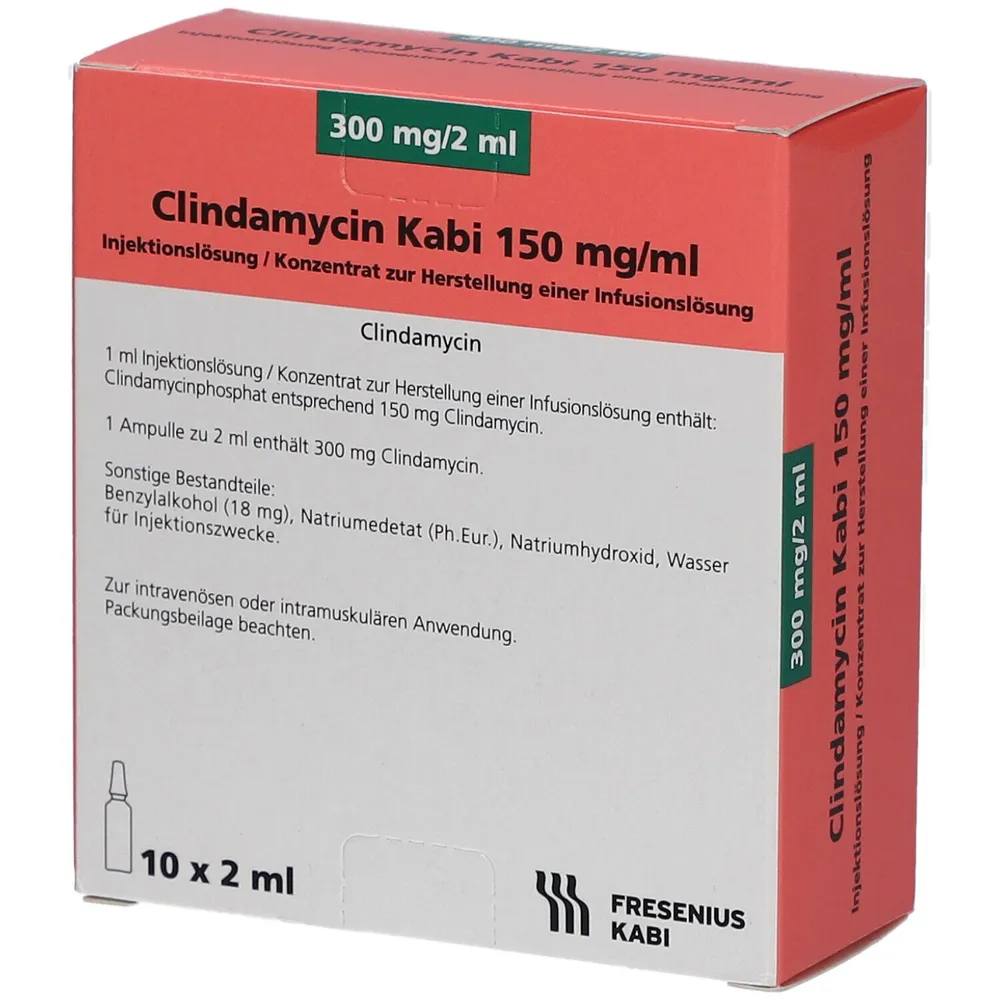
Table of Contents
- Package leaflet: Information for the user
- 1. What Clindamycin Kabi is and what it is used for
- 2. Important information before using Clindamycin Kabi
- 3. How to use Clindamycin Kabi
- 4. Possible adverse reactions
- 5. How to store Clindamycin Kabi
- 6. Contents of the pack and other information
- Information intended exclusively for medical professionals:
Package leaflet: Information for the user
Clindamycin Kabi, 150 mg/ml, solution for injection/concentrate for solution for infusion
Clindamycinum
Please read all of this leaflet carefully before using this medicine, because it contains
important information for you.
Keep this leaflet as you may need to read it again.
If you have any further questions, please ask your doctor, pharmacist or nurse.
If you experience any side effects, including any not listed in this leaflet, please inform your doctor, pharmacist or nurse. See section 4.
Contents of the leaflet
- What Clindamycin Kabi is and what it is used for
- What you need to know before you use Clindamycin Kabi
- How to use Clindamycin Kabi
- Possible side effects
- How to store Clindamycin Kabi
- Contents of the pack and other information
1. What Clindamycin Kabi is and what it is used for
Clindamycin Kabi contains the active substance – clindamycin (in the form of phosphate). Clindamycin is an antibiotic.
Clindamycin Kabi is used to treat severe infections caused by bacteria sensitive to clindamycin. In aerobic bacterial infections, clindamycin is an alternative treatment when other antibacterial agents are ineffective or contraindicated (e.g. in patients allergic to penicillins). If the infection is caused by anaerobic bacteria, your doctor may consider clindamycin as a first-line treatment.
Clindamycin is used in the treatment of:
bone and joint infections;
chronic sinusitis;
lower respiratory tract infections;
intra-abdominal infections (peritonitis);
genital infections;
skin and soft tissue infections.
2. Important information before using Clindamycin Kabi
When not to use Clindamycin Kabi
if the patient is allergic to clindamycin or lincomycin, or to any of the other
ingredients of this medicine (listed in section 6).
Warnings and precautions
Before starting treatment with Clindamycin Kabi, consult a doctor, pharmacist, or
nurse:
- if the patient has impaired liver or kidney function;
- if the patient has muscle function disorders such as myasthenia gravis (pathological muscle weakness) or Parkinson's disease (so-called paralysis agitans);
- if the patient previously had stomach or intestinal diseases (e.g. previous colitis);
if the patient has any type of allergy, e.g. penicillin allergy, as isolated cases of allergic reactions to clindamycin have been observed in patients allergic to penicillin.
Consult a doctor if any of the above precautions or warnings apply to the patient or have applied in the past.
Severe hypersensitivity reactions have been observed in patients receiving clindamycin, including drug reaction with eosinophilia and systemic symptoms (DRESS), erythema multiforme bullosum (Stevens-Johnson syndrome, SJS), toxic epidermal necrolysis (Lyell's syndrome, TEN), and acute generalized exanthematous pustulosis (AGEP). If symptoms of hypersensitivity or severe skin reactions occur, inform the doctor immediately.
Severe allergic reactions may occur even after the first dose of the medicine. In such a case, the doctor will immediately discontinue administration of Clindamycin Kabi and initiate standard emergency procedures.
Rapid intravenous injection may cause adverse effects and should be avoided. The doctor will dilute the medicine before intravenous administration and ensure that it is infused over at least 10–60 minutes.
During prolonged treatment (more than 10 days), blood cell counts and liver and kidney function should be monitored regularly.
Severe kidney function disorders may occur. Inform the doctor about all concomitantly used medicines and any kidney problems. If the patient experiences reduced urine output or fluid retention causing swelling of the legs, ankles, or feet, shortness of breath, or nausea, contact the doctor immediately.
Prolonged and repeated use of Clindamycin Kabi may lead to skin and mucous membrane infections caused by microorganisms resistant to clindamycin. Fungal infections may also occur.
Treatment with clindamycin may lead to severe infection of the large intestine (colitis). Therefore, the doctor should be informed immediately if severe and persistent diarrhoea occurs during or within two months after completion of treatment, especially if mucus or blood is present in the stool.
Clindamycin Kabi should not be used in acute viral respiratory tract infections.
Clindamycin Kabi is not suitable for the treatment of encephalitis (meningitis).
Children
Extreme caution should be exercised when using this medicine in children under 3 years of age, as the medicine contains benzyl alcohol (see below).
Clindamycin Kabi and other medicines
Inform the doctor, pharmacist, or nurse about all medicines currently or recently used, as well as any medicines the patient plans to use.
Inform the doctor about taking warfarin or similar medicines used to thin the blood. The patient may be more susceptible to bleeding. The doctor may order regular blood tests to monitor blood clotting.
Clindamycin Kabi should not be used concomitantly with medicines containing erythromycin, as mutual reduction of efficacy cannot be excluded.
Clindamycin Kabi should not be administered after treatment with lincomycin.
Clindamycin Kabi may enhance the effect of muscle relaxants, which may lead to unexpected, life-threatening events during surgery.
Rifampicin may increase the elimination of clindamycin from the blood; therefore, the treating doctor should regularly monitor clindamycin blood levels.
Pregnancy and breastfeeding
The patient should inform the doctor if:
- she is pregnant or suspects she may be pregnant – after assessing the benefit-risk ratio associated with the use of clindamycin, the doctor will decide how to use Clindamycin Kabi;
- she is breastfeeding – this medicine may pass into human milk and allergic reactions (hypersensitivity), diarrhoea, or fungal infections may occur in the breastfed infant.
Before using any medicine, consult a doctor or pharmacist.
Driving and operating machinery
Dizziness, headache, and fatigue may occur during treatment with this medicine. In such cases, do not drive, use tools, or operate machinery.
Clindamycin Kabi contains sodium chloride and benzyl alcohol
Sodium chloride
The medicine contains 8.5 mg of sodium (main component of table salt) in each ml of solution. This corresponds to 0.43% of the maximum recommended daily sodium intake in the diet of adults.
Benzyl alcohol
The medicine contains 9 mg of benzyl alcohol in each ml of solution.
Benzyl alcohol may cause allergic reactions.
Benzyl alcohol is associated with a risk of serious adverse effects, including breathing problems (so-called respiratory distress syndrome) in young children.
Do not administer this medicine to neonates (up to 4 weeks of age) unless directed by a doctor.
Do not use this medicine for longer than one week in young children (under 3 years of age) unless directed by a doctor or pharmacist.
If pregnant or breastfeeding, consult a doctor or pharmacist, as large amounts of benzyl alcohol may accumulate in the body and may cause adverse effects (so-called "metabolic acidosis").
If the patient has liver or kidney disease, consult a doctor or pharmacist, as large amounts of benzyl alcohol may accumulate in the body and may cause adverse effects (so-called "metabolic acidosis").
3. How to use Clindamycin Kabi
Clindamycin Kabi is administered by intramuscular injection (into the muscle) as an undiluted solution or, after dilution, by intravenous infusion (into the vein). The medicine is usually given by a doctor or nurse.
The doctor will determine the appropriate clindamycin dose for the individual patient.
The usual dose for adult patients and adolescents over 12 years of age is:
- for treatment of less severe infections:
8 to 12 ml of Clindamycin Kabi per day (corresponding to 1.2 to 1.8 g of clindamycin)
- for treatment of severe infections:
12 to 18 ml of Clindamycin Kabi (corresponding to 1.8 to 2.7 g of clindamycin)
divided into two to four equal doses.
The maximum daily dose in adult patients and adolescents over 12 years of age is usually 18 ml of Clindamycin Kabi (corresponding to 2.7 g of clindamycin) divided into two to four equal doses. In life-threatening infections, doses up to 4.8 g per day may be administered.
In patients with liver or kidney disease, clindamycin metabolism is impaired. However, in most cases, dose reduction is not necessary. Monitoring of clindamycin blood levels is recommended.
Clindamycin is not removed from the body during hemodialysis. Therefore, there is no need to administer additional doses to dialyzed patients before or after hemodialysis.
Use in children
Depending on the severity and location of the infection, the dose for children aged 4 weeks to 12 years is 15 to 40 mg of clindamycin per kg of body weight, given in three or four equal doses.
The duration of treatment depends on the type and severity of the disease.
If you have any doubts regarding the use of the medicine, consult your doctor, pharmacist, or nurse.
4. Possible adverse reactions
Like all medicines, this medicine can cause adverse reactions, although not everyone experiences them.
Inform a doctor immediately if the patient experiences:
fluid retention causing swelling of the legs, ankles or feet, breathlessness or nausea.
Very common adverse reactions (may affect more than 1 in 10 people)
Gastrointestinal disorders such as diarrhoea, abdominal pain, vomiting, nausea.
Common adverse reactions (may affect up to 1 in 10 people)
Pseudomembranous colitis, which may be caused by antibiotics, can be life-threatening and requires appropriate, immediate treatment.
Blood disorders such as a marked decrease in the number of granulocytes in the blood (agranulocytosis), neutropenia (lack of neutrophils), tendency to bleed (thrombocytopenia), leukopenia (lack of white blood cells), and eosinophilia (increase in acidophilic cells (eosinophils)).
Vascular disorders such as thrombophlebitis.
Skin disorders such as rash (widespread rash with small bumps), urticaria (hives).
Abnormal liver function test results.
Uncommon adverse reactions (may affect up to 1 in 100 people)
Nervous system disorders such as neuromuscular blockade (blocking signal transmission from nerves to muscles) and taste disturbances.
Cardiac and vascular disorders such as circulatory-respiratory arrest and low blood pressure (hypotension).
General disorders and administration site conditions such as pain and abscess (ulcer) at the injection site.
Rare adverse reactions (may affect up to 1 in 1,000 people)
Drug fever, hypersensitivity reaction to one of the components of the medicine (benzyl alcohol).
Severe skin reactions:
widespread blistering rash with peeling skin, especially around the mouth, nose, eyes and genital organs (Stevens-Johnson syndrome), and a more severe form causing extensive skin detachment (toxic epidermal necrolysis);
widespread red skin rash with small pus-filled blisters (pustular exanthema);
angioedema (swelling, particularly of the face and neck, wheezing and/or breathing difficulties).
Itching.
Vaginitis (inflammation of the vaginal mucosa).
Very rare adverse reactions (may affect up to 1 in 10,000 people)
Severe allergic reaction (anaphylactic reaction).
Transient hepatitis with cholestatic jaundice.
Hypersensitivity reaction with rash and blister formation.
Arthritis (polyarthritis).
Frequency not known (cannot be estimated from available data)
Colitis (severe infection of the large intestine caused by Clostridium difficile).
Vaginal infection.
Severe acute allergic reactions such as a significant drop in blood pressure, pallor, weak rapid pulse, cold clammy skin, impaired consciousness (anaphylactic shock), anaphylactoid reaction, hypersensitivity.
Somnolence.
Dizziness.
Headache.
Jaundice.
Fever, swollen lymph nodes or skin rash may be symptoms of a condition known as drug reaction with eosinophilia and systemic symptoms (DRESS), which may be severe and life-threatening.
Rare skin eruptions characterised by the rapid appearance of red skin areas with small pustules (small blisters filled with whitish-yellow fluid) (acute generalized exanthematous pustulosis, AGEP).
Irritation at the injection site.
Reporting of adverse reactions
If any adverse reactions occur, including any not listed in this leaflet, tell a doctor, pharmacist or nurse. Adverse reactions can be reported directly to the Department of Monitoring Adverse Drug Reactions, Office for Registration of Medicinal Products, Medical Devices and Biocidal Products
Al. Jerozolimskie 181C
02-222 Warsaw
Phone: +48 22 49 21 301
Fax: +48 22 49 21 309
Website: https://smz.ezdrowie.gov.pl
Adverse reactions can also be reported to the marketing authorisation holder.
Reporting adverse reactions helps provide more information on the safety of the medicine.
5. How to store Clindamycin Kabi
Keep this medicine out of the sight and reach of children.
Do not use this medicine after the expiry date stated on the label and the outer carton following "EXP". The expiry date refers to the last day of the stated month.
Do not store above 25°C.
Do not use this medicine if you notice any discoloration, sediment, or other visible solid particles.
Medicines should not be disposed of via wastewater or household waste. Ask your pharmacist how to dispose of medicines no longer required. Such measures help protect the environment.
6. Contents of the pack and other information
What Clindamycin Kabi contains
The active substance is clindamycin.
One millilitre of injection solution/concentrate for solution for infusion contains 150 mg clindamycin (as phosphate).
One 2 ml vial contains 300 mg clindamycin.
One 4 ml vial contains 600 mg clindamycin.
One 6 ml vial contains 900 mg clindamycin.
Other components are: benzyl alcohol (9 mg in each ml of solution), disodium edetate,
sodium hydroxide (for pH adjustment) and water for injections.
What Clindamycin Kabi looks like and contents of the pack
Clindamycin Kabi is a clear, colourless or slightly coloured solution for injection/concentrate for solution for infusion.
Clindamycin Kabi is available in vials made of colourless glass, containing 2 ml, 4 ml or 6 ml of solution for injection.
Pack contains: 5 or 10 vials.
Not all pack sizes may be marketed.
Marketing Authorisation Holder and Manufacturer
Marketing Authorisation Holder
Fresenius Kabi Polska Sp. z o.o.
Al. Jerozolimskie 134
02-305 Warsaw
Poland
Manufacturer
Labesfal - Laboratórios Almiro, S.A.
Zona Industrial do Lagedo
3465-157 Santiago de Besteiros
Portugal
This medicinal product is authorised in the Member States of the European Economic Area under the following names:
| Belgium | Clindamycin Fresenius Kabi 150 mg/ml solution for injection |
| Bulgaria | Clindamycin Kabi 150 mg/ml injection solution |
| Czech Republic | Clindamycin Kabi 150 mg/ml, injection solution |
| Denmark | Clindamycin Kabi 150 mg/ml injection solution |
| Finland | Clindamycin Fresenius Kabi 150 mg/ml injection solution, solution |
| Greece | Clindamycin Kabi 150 mg/ml injectable solution |
| Spain | Clindamycin Fresenius Kabi 150 mg/ml injectable solution |
| Netherlands | Clindamycin Kabi 150 mg/ml solution for injection |
| Ireland | Clindamycin 150 mg/ml solution for injection |
| Luxembourg | Clindamycin Kabi 150 mg/ml injection solution |
| Poland | Clindamycin Kabi |
| Slovakia | Clindamycin Kabi 150 mg/ml injection solution |
| Hungary | Clindamycin Kabi 150 mg/ml solution for injection |
Information intended exclusively for medical professionals:
For single use only. Any unused solution should be discarded.
Do not use Clindamycin Kabi if any particulate matter or significant discoloration of the solution is observed.
The solution should be inspected after dilution. Only clear, particle-free solutions should be used.
The diluted medicinal product is for single use only; any unused solution must be discarded.
Chemical and physical stability of the diluted solution has been confirmed for 48 hours at 25°C.
From a microbiological standpoint, the medicinal product should be used immediately after dilution. If not used immediately, the user is responsible for the storage duration and conditions prior to use. Generally, the solution should not be stored for longer than 24 hours at a temperature of 2°C to 8°C, unless dilution has been carried out under controlled and validated aseptic conditions.
Prior to intravenous infusion, Clindamycin Kabi must be diluted (final concentration must not exceed 18 mg of clindamycin per 1 mL) and administered as an infusion lasting at least 10 to 60 minutes (infusion rate must not exceed 30 mg/min).
The infusion solution should always be administered separately unless compatibility with other medicinal products has been confirmed. Clindamycin Kabi may be diluted in 0.9% sodium chloride solution, 5% glucose solution, or Ringer's lactate solution.