Clemastinum wzf
Poland
Table of Contents
Patient Information Leaflet
CLEMASTINUM WZF, 1 mg/ml, solution for injection
Clemastinum
Please read the entire leaflet carefully before using this medicine, as it contains important information for you.
- Keep this leaflet for future reference.
- If you have any questions, please consult your doctor or pharmacist.
- This medicine has been prescribed for a specific individual. Do not share it with others. This medicine may harm other people, even if their symptoms are the same as yours.
- If you experience any adverse reactions, including any not listed in this leaflet, inform your doctor or pharmacist. See section 4.
Table of Contents
- What Clemastinum WZF is and what it is used for
- Important information before using Clemastinum WZF
- How to use Clemastinum WZF
- Possible side effects
- How to store Clemastinum WZF
- Contents of the pack and other information
1. What Clemastinum WZF is and what it is used for
Clemastinum WZF is an antiallergic medicine that relieves allergic symptoms and is used in adults:
- as supportive treatment in anaphylactic shock and angioedema (symptoms: low blood pressure, swelling of the skin, lips, tongue, throat, causing breathing difficulties);
- prior to procedures that may cause histamine release in the body, to prevent severe allergic reactions.
2. Important information before using the medicine Clemastinum WZF
When not to use Clemastinum WZF
- if the patient is allergic to clemastine, chlorpheniramine, or diphenhydramine (substances with a structure similar to clemastine, contained in other medicines), or to any of the other ingredients of this medicine (listed in section 6);
- during concomitant use of medicines known as monoamine oxidase inhibitors (MAO inhibitors) — see section "Clemastinum WZF and other medicines".
Warnings and precautions
Before starting treatment with Clemastinum WZF, discuss with your doctor or pharmacist:
- if the patient suffers from glaucoma or has increased intraocular pressure;
- if the patient has gastric or duodenal ulcers, or other severe gastrointestinal disorders (e.g. pyloric stenosis);
- if the patient has been diagnosed with prostate enlargement or urinary retention due to other causes;
- if the patient suffers from asthma;
- if the patient has hyperthyroidism;
- if the patient has cardiovascular diseases or hypertension;
- if the patient has porphyria (disorders in heme formation — the red pigment of blood, which is also part of certain enzymes), as the medicine may exacerbate symptoms of porphyria;
- if the patient is over 60 years of age, because increased drowsiness, fatigue, or hypotension cannot be excluded. During treatment with Clemastinum WZF, as with other antihistamines, the patient should not consume alcohol.
Clemastinum WZF and other medicines
Inform your doctor or pharmacist about all medicines currently or recently taken, and any medicines planned for use.
- Concomitant use of certain medicines with clemastine may affect the central nervous system, especially if the patient is taking:
- barbiturates (sedatives and hypnotics);
- tricyclic antidepressants (used in the treatment of depression);
- medicines used in Parkinson's disease;
- strong analgesics (opioid group, e.g. morphine).
- Some antidepressants (monoamine oxidase inhibitors — MAO inhibitors) prolong and intensify the effect of clemastine.
Pregnancy and breastfeeding
If the patient is pregnant or breastfeeding, suspects she may be pregnant, or is planning to become pregnant, she should consult a doctor or pharmacist before using this medicine.
This medicine may be used during pregnancy only if clearly necessary. The decision whether Clemastinum WZF can be used during pregnancy will be made by the doctor.
The medicine should not be used during breastfeeding, as clemastine passes into breast milk in small amounts and may cause adverse effects in breastfed infants.
Driving and operating machinery
Due to the possibility of adverse effects (e.g. drowsiness, fatigue, dizziness) occurring during treatment, driving vehicles or operating machinery should be avoided.
Clemastinum WZF contains sorbitol, ethanol 96%, propylene glycol, and sodium
The medicine contains 90 mg of sorbitol in 2 ml of solution.
Sorbitol is a source of fructose. If the patient has previously been diagnosed with hereditary fructose intolerance, a rare genetic disorder, the patient must not take this medicine. In patients with hereditary fructose intolerance, the body cannot metabolize fructose present in this medicine, which may lead to severe adverse reactions.
Inform your doctor before taking this medicine if you have hereditary fructose intolerance.
This medicine contains 140 mg of alcohol (96% ethanol) in 2 ml of solution (in one ampoule). The amount of alcohol in 2 ml of this medicine is equivalent to less than 3 ml of beer and about 1 ml of wine.
The small amount of alcohol in this medicine will not cause noticeable effects.
The medicine contains 600 mg of propylene glycol in 2 ml of solution.
The medicine contains less than 1 mmol (23 mg) of sodium in 2 ml of solution, meaning the medicine is considered "sodium-free".
The medicine may be diluted with 0.9% sodium chloride solution or 5% glucose solution. The sodium content originating from the diluent should be taken into account when calculating the total sodium content in the prepared diluted solution. For precise information regarding the sodium content in the diluent used, please refer to the patient leaflet of the diluent.

3. How to use Clemastinum WZF
Clemastinum WZF is usually administered by medical personnel.
This medicine is intended for adults. It should be given intravenously or intramuscularly.
Duration of treatment
The duration of treatment is determined by the physician – the medicine is used on an as-needed basis.
Detailed dosage instructions, as well as directions for use and preparation of the medicine for administration,
are provided at the end of this leaflet under the section “Information intended exclusively for healthcare professionals”.
Use of a higher than recommended dose of Clemastinum WZF
Since the medicine is administered by medical personnel, it is unlikely that a patient will receive a higher than recommended dose.
However, inform the doctor or nurse immediately if any of the following occur:
- excitation, hallucinations, ataxia, motor coordination disturbances, muscle tremors, involuntary movements, hyperthermia, cyanosis, seizures, worsening breathing difficulties;
- dry mouth, dilated pupils, facial flushing, elevated body temperature, drowsiness.
Missed dose of Clemastinum WZF
Since the medicine is administered by medical personnel, it is unlikely that a dose will be missed.
If you have any further questions about the use of this medicine, consult your doctor or pharmacist.
4. Possible adverse reactions
Like any medicine, this medicine may cause adverse reactions, although not everyone experiences them.
The adverse reactions listed below are categorized according to their frequency of occurrence.
Most common are:
- sedation, drowsiness, coordination disturbances, dizziness;
- abdominal pain, heartburn, nausea, vomiting, diarrhoea, constipation;
- increased density of respiratory tract secretions.
The following may occur:
- fatigue, confusion, anxiety, excessive excitation (especially in children), weakness, headache, tremors, insomnia, blurred vision, double vision, tinnitus, seizures;
- loss of appetite, dryness of the oral mucosa;
- feeling of chest tightness, wheezing, dryness of nasal and throat mucosa, sensation of nasal congestion;
- decreased blood pressure, palpitations, tachycardia, extrasystoles;
- changes in blood picture (reduced platelet count, peripheral granulocytopenia, hemolytic anemia);
- difficulty in urination, urinary retention;
- urticaria, rash;
- excessive sweating, chills, photosensitivity.
In patients over 60 years of age, there is a higher probability of occurrence of decreased blood pressure, drowsiness, fatigue, and dizziness.
Reporting of adverse reactions
If any adverse reactions occur, including any not listed in this leaflet, inform your doctor or pharmacist. Adverse reactions can be reported directly to the Department of Monitoring Adverse Drug Reactions of the Office for Registration of Medicinal Products, Medical Devices and Biocidal Products
Al. Jerozolimskie 181C
02-222 Warsaw
Tel.: + 48 22 49 21 301
Fax: + 48 22 49 21 309
Website: https://smz.ezdrowie.gov.pl
Adverse reactions can also be reported to the marketing authorization holder.
Reporting adverse reactions helps to provide more information on the safety of the medicine.
5. How to store Clemastinum WZF
Keep the medicine out of the sight and reach of children.
Store below 25°C. Do not freeze. Keep the ampoules in the outer packaging to protect from light.
Do not use this medicine after the expiry date stated on the carton and on the ampoule.
The expiry date refers to the last day of the stated month.
The marking on the packaging: EXP indicates the expiry date, and Lot indicates the batch number.
Medicines must not be disposed of via wastewater or household waste. Ask your pharmacist how to dispose of medicines no longer required. This will help protect the environment.
6. Contents of the package and other information
What Clemastinum WZF contains
- The active substance is clemastine. Each ml of solution contains 1 mg of clemastine (as clemastine fumarate).
- The other ingredients are: sorbitol, 96% ethanol, propylene glycol, disodium citrate dihydrate, water for injections.
What Clemastinum WZF looks like and contents of the pack
Clemastinum WZF is a colourless, transparent liquid.
Each pack contains 5 ampoules of 2 ml in a cardboard box.
Marketing Authorisation Holder and Manufacturer
Zakłady Farmaceutyczne POLPHARMA S.A.
ul. Pelplińska 19, 83-200 Starogard Gdański
tel. + 48 22 364 61 01
Information intended exclusively for healthcare professionals:
CLEMASTINUM WZF, 1 mg/ml, solution for injection
Clemastinum
The medicine should be administered intravenously or intramuscularly.
Before intravenous administration, the contents of the ampoule should be diluted fivefold (1:5) with 0.9% sodium chloride solution (see section 2, subsection "Clemastinum WZF contains sorbitol, 96% ethanol, propylene glycol and sodium") or 5% glucose solution. Aseptic techniques must be maintained during preparation and administration of the medicine. Inject slowly over 2–3 minutes.
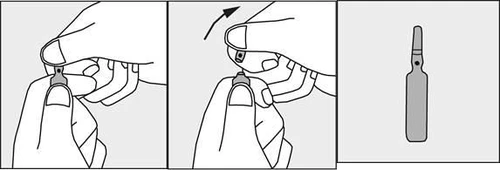
Instructions for opening the ampoule
Before opening the ampoule, ensure that all the solution is in the lower part of the ampoule. Gently shake the ampoule or tap it with your finger to help the solution flow down.
Each ampoule has a coloured dot (see Figure 1) indicating the score line located beneath it.
- To open the ampoule, hold it vertically in both hands with the coloured dot facing towards you – see Figure 2. Hold the upper part of the ampoule so that the thumb is positioned above the coloured dot.
- Press in the direction of the arrow shown in Figure 3. The ampoules are intended for single use only and should be opened immediately before use. Any unused portion of the medicine should be discarded in accordance with applicable regulations.
Figure 1 Figure 2 Figure 3
Adults
Adjunctive treatment in anaphylactic shock, angioedema:
2 ml (1 ampoule) intravenously or intramuscularly twice daily.
Prophylactic use before procedures that may trigger histamine release:
2 ml (1 ampoule) intravenously immediately before the procedure.
Children
Administration of the medicine is not recommended.