Clemastinum hasco
Poland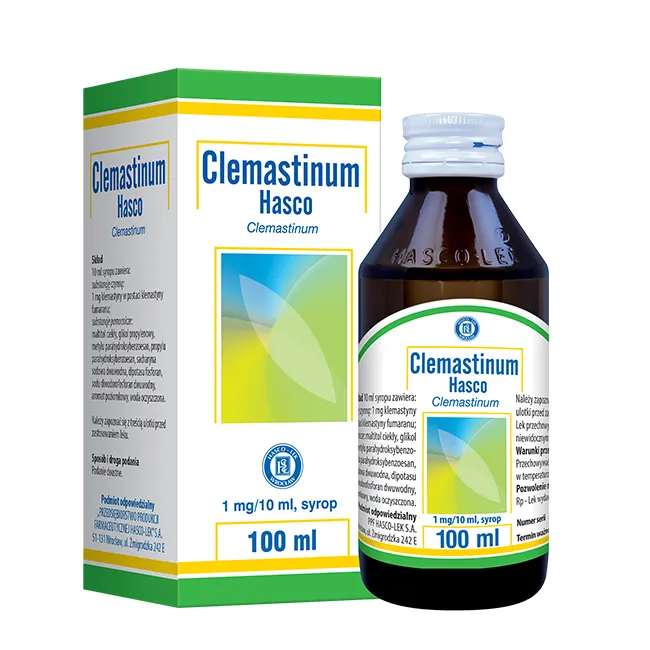
Table of Contents
Patient Information Leaflet
CLEMASTINUM HASCO
1 mg/10 ml, syrup
Clemastinum
Please read this leaflet carefully before using the medicine, as it contains
important information for the patient.
- Keep this leaflet, so that you can read it again if necessary.
- If you have any questions, please consult your doctor, pharmacist or nurse.
- This medicine has been prescribed for a specific individual. Do not pass it on to others. The medicine may harm someone else, even if their symptoms are the same.
- If the patient experiences any adverse reactions, including any not listed in this leaflet, they should inform their doctor, pharmacist or nurse. See section 4.
Table of Contents
- What Clemastinum HASCO is and what it is used for
- Important information before taking Clemastinum HASCO
- How to take Clemastinum HASCO
- Possible side effects
- How to store Clemastinum HASCO
- Contents of the pack and other information
1. What Clemastinum HASCO is and what it is used for
Clemastinum HASCO syrup contains clemastine, a medicine which inhibits the action of histamine – one of the substances involved in allergic reactions in the body. Due to its antihistaminic effect, clemastine relieves symptoms of allergic rhinitis (sneezing, watery nasal discharge, tearing) and skin allergies (urticaria, swelling, itching). This medicine is intended for relieving symptoms of:
- Skin allergies (such as contact dermatitis, urticaria, pruritus) and skin manifestations of angioedema (Quincke's edema);
- Allergic rhinitis, such as watery nasal discharge, sneezing, and tearing.
If there is no improvement or if the patient feels worse, consult a doctor.
2. Important information before using Clemastinum HASCO
When not to use Clemastinum HASCO:
- if the patient is allergic to clemastine or any of the other ingredients of this medicine (listed in section 6),
- if the patient is allergic to other substances with a chemical structure similar to clemastine (e.g. diphenhydramine, chlorpheniramine),
- in patients concurrently using medicines belonging to the group of so-called monoamine oxidase inhibitors (MAO inhibitors), see "Clemastinum HASCO with other medicines",
- in children during the first year of life.
Warnings and precautions
Before starting treatment with Clemastinum HASCO syrup, discuss this with your doctor,
pharmacist, or nurse.
1/5
Exercise caution:
- in patients with increased intraocular pressure or narrow-angle glaucoma,
- in patients with pyloric stenosis,
- in patients with peptic ulcer causing impaired passage of food content,
- in patients with benign prostatic hyperplasia or urinary bladder neck obstruction,
- in patients with hyperthyroidism,
- in patients with bronchial asthma,
- in patients with cardiovascular diseases and arterial hypertension,
- in patients with porphyria, as clemastine may exacerbate symptoms of this disease,
- in elderly patients due to increased risk of adverse effects (e.g. dizziness, excessive sedation, and lowering of blood pressure).
Consult your doctor, even if the above warnings refer to conditions
that occurred in the past.
Avoid using clemastine concurrently with medicines that depress the central
nervous system (see "Clemastinum HASCO with other medicines").
Clemastine treatment should be discontinued for several days (at least 3 days) prior to performing
allergy tests.
Clemastinum HASCO with other medicines
Inform your doctor, pharmacist, or nurse about all medicines currently taken or recently used,
as well as any medicines the patient intends to use.
Concomitant use of clemastine and medicines that depress the central nervous system
(e.g. sedatives, hypnotics, anxiolytics, certain psychotropic drugs) enhances
the depressant effect of clemastine on the central nervous system. Therefore, simultaneous use
of clemastine with such medicines should be avoided.
Concomitant use of clemastine with anticholinergic drugs may intensify their effects.
Medicines belonging to the group of monoamine oxidase inhibitors (used in the treatment of depression) prolong and enhance the effect of clemastine; therefore, concomitant use of these medicines is contraindicated—see "When not to use Clemastinum HASCO".
Clemastinum HASCO with food, drink, and alcohol
Do not consume alcohol while taking clemastine.
Pregnancy and breastfeeding
If the patient is pregnant or breastfeeding, suspects she may be pregnant, or is planning to have
a child, she should consult a doctor or pharmacist before using this medicine.
Clemastine crosses the placenta; there are insufficient data to fully assess the safety of using this medicine during pregnancy. Clemastine may be used during pregnancy only on a doctor's advice and only in cases of clear necessity.
Clemastine should not be used in breastfeeding women, as it passes into breast milk.
Driving and operating machinery
This medicine may cause drowsiness, which impairs psycho-physical performance and the ability to drive motor vehicles or operate machinery. Therefore, during treatment with clemastine, patients should not drive or operate machinery.
Clemastinum HASCO contains methyl parahydroxybenzoate (E 218)
and propyl parahydroxybenzoate
This medicine may cause allergic reactions (delayed-type reactions possible).
2/5
Clemastinum HASCO contains maltitol (E 965)
If the patient has previously been diagnosed with intolerance to certain sugars, the patient should
consult a doctor before taking this medicine. The medicine may have a mild laxative effect.
Calorific value: 2.3 kcal/g of maltitol.
Clemastinum HASCO contains propylene glycol (E 1520)
The medicine contains approximately 369 mg of propylene glycol in each 10 ml of syrup.
Clemastinum HASCO contains sodium
The medicine contains less than 1 mmol (23 mg) of sodium in 10 ml of syrup, meaning the medicine is considered "sodium-free".
3. How to use Clemastinum HASCO
This medicine should always be used as directed by a doctor or pharmacist.
If in doubt, consult a doctor or pharmacist.
For oral use.
The package includes a measuring device allowing measurement of 2.5 ml, 5 ml or 10 ml of syrup.
Children aged 1 to 3 years:
2.5 ml to 5 ml of syrup (i.e. 0.25 mg to 0.5 mg of clemastine) twice daily, in the morning and evening.
Children aged 3 to 6 years:
5 ml of syrup (i.e. 0.5 mg of clemastine) twice daily, in the morning and evening.
Children aged 6 to 12 years:
5 ml to 10 ml of syrup (i.e. 0.5 mg to 1 mg of clemastine) twice daily, in the morning and evening.
Children over 12 years of age and adults:
10 ml of syrup (i.e. 1 mg of clemastine) twice daily, in the morning and evening.
The maximum daily dose for adults is up to 60 ml of syrup (i.e. up to 6 mg of clemastine).
Taking more than the recommended dose of Clemastinum HASCO
If more than the recommended dose is taken, consult a doctor or pharmacist immediately.
The most common symptoms of clemastine overdose in children include: agitation, hallucinations,
incoherence and motor coordination disturbances, muscle tremors, high fever, seizures, cyanosis (bluish skin discoloration), and excessive excitability progressing into deepening depression.
Dryness of the oral mucous membranes, pupil dilation, facial flushing, and elevated body temperature may also occur. In adults, drowsiness and even coma are more commonly observed.
Coma and cardiovascular collapse may occur in both children and adults.
Management following overdose
If the patient is conscious, induce vomiting shortly after the overdose, followed by administration of activated charcoal. Cold compresses should be used to reduce fever. There is no specific antidote; symptomatic treatment should be administered if necessary.
Missed dose of Clemastinum HASCO
Do not take a double dose to make up for a missed dose.
If you have any further questions about the use of this medicine, consult your doctor, pharmacist or nurse.
3/5
4. Possible adverse reactions
Like all medicines, this medicine can cause adverse reactions, although not everybody will experience them.
The following adverse reactions may occur:
Nervous system disorders
Most commonly: excessive sedation, drowsiness, headache and dizziness, disturbances in motor coordination.
Also possible: disorientation, restlessness, excessive excitation, feeling of fatigue, tremors, insomnia, blurred vision, double vision, tinnitus, convulsions, difficulty concentrating.
Gastrointestinal disorders
Most commonly: stomach pain, nausea, constipation, diarrhoea, vomiting. Loss of appetite may also occur.
Respiratory, thoracic and mediastinal disorders
Most commonly: increased viscosity of respiratory tract secretions. Also possible: feeling of chest tightness, wheezing, dryness of the mucous membranes of the mouth, nose and throat, sensation of nasal congestion.
Cardiac and vascular disorders
Hypotension, palpitations, tachycardia, extrasystoles.
Skin and subcutaneous tissue disorders
Urticaria, rash, pruritus.
Blood and lymphatic system disorders
Blood count changes (decreased white blood cell count, marked decrease or absence of granulocytes in blood, decreased platelet count, and haemolytic anaemia).
Renal and urinary disorders
Difficulty in urination, urinary retention.
General disorders and administration site conditions
Excessive sweating, chills, photosensitivity.
Reporting of adverse reactions
If any adverse reactions occur, including any adverse reactions not listed in this leaflet, inform your doctor, pharmacist, or nurse. Adverse reactions can be reported directly to the Department of Monitoring Adverse Drug Reactions of the Office for Registration of Medicinal Products, Medical Devices and Biocidal Products:
Aleje Jerozolimskie 181C, 02-222 Warsaw
Tel: +48 22 49 21 301, Fax: +48 22 49 21 309
Website: https://smz.ezdrowie.gov.pl
Adverse reactions can also be reported to the marketing authorization holder.
Reporting adverse reactions helps to provide more information on the safety of the medicine.
5. How to store Clemastinum Hasco
Keep this medicine out of sight and reach of children.
Store in the original packaging at a temperature not exceeding 25°C.
4/5
Do not use this medicine after the expiry date stated on the packaging. The expiry date refers to the last day of the stated month.
Medicines must not be disposed of via wastewater or household waste. Ask your pharmacist how to dispose of medicines no longer in use. This will help protect the environment.
6. Contents of the packaging and other information
What Clemastinum HASCO contains
- The active substance is clemastine. 10 ml of syrup contains 1 mg of clemastine in the form of clemastine fumarate.
- The other ingredients (excipients) are: liquid maltitol (E 965), propylene glycol (E 1520), methyl parahydroxybenzoate (E 218), propyl parahydroxybenzoate, sodium saccharin dihydrate, dipotassium phosphate, disodium dihydrogen phosphate dihydrate, strawberry flavor (contains propylene glycol (E 1520)), purified water.
What Clemastinum HASCO looks like and contents of the pack
The medicine is a colorless syrup, clear or slightly opalescent.
One bottle contains 100 ml of syrup. A measuring cup or dosing spoon is included in the packaging for administering the medicine.
Marketing Authorisation Holder and Manufacturer
„PRZEDSIĘBIORSTWO PRODUKCJI FARMACEUTYCZNEJ HASCO-LEK” S.A.
51-131 Wrocław, ul. Żmigrodzka 242 E
Product Information
tel.: (22) 742 00 22
e-mail: [email protected]
5/5