Clatra
Poland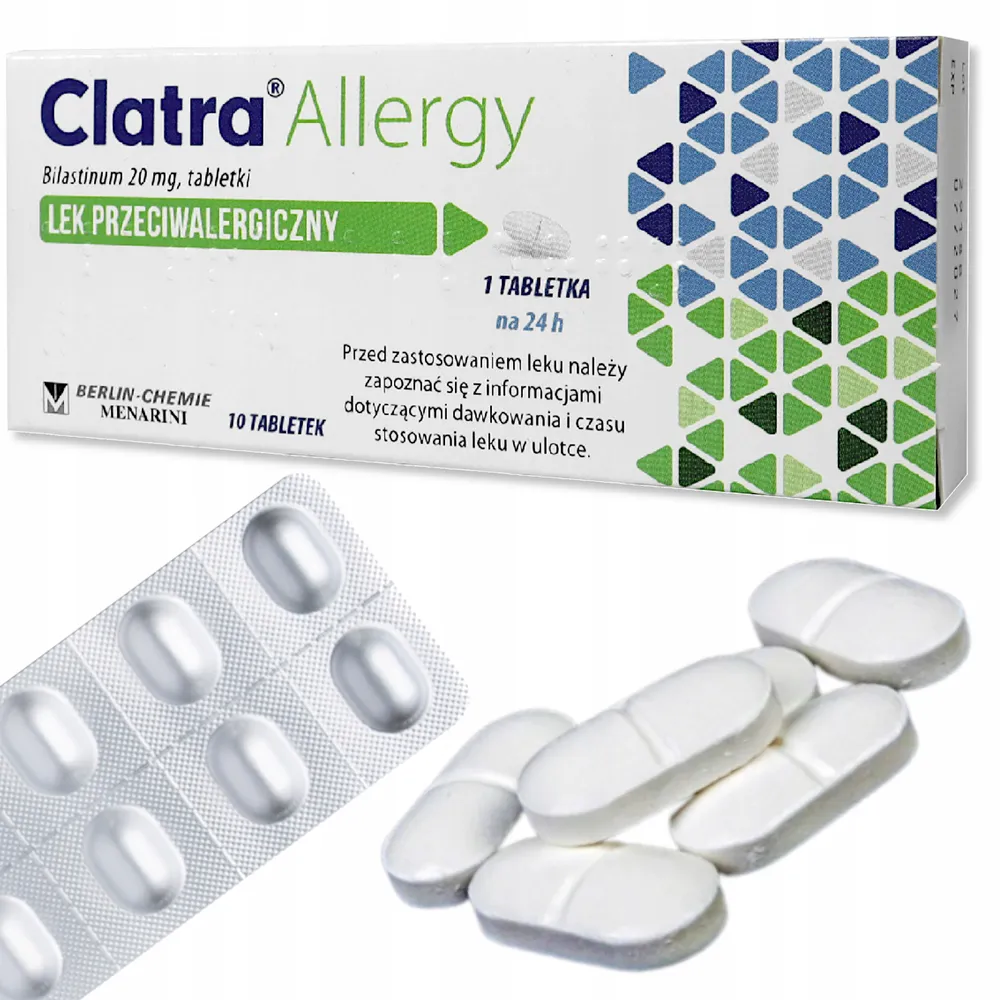
Table of Contents
Package leaflet: Information for the patient
Warning! Keep this leaflet! Information on the immediate packaging is in a foreign language.
Clatra (Bilaska 20 mg), 20 mg, tablets
Bilastinum
Clatra and Bilaska 20 mg are different trade names for the same medicine.
Please read the leaflet carefully before using the medicine, as it contains
important information for the patient.
- Keep this leaflet for future reference.
- Consult your doctor or pharmacist if you have any further questions.
- This medicine has been prescribed for a specific individual. Do not share it with others. This medicine may harm others, even if their symptoms are the same.
- If the patient experiences any adverse reactions, including any adverse reactions not listed in this leaflet, inform the doctor or pharmacist. See section 4.
Table of contents of the leaflet:
- What Clatra is and what it is used for
- Important information before taking Clatra
- How to take Clatra
- Possible side effects
- How to store Clatra
- Contents of the pack and other information
1. What Clatra is and what it is used for
Clatra contains the active substance bilastine, which has antihistamine properties.
Clatra is used to relieve symptoms of seasonal allergic rhinitis (sneezing, itching, runny or blocked nose, and red, watery eyes) and other forms of allergic rhinitis. The medicine may also be used to treat itchy skin rashes (wheals or urticaria).
2. Important information before using Clatra
When not to use Clatra
- if the patient is allergic to bilastine or to any of the other ingredients of this medicine (listed in section 6).
Warnings and precautions
Before starting Clatra, consult your doctor or pharmacist if the patient has moderate to severe kidney function impairment and is taking other medicines (see "Clatra and other medicines").
Children
Do not give this medicine to children under 12 years of age.
Do not exceed the recommended dose. If symptoms persist, consult a doctor.
Clatra and other medicines
Inform your doctor or pharmacist about all medicines the patient is currently taking or has recently taken, including those obtained without a prescription, as well as any medicines the patient plans to take.
Specifically, inform your doctor if the patient is taking any of the following medicines:
- ketoconazole (an antifungal medicine)
- erythromycin (an antibiotic)
- diltiazem (a medicine used for coronary heart disease)
- cyclosporine (an immunosuppressive medicine used in patients after organ transplantation or in autoimmune and allergic diseases such as psoriasis, atopic dermatitis, rheumatoid arthritis)
- ritonavir (used in the treatment of HIV)
- rifampicin (an antibiotic)
Clatra with food, drink and alcohol
Do not take the medicine together with food or grapefruit juice or other fruit juices, as this may reduce the effectiveness of Clatra. To avoid reduced effectiveness, do one of the following:
- swallow the tablet and wait one hour before eating a meal or drinking fruit juice, or
- wait two hours after eating or drinking fruit juice before taking the tablet.
Bilastine at the recommended dose (20 mg) does not increase drowsiness caused by alcohol consumption.
Pregnancy, breastfeeding and fertility
There are no data or limited data on the use of bilastine during pregnancy, breastfeeding, or its effect on fertility.
If the patient is pregnant, breastfeeding, suspects she may be pregnant, or is planning to have a child, she should consult a doctor before using this medicine. Before taking any medicine, consult a doctor or pharmacist.
Driving and using machines
It has been shown that bilastine at a dose of 20 mg does not affect the ability to drive in adults. However, individual response to treatment may vary.
Therefore, before driving or operating machinery, patients should assess how this medicine affects them.
Clatra contains sodium
This medicine contains less than 1 mmol (23 mg) of sodium per tablet, meaning the medicine is considered "sodium-free".
3. How to use Clatra
This medicine should always be taken exactly as prescribed by your doctor or pharmacist.
If in doubt, consult your doctor or pharmacist.
The recommended dose for adults, including elderly people, and adolescents aged 12 years and older, is 1 tablet (20 mg) once daily.
- This is an oral tablet.
- The tablet should be taken one hour before or two hours after any meal or fruit juice (see section 2, "Clatra with food, drink and alcohol").
- Swallow the tablet with a glass of water.
- The break line on the tablet is only intended to facilitate splitting the tablet for easier swallowing.
Regarding duration of treatment, your doctor will determine the type of illness and decide how long Clatra should be taken.
Use in children
Other pediatric formulations of this medicine—bilastine 10 mg orodispersible tablet or bilastine 2.5 mg/mL oral solution—are more suitable for children aged 6 to 11 years weighing at least 20 kg—please consult your doctor or pharmacist.
These bilastine formulations should not be given to children under 6 years of age weighing less than 20 kg, due to insufficient data on use.
Taking more Clatra than prescribed
If you take more Clatra than prescribed, contact your doctor or pharmacist immediately or go to the nearest hospital emergency department. Take the medicine pack or leaflet with you.
If you forget to take Clatra
Do not take a double dose to make up for a missed dose.
If you miss a dose, take it as soon as possible, then return to taking your regular dose at the usual time.
If you have any further questions, consult your doctor or pharmacist.
4. Possible adverse reactions
Like any medicine, this medicine can cause adverse reactions, although not everyone will experience them.
If the patient experiences hypersensitivity reactions, including: difficulty breathing, dizziness, collapse or loss of consciousness, swelling of the face, lips, tongue or throat, and/or skin redness and swelling, administration of the medicine should be discontinued and immediate medical advice should be sought.
Other adverse reactions that may occur in adults and adolescents include:
Common: occurring in less than 1 in 10 treated patients
- Headache
- Drowsiness
Uncommon: occurring in less than 1 in 100 treated patients
- Abnormal ECG findings
- Blood test abnormalities indicating liver function disorders
- Dizziness
- Stomach pain
- Fatigue
- Increased appetite
- Heart rhythm disturbances
- Weight gain
- Nausea
- Anxiety
- Feeling of dryness or discomfort in the nose
- Abdominal pain
- Diarrhoea
- Gastritis
- Dizziness (feeling of dizziness or vertigo)
- Weakness
- Excessive thirst
- Dyspnoea (difficulty breathing)
- Dry mouth
- Indigestion
- Itching
- Facial rash
- Fever
- Tinnitus (ringing in the ears)
- Sleep disorders
- Blood test abnormalities indicating kidney function disorders
- Increased blood lipid levels
Frequency unknown: cannot be estimated from available data
- Palpitations (awareness of heartbeat)
- Tachycardia (rapid heartbeat)
- Vomiting
Adverse reactions that may occur in children include:
Common: occurring in less than 1 in 10 treated patients
- Nasal mucositis (nasal irritation)
- Allergic conjunctivitis (eye irritation)
- Headache
- Stomach pain (abdominal pain, epigastric pain)
Uncommon: occurring in less than 1 in 100 treated patients
- Eye irritation
- Dizziness
- Loss of consciousness
- Diarrhoea
- Nausea
- Swelling of the lips
- Rash
- Urticaria
- Fatigue
Reporting of adverse reactions
If any adverse symptoms occur, including any adverse effects not listed in this leaflet, patients should inform their doctor or pharmacist. Adverse reactions can be reported directly to the Department of Monitoring of Adverse Drug Reactions at the Office for Registration of Medicinal Products, Medical Devices and Biocidal Products, Al. Jerozolimskie 181C, 02-222 Warsaw, tel.: + 48 22 49 21 301, fax: + 48 22 49 21 309, website: https://smz.ezdrowie.gov.pl.
Reporting adverse reactions helps to provide more information on the safety of the medicine.
5. How to store the medicine Clatra
Keep this medicine out of the sight and reach of children.
Do not use this medicine after the expiry date stated on the packaging. The expiry date refers to the last day of the stated month.
No special storage instructions apply.
Medicines must not be disposed of via wastewater or household waste. Ask your pharmacist how to dispose of medicines no longer in use. This will help protect the environment.
6. Contents of the pack and other information
What Clatra contains
- The active substance is bilastine. Each tablet contains 20 mg of bilastine.
- The other ingredients are: microcrystalline cellulose, sodium carboxymethyl starch (type A), colloidal anhydrous silica, magnesium stearate.
What Clatra looks like and contents of the pack
Clatra tablets are white, oval, biconvex tablets with a score line on one side (10 mm in length, 5 mm in width).
The tablets are packed in blisters. Pack sizes: 10, 20, 30, 40 or 50 tablets.
For more detailed information, please contact the responsible party or the parallel importer.
Marketing Authorisation Holder in France, the country of export:
Menarini International Operations Luxembourg S.A.
1, avenue de la Gare
1611 Luxembourg
Luxembourg
Manufacturer:
Faes Farma S.A., Maximo Aguirre, 14, 48 940 Leioa (Vizcaya), Spain
A. Menarini Manufacturing Logistics and Services S.R.L., Campo di Pile, L’Aquila, Italy
Menarini - Von Heyden GmbH, Leipziger Strasse 7-13, 01097 Dresden, Germany
Parallel Importer:
InPharm Sp. z o.o.
ul. Strumykowa 28/11
03-138 Warsaw
Poland
Repackaged by:
InPharm Sp. z o.o. Services sp. k.
ul. Chełmżyńska 249
04-458 Warsaw
Poland
Marketing Authorisation Number in France, the country of export: 34009 499 137 0 1
Parallel Import Authorisation Number: 429/24
This medicinal product is authorised in the European Economic Area (EEA) under the following names:
Austria: Olisir 20 mg Tabletten
Belgium: Bellozal 20 mg Tablet
Bulgaria: Fortecal 20 mg Таблетка
Cyprus: Bilaz 20 mg Δισκίο
Czech Republic: Xados
Denmark: Revitelle, tabletter 20 mg
Estonia: Opexa
Finland: Revitelle 20 mg tabletti
France: Bilaska 20 mg Comprimé
Germany: Bilaxten 20 mg Tabletten
Greece: Bilaz 20 mg Δισκίο
Hungary: Lendin 20 mg tabletta
Iceland: Bilaxten 20 mg töflur
Ireland: Drynol 20 mg tablets
Italy: Bysabel 20 mg Compressa
Latvia: Opexa 20 mg tabletes
Lithuania: Opexa 20 mg tabletės
Luxembourg: Bellozal 20 mg Tablet
Malta: Gosall 20 mg tablets
Norway: Zilas 20 mg tablett
Poland: Clatra
Portugal: Lergonix 20 mg Comprimido
Romania: Borenar 20 mg comprimate
Slovakia: Omarit 20 mg Tableta
Slovenia: Bilador 20 mg tablete
Spain: Ibis 20 mg Comprimido
Sweden: Bilaxten 20 mg tablett
United Kingdom (Northern Ireland): Ilaxten 20 mg tablets