Clarithromycin adamed
Poland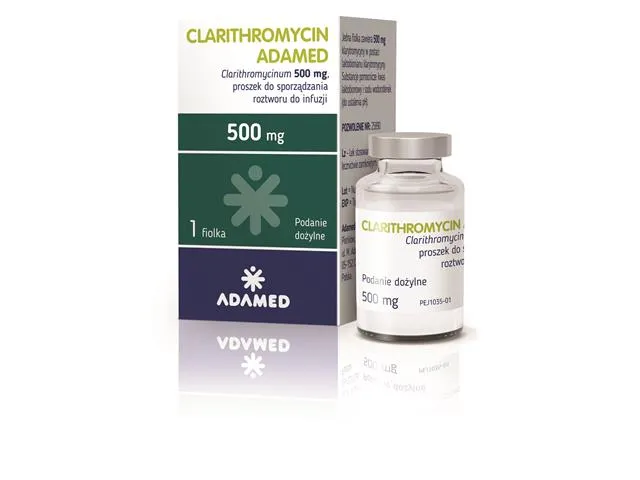
Table of Contents
- Package leaflet: Information for the patient
- 1. What Clarithromycin Adamed is and what it is used for
- 2. Important information before using Clarithromycin Adamed
- 3. How to use Clarithromycin Adamed
- 4. Possible adverse reactions
- 5. How to store Clarithromycin Adamed
- 6. Contents of the pack and other information
- Information intended exclusively for medical professionals
Package leaflet: Information for the patient
Clarithromycin Adamed, 500 mg, powder for solution for infusion
Clarithromycinum
Please read the entire leaflet carefully before use, as it contains
important information for the patient.
- Keep this leaflet for future reference.
- If you have any doubts, consult your doctor or nurse.
- This medicine has been prescribed for a specific individual. Do not give it to others. This medicine may harm someone else, even if their symptoms are the same.
- If you experience any adverse reactions, including any adverse reactions not listed in this leaflet, inform your doctor, pharmacist or nurse. See section 4.
Table of contents of the leaflet
- What Clarithromycin Adamed is and what it is used for
- What you need to know before receiving Clarithromycin Adamed
- How to use Clarithromycin Adamed
- Possible side effects
- How to store Clarithromycin Adamed
- Contents of the pack and other information
1. What Clarithromycin Adamed is and what it is used for
Clarithromycin Adamed contains the active substance clarithromycin. It is a macrolide antibiotic that inhibits the growth of bacteria causing infections.
Clarithromycin Adamed in the form of powder for solution for infusion is indicated for use in adults and adolescents aged 12 years and older for the treatment of infections caused by microorganisms sensitive to clarithromycin, when intravenous administration of an antibiotic is necessary. These infections include:
- upper respiratory tract infections,
- lower respiratory tract infections,
- skin and soft tissue infections,
- disseminated or localized infections caused by mycobacteria.
2. Important information before using Clarithromycin Adamed
When not to use Clarithromycin Adamed
-
if the patient is allergic to clarithromycin or other macrolide antibiotics (such as azithromycin, erythromycin) or to any of the other ingredients of this medicine (listed in section 6);
-
if the patient is taking any of the following medicines:
- medicines that may cause severe heart rhythm disorders, including:
- astemizole or terfenadine (medicines used in allergies);
- cisapride (a medicine used for gastrointestinal motility disorders);
- pimozide (a medicine used for psychiatric disorders);
- ticagrelor, ivabradine or ranolazine (used in the treatment of angina pectoris or to reduce the risk of heart attack or stroke);
- ergot alkaloids such as ergotamine or dihydroergotamine (medicines used, among others, in migraine);
- lovastatin, simvastatin (statins used to reduce blood cholesterol levels);
- medicines that may cause severe heart rhythm disorders, including:
-
midazolam administered orally (a medicine used for anxiety and insomnia);
-
colchicine (a medicine used in the treatment of gout);
-
a medicine containing lomitapide.
- if the patient has low blood potassium or magnesium levels (hypokalaemia or hypomagnesaemia);
- if the patient has, or there is a family history of, heart rhythm disorders (ventricular arrhythmias, including torsade de pointes) or electrocardiogram (ECG) abnormalities known as "long QT syndrome";
- if the patient has severe hepatic impairment with concomitant renal impairment.
Warnings and precautions
Before starting treatment with Clarithromycin Adamed, discuss this with your doctor.
- if the patient is pregnant or suspects she may be pregnant;
- if the patient has impaired kidney or liver function;
- if the patient has coronary artery disease, severe heart failure, or bradycardia;
- if the patient is taking any of the medicines listed in the section "Clarithromycin Adamed with other medicines".
If any of the following situations occur during treatment with Clarithromycin Adamed, the patient should inform the doctor immediately.
- Severe hypersensitivity reactions such as maculopapular rash, urticaria, petechiae, laryngeal oedema, bronchospasm. The patient should immediately consult a doctor who will initiate appropriate treatment.
- Diarrhoea, especially acute or prolonged. The patient should inform the doctor as soon as possible. If necessary, the doctor will recommend appropriate treatment. Anti-diarrhoeal medicines should not be used.
- Symptoms indicating liver dysfunction, such as loss of appetite, jaundice, dark urine, itching or abdominal pain. Treatment should be discontinued and the patient should consult a doctor.
- New infection (superinfection) with bacteria resistant to clarithromycin or fungi, especially during prolonged antibiotic use. The doctor will recommend appropriate treatment.
Additionally, during treatment with Clarithromycin Adamed, the following may occur:
- cross-resistance of bacteria (bacteria resistant to clarithromycin may also show resistance to other macrolide antibiotics as well as to lincomycin and clindamycin).
Clarithromycin Adamed with other medicines
Tell your doctor about all medicines the patient is currently taking or has recently taken, as well as any medicines the patient plans to take.
It is essential to inform the doctor if the patient is taking any of the following medicines, as their use together with Clarithromycin Adamed is contraindicated:
- astemizole or terfenadine (medicines used in allergies);
- cisapride (a medicine used for gastrointestinal motility disorders);
- pimozide (a medicine used for psychiatric disorders);
- ergot alkaloids such as ergotamine or dihydroergotamine (medicines used, among others, in migraine);
- statins – lovastatin, simvastatin (medicines reducing blood cholesterol levels);
- midazolam administered orally (a medicine used for anxiety or insomnia);
- colchicine (a medicine used in gout);
- tikagrelor (an antiplatelet agent);
- ranolazine (a heart medicine).
Inform your doctor if the patient is taking any of the following medicines,
as special caution is required when using them together with Clarithromycin Adamed:
- rifampicin, rifapentine, rifabutin (antibiotics used in the treatment of tuberculosis);
- fluconazole, itraconazole (antifungal medicines);
- atazanavir, efavirenz, etravirine, nevirapine, ritonavir, saquinavir, zidovudine (used in the treatment of HIV infection);
- digoxin, quinidine, disopyramide, verapamil, amlodipine, diltiazem (used in the treatment of heart rhythm disorders or hypertension);
- alprazolam, triazolam, midazolam administered intravenously or orally mucosally (medicines used for anxiety or insomnia);
- warfarin or any other anticoagulant, e.g., dabigatran, rivaroxaban, apixaban, edoxaban (medicines used to thin the blood);
- quetiapine or any other atypical antipsychotic;
- carbamazepine, valproate, phenytoin (antiepileptic medicines);
- atorvastatin, rosuvastatin (statins – medicines reducing blood cholesterol levels);
- methylprednisolone (an anti-inflammatory medicine);
- omeprazole (a medicine reducing gastric acid secretion);
- cilostazol (a medicine used in intermittent claudication, which causes pain in the lower limb muscles during exertion and subsides after short rest);
- cyclosporine, tacrolimus, sirolimus (medicines used, among others, after organ transplantation);
- sildenafil, tadalafil, vardenafil (medicines used in erectile dysfunction);
- vinblastine (a medicine used in cancer chemotherapy);
- theophylline (a medicine used in bronchial asthma);
- tolterodine (a medicine used in urinary incontinence);
- phenobarbital (an anticonvulsant medicine);
- St. John’s wort (a herbal medicine used in mild depression);
- sulfonylureas, nateglinide, repaglinide, insulin (medicines used in diabetes).
This is also important when using medicines with the following names:
- hydroxychloroquine or chloroquine (used in the treatment, among others, of rheumatoid arthritis, and in the treatment or prevention of malaria). Taking these medicines together with clarithromycin may increase the risk of heart rhythm disorders and other serious adverse effects affecting the heart.
- corticosteroids administered orally, by injection or by inhalation (used to suppress the immune system, which is useful in treating many different conditions).
Pregnancy and breastfeeding
If the patient is pregnant or suspects she may be pregnant, or is breastfeeding, or is planning to become pregnant, she should consult her doctor before using this medicine.
The safety of clarithromycin during pregnancy and breastfeeding has not been established.
Clarithromycin may be used during pregnancy only if, in the opinion of the doctor, the benefit to the mother outweighs the potential risk to the foetus.
Since clarithromycin passes into human milk, a breastfeeding woman should exercise particular caution when taking Clarithromycin Adamed.
Driving and operating machinery
The medicine may cause dizziness, confusion and disorientation, which may affect the ability to drive and operate machinery. If such symptoms occur, the patient should not drive or perform any work requiring concentration.
Clarithromycin Adamed contains sodium
The medicine contains less than 1 mmol (23 mg) of sodium per dose, meaning the medicine is considered "sodium-free".
3. How to use Clarithromycin Adamed
This medicine is administered to the patient exclusively by trained medical personnel.
Intravenous medicinal product.
Adults
The recommended daily dose of clarithromycin for infusion is 1 gram, given in two divided doses of 500 mg each.
The powder in the vial must be dissolved and then diluted in an appropriate solvent (instructions for preparing the infusion solution are provided at the end of this leaflet in the section intended for medical personnel). The dose should be administered intravenously as an infusion lasting at least 60 minutes.
The medicine must not be administered as a single, rapid injection (bolus) or by intramuscular injection.
Depending on the severity of infection, intravenous clarithromycin administration is limited to 2–5 days. As soon as possible, oral administration of the medicine should be initiated, according to the physician's instructions.
Children and adolescents
There is insufficient documented evidence regarding the use and dosing of Clarithromycin Adamed infusion formulation in children under 12 years of age.
For adolescents aged 12 to 18 years, the dosing regimen is the same as in adults.
Patients with renal impairment
Depending on the degree of renal impairment, the physician may recommend reducing the dose by half, i.e. to 500 mg per day.
Immunocompromised patients infected with mycobacteria
Clinical data on the use of Clarithromycin Adamed infusion formulation in immunocompromised patients are currently lacking. However, data are available on the use of oral formulations of clarithromycin in HIV-infected patients. For the treatment of disseminated or localized mycobacterial infections, the recommended daily dose in adults is 500 mg of clarithromycin twice daily.
Use of a higher than recommended dose of Clarithromycin Adamed
This medicine is administered by trained medical personnel. If the patient suspects that a higher than recommended dose has been administered, they should inform their doctor or nurse immediately.
Missed dose of Clarithromycin Adamed
This medicine is administered by trained medical personnel. If the patient suspects that a dose has been missed, they should inform their doctor or nurse.
If you have any further doubts concerning the use of this medicine, consult your doctor or nurse.
4. Possible adverse reactions
Like all medicines, this medicine can cause adverse reactions, although not everyone will experience them.
If any of the following adverse reactions occur in the patient, at any stage of treatment, stop taking
Clarithromycin Adamed immediately and consult a doctor without delay:
- Anaphylactic shock or anaphylactoid reaction – an acute, life-threatening allergic reaction characterized, among others, by confusion, pale skin, drop in blood pressure, sweating, reduced urine output, rapid breathing, weakness, and fainting
- Allergic reactions: rash (common), itching, urticaria (not common), angioedema of the face, tongue, lips, eyes, and throat, breathing difficulties
- Severe skin reactions:
- Acute generalized exanthematous pustulosis – red, scaly rash with subcutaneous nodules and blisters, pustular dermatitis (not common)
- Bullous erythema multiforme (Stevens-Johnson syndrome) characterized by sudden onset of fever and blisters, which resolve rapidly and spontaneously after discontinuation of the drug; a severe condition characterized by blisters and erosions on the skin, in the oral cavity, eyes, and genital organs, accompanied by fever and joint pain
- Toxic epidermal necrolysis (Lyell's syndrome) – a severe, rapidly progressing disease characterized by rupturing giant subepidermal blisters, extensive erosions on the skin, shedding of large epidermal sheets, and fever
- DRESS syndrome – a severe (life-threatening) drug-induced rash occurring with increased eosinophil count and internal organ involvement
- Severe or prolonged diarrhoea, possibly with blood or mucus in the stool (pseudomembranous colitis). Diarrhoea may occur even up to two months after completion of clarithromycin treatment. In such cases, medical advice should also be sought
- Yellowing of the skin (jaundice), skin irritation, pale stool, dark urine, abdominal tenderness, or loss of appetite. These may be symptoms of liver inflammation or liver failure
- Cardiac arrest, atrial fibrillation, extrasystoles, palpitations, ECG changes (prolongation of the QT interval) (not common)
- Loss of consciousness (not common)
- Pulmonary embolism (not common; symptoms include dyspnoea, chest pain, cough, cyanosis). These reactions occur with unknown frequency unless otherwise stated.
Other adverse reactions
In clinical trials and post-marketing surveillance of clarithromycin in the form of powder for
preparation of infusion solution, very common (in more than 1 in 10 patients) reports were made
of phlebitis at the injection site.
In patients receiving intravenous or oral clarithromycin, the following adverse reactions were
common (occurring in less than 1 in 10 patients):
- Pain at injection site, inflammation at injection site, phlebitis at injection site;
- Insomnia;
- Taste disturbances, headache, altered taste perception;
- Vasodilation;
- Diarrhoea, vomiting, dyspepsia, nausea, abdominal pain;
- Abnormal liver function test results;
- Excessive sweating.
Adverse reactions reported not commonly (occurring in less than 1 in 100 patients):
- Connective tissue inflammation, candidiasis (fungal infection), vaginal infection;
- Decreased white blood cell count;
- Anorexia, decreased appetite;
- Anxiety;
- Dyskinesia (involuntary, uncoordinated movements of limbs or entire body), dizziness, somnolence, tremor;
- Balance disorders, hearing loss, tinnitus;
- Asthma;
- Oesophagitis, gastritis, oral inflammation, glossitis, constipation, dry mouth, belching, flatulence;
- Increased liver enzyme activity: alanine aminotransferase, increased aspartate aminotransferase activity;
- Musculoskeletal stiffness;
- Increased blood creatinine, increased blood urea, abnormal albumin to globulin ratio;
- Asthenia (weakness, lack of energy).
The following adverse reactions have been reported after marketing authorization of
clarithromycin in various dosage forms (tablets, granules for oral suspension, powder for
preparation of infusion solution) with unknown frequency (frequency cannot be estimated from
available data):
- Roseola;
- Agranulocytosis (reduced granulocyte count), thrombocytopenia (reduced platelet count);
- Acne;
- Psychotic disorder, confusion, depersonalization, depression, disorientation, hallucinations, unusual dreams, mania;
- Seizures, loss of taste, parosmia, anosmia, paresthesia (numbness, tingling);
- Deafness;
- Cardiac arrhythmias such as torsade de pointes, ventricular tachycardia, ventricular fibrillation;
- Bleeding;
- Acute pancreatitis, tongue discoloration, tooth discoloration;
- Myopathy (muscle disease with muscle weakness);
- Rhabdomyolysis (syndrome of symptoms caused by breakdown of muscle tissue), renal failure, interstitial nephritis;
- Changes in diagnostic test results (increased international normalized ratio (INR), prolonged prothrombin time, abnormal urine color).
Patients with impaired immunity
In addition to symptoms related to the underlying disease, the following adverse reactions have
been observed in adult patients with impaired immunity:
- Nausea, vomiting, taste disturbances, constipation, abdominal pain, diarrhoea, flatulence, dry mouth;
- Headache, hearing disturbances;
- Rash;
- Dyspnoea, insomnia;
- Abnormal laboratory test results: increased aspartate aminotransferase (AspAT) and alanine aminotransferase (AlAT) activity, increased blood urea nitrogen, decreased platelet and white blood cell counts.
Reporting of adverse reactions
If any adverse symptoms occur, including any adverse reactions not listed in this leaflet, inform your
doctor, pharmacist, or nurse. Adverse reactions can be reported directly to the Department of Monitoring Adverse Drug Reactions of the Office for Registration of Medicinal Products, Medical Devices and Biocidal Products,
Al. Jerozolimskie 181C, 02-222 Warsaw,
Tel.: 22 49 21 301,
Fax: 22 49 21 309,
Website: https://smz.ezdrowie.gov.pl
Adverse reactions can also be reported to the marketing authorization holder.
Reporting adverse reactions helps to provide more information on the safety of the medicine.
5. How to store Clarithromycin Adamed
Keep this medicine out of sight and reach of children.
Do not use this medicine after the expiry date stated on the packaging following the term
EXP. The expiry date refers to the last day of the stated month.
Store below 30°C.
The infusion solution should not be stored for longer than 24 hours at a temperature of 2°C to 8°C,
provided it has been prepared and diluted under controlled and validated aseptic conditions.
Medicines should not be disposed of via the sewage system or household waste. Ask your
pharmacist how to dispose of medicines no longer required. Such measures will help
protect the environment.
6. Contents of the pack and other information
What Clarithromycin Adamed contains
- The active substance is clarithromycin. One vial contains 500 mg of clarithromycin in the form of clarithromycin lactobionate.
- The other components are: lactobionic acid and sodium hydroxide (for pH adjustment).
What Clarithromycin Adamed looks like and contents of the pack
Clarithromycin Adamed is a white or almost white powder for solution for infusion. After reconstitution with water for injections, a colourless, clear solution is obtained.
The container is a 15 ml type I clear glass vial, closed with a bromobutyl rubber stopper and sealed with an aluminium cap with a plastic flip-off cap, packed in a cardboard box.
Pack size: 1 vial in a cardboard box.
Marketing Authorisation Holder
Adamed Pharma S.A.
Pieńków, ul. M. Adamkiewicza 6A
05-152 Czosnów
Poland
Manufacturer
Adamed Pharma S.A.
Pieńków, ul. M. Adamkiewicza 6A
05-152 Czosnów
Poland
ANFARM HELLAS S.A
53-57 Perikleous str., Gerakas
15344, Attiki,
Greece
For further information about this medicinal product, please contact the Marketing Authorisation Holder:
Adamed Pharma S.A.
Pieńków, ul. M. Adamkiewicza 6A
05-152 Czosnów
Poland
Tel.: +48 22 732 77 00
Information intended exclusively for medical professionals
Clarithromycin Adamed, 500 mg, powder for solution for infusion
Clarithromycinum
The powder in the vial must be dissolved and then diluted in an appropriate diluent (see below: Preparation of infusion solution).
The drug dose should be administered intravenously as an infusion lasting at least 60 minutes (as a solution with a concentration of 2 mg/ml).
The drug must not be administered as a single, rapid injection ( bolus ) or by intramuscular injection.
PREPARATION OF INFUSION SOLUTION
A. Preparation of the concentrate solution for infusion
Inject 10 ml of Water for Injections into the vial containing the powder. Shake until the contents are completely dissolved. Only Water for Injections should be used for reconstitution. Other solvents may cause precipitation. Do not use inorganic salt solutions or solutions containing preservatives.
Each 1 ml of the concentrate solution prepared as described above contains 50 mg of clarithromycin.
The concentrate solution is chemically and physically stable for 24 hours at temperatures below 25°C or for 48 hours at temperatures between 2°C and 8°C. From a microbiological standpoint, the product should be used immediately after preparation. Otherwise, the user is responsible for storage conditions and duration. The solution should not be stored for longer than 24 hours at 2°C to 8°C, unless it has been prepared and diluted under controlled and validated aseptic conditions.
B. Preparation of the infusion solution
Dilute the concentrate solution (500 mg in 10 ml of Water for Injections) to a final volume of 250 ml using one of the following diluents:
- 5% glucose in Ringer's lactate solution,
- 5% glucose, Ringer's lactate solution,
- 5% glucose in 0.3% sodium chloride solution,
- 5% glucose in 0.45% sodium chloride solution,
- 0.9% sodium chloride solution.
Each 1 ml of the resulting intravenous infusion solution contains 2 mg of clarithromycin.
The infusion solution is chemically and physically stable for 6 hours at temperatures below 25°C or for 48 hours at temperatures between 2°C and 8°C.
From a microbiological standpoint, the infusion solution should be used immediately after preparation. Otherwise, the user is responsible for storage conditions and duration. The solution should not be stored for longer than 24 hours at 2°C to 8°C, unless it has been prepared and diluted under controlled and validated aseptic conditions.
Note: There are currently no clinically documented studies on pharmaceutical compatibility with other intravenous solutions.
Any unused portions of the medicinal product or waste materials should be disposed of in accordance with local regulations.