Cinie 100
Poland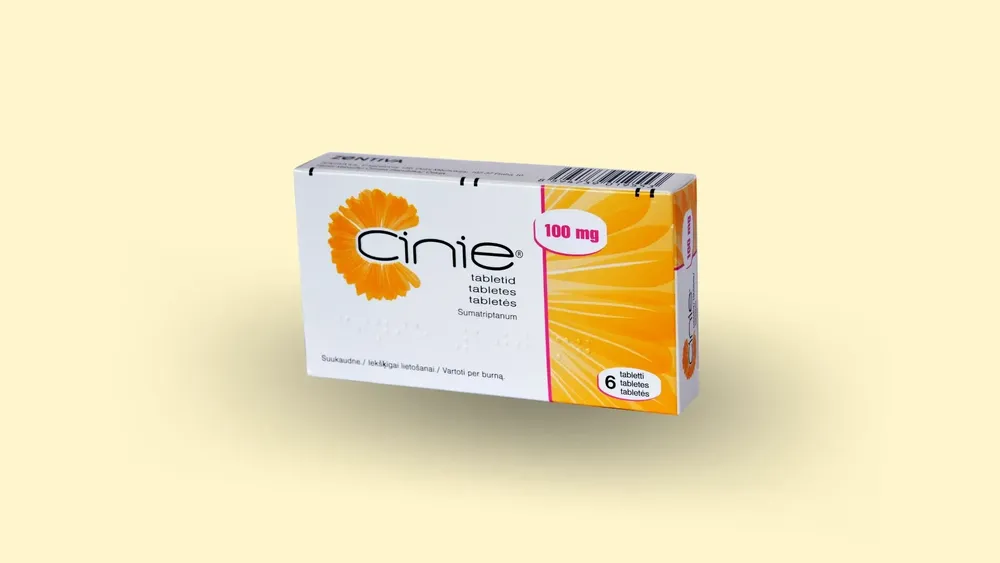
Table of Contents
Package leaflet: Information for the user
Cinie 50, 50 mg, tablets
Cinie 100, 100 mg, tablets
Sumatriptanum
Please read carefully the entire leaflet before using this medicine, as it contains
important information for the patient.
- Keep this leaflet, as you may need to read it again.
- If you have any questions, please consult your doctor or pharmacist.
- This medicine has been prescribed for a specific individual. Do not pass it on to others. The medicine may harm another person, even if their symptoms are the same.
- If any side effects occur, including any possible side effects not listed in this leaflet, inform your doctor or pharmacist. See section 4.
Table of contents of the leaflet
What Cinie is and what it is used for
- Important information before taking Cinie
- How to take Cinie
- Possible side effects
- How to store Cinie
- Contents of the pack and other information
1. What Cinie is and what it is used for
Cinie is a pain-relieving medicine belonging to the group of anti-migraine drugs. The active substance
contained in Cinie is sumatriptan, a 5-HT receptor agonist.
Migraine is believed to result from the dilation of blood vessels. Cinie causes constriction of blood
vessels and thereby relieves migraine headache.
Cinie is used to treat acute migraine attacks with or without aura (warning symptoms which typically
include visual disturbances such as flashes of light, lines, stars or waves).
2. Important information before taking Cinie
When not to take Cinie:
- if the patient is allergic to sumatriptan or to any of the other ingredients of this medicine (listed in section 6).
- if the patient has previously had a myocardial infarction.
- if the patient has heart disease.
- if the patient has symptoms suggesting heart disease, such as transient chest pain or a feeling of pressure in the chest.
- if the patient has previously had a stroke or transient ischaemic attack (a milder form of stroke lasting less than 24 hours).
- if the patient has circulatory disorders in the legs causing painful cramps when walking (peripheral vascular disorders).
- if the patient has significantly elevated blood pressure or if blood pressure remains high despite treatment.
- if the patient has severe liver function disorders.
- if the patient is currently taking or has recently taken medicines containing ergotamine or ergotamine derivatives (including methysergide), or other triptans, or 5-hydroxytryptamine 5-HT receptor agonists (such as naratriptan, rizatriptan or zolmitriptan).
- if the patient is currently taking or has recently taken antidepressant medicines belonging to the group of so-called monoamine oxidase inhibitors (MAO inhibitors).
If there is suspicion that the patient has any of the above conditions, or if there are any
doubts, contact a doctor before using Cinie.
Warnings and precautions
Before prescribing Cinie, the doctor should confirm that the headache is due to migraine and not
another condition.
Before starting treatment with Cinie, discuss the following with your doctor or pharmacist:
- if the patient has liver or kidney disorders.
- if the patient has been diagnosed with epilepsy or another condition that may lower the seizure threshold.
- if the patient has hypersensitivity to antibacterial medicines belonging to the sulfonamide group.
- if the patient is being treated for high blood pressure, as in rare cases sumatriptan may increase blood pressure.
- if the patient is taking antidepressant medicines such as selective serotonin reuptake inhibitors (SSRIs, such as fluoxetine, paroxetine, fluvoxamine or sertraline) or serotonin-noradrenaline reuptake inhibitors (SNRIs, such as venlafaxine) or the strong analgesic buprenorphine. Taking these medicines together with Cinie may lead to serotonin syndrome, a potentially life-threatening condition (see "Cinie with other medicines").
- if the patient experiences pain and/or pressure in the chest or throat. These symptoms are usually short-lived. If they persist or worsen, contact a doctor immediately.
- if the patient develops chronic headaches during the day. Overuse of Cinie may lead to chronic headaches. In such cases, contact a doctor, as it may be necessary to discontinue treatment with Cinie.
- if the patient is at risk of heart disease (e.g. patients with diabetes, smokers or patients undergoing nicotine replacement therapy), especially women after menopause and men over 40 years of age with the above risk factors. Before starting treatment with Cinie, the doctor should evaluate heart function. Very rarely, serious cardiac events have been reported after taking Cinie, even in patients with no prior history of heart disease. If in doubt, contact a doctor.
Cinie with other medicines
Inform your doctor or pharmacist about all medicines currently taken or recently taken, as well as any
medicines the patient plans to take.
Some medicines may affect the effectiveness of Cinie, and Cinie may affect the effectiveness of other
medicines. Contact your doctor if taking:
-
other anti-migraine medicines:
-
ergotamine, a medicine used to treat migraine, or medicines with similar action, such as methysergide. Do not take Cinie at the same time as these medicines. Wait at least 24 hours after taking these medicines before taking Cinie. After taking Cinie, wait at least 6 hours before taking any medicine containing ergotamine.
-
other triptans or 5-HT receptor agonists (such as naratriptan, rizatriptan or zolmitriptan), medicines used to treat migraine. Do not take Cinie at the same time as these medicines. Wait at least 24 hours after taking these medicines before taking Cinie. After taking Cinie, wait at least 24 hours before taking any triptans or 5-HT receptor agonists.
-
antidepressant medicines or strong analgesics:
-
MAO inhibitors (monoamine oxidase inhibitors). Do not take Cinie within 2 weeks of stopping treatment with MAO inhibitors (see also section "When not to use Cinie").
-
selective serotonin reuptake inhibitors (SSRIs), serotonin-noradrenaline reuptake inhibitors (SNRIs) and buprenorphine (a strong analgesic). Concomitant use of Cinie with medicines from these groups may cause serotonin syndrome (a combination of symptoms which may include restlessness, agitation, confusion, excessive sweating, body temperature above 38°C, hallucinations, coma, hyperreflexia, muscle rigidity, rhythmic muscle contractions including those of the muscles controlling eye movements, shivering, rapid heart rate and tremor). Inform your doctor immediately if such symptoms occur.
-
medicines used to treat bipolar affective disorder (manic-depressive illness), such as lithium.
Concomitant use of sumatriptan and herbal remedies containing St John's wort ( Hypericum perforatum ) may lead to an increased frequency of adverse effects.
Pregnancy and breastfeeding
If the patient is pregnant or breastfeeding, suspects she may be pregnant, or plans to become pregnant,
she should consult her doctor or pharmacist before using this medicine.
Pregnancy
Information on the safety of sumatriptan use during pregnancy is limited. Available data do not indicate an increased risk of congenital malformations. Cinie is not recommended during pregnancy unless the doctor decides otherwise.
Breastfeeding
Sumatriptan, the active substance in Cinie, passes into breast milk. Breastfeeding should be avoided for 12 hours after taking Cinie. Breast milk expressed during this time should be discarded and not used to feed the infant.
Some breastfeeding women have reported breast and/or nipple pain after using sumatriptan. The pain is usually transient and resolves within 3 to 12 hours.
Driving and operating machinery
Migraine or treatment of migraine with Cinie may cause drowsiness. In such cases, do not drive or operate machinery.
Cinie contains lactose and sodium
If the patient has previously been diagnosed with intolerance to certain sugars, the patient should contact
a doctor before taking this medicine.
This medicine contains less than 1 mmol (23 mg) of sodium per tablet, meaning the medicine is considered "sodium-free".
3. How to take Cinie
Always take this medicine exactly as directed by your doctor or pharmacist. If in doubt, consult your doctor or pharmacist.
Cinie should not be used prophylactically, as it is intended for the treatment of migraine attacks. Cinie should be taken as soon as possible after the onset of migraine pain. The medicine is equally effective if taken later during the migraine attack.
The recommended dose for adults is 50 mg. Some patients may require a dose of 100 mg. If Cinie does not rapidly relieve symptoms, it is not advisable to take another dose during the same attack. Sumatriptan may be used during the next attack. If symptoms resolve after one dose but then recur, a second tablet may be taken no sooner than 2 hours after the first tablet.
Do not take more than 300 mg ( six 50 mg tablets or three 100 mg tablets ) within 24 hours.
Use in children and adolescents
Cinie is not recommended for use in children and adolescents.
Use in elderly patients
Cinie is not recommended for use in patients over 65 years of age.
Use in patients with liver function disorders
In patients with mild to moderate liver function disorders, consider using lower doses of 25 mg to 50 mg.
Tablets should be swallowed whole with water.
Cinie 50: The tablet breakline is not intended for splitting the tablet.
Taking more Cinie than recommended
Symptoms of overdose are the same as those listed in section 4. If too many tablets have been taken, contact a doctor or go to hospital.
If you have any further questions about the use of this medicine, consult your doctor or pharmacist.
4. Possible adverse reactions
Like all medicines, this medicine can cause adverse reactions, although not everyone will experience them.
In case of doubt, you should consult a doctor.
The following serious adverse reactions have been reported, but their frequency is unknown:
- Skin allergic reactions: skin rash in the form of red spots or hives (wheals).
- Anaphylaxis (severe allergic reactions, such as eyelid, facial or lip swelling, and sudden wheezing, palpitations or chest tightness). If a severe allergic reaction occurs, treatment with Cinie must be discontinued and medical help must be sought immediately.
The following adverse reactions may occur with the following frequency:
Common (may occur in up to 1 in 10 patients):
- Drowsiness, dizziness, tingling. Unusual sensations, including numbness, tingling, feeling of heat or cold.
- Transient increase in blood pressure (occurring shortly after treatment), flushing.
- Nausea or vomiting.
- Sensation of pressure. Usually transient, but may be severe and may affect any part of the body, including the chest and throat. Muscle pain.
- Shortness of breath.
- Sensation of pain, heat, cold, pressure, tightness or anxiety. These symptoms may be severe and may affect any part of the body, including the chest and throat.
- Feeling of weakness, fatigue.
Rare (may occur in up to 1 in 1,000 patients):
- Chest pain.
Very rare (may occur in up to 1 in 10,000 patients):
- Cinie may affect blood test results assessing liver function.
Frequency unknown (frequency cannot be estimated from available data):
- Nystagmus (involuntary eye movements), scotoma (black spots in the visual field), tremor and dystonia (involuntary muscle contractions).
- Seizures – usually in patients with a history of epilepsy.
- Visual disturbances (flickering, double vision, reduced vision, vision loss, including permanent damage), although these may be related to the migraine attack itself.
- Increased heart rate, decreased heart rate, palpitations, cardiac arrhythmias, and severe complications involving the coronary arteries, chest pain, myocardial infarction, transient ischemic changes on ECG.
- Drop in blood pressure, a condition characterized by episodes of skin pallor or cyanosis and (or) pain in fingers of hands and feet, nose or jaw in response to cold or stress (Raynaud's phenomenon).
- Colitis (inflammation of the colon), presenting with pain in the lower left part of the abdomen and bloody diarrhea. Diarrhea. Difficulty swallowing.
- Neck stiffness. Joint pain.
- Feeling of anxiety.
- Excessive sweating.
- In patients who have recently experienced trauma or who have an inflammatory condition (e.g. rheumatism or inflammatory bowel disease), pain or worsening of pain at the site of injury or inflammation may occur.
Reporting of adverse reactions
If any adverse reactions occur, including any adverse reactions not listed in this leaflet, inform your doctor, pharmacist or nurse. Adverse reactions can be reported directly to the Department of Monitoring of Adverse Drug Reactions of the Office for Registration of Medicinal Products, Medical Devices and Biocidal Products.
Al. Jerozolimskie 181 C, 02-222 Warsaw.
Tel.: +48 22 49 21 301, fax: +48 22 49 21 309, website: https://smz.ezdrowie.gov.pl
Reporting adverse reactions helps to provide more information on the safety of the medicine.
5. How to store the medicine Cinie
Keep this medicine out of sight and reach of children.
Do not use this medicine after the expiry date stated on the packaging after "Expiry date". The expiry date refers to the last day of the stated month.
No special storage conditions apply for this medicine.
Medicines must not be disposed of via the sewage system or household waste. Ask your pharmacist how to dispose of medicines no longer required. This helps protect the environment.
6. Contents of the pack and other information
What Cinie contains
The active substance is sumatriptan.
Cinie 50: Each tablet contains 50 mg of sumatriptan (as succinate).
Cinie 100: Each tablet contains 100 mg of sumatriptan (as succinate).
The other ingredients are:
Cinie 50: lactose monohydrate, microcrystalline cellulose, sodium croscarmellose, magnesium stearate,
iron oxide red (E172).
Cinie 100: lactose monohydrate, microcrystalline cellulose, sodium croscarmellose, magnesium stearate.
What Cinie looks like and contents of the pack
Cinie 50 tablets: pink to almost pink, deeply scored, elongated, biconvex tablets with a division line on one side.
The division line on the tablet is not intended for breaking the tablet.
Cinie 100 tablets: white to almost white, elongated, biconvex tablets.
Pack sizes:
Cinie 50: Carton containing 2, 4, 6 or 12 tablets in blisters OPA/Al/PVC/Al.
Cinie 100: Carton containing 2, 3, 4, 6, 12 or 18 tablets in blisters OPA/Al/PVC/Al.
Not all pack sizes may be marketed.
Marketing Authorisation Holder
Zentiva k.s., U kabelovny 130, Dolní Měcholupy, 102 37 Prague 10, Czech Republic.
Manufacturer
Saneca Pharmaceuticals a.s., Nitrianska 100, 920 27 Hlohovec, Slovak Republic
For further information about this medicine and its trade names in the European Economic Area countries, please contact:
Zentiva Polska Sp. z o.o.
ul. Bonifraterska 17
00-203 Warsaw
tel.: +48 22 375 92 00