Cetraxal
Poland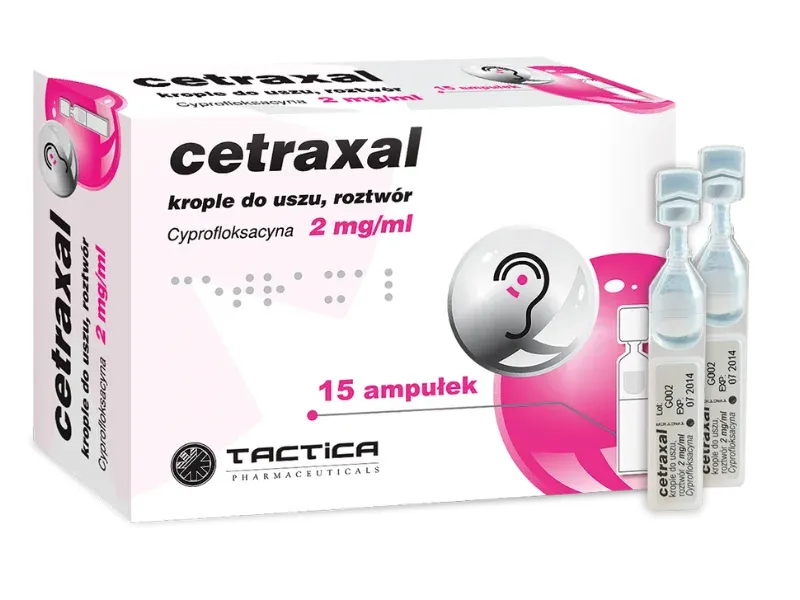
Table of Contents
Cetraxal, 2 mg/ml, ear drops, solution
Ciprofloxacin
Please read the following information in the leaflet carefully before using the medicine, as it contains
important information for the patient.
- Keep this leaflet for future reference.
- If you have any questions, please consult your doctor, pharmacist, or nurse.
- This medicine has been prescribed for a specific individual. Do not share it with others. The medicine may harm other people, even if their symptoms are the same.
- If the patient experiences any adverse reactions, including any not listed in this leaflet, inform your doctor, pharmacist, or nurse. See section 4.
Leaflet contents:
- What Cetraxal is and what it is used for
- Important information before using Cetraxal
- How to use Cetraxal
- Possible side effects
- How to store Cetraxal
- Contents of the pack and other information
1. What Cetraxal is and what it is used for
Cetraxal is an antibacterial ear drop solution containing ciprofloxacin, an active substance belonging to the group of antibiotics known as fluoroquinolones. Ciprofloxacin acts bactericidally against bacteria causing infections. Cetraxal is indicated for the treatment of acute bacterial external otitis, when the tympanic membrane is intact (see section 2. Important information before using Cetraxal), in adults and children above one year of age.
2. Important information before using Cetraxal
When not to use Cetraxal
- If the patient is allergic (hypersensitive) to ciprofloxacin or to any substance belonging to the quinolone antibacterial agents, or to any of the other components of Cetraxal (listed in section 6).
Warnings and precautions
- If, after starting treatment, the patient develops hives, rash, or any other allergic symptoms (e.g. sudden swelling of the face, throat or eyelids, difficulty breathing), treatment must be stopped immediately and the patient should contact a doctor. Serious hypersensitivity reactions require immediate medical intervention.
- This medicine is for ear use only. It must not be swallowed, injected, or inhaled. It should not be used in the eyes.
- Inform your doctor if symptoms of the disease do not improve within one week after starting treatment.
- As with any antibiotic, additional infections caused by organisms not susceptible to ciprofloxacin may occasionally occur. If such an infection develops, the doctor should initiate appropriate treatment.
- Cetraxal should be used with caution in patients with diagnosed or suspected perforation of the eardrum, or when such a risk exists.
Cetraxal and other medicines
Tell your doctor or pharmacist if you are currently taking or have recently taken any other medicines, including those obtained without a prescription. Concomitant use with other ear medications is not recommended.
Pregnancy, breastfeeding and fertility
Cetraxal may be used during pregnancy and breastfeeding.
If the patient is pregnant or breastfeeding, suspects she may be pregnant, or is planning to have a baby, she should consult a doctor or pharmacist before using this medicine.
Driving and operating machinery
Cetraxal has no effect on the ability to drive or operate machinery.
3. How to use Cetraxal
Cetraxal must always be used exactly as prescribed by your doctor. If in doubt, consult your doctor or pharmacist.
Cetraxal is intended for otic (ear) use only. It must not be swallowed, injected, or inhaled.
Dosage
The recommended dose for adults and children over 1 year of age is the contents of one single-dose ampoule instilled into the affected ear twice daily for seven days.
Method of administration
Warm the solution by holding the ampoule in your hands for several minutes to avoid dizziness that may occur if a cold solution is instilled into the ear canal. Lie down with the affected ear facing upward, then instill the drops while gently pulling on the outer ear in different directions to help the drops penetrate. Remain in this position for approximately 5 minutes to allow the drops to reach deeper into the ear. After sitting up again, some of the solution may drain out. This can be gently blotted with sterile absorbent paper. Repeat the procedure for the other ear, if necessary.
If the ear canal is narrow, pulling the ear upward may help improve delivery of the medication to the eardrum.
Following these instructions carefully is very important to ensure effective treatment. When instilling the drops, keeping the head upright or moving it too quickly may cause some of the medication to be lost, as the drops will run out onto the face instead of penetrating into the ear canal.
After using the medication, discard the single-dose ampoule. Do not store it for reuse.
Use of more Cetraxal than prescribed
Since this medicine is supplied in single-dose units, accidental overdose is unlikely. However, if you have concerns, contact your doctor or pharmacist for advice.
If you forget to use Cetraxal
Do not use a double dose to make up for a missed dose. If you forget to instill the drops, use the prescribed dose as soon as you remember. If it is almost time for your next dose, wait and use the next dose at the scheduled time.
Stopping Cetraxal treatment
It is very important to continue using these drops for the full duration prescribed by your doctor, even if symptoms improve. Do not stop treatment early, as the infection may return.
If you have any further questions about the use of this medicine, consult your doctor or pharmacist.
4. Possible adverse reactions
Like all medicines, Cetraxal can cause adverse reactions, although not everyone experiences them.
Uncommon adverse reactions (occurring in at least 1 in 1,000 patients):
- Itching of the ear, tinnitus (ringing in the ears)
- Headache
- Dizziness
- Local skin reactions or skin irritation (dermatitis)
- Pain at the site of application
Very rare adverse reactions (occurring in fewer than 1 in 10,000 patients):
- Rash
- Skin blistering and peeling (toxic epidermal necrolysis)
- Redness and peeling of the skin (exfoliative dermatitis)
- Severe allergic reaction with fever, red spots, joint pain and/or eye problems (Stevens-Johnson syndrome)
- Skin allergy with itching and appearance of hives (urticaria)
If any of the adverse reactions worsen or if any adverse reactions not listed in this leaflet occur, inform your doctor or pharmacist.
Reporting suspected adverse reactions
After the medicinal product has been authorized, it is important to report suspected adverse reactions. This allows continuous monitoring of the benefit-risk balance of the medicinal product. Healthcare professionals should report any suspected adverse reactions via the Department of Monitoring Adverse Drug Reactions at the Office for Registration of Medicinal Products, Medical Devices and Biocidal Products
Al. Jerozolimskie 181 C
02-222 Warsaw
Phone: (+48 22) 49-21-301
Fax: (+48 22) 49-21-309
Website: https://smz.ezdrowie.gov.pl
Adverse reactions can also be reported to the marketing authorization holder.
Reporting adverse reactions helps to gather more information on the safety of using the medicine.
5. How to store Cetraxal
Keep the medicine out of the reach and sight of children.
Do not use the medicine after the expiry date stated on the packaging. The expiry date refers to the last day of the specified month.
Store below 30°C in the original packaging to protect from light.
The contents of the vial should be used immediately after opening the single dose. Any unused portion remaining in the vial should be discarded.
The shelf life of vials after first opening the sachet: 8 days.
Medicines must not be disposed of via wastewater or household waste. Ask your pharmacist what to do with medicines no longer required. Such measures help protect the environment.
6. Contents of the package and other information
What Cetraxal contains
The active substance is ciprofloxacin in the form of ciprofloxacin hydrochloride monohydrate.
1 ml of solution contains 2 mg of ciprofloxacin as hydrochloride. Each ampoule contains 0.25 ml of solution, which contains 0.58 mg of ciprofloxacin hydrochloride corresponding to 0.50 mg of ciprofloxacin.
The other ingredients are: povidone K-90-F (E1201), glycerol (E422), purified water, and sodium hydroxide (E524) and lactic acid (E270) for pH adjustment.
What Cetraxal looks like and contents of the pack
Cetraxal ear drops are a clear solution contained in ampoules. For protection, the ampoules are packed in aluminium foil sachets. Each pack contains 15 ampoules.
Marketing Authorisation Holder
TACTICA Pharmaceuticals Sp. z o.o.
ul. Królowej Jadwigi 148a/1a
30-212 Kraków, Poland
tel.: +48 889 388 538
Logo of the marketing authorisation holder
Manufacturer
Laboratorios SALVAT, S.A.
C/ Gall, 30-36.
08950 Esplugues de Llobregat
Barcelona
Spain
Manufacturer for the German market only
InfectoPharm Arzneimittel und Consilium GmbH
Von-Humboldt-Str. 1
64646 Heppenheim
Germany
This medicinal product is authorised in the European Economic Area countries under the following names:
Denmark Cetraxal 2 mg/ml Øredråber opløsning
Finland Cetraxal 2 mg/ml Korvatipat, liuos
France Cetraxal 2 mg/ml solution pour instillation auriculaire
Germany InfectoCipro 2 mg/ml Ohrentropfen, Lösung
Greece Cetraxal 2 mg/ml Ωτικές σταγόνες, διάλυµα
Iceland Cetraxal 2 mg/ml eyrnadropar, lausn
Italy UNICEXAL 2 mg/ml gocce auricolari, soluzione
Netherlands Cetraxal 2 mg/ml oordruppels, oplossing
Norway Cetraxal
Poland Cetraxal
Sweden Cetraxal 2 mg/ml örondroppar, lösning
United Kingdom Cetraxal 2 mg/ml ear drops solution