Cefazolin sandoz
Poland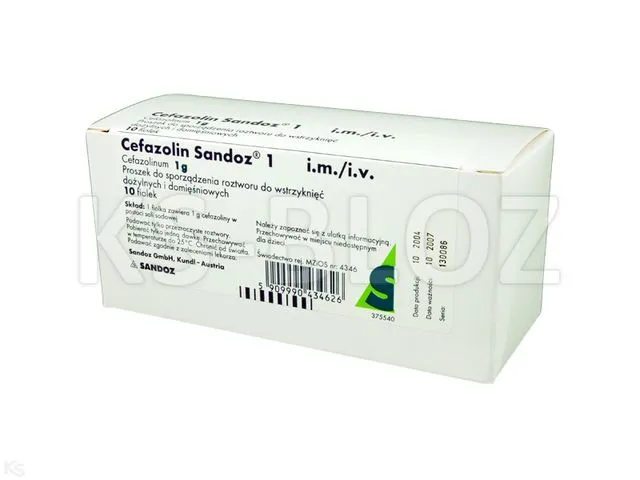
Table of Contents
- Package leaflet: Information for the patient
- 1. What Cefazolin Sandoz is and what it is used for
- 2. Important information before using Cefazolin Sandoz
- 3. How to use Cefazolin Sandoz
- 4. Possible adverse reactions
- 5. How to store Cefazolin Sandoz
- 6. Contents of the pack and other information
- Information intended exclusively for healthcare professionals:
Package leaflet: Information for the patient
Cefazolin Sandoz, 1 g, powder for solution for injection and infusion
Cefazolinum
Read the entire leaflet before using this medicine, as it contains important information for the patient.
- Keep this leaflet for future reference.
- If you have any questions, consult your doctor or pharmacist.
- This medicine has been prescribed for a specific individual. Do not pass it on to others. The medicine may harm someone else, even if their symptoms are the same.
- If you experience any adverse reactions, including those not listed in this leaflet, inform your doctor or pharmacist. See section 4.
Table of contents
- What Cefazolin Sandoz is and what it is used for
- What you need to know before using Cefazolin Sandoz
- How to use Cefazolin Sandoz
- Possible side effects
- How to store Cefazolin Sandoz
- Contents of the pack and other information
1. What Cefazolin Sandoz is and what it is used for
Cefazolin Sandoz is an antibiotic containing cefazolin as the active substance – a synthetic cephalosporin for intravenous or intramuscular injection. Like other beta-lactam antibiotics, cefazolin acts bactericidally by inhibiting bacterial cell wall synthesis.
Cefazolin Sandoz is indicated for the treatment of infections caused by microorganisms sensitive to cefazolin:
- lower respiratory tract infections (exacerbation of chronic bacterial bronchitis, pneumonia),
- urinary tract infections (acute pyelonephritis),
- skin and soft tissue infections,
- endocarditis,
- sepsis; and for prophylaxis of perioperative infections (infections following surgical procedures with a high risk of such infections).
2. Important information before using Cefazolin Sandoz
When not to use Cefazolin Sandoz
Do not use the medicine if the patient is allergic to cefazolin, any of the other ingredients of this medicine
(listed in section 6), or to other cephalosporins.
If the patient has previously experienced a severe allergic reaction to penicillin or to
any other beta-lactam antibiotics (penicillins, monobactams, carbapenems).
Cefazolin dissolved in lidocaine solution must not be administered to children under one year of age.
If any of the above situations apply to the patient, consult a doctor or pharmacist.
Warnings and precautions
Before starting treatment with Cefazolin Sandoz, discuss with a doctor if:
- the patient has a tendency towards allergies (e.g. bronchial asthma or hay fever);
- the patient has a known hypersensitivity to penicillins or cephalosporins, as they may also be allergic to other beta-lactam antibiotics, including cefazolin;
- the patient has impaired kidney function, as dosage adjustment may be necessary;
- the patient has factors that may cause vitamin K deficiency or coagulation disorders for other reasons (such as parenteral nutrition, impaired liver or kidney function, hemophilia, thrombocytopenia).
If any of the following symptoms occur during treatment, inform the doctor immediately:
- Severe or persistent diarrhoea. This may be a sign of potentially life-threatening antibiotic-associated pseudomembranous colitis (see section 4). If diarrhoea occurs, the patient should stop taking the medicine immediately and contact a doctor. Do not take medications that inhibit intestinal motility.
- Symptoms of a new infection. This may develop due to overgrowth of bacteria resistant to cefazolin. The doctor will initiate appropriate treatment.
During treatment with cefazolin, allergic reactions to this medicine have been reported, including difficulty breathing and chest pain. If any of these symptoms occur, stop using cefazolin immediately and contact a doctor or emergency department without delay.
Extreme caution is required when using Cefazolin Sandoz.
Serious skin reactions, including Stevens-Johnson syndrome, toxic epidermal necrolysis, and drug reaction with eosinophilia and systemic symptoms (DRESS), have been reported during treatment with Cefazolin Sandoz. If any symptoms associated with severe skin reactions described in section 4 are observed, discontinue cefazolin and seek immediate medical advice.
Long-term treatment or high doses
During prolonged treatment or administration of high doses, increased liver enzyme activity and changes in blood cells may occur (see section 4).
Information for athletes
When cefazolin is dissolved in lidocaine solution, positive results in anti-doping tests may occur.
Effect on laboratory test results
Cefazolin Sandoz may alter the results of urine tests for sugar (glucose). If the patient is undergoing urine glucose testing, they should inform the doctor about taking this medicine. Alternative tests may be required.
Indirect and direct Coombs tests may yield false-positive results, for example, in newborns whose mothers received cephalosporins.
Children
This medicine must not be used in premature infants or newborns during the first month of life.
Cefazolin Sandoz and other medicines
Inform the doctor or pharmacist about all medicines currently taken, recently taken, or planned to be taken.
This particularly includes:
- antibiotics such as tetracyclines, sulfonamides, erythromycin, chloramphenicol, as they may mutually interfere with the effectiveness when used concomitantly with cefazolin; their use with cefazolin is contraindicated;
- probenecid, as it may interfere with cefazolin elimination;
- vitamin K, as Cefazolin Sandoz may interfere with its metabolism in the body;
- anticoagulants or high-dose heparin, as cefazolin very rarely may cause coagulation disorders;
- medicines that may be harmful to the kidneys, such as certain antibiotics (i.e. aminoglycosides, colistin, polymyxin B) and diuretics (e.g. furosemide), as concomitant administration of cefazolin may increase their nephrotoxic effects.
If in doubt about concomitant medications, consult a doctor or pharmacist.
Pregnancy, breastfeeding, and fertility
If a woman is pregnant, breastfeeding, suspects she may be pregnant, or plans to have a child, she should consult a doctor before using this medicine.
Pregnancy
Avoid using this medicine during pregnancy unless, in the doctor's opinion, it is absolutely necessary.
Breastfeeding
Small amounts of cefazolin pass into human milk. In breastfed infants, allergic reactions, intestinal flora imbalance, or fungal superinfection may occur. If diarrhoea or fungal infection (e.g. thrush) occurs in the breastfed infant, breastfeeding should be discontinued.
Fertility
There is no data available on the effect of cefazolin on fertility in humans.
Driving and operating machinery
The effect of Cefazolin Sandoz on the ability to drive and operate machinery has not been studied. However, adverse reactions (e.g. allergic reactions, dizziness) may occur during treatment, which could impair the ability to perform these activities (see section 4).
Cefazolin Sandoz contains sodium
Cefazolin Sandoz contains 50.6 mg of sodium (the main component of table salt) per vial.
This corresponds to 2.5% of the maximum recommended daily sodium intake in the adult diet.
The medicine may be diluted in 0.9% NaCl solution. The sodium content from the diluent should be taken into account when calculating the total sodium content in the prepared dilution. For precise information on the sodium content in the diluent used, refer to the patient leaflet of the diluent.
This should be considered in patients with hypertension and in patients with heart failure.
3. How to use Cefazolin Sandoz
The dose and duration of treatment are determined by the physician. The medicine should always be used as directed by the physician. Do not reduce the dose or discontinue treatment without prior consultation with the physician.
The dose of the medicine depends on the sensitivity of the microorganisms causing the disease and on the severity of the infection.
Adults
| Type of infection | Dose | Dosing frequency | Total daily dose |
| Mild infections (caused by Gram-positive bacteria) | 500 mg 1 g | every 8 hours every 12 hours | 1.5 g 2 g |
| Uncomplicated urinary tract infections | 1 g | every 12 hours | 2 g |
| Moderate to severe infections (caused by Gram-negative bacteria) | 1 g | every 6 to 8 hours | 3 to 4 g |
| Life-threatening infections | 1 to 1.5 g | every 6 hours | 4 to 6 g |
Rarely, doses up to 12 g have been used.
Adults with renal impairment
| Creatinine clearance [ml/min/1.73 m2 BSA] | Serum creatinine concentration [mg/100 ml] | Total daily dose | Dosing frequency |
| ≥55 | ≤1.5 | usually prescribed dose | unchanged |
| 35 to 54 | 1.6 to 3.0 | usually prescribed dose | every 12 hours |
| 11 to 34 | 3.1 to 4.5 | ½ usually prescribed dose | every 12 hours |
| ≤10 | ≥4.6 | ¼ usually prescribed dose | every 24 hours |
In patients undergoing hemodialysis, the dosing regimen depends on the dialysis conditions.
For prevention of perioperative infections
The dosage depends on the type and duration of the surgical procedure.
Cefazolin Sandoz in an initial dose of 1 g to 2 g is administered intravenously or intramuscularly from
30 minutes to 1 hour before the start of surgery.
If the procedure lasts longer (at least 2 hours), an additional dose of 500 mg to 1 g is administered intravenously or intramuscularly during the procedure.
After surgery, within 24 hours, doses of 500 mg to 1 g are administered intravenously or intramuscularly every 6 to 8 hours.
In the treatment of infections that may pose a significant risk to the patient (e.g. after cardiac surgery or major orthopedic procedures, such as total joint replacement), continued administration of the drug for 24 to 48 hours is recommended, using doses typically applied after surgical procedures.
Elderly patients
In elderly patients with normal renal function, dosage adjustment is not necessary.
Neonates under 1 month of age
The safety of the drug has not been established in neonates under 1 month of age.
Children and adolescents
In most mild to moderate infections, an effective total daily dose is 25 to 50 mg/kg body weight, divided into 3 or 4 equal doses.
In severe infections, the total daily dose may be increased up to the maximum recommended dose of 100 mg/kg body weight.
Dosage recommendations for infants and younger and older children
| Body weight | 25 mg/kg body weight per day in 3 divided doses | 25 mg/kg body weight per day in 4 divided doses |
| Administration every approximately 8 hours |
Volume to be withdrawn from vial of solution at concentration 125 mg/ml |
Administration every approximately 6 hours |
Volume to be withdrawn from vial of solution at concentration 125 mg/ml |
|
| 4.5 kg | 40 mg | 0.3 ml | 30 mg | 0.25 ml |
| 9.0 kg | 75 mg | 0.6 ml | 55 mg | 0.45 ml |
| 13.5 kg | 115 mg | 0.9 ml | 85 mg | 0.7 ml |
| 18.0 kg | 150 mg | 1.2 ml | 115 mg | 0.9 ml |
| 22.5 kg | 190 mg | 1.5 ml | 140 mg | 1.1 ml |
| Body weight | 50 mg/kg body weight per day in 3 divided doses |
50 mg/kg body weight in 4 divided doses |
||
| Administration every approximately 8 hours |
Volume to be withdrawn from vial of solution at concentration 225 mg/ml |
Administration every approximately 6 hours |
Volume to be withdrawn from vial of solution at concentration 225 mg/ml |
|
| 4.5 kg | 75 mg | 0.35 ml | 55 mg | 0.25 ml |
| 9.0 kg | 150 mg | 0.7 ml | 110 mg | 0.5 ml |
| 13.5 kg | 225 mg | 1.0 ml | 170 mg | 0.75 ml |
| 18.0 kg | 300 mg | 1.35 ml | 225 mg | 1.0 ml |
| 22.5 kg | 375 mg | 1.7 ml | 280 mg | 1.25 ml |
Children with renal insufficiency
| Creatinine clearance [ml/min/1.73 m² BSA] | Cefazolin dose [mg/kg BSA] | Dosing interval [hours] |
| >50 | 7 (up to 500 mg per dose) | 6 to 8 |
| 25 to 50 | 7 | 12 |
| 10 to 25 | 7 | 24 to 36 |
| <10 | 7 | 48 to 72 |
In children undergoing haemodialysis, an initial dose of 7 mg/kg body weight should be administered, and between subsequent dialyses a dose of 3 to 4 mg/kg body weight (the interval between dialyses is 72 hours).
Duration of treatment
The duration of treatment depends on the course of the disease. Cefazolin Sandoz should be administered for at least 2 to 3 days after the fever has subsided or the infection has been eliminated. In the treatment of infections caused by beta-haemolytic streptococci, the drug should be administered for at least 10 days.
Method of administration
The prepared solution of Cefazolin Sandoz should be administered intravenously or intramuscularly by a physician or nurse. Detailed information is provided at the end of this leaflet, in the section intended for medical personnel.
Overdose of Cefazolin Sandoz
In case of an overdose, contact a physician immediately.
Overdose may cause pain, inflammation, and phlebitis at the injection site. Parenteral administration of very high doses may cause dizziness, tingling sensations, and headache. In patients with kidney disease, overdose may lead to seizures. Increased blood concentrations of creatinine, bilirubin, urea nitrogen, and liver enzyme activity may occur; a positive Coombs test result, thrombocytosis or thrombocytopenia (increased or decreased platelet count), eosinophilia, leukopenia, and prolonged prothrombin time may also develop.
Treatment of overdose
If seizures occur, the drug should be discontinued immediately. Administration of anticonvulsant drugs may be indicated. The physician should monitor vital functions and laboratory parameters. After significant overdose, especially in patients with renal impairment, if no response to other treatment methods is observed, simultaneous use of haemodialysis with haemoperfusion may be beneficial, although additional data are lacking. Peritoneal dialysis is ineffective.
Missed dose of Cefazolin Sandoz
Cefazolin Sandoz should be used as directed by the physician. If a dose is missed, it should be administered as soon as possible, followed by resumption of the recommended dosing schedule. Do not administer two doses simultaneously.
Discontinuation of Cefazolin Sandoz
The drug should always be used for the entire duration of the treatment cycle, even if the patient's condition improves. Premature discontinuation of the drug may result in recurrence of infection. It may also lead to bacterial resistance to this drug.
If there are any doubts regarding the use of this medicinal product, consult a physician or pharmacist.
4. Possible adverse reactions
Like all medicines, this medicine can cause adverse reactions, although not everyone will experience them.
If any of the following symptoms occur, treatment must be stopped immediately
and you should contact your doctor: facial swelling, tongue swelling, laryngeal swelling with airway narrowing, rapid heartbeat, shortness of breath, sudden drop in blood pressure, blisters and peeling of the skin and mucous membranes, anaphylactic shock, toxic epidermal necrolysis, Stevens-Johnson syndrome, pseudomembranous colitis, jaundice, hepatitis, severe persistent diarrhoea, angioedema, drug fever.
These are serious adverse symptoms which may indicate hypersensitivity to
cefazolin. In such cases, immediate medical assistance or hospital treatment is required.
Adverse reactions occurring frequently (not more frequent than 1 in 10 people):
- skin allergic reactions such as erythema, urticaria and itching
- nausea, vomiting, diarrhoea, loss of appetite
- rash
- pain at the site of intramuscular injection, sometimes with tissue induration
Adverse reactions occurring not frequently (not more frequent than 1 in 100 people):
- decreased or increased white blood cell count (leukopenia or leukocytosis), increased granulocyte count (granulocytosis), decreased granulocyte count (agranulocytosis), decreased neutrophil granulocyte count (neutropenia), decreased platelet count (thrombocytopenia), increased monocyte count (monocytosis), decreased lymphocyte count (lymphocytopenia), increased basophil and eosinophil granulocyte count (basophilia and eosinophilia), decreased haemoglobin concentration, decreased haematocrit value, anaemia including aplastic and haemolytic anaemia (caused by destruction of red blood cells), pancytopenia (decreased number of red blood cells, white blood cells and platelets)
- severe hypersensitivity reactions such as angioedema and drug fever
- slight, transient increase in liver enzyme activity (AspAT, AlAT) and alkaline phosphatase
- erythema multiforme, vasomotor oedema
- phlebitis, thrombophlebitis
Adverse reactions occurring rarely (less frequent than 1 in 1,000 people):
- rhinitis
- coagulation disorders and bleeding
- increased or decreased blood glucose concentration (hyperglycaemia or hypoglycaemia)
- dizziness
- pleural effusion, dyspnoea or respiratory failure, cough
- transient increase in gamma-GT and/or LDH enzyme activity, increased bilirubin concentration
- very severe skin reactions with blistering and peeling of the epidermis (toxic epidermal necrolysis, Stevens-Johnson syndrome)
- interstitial pneumonia or pneumonia
- interstitial nephritis and other kidney diseases
- malaise, fatigue, chest pain, pneumonia
Adverse reactions occurring very rarely (less frequent than 1 in 10,000 people):
- life-threatening anaphylactic shock
- transient hepatitis and cholestatic jaundice
- itching of the vagina and vulva
Frequency unknown (cannot be estimated from available data):
- chest pain, which may indicate a potentially severe allergic reaction known as Kounis syndrome
Others:
- phlebitis at the injection site after intravenous administration
- photosensitivity-like reaction after previous exposure to UV radiation (so-called "memory effect").
During treatment with certain cephalosporins, the following have also been reported:
- nightmares, peripheral dizziness, hyperkinesia, nervousness or anxiety, insomnia, somnolence, weakness, hot flushes, colour vision disturbances, confusion, and increased seizure threshold.
Reporting of adverse reactions
If any adverse reactions occur, including any not listed in this leaflet, inform your doctor or pharmacist. Adverse reactions can be reported directly to the Department of Monitoring Adverse Drug Reactions of the Office for Registration of Medicinal Products, Medical Devices and Biocidal Products
Al. Jerozolimskie 181C, 02-222 Warsaw
Tel.: +48 22 49 21 301
Fax: +48 22 49 21 309
website: https://smz.ezdrowie.gov.pl
Adverse reactions can also be reported to the marketing authorisation holder.
Reporting adverse reactions helps provide more information on the safety of this medicine.
5. How to store Cefazolin Sandoz
Keep the medicine out of sight and reach of children.
Do not use this medicine after the expiry date stated on the outer packaging and on the vial.
The expiry date refers to the last day of the stated month.
Vials with powder for solution for injection and infusion: store in the outer packaging to protect from light, at a temperature below 25 °C.
Prepared solution: store for no longer than 24 hours at a temperature of 2 ° to 8 °C.
Medicines must not be disposed of via wastewater or household waste. Ask your pharmacist how to dispose of medicines no longer required. Such measures will help protect the environment.
6. Contents of the pack and other information
What Cefazolin Sandoz contains
One vial contains 1000 mg of cefazolin as the sodium salt (1048 mg).
The medicine does not contain any excipients.
What Cefazolin Sandoz looks like and contents of the pack
Cefazolin Sandoz is available in 15 ml vials made of type III glass, with a stopper made of halobutyl rubber and an aluminium cap with a plastic flip-off cap, packed in a cardboard box.
The pack contains 1 vial or 10 vials.
Marketing Authorisation Holder and Manufacturer
Sandoz GmbH
Biochemiestrasse 10
A-6250 Kundl, Austria
For further information about this medicine, please contact:
Sandoz Polska Sp. z o.o.
ul. Domaniewska 50 C
02-672 Warsaw
tel. +48 22 209 70 00
(logo of the Marketing Authorisation Holder)
Information intended exclusively for healthcare professionals:
Administration method and route for Cefazolin Sandoz
Administration method
The prepared solution should be administered deep intramuscularly or intravenously.
Cefazolin Sandoz must not be administered intrathecally.
Only freshly prepared, clear and colorless solutions should be used. Use a single dose only.
Any unused solution must be discarded.
Intramuscular administration
The drug may be administered intramuscularly only in uncomplicated infections.
Prior to intramuscular injection, the drug should be dissolved in 0.5% lidocaine solution.
Intramuscular doses (up to 1 g) should be injected into large muscle mass.
Alternatively, 0.9% sodium chloride solution may be used as a solvent.
1 g of powder should be dissolved in 4 ml of solvent.
Intravenous administration
Solutions for intravenous injection or intravenous infusion should be prepared by dissolving the dry substance in Water for Injections or 0.9% NaCl solution. At least 4 ml of solvent per gram of powder should be used.
To prepare solutions for intravenous infusion, fill an infusion bottle with 50–100 ml of 0.9% NaCl solution, wait until the powder dissolves completely, and then administer via slow intravenous infusion.
Cefazolin dissolved in lidocaine solution must not be administered intravenously.
Intravenous infusion
Higher daily doses (4 to 6 g in 2 or 3 divided doses) should be administered by intravenous infusion over 20 to 30 minutes.
Cefazolin may be administered mixed with other intravenous fluids or in a separate infusion bottle intended for intravenous infusion.
Direct intravenous injection
A dose of up to 1 g of cefazolin may be administered as a slow intravenous injection (over 3 to 5 minutes), directly into the vein or through a catheter.