Carmustine accord
Poland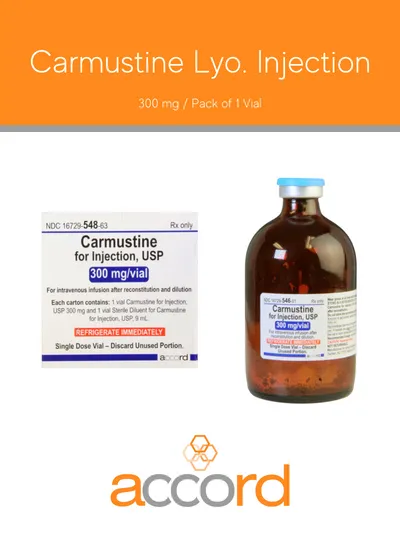
Table of Contents
Patient Information Leaflet
Carmustine Accord, 100 mg, powder and solvent for preparation of concentrate for infusion solution
Carmustinum
Please read all of this leaflet carefully before this medicine is administered, because it contains important information for the patient.
- Keep this leaflet, as you may need to read it again.
- If you have any further questions, please ask your doctor, pharmacist, or nurse.
- If you experience any side effects, including any not listed in this leaflet, please inform your doctor or nurse. See section 4.
Leaflet Contents
- What Carmustine Accord is and what it is used for
- Important information before using Carmustine Accord
- How to use Carmustine Accord
- Possible side effects
- How to store Carmustine Accord
- Contents of the pack and other information
1. What Carmustine Accord is and what it is used for
Carmustine Accord is a medicine containing carmustine. Carmustine belongs to a group of anticancer drugs known as nitrosourea derivatives, which work by slowing the growth of cancer cells.
Carmustine is indicated for use in adults for the treatment of the following malignant tumours as monotherapy or in combination with other anticancer drugs or other therapeutic agents (radiotherapy, surgery):
- Brain tumours (glioblastoma multiforme, brain stem gliomas, medulloblastoma, astrocytoma, and ependymoma) and brain metastases
- Second-line therapy for non-Hodgkin's lymphoma and Hodgkin's disease
- Gastrointestinal tract tumours
- Malignant melanoma (skin cancer)
- As conditioning treatment prior to autologous haematopoietic stem cell transplantation in malignant haematological diseases (Hodgkin's disease/non-Hodgkin's lymphoma)
2. Information before using Carmustine Accord
When not to use Carmustine Accord:
- if the patient is allergic to carmustine or any of the other ingredients of this medicine (listed in section 6);
- if the patient has bone marrow suppression disorders resulting in reduced numbers of platelets, white blood cells (leukocytes), or red blood cells (erythrocytes) due to chemotherapy or other causes;
- if the patient has severe kidney function impairment;
- in children and adolescents;
- in breastfeeding women.
Warnings and precautions
Before starting treatment with Carmustine Accord, discuss this with your doctor, pharmacist, or nurse.
The main adverse effect of this medicine is delayed bone marrow suppression, which may manifest as fatigue, bleeding from the skin and mucous membranes, and infections with fever due to blood changes. Therefore, your doctor will monitor your blood count weekly for at least 6 weeks after administration of the dose. When using the recommended doses, treatment cycles with Carmustine Accord will be administered no more frequently than every 6 weeks. Prior to each administration, your doctor will check your blood count.
Before starting treatment, liver, lung, and kidney function tests will be performed and repeated regularly during treatment.
Because treatment with Carmustine Accord may cause lung damage, a chest X-ray and lung function tests will be performed before starting treatment (see also section "Possible side effects").
High-dose treatment with Carmustine Accord (up to 600 mg/m²) is used exclusively in combination with subsequent stem cell transplantation. High doses may increase the risk and severity of toxic effects on the lungs, kidneys, liver, heart, and gastrointestinal tract, as well as infections and electrolyte imbalances (low levels of potassium, magnesium, and phosphorus in the blood).
Abdominal pain (neutropenic enterocolitis) may occur as an adverse reaction related to therapy following treatment with chemotherapeutic agents.
Your doctor will inform you about the possibility of lung damage and allergic reactions, and their symptoms.
If such symptoms occur, contact your doctor immediately (see section 4).
Children and adolescents
Carmustine Accord must not be used in children and adolescents under 18 years of age.
Carmustine Accord and other medicines
Tell your doctor or pharmacist about all medicines you are currently taking, have recently taken, or plan to take, including over-the-counter medicines, such as:
- Phenytoin used for epilepsy
- Dexamethasone used as an anti-inflammatory and immunosuppressive agent
- Cimetidine used for stomach problems such as indigestion
- Digoxin used for irregular heart rhythm
- Melphalan – an anticancer medicine
Use of Carmustine Accord with alcohol
The amount of alcohol in this medicinal product may alter the effects of other medicines.
Pregnancy, breastfeeding, and fertility
If you are pregnant, breastfeeding, think you may be pregnant, or plan to become pregnant, consult your doctor or pharmacist before using this medicine.
Pregnancy and fertility
Carmustine Accord must not be used during pregnancy, as it may harm the unborn child. This medicine should generally not be given to pregnant women. If used during pregnancy, the patient must be aware of the potential risks to the unborn child. Women of childbearing potential must be advised to use effective contraception to prevent pregnancy during treatment with this medicine and for at least 6 months after the end of treatment.
Men must use appropriate contraceptive measures during treatment with Carmustine Accord and for at least 6 months after treatment to prevent pregnancy in their partners.
Breastfeeding
Breastfeeding must be avoided during treatment with this medicine and for 7 days after treatment. A risk to newborns/infants cannot be excluded.
Driving and using machines
Carmustine Accord has no effect or only a negligible effect on the ability to drive and use machines. However, consult your doctor before driving or operating any tools or machines, because the alcohol content in this medicine may impair the ability to drive or operate machinery.
Carmustine Accord contains ethanol (alcohol)
This medicine contains 2.37 g of alcohol (ethanol) per vial, equivalent to 33.86 mg/kg. The alcohol content in the maximum dose (600 mg/m²) of this medicine is equivalent to 640 ml of beer or 256 ml of wine.
The alcohol content in this medicine may affect the ability to drive or operate machinery. It may impair judgment and reaction speed.
Patients with epilepsy or liver disease should consult their doctor or pharmacist before taking this medicine.
The alcohol content in this medicine may alter the effects of other medicines. If you are taking other medicines, consult your doctor or pharmacist.
Pregnant or breastfeeding women should consult their doctor or pharmacist before taking this medicine.
Patients with alcohol dependence should consult their doctor or pharmacist before taking this medicine.
Since this medicine is usually administered slowly over 1–2 hours, the effects of alcohol may be reduced.
3. How to use Carmustine Accord
Carmustine Accord will always be administered by medical personnel experienced in the use of anticancer medicinal products.
Adults
The dose depends on the patient's health status, body surface area and response to treatment. The medicine is usually given no more frequently than every 6 weeks. The recommended dose of Carmustine Accord for monotherapy in previously untreated patients is 150 to 200 mg/m administered intravenously every 6 weeks.
The medicine may be given as a single dose or divided into daily infusions of 75 to 100 mg/m on two consecutive days. Dosing also depends on whether Carmustine Accord is administered together with other anticancer medicines.
Doses may be adjusted according to the patient's response to treatment.
The recommended dose of Carmustine Accord administered intravenously in combination with other chemotherapeutic agents prior to haematopoietic stem cell transplantation is 300–600 mg/m².
To avoid toxic effects on the bone marrow, blood counts will be monitored frequently and the dose adjusted if necessary.
Method of administration
After reconstitution and dilution, Carmustine Accord is administered intravenously as an infusion (intravenous infusion) over one to two hours, protected from light. The duration of infusion should not be less than one hour; otherwise, burning and pain at the injection site may occur. The infusion site will be monitored during administration.
The duration of treatment will be determined by the physician and may vary between individual patients.
Overdose of Carmustine Accord
Since the medicine will be administered by a doctor or nurse, administration of an incorrect dose is unlikely. However, inform your doctor or nurse if you have any concerns regarding the amount of medicine received.
If you have any further questions about the use of this medicine, consult your doctor, pharmacist or nurse.
4. Possible side effects
Like all medicines, this medicine can cause side effects, although not everybody will experience them.
You should inform your doctor or nurse immediately if any of the following occurs:
sudden wheezing, breathing difficulties, swelling of the eyelids, face or lips, rash or itching (especially if affecting the whole body), or a feeling of faintness. These may be symptoms of a severe allergic reaction.
Carmustine Accord may cause the following side effects:
Very common (may affect more than 1 in 10 people):
- Delayed myelosuppression (reduction in blood cells produced by the bone marrow), which may increase the likelihood of infections if white blood cell count is reduced;
- Ataxia (lack of voluntary coordination of muscle movements);
- Dizziness;
- Headache;
- Transient eye redness, blurred vision due to retinal haemorrhage;
- Hypotension (low blood pressure);
- Phlebitis (inflammation of the vein) associated with pain, swelling, redness, and tenderness on pressure;
- Respiratory disorders (lung-related problems) associated with difficulty breathing. This medicine may cause severe (potentially fatal) lung damage. Lung damage may occur several years after treatment. You should inform your doctor immediately if you experience any of the following symptoms: shortness of breath, persistent cough, chest pain, or persistent fatigue/weakness;
- Severe nausea and vomiting;
- Skin contact: skin inflammation;
- Accidental skin contact may cause transient skin discolouration (darkening of the skin area or nails).
Common (may affect up to 1 in 10 people):
- Acute leukaemias and bone marrow dysplasias (abnormal bone marrow development). Possible symptoms include: bleeding gums, bone pain, fever, frequent infections, frequent or severe nosebleeds, lumps caused by swollen lymph nodes in the neck or surrounding areas, under the arms, in the abdomen or groin, pale skin, shortness of breath, weakness, fatigue, or general loss of energy;
- Anaemia (reduced number of red blood cells in the blood);
- Encephalopathy (brain disorder). Possible symptoms include: muscle weakness in one area, inability to make decisions or poor concentration, involuntary muscle twitching, tremors, difficulty speaking or swallowing, seizures;
- Loss of appetite;
- Constipation;
- Diarrhoea;
- Inflammation of the mouth and lips;
- Reversible hepatic toxicity when treated with high doses. This disorder may lead to increased liver enzyme activity and bilirubin levels (parameters measured in blood tests);
- Alopecia (hair loss);
- Skin redness;
- Reactions at the injection site.
Rare (may affect up to 1 in 1,000 people):
- Veno-occlusive disease (progressive blockage of veins), manifesting as blockage of very small (microscopic) veins in the liver. Possible symptoms include: fluid accumulation in the abdomen, enlarged spleen, severe bleeding from the oesophagus, yellowing of the skin and whites of the eyes;
- Breathing problems caused by interstitial fibrosis (with lower-dose administration);
- Kidney problems;
- Gynaecomastia (enlargement of breasts in males).
Unknown frequency (cannot be estimated from available data):
- Muscle pain;
- Seizures, including status epilepticus;
- Tissue damage due to leakage at the site of drug administration;
- Infertility;
- Any signs of infection;
- Carmustine has been shown to have harmful effects on the development of unborn children;
- Electrolyte disturbances (and electrolyte imbalance (low levels of potassium, magnesium and phosphate in the blood)).
Reporting of side effects
If you experience any side effects, including any not listed in this leaflet, tell your doctor or pharmacist. Side effects can be reported directly to the Department of Monitoring Adverse Drug Reactions, Office for Registration of Medicinal Products, Medical Devices and Biocidal Products, Al. Jerozolimskie 181C, 02-222 Warsaw, Tel: +48 22 49 21 301, Fax: +48 22 49 21 309, Website: https://smz.ezdrowie.gov.pl
Reporting side effects helps provide more information on the safety of this medicine. Side effects can also be reported to the marketing authorisation holder.
5. How to store Carmustine Accord
The medicine will be stored by a doctor or other qualified medical personnel.
Keep the medicine out of the sight and reach of children.
Do not use this medicine after the expiry date stated on the label and carton following EXP.
The expiry date refers to the last day of the stated month.
Store and transport in a refrigerated condition (2°C–8°C).
Keep the vials in the cardboard carton to protect from light.
After reconstitution (reconstituted stock solution)
Chemical and physical stability of the reconstituted stock solution has been demonstrated for 24 hours
at a temperature of 2°C to 8°C.
After dilution (diluted infusion solution)
Chemical and physical stability of the diluted infusion solution has been demonstrated for 4 hours at
20°C to 25°C when stored in a glass or polypropylene container, protected from light, in 500 ml of
sodium chloride 0.9% solution for injection or 5% glucose solution for injection. These solutions remain
stable for 24 hours** in a refrigerator (2°C to 8°C) and for an additional 3 hours at 20°C to 25°C, protected
from light.
From a microbiological standpoint, if the method of opening, reconstitution, and dilution does not exclude
the risk of microbiological contamination, the product should be used immediately. If the product is not
used immediately, the user is responsible for the storage duration and conditions during use.
The solution must be protected from light until administration is complete.
Medicines must not be disposed of via wastewater or household waste. Ask a pharmacist how to dispose
of medicines no longer in use. This will help protect the environment.
**The 24-hour storage period for the ready-to-use diluted solution is the total time during which carmustine
remains in solution, including the time of reconstitution using 3 ml of ethanol and 27 ml of water for injection.
6. Contents of the pack and other information
What Carmustine Accord contains
The active substance is carmustine.
Each 30 ml vial of powder for concentrate solution for infusion contains 100 mg of carmustine.
Each vial of solvent contains 3 ml of anhydrous ethanol.
After reconstitution with the provided solvent and dilution in 27 ml of sterile water for injections,
1 ml of solution contains 3.3 mg of carmustine.
Excipients:
- Powder: No excipients.
- Solvent: Ethanol, anhydrous.
What Carmustine Accord looks like and contents of the pack
Carmustine Accord is a powder and solvent for concentrate solution for infusion.
Pale yellow dry flakes or dry compact mass in a 30 ml amber glass vial closed with a grey bromobutyl rubber stopper and an aluminium seal with a polypropylene cap.
The solvent is a clear, colourless liquid in a 5 ml clear glass vial closed with a butyl rubber stopper coated with fluorocarbon polymer and an aluminium seal with a polypropylene cap.
Pack sizes:
The pack contains 1 vial containing 100 mg of powder and 1 vial containing 3 ml of solvent.
The pack contains 10 vials containing 100 mg of powder and 10 vials containing 3 ml of solvent.
Not all pack sizes may be marketed.
Marketing Authorisation Holder
Accord Healthcare Polska Sp. z o.o.
ul. Taśmowa 7
02-677 Warsaw
Tel: + 48 22 577 28 00
Manufacturer / Importer
Accord Healthcare Polska Sp. z o.o.
ul. Lutomierska 50
95-200 Pabianice
Laboratori Fundació Dau
C/ C, 12-14 Pol. Ind.
Zona Franca
08040 Barcelona
Spain
This medicinal product is authorised in the European Economic Area countries and the United Kingdom (Northern Ireland) under the following names:
| Country | Product Name |
| Cyprus | Carmustine Accord |
| Czech Republic | Carmustine Accord |
| Denmark | Carmustine Accord |
| Estonia | Carmustine Accord |
| Finland | Carmustine Accord 100 mg Powder and solvent for concentrate for infusion, solution |
| France | Carmustine Accord 100 mg Poudre et solvant pour solution à diluer pour perfusion |
| Spain | Carmustine Accord 100 mg powder and solvent for concentrate for solution for perfusion |
| Netherlands | Carmustine Accord 100 mg powder and solvent for concentrate for solution for infusion |
| Ireland | Carmustine 100 mg powder and solvent for concentrate for solution for infusion |
| Malta | Carmustine 100 mg powder and solvent for concentrate for solution for infusion |
| Germany | Carmustine Accord 100 mg Powder and solvent for a concentrate for infusion solution |
| Norway | Carmustine Accord |
| Poland | Carmustine Accord |
| Portugal | Carmustina Accord |
| Sweden | Carmustine Accord 100 mg powder and liquid for concentrate for infusion solution, solution |
| United Kingdom (Northern Ireland) | Carmustine 100 mg powder and solvent for concentrate for solution for infusion |
| Italy | Carmustina Accord |
Information intended exclusively for healthcare professionals:
Below is a brief description of the method of preparation and (or) administration, pharmaceutical incompatibilities, dosing, overdose or required monitoring actions and laboratory tests, based on the current Product Characteristics.
The medicinal product Carmustine Accord powder for solution for infusion does not contain preservatives and is not intended for use in multidose vials.
Reconstitution and further dilution must be performed under aseptic conditions.
By adhering to the recommended storage conditions, degradation of the substance in the unopened vial can be avoided until the expiry date indicated on the packaging.
Storage of carmustine at temperatures of 28°C or higher may lead to liquefaction of the substance, as carmustine has a low melting point (approximately 28°C to 29°C). An oily layer at the bottom of the vial visible in bright light indicates degradation. Such a medicinal product must not be used. Sharp-edged flakes or even a solid mass may be visible in the unopened vial, provided there is no degradation of carmustine.
Reconstitution and dilution of the powder for solution for infusion
Dissolve carmustine (100 mg of powder) in 3 ml of the supplied sterile, cooled solvent (ethanol) in the primary container (brown glass vial). Carmustine must be completely dissolved in ethanol before adding sterile water for injections. Dissolution of the powder may take up to 3 minutes. Then, aseptically add 27 ml of sterile water for injections to the alcohol solution. Mix the resulting 30 ml of stock solution thoroughly.
One milliliter of the stock solution contains 3.3 mg of carmustine in 10% ethanol, with a pH of 4 to 6.8.
The reconstituted solution, prepared as recommended, is yellowish and practically free from visible particles.
The 30 ml stock solution should be immediately diluted by adding it to 30 ml of the stock solution to 500 ml of sodium chloride solution for injection at a concentration of 9 mg/ml (0.9%) or to 500 ml of 5% glucose solution for injection.
Method of administration
The Carmustine Accord product is intended for intravenous administration after reconstitution and further dilution.
Reconstitute the powder using the supplied sterile solvent (3 ml vial) to prepare a solution, then add an additional 27 ml of sterile water for injections to obtain a yellowish stock solution. The stock solution should be further diluted in 500 ml of sodium chloride solution for injection at a concentration of 9 mg/ml (0.9%) or in 5% glucose solution for injection at a concentration of 50 mg/ml (5%).
The resulting ready-to-use infusion solution should be administered immediately by intravenous infusion over one to two hours, protected from light. The infusion duration should not be less than one hour—otherwise, burning and pain at the injection site may occur. The intravenous infusion site should be monitored during administration.
Pregnant personnel must not have contact with this medicinal product.
Guidelines for safe handling and disposal of cytotoxic medicinal products must be followed.
Dosing and laboratory tests
Initial doses
The recommended dose of the medicinal product Carmustine Accord used as monotherapy in previously untreated patients is 150 to 200 mg/m² administered intravenously every 6 weeks. The drug may be given as a single dose or divided into daily infusions of 75 to 100 mg/m² on two consecutive days.
When the medicinal product Carmustine Accord is used in combination with other myelosuppressive medicinal products or in patients with reduced bone marrow reserve, doses should be adjusted according to the patient's hematological profile, as described below.
Monitoring and subsequent doses
The next course of treatment with the medicinal product Carmustine Accord may only be administered once blood counts have returned to acceptable levels (platelet count above 100,000/mm³, leukocyte count above 4,000/mm³), which usually occurs within six weeks. Blood counts should be monitored frequently, and re-treatment must not be administered before six weeks have elapsed due to the risk of delayed hematological toxicity.
After the initial dose, subsequent doses should be adjusted according to the patient's hematological response to the previous dose, both in monotherapy and in combination therapy with other myelosuppressive medicinal products. The following approximate dose adjustment scheme is recommended:
Table 1:
| Lowest level after previous dose | Percentage of previous dose to administer | |
| White blood cells/mm3 | Platelets/mm3 | |
| >4 000 | >100 000 | 100% |
| 3 000 – 3 999 | 75 000 – 99 999 | 100% |
| 2 000 – 2 999 | 25 000 – 74 999 | 70% |
| <2 000 | <25 000 | 50% |
In cases where the lowest value after administration of the initial dose does not fall within the same row for both leukocytes and platelets (e.g., white blood cell count >4,000 and platelet count <25,000), the dose adjustment should be based on the value corresponding to the lower percentage of the previous dose (e.g., platelet count <25,000 – maximum 50% of the previous dose should be administered).
There are no limitations regarding the duration of treatment with carmustine. If the malignancy remains incurable or severe or intolerable adverse reactions occur, carmustine treatment should be discontinued.
Conditioning treatment prior to hematopoietic stem cell transplantation
Carmustine is administered intravenously at a dose of 300–600 mg/m² in combination with other chemotherapeutic agents to patients with malignant hematological disorders prior to hematopoietic stem cell transplantation.
Special patient groups
Children and adolescents
Carmustine should not be used in children and adolescents under 18 years of age due to safety concerns.
Elderly patients
Doses should generally be selected cautiously in elderly patients, particularly starting at the lower end of the dose range, due to the higher likelihood of impaired liver, kidney, or heart function; concomitant diseases; and concomitant use of other medicinal products. Since elderly patients have a greater likelihood of impaired renal function, caution should be exercised when determining the dose, glomerular filtration rate should be monitored, and the dose should be adjusted accordingly.
Renal impairment
In patients with renal impairment, the dose of the medicinal product Carmustine Accord should be reduced if a decreased glomerular filtration rate is observed.
Compatibility/incompatibility with containers
The intravenous solution is unstable in containers made of polyvinyl chloride (PVC). All plastic materials coming into contact with the carmustine solution for infusion (e.g., infusion sets, etc.) should be made of polyethylene free of PVC; otherwise, glass containers should be used.