Canespor
Poland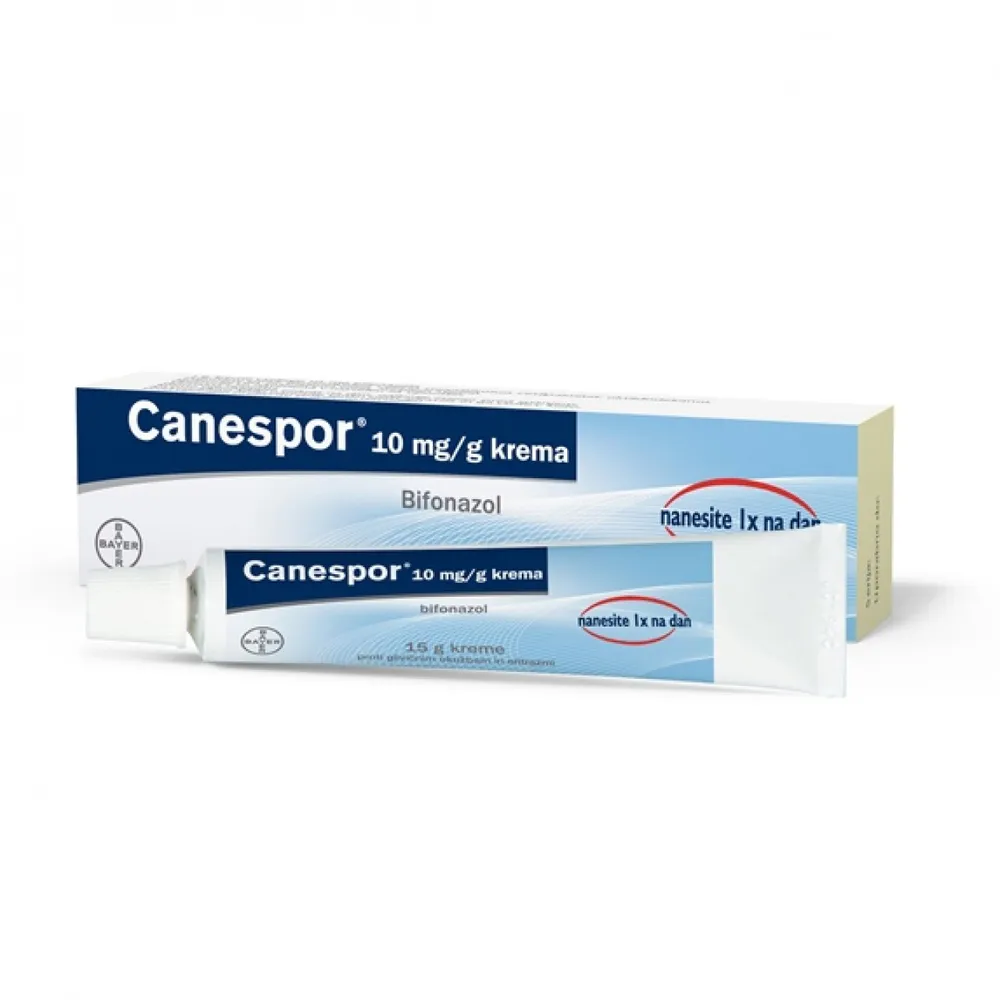
Table of Contents
PACKAGE LEAFLET: INFORMATION FOR THE PATIENT
Warning! Keep the leaflet, information on the immediate packaging in a foreign language!
Canespor (Canesten Unidia)
10 mg/g, cream
Bifonazole
Canespor and Canesten Unidia are different trade names for the same medicinal product.
Please read this leaflet carefully before using the medicine, as it contains important information for the patient.
This medicine should always be used exactly as described in this patient leaflet or as directed by a doctor or pharmacist.
- Keep this leaflet for future reference.
- If you need advice or further information, consult your pharmacist.
- If you experience any adverse reactions, including any possible side effects not listed in this leaflet, inform your doctor or pharmacist. See section 4.
- If there is no improvement or if you feel worse, contact your doctor.
Table of contents
- What Canespor is and what it is used for
- What you need to know before using Canespor
- How to use Canespor
- Possible side effects
- How to store Canespor
- Contents of the pack and other information
1. What Canespor is and what it is used for
Canespor is an antifungal medicine available as a cream. It contains the active substance bifonazole, which has a broad antifungal spectrum of activity.
Canespor is indicated for the topical treatment of fungal skin infections such as tinea manuum and tinea pedis (athlete's foot), tinea corporis (ringworm), tinea intertriginosa (fungal infection of skin folds), pityriasis versicolor, superficial fungal infections of the skin, and for the topical treatment of seborrhoeic dermatitis.
2. Important information before using Canespor
When not to use Canespor:
- if the patient is allergic to the active substance – bifonazole – or to any of the other ingredients of this medicine listed in section 6.
Warnings and precautions
Before starting treatment with Canespor, consult your doctor or pharmacist.
Patients who have previously experienced hypersensitivity reactions to other antifungal imidazole derivatives (e.g. econazole, clotrimazole, miconazole) should use bifonazole-containing medicines with caution.
If symptoms persist or do not improve after discontinuing treatment, contact your doctor.
Avoid contact of the medicine with the eyes. Do not swallow.
Some excipients in Canespor may reduce the effectiveness of latex-containing products such as condoms and diaphragms, when applied to the genital area.
This effect is temporary and occurs only during treatment.
Children and adolescents
Canespor may be used in infants and young children (aged 28 days to 23 months) only on medical advice and under medical supervision. There is no data available on the use of this medicine in newborns.
Canespor and other medicines
Concomitant use of Canespor with warfarin increases the risk of bleeding. If Canespor and warfarin are used together, the patient must be under strict medical supervision.
Inform your doctor or pharmacist about all medicines the patient is currently taking or has recently taken, as well as any medicines the patient intends to take.
Pregnancy, breastfeeding and fertility
If the patient is pregnant, breastfeeding, suspects she may be pregnant, or is planning to have a child, she should consult her doctor or pharmacist before using this medicine.
Canespor should not be used during the first trimester of pregnancy.
If the doctor decides that treatment with Canespor is necessary during breastfeeding, breastfeeding should be discontinued.
Driving and operating machinery
Canespor has no effect or negligible effect on the ability to drive and operate machinery.
Canespor contains benzyl alcohol
1 g of Canespor cream contains 20 mg of benzyl alcohol.
Benzyl alcohol may cause allergic reactions and mild local irritation.
3. How to use Canespor
This medicine should always be used exactly as described in the patient leaflet or as directed by a doctor or pharmacist. If in doubt, consult a doctor or pharmacist.
Recommended dose
Apply the medicine once daily, preferably in the evening before going to sleep. A small amount of the medicine is usually sufficient to cover an affected skin area the size of the palm of the hand.
Method of administration
Apply a thin layer of the medicine to the affected area and gently massage in.
Duration of treatment
Treatment with Canespor should be continued for an appropriately long period. The medicine is usually used as shown in the table below.
| Indications | Duration of treatment |
| Tinea pedis, including interdigital tinea (Tinea pedis, tinea pedum interdigitalis) | 3 weeks |
| Tinea of trunk, hands and skin folds (Tinea corporis, tinea manuum, tinea inguinalis) | 2 to 3 weeks |
| Pityriasis versicolor | 2 weeks |
| Seborrheic dermatitis | 2 weeks |
| Superficial cutaneous candidiasis | 2 to 4 weeks |
Use in children and adolescents
The medicinal product may be used in infants and young children (from 28 days to 23 months of age) only
on the advice and under the supervision of a physician. There are no data regarding use in newborns.
Use of a higher than recommended dose of Canespor
There is no risk of acute poisoning.
Missed dose of Canespor
Do not use a double dose to make up for a missed dose.
The next dose should be administered as soon as possible.
If you have any further doubts concerning use of this medicinal product, consult your
physician or pharmacist.
4. Possible adverse reactions
Like all medicines, Canespor may cause adverse reactions, although not everyone experiences them.
Frequency unknown (cannot be estimated from available data):
pain at the application site, marginal swelling (at the application site), contact dermatitis, allergic dermatitis, erythema, pruritus, rash, urticaria, vesicles, skin desquamation, exanthem, dry skin, skin irritation, skin maceration, burning sensation on the skin.
Adverse reactions usually resolve after discontinuation of treatment.
Reporting of adverse reactions
If any adverse reactions occur, including those not listed in this leaflet, inform your doctor or pharmacist. Adverse reactions can be reported directly to the Department of Monitoring Adverse Reactions of Medicinal Products at the Office for Registration of Medicinal Products, Medical Devices and Biocidal Products, Al. Jerozolimskie 181C, 02-222 Warsaw, phone: +48 22 49 21 301; fax: +48 22 49 21 309; website: https://smz.ezdrowie.gov.pl.
Reporting adverse reactions enables the collection of further information on the safety of the medicine.
5. How to store Canespor
Keep the medicine out of the sight and reach of children.
Do not store above 25°C.
Do not use this medicine after the expiry date stated on the packaging. The expiry date refers to the last day of the stated month.
Medicines must not be disposed of via the sewage system or household waste. Ask your pharmacist how to dispose of medicines no longer in use. This will help protect the environment.
6. Contents of the packaging and other information
What the medicine contains
The active substance is bifonazole.
The other ingredients are: benzyl alcohol, cetostearyl alcohol, cetyl palmitate,
octyldodecanol, polysorbate 60, sorbitan stearate, purified water.
What Canespor looks like and contents of the pack
Canespor is a cream.
The medicine is available in an aluminium tube with a polyethylene cap containing 15 g of cream, packed in a cardboard box.
For more detailed information, please contact the responsible party or parallel importer.
Responsible entity in Portugal, country of export:
Bayer Portugal, Lda.
Avenida Vítor Figueiredo nº4, 4º piso
2790-255 Carnaxide
Portugal
Manufacturer:
Kern Pharma, S.L.
C/ Venus, 72 - Polígono Industrial Colon II
E-08228 Terrasa - Barcelona
Spain
GP Grenzach Produktions GmbH
Emil-Barrel-Str. 7
D-79639 Grenzach-Wyhlen
Germany
Parallel importer:
Medezin Sp. z o.o.
ul. Zbąszyńska 3
91-342 Łódź
Poland
Repackaged in:
Medezin Sp. z o.o.
ul. Zbąszyńska 3
91-342 Łódź
Poland
Marketing Authorization number in Portugal, country of export: 9627307
Parallel import authorization number: 116/20