Campral
Poland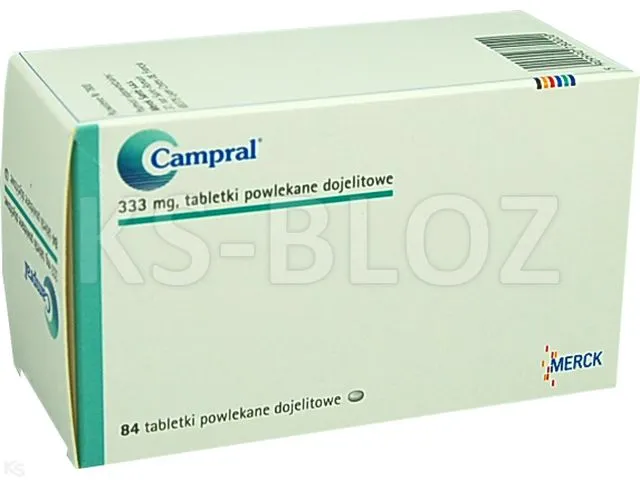
Table of Contents
Patient Information Leaflet
Campral
333 mg, enteric-coated tablets
Acamprosate
Please read the following information carefully before taking this medicine, as it contains
important information for the patient.
- Keep this leaflet, as you may need to read it again.
- If you have any further questions, please consult your doctor or pharmacist.
- This medicine has been prescribed for a specific individual. Do not pass it on to others. It may harm someone else, even if their symptoms are the same.
- If you experience any adverse reactions, including those not listed in this leaflet, inform your doctor or pharmacist. See section 4.
Table of contents
- What Campral is and what it is used for
- Important information before taking Campral
- How to take Campral
- Possible side effects
- How to store Campral
- Contents of the pack and other information
1. What Campral is and what it is used for
The active substance in Campral is acamprosate, which has a chemical structure similar to that of neurotransmitters such as taurine or γ-aminobutyric acid (GABA). Studies have shown that acamprosate affects alcohol dependence by reducing alcohol consumption without interfering with food and fluid intake.
Campral is indicated for the maintenance of alcohol abstinence in alcohol-dependent patients, as part of a psychosocial support programme.
2. Important information before using Campral
When not to use Campral
- if the patient is allergic to the active substance or to any of the other ingredients of this medicine (listed in section 6);
- if the patient has impaired renal function (serum creatinine concentration > 120 micromol/L);
- in breastfeeding women.
Warnings and precautions
The safety and efficacy of Campral have not been established in patients under 18 years of age and over 65 years of age; therefore, use of the medicine is not recommended in these patient populations.
The safety and efficacy of Campral have not been established in patients with severe hepatic impairment.
Due to the well-known and complex interrelationship between alcohol dependence, depression and suicidal tendencies, patients with alcohol dependence, including those treated with acamprosate, should be monitored for the emergence of such symptoms.
Campral is not indicated for the treatment of acute symptoms of alcohol withdrawal.
Abuse and dependence: non-clinical studies indicate that acamprosate has no or negligible potential to cause drug dependence.
Campral with other medicines
Inform your doctor about all medicines the patient is currently taking or has recently taken, as well as any medicines the patient plans to take.
No changes in the frequency of clinical and/or biological adverse reactions have been demonstrated when acamprosate was administered concomitantly with disulfiram, oxazepam, tetrazepam, or meprobamate.
In clinical studies, acamprosate was safely used in combination with antidepressants, anxiolytics, hypnotics and sedatives, as well as non-opioid analgesics.
Campral with food and drink
Concomitant consumption of alcohol with Campral does not affect the action of alcohol or acamprosate.
Pregnancy, breastfeeding and fertility
Pregnancy
If the patient is pregnant or breastfeeding, suspects she may be pregnant, or is planning to have a child, she should consult her doctor before using this medicine.
There are insufficient data on the use of Campral in pregnant women. Animal studies have not shown any evidence of toxic or teratogenic effects on the foetus.
Campral should be used during pregnancy only after careful assessment of benefit versus risk, when the patient cannot refrain from drinking alcohol without treatment with Campral, and consequently, when there is a risk of toxic and teratogenic effects of alcohol on the foetus.
Breastfeeding
Campral passes into the milk of lactating animals. It is not known whether acamprosate passes into human breast milk. There are insufficient data on the use of acamprosate in infants. For this reason, Campral must not be used in breastfeeding women.
Fertility
In animal studies, no adverse effect on fertility has been observed. It is not known whether acamprosate affects fertility in humans.
Driving and operating machinery
Campral has no influence on the ability to drive or operate machinery.
Campral contains sodium
The medicine contains less than 1 mmol (23 mg) of sodium per tablet, i.e. the medicine is considered "sodium-free".
3. How to use Campral
This medicine should always be used exactly as your doctor has told you. If in doubt, consult your doctor or pharmacist.
Adults aged 18 - 65
For patients with a body weight of 60 kg or more, the recommended dose is 2 tablets of acamprosate (666 mg) three times daily (in the morning, at midday, and at bedtime).
For patients with a body weight below 60 kg, 4 tablets are administered in three divided doses (two tablets in the morning, one at midday, and one at bedtime).
In patients with normally functioning gastrointestinal tract, it is recommended to take the medicine between meals. Taking the medicine with food reduces its absorption.
Children and elderly people
Acamprosate should not be given to children or elderly people.
The recommended duration of treatment is 1 year. Treatment with acamprosate should be initiated as early as possible after alcohol cessation. An occasional episode of alcohol consumption is not a contraindication to continuing treatment.
If you feel the effect of the medicine is too strong or too weak, consult your doctor.
Taking more Campral than prescribed
If you take more Campral than recommended, diarrhoea usually occurs; consult your doctor.
Missing a dose of Campral
If you miss a dose, take the next dose at the scheduled time, according to your doctor's instructions. Do not take a double dose to make up for a missed dose.
4. Possible adverse reactions
Like all medicines, this medicine can cause adverse reactions, although not everyone will experience them.
The adverse reactions listed below may occur during treatment with Campral. The frequency of occurrence is defined as follows: very common (more than 1 in 10 patients), common (more than 1 in 100 but less than 1 in 10 patients), uncommon (more than 1 in 1,000 patients but less than 1 in 100 patients), rare (more than 1 in 10,000 patients but less than 1 in 1,000 patients), very rare (less than 1 in 10,000 patients, including isolated cases), frequency not known (frequency cannot be estimated from the available data).
Very common: diarrhoea.
Common: abdominal pain, nausea, vomiting, flatulence, skin itching, maculopapular rash, coldness of genitals or impotence, decreased libido.
Uncommon: increased libido.
Very rare: hypersensitivity reactions, including urticaria, angioedema (swelling affecting deeper skin layers and subcutaneous tissue, possibly involving mucous membranes; angioedema often localized in the face (eyelids, lips), but potentially affecting virtually any body area, including the gastrointestinal tract, respiratory system, and urinary system) or anaphylactic reactions (itching, generalized erythema, urticaria of varying severity, rapid drop in blood pressure, tachycardia or, less commonly, bradycardia, dyspnoea, difficulty breathing due to laryngeal oedema, spasmodic abdominal pain, vomiting, diarrhoea, sometimes bloody).
Frequency not known: vesiculobullous skin eruptions.
Reporting of adverse reactions
If any adverse reactions occur, including any possible adverse reactions not listed in this leaflet, inform your doctor or pharmacist. Adverse reactions can be reported directly to the Department of Monitoring Adverse Drug Reactions at the Office for Registration of Medicinal Products, Medical Devices and Biocidal Products
Al. Jerozolimskie 181C
02-222 Warsaw
Phone: +48 22 49 21 301
Fax: +48 22 4921 309
Website: https://smz.ezdrowie.gov.pl
Reporting adverse reactions helps to provide more information on the safety of the medicine.
Adverse reactions may also be reported to the marketing authorization holder.
5. How to store Campral
Keep this medicine out of sight and reach of children.
There are no special storage instructions for this medicine.
Do not use this medicine after the expiry date stated on the carton after: "EXP". The expiry date refers to the last day of the stated month.
6. Contents of the pack and other information
What Campral contains
- The active substance is acamprosate.
- The other ingredients are: crospovidone, microcrystalline cellulose, magnesium silicate, sodium carboxymethyl starch, colloidal anhydrous silica, magnesium stearate, copolymer of methacrylic acid and ethyl acrylate (1:1) 30% dispersion, talc, propylene glycol.
What Campral looks like and contents of the pack
Campral is an enteric-coated tablet.
The pack contains 60, 84, 180 or 200 enteric-coated tablets.
Not all pack sizes may be marketed.
Marketing Authorisation Holder
Merck Sante s.a.s.
37, rue Saint-Romain
69379 Lyon Cedex 08,
France
Marketing Authorisation Holder's logo
Manufacturer
Merck Sante s.a.s.
2, rue du Pressoir Vert
45400 Semoy,
France
or
Merck, SL
Poligono Merck
Mollet Del Valles, 08100 Barcelona,
Spain
For further information, please contact the Marketing Authorisation Holder's representative:
Merck Sp. z o.o.
tel. 22 53 59 700
fax. 22 53 59 703