Calcium gluconate hameln
Poland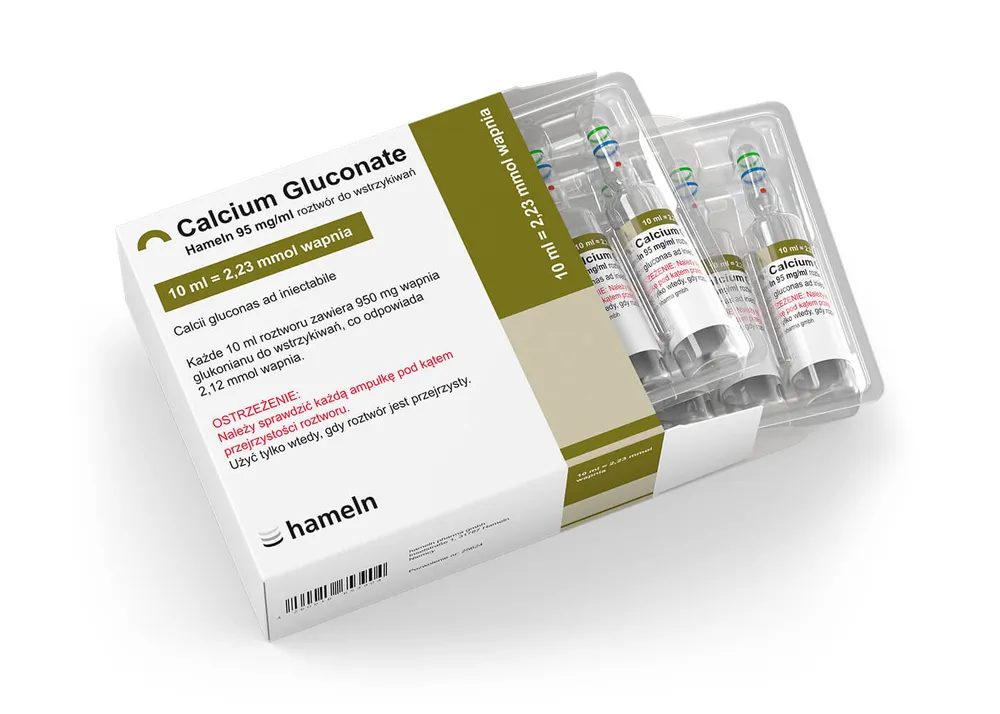
Table of Contents
- Patient Information Leaflet
- 1. What Calcium Gluconate hameln 95 mg/ml is and what it is used for
- 2. Important information before using Calcium Gluconate hameln 95 mg/ml
- 3. How to use Calcium Gluconate hameln 95 mg/ml
- 4. Possible adverse reactions
- 5. How to store Calcium Gluconate hameln 95 mg/ml
- 6. Contents of the pack and other information
Patient Information Leaflet
Calcium Gluconate hameln, 95 mg/ml, solution for injection
Calcii gluconas ad iniectabile
Please read all of this leaflet carefully before this medicine is administered, because it contains
important information for you.
- Keep this leaflet, as you may need to read it again.
- If you have any further questions, ask your doctor, pharmacist or nurse.
- If you experience any side effects, including any not listed in this leaflet, tell your doctor, pharmacist or nurse. See section 4.
Table of contents
- What Calcium Gluconate hameln 95 mg/ml is and what it is used for
- What you need to know before you receive Calcium Gluconate hameln 95 mg/ml
- How to use Calcium Gluconate hameln 95 mg/ml
- Possible side effects
- How to store Calcium Gluconate hameln 95 mg/ml
- Contents of the pack and other information
1. What Calcium Gluconate hameln 95 mg/ml is and what it is used for
Calcium occurs naturally in the body and is necessary for the normal functioning of muscles
and nerves. It is essential for heart function and blood clotting.
Calcium Gluconate hameln 95 mg/ml is used to correct too low levels of calcium in the body and to
prevent abnormal heart rhythms (arrhythmias) caused by high levels of potassium in the blood.
It is indicated in the treatment of acute symptomatic hypocalcaemia in adults, children and adolescents, and in the treatment of severe hyperkalaemia with or without electrocardiogram (ECG) changes. It may also be used in emergency situations (cardiac arrest) to restore normal heart function when blood potassium levels are too high.
2. Important information before using Calcium Gluconate hameln 95 mg/ml
When not to use Calcium Gluconate hameln 95 mg/ml
- if the patient is allergic to calcium gluconate or any of the other ingredients of this medicine (listed in section 6);
- if the patient has high levels of calcium in the blood (for example, due to hyperparathyroidism, high vitamin D levels, malignancy, impaired kidney function, osteoporosis due to immobilization, sarcoidosis, or so-called milk-alkali syndrome);
- if the patient has high levels of calcium in the urine (hypercalciuria);
- if the patient has been treated with cardiac glycosides (heart medications), unless administration of the drug is necessary for the treatment of severe symptoms of hypocalcemia or acute severe hyperkalemia, despite the significant risk to the patient, when safer alternative treatments are not available and oral calcium cannot be administered;
- in premature infants and full-term newborns (within the first 28 days of life) who have received the antibiotic ceftriaxone;
- in children (under 18 years of age) requiring repeated or long-term treatment, due to the risk of exposure to aluminium leaching from the glass vial;
- if the patient has impaired kidney function and repeated or long-term treatment is required, due to the risk of exposure to aluminium;
- if the patient is receiving total parenteral nutrition (TPN) (feeding bypassing the stomach via intravenous administration), due to the risk of exposure to aluminium.
Warnings and precautions
Before starting treatment with Calcium Gluconate hameln 95 mg/ml, discuss this with your doctor,
pharmacist, or nurse:
- if the patient has chronic kidney disease or is at risk of developing kidney stones;
- if the patient develops calcium deposition in the kidneys (nephrocalcinosis);
- if the patient has heart disease;
- if the patient has sarcoidosis (swelling or inflammation of tissues, usually affecting the lungs and skin);
- if the patient has impaired kidney function. This condition may be associated with elevated blood calcium levels and hyperparathyroidism; therefore, the doctor should closely monitor blood chemistry, and the patient should receive this medicine only if absolutely necessary.
This medicine must not be mixed or administered simultaneously with ceftriaxone, even when using
separate intravenous administration sets or administered at different infusion sites.
This medicine must not be mixed or administered simultaneously with sodium bicarbonate (sometimes
used in the treatment of severe hyperkalemia).
This medicine should be administered as a slow injection or infusion to minimize, as much as possible,
the risk of vasodilation or cardiac disturbances. Rapid injection or infusion may cause cardiovascular
adverse reactions due to the high concentration of calcium.
During intravenous injection or infusion of this medicine, cardiac function should be monitored to
ensure that any worsening of heart function, such as severe arrhythmia (irregular heartbeat), is treated
immediately.
The medicinal product Calcium Gluconate hameln 95 mg/ml may cause local tissue irritation.
Redness of the skin, burning sensation, and pain during injection or infusion into a vein may indicate
that the medicine has been accidentally administered outside the blood vessel, which may lead to
serious tissue damage (skin necrosis). The doctor will ensure that the solution does not leak into the
surrounding tissues and will closely observe the injection or infusion site.
During treatment, serum and urinary calcium levels should be closely monitored.
Calcium gluconate may leach aluminium oxide from the glass vial. Increased aluminium levels may
lead to risks associated with aluminium toxicity, such as adverse effects on bone mineralization and
neurological development (brain and nervous system), and a blood disorder in which organs and
tissues do not receive sufficient oxygen (microcytic anemia), particularly in susceptible patients such
as those with impaired kidney function and children (under 18 years of age).
Calcium Gluconate hameln 95 mg/ml and other medicines
Inform your doctor or pharmacist about all medicines the patient is currently taking or has recently
taken, as well as any medicines the patient plans to use.
This is especially important for the following medicines, as they may interact with Calcium Gluconate
hameln 95 mg/ml:
- digoxin (heart medications) and other cardiac glycosides, whose effects may be enhanced;
- thiazide diuretics (water pills), which may reduce the body's ability to excrete calcium, leading to increased calcium levels;
- ceftriaxone (antibiotic), due to the risk of precipitation, must not be administered simultaneously, even through separate infusion lines;
- adrenaline (epinephrine), used after heart surgery, whose effect may be reduced;
- magnesium and calcium may mutually reduce each other's effects;
- calcium channel blockers (heart medications), whose effects may be reduced;
- vitamin D; avoid taking high doses.
Pregnancy and breastfeeding
If the patient is pregnant or breastfeeding, suspects she may be pregnant, or is planning to become
pregnant, she should consult her doctor or pharmacist before using this medicine.
Calcium Gluconate hameln 95 mg/ml should not be used during pregnancy unless absolutely
necessary.
Since calcium passes into breast milk, discuss with your doctor whether breastfeeding should be
discontinued if treatment is necessary.
Driving and operating machinery
It is unlikely that this medicine will affect the ability to drive or operate machinery.
3. How to use Calcium Gluconate hameln 95 mg/ml
Intravenous administration is performed by a nurse or doctor. The physician determines the appropriate dose for adult or pediatric patients, as well as how and when it should be administered.
Treatment of acute symptomatic hypocalcemia and acute severe hyperkalemia with or without ECG changes
Adults
- The recommended dose for adults is 10 ml, which may be repeated if necessary. Administration of more than 50 ml (5 ampoules) of Calcium Gluconate hameln 95 mg/ml injection solution within 24 hours is not recommended due to the risk of exposure to aluminium.
Newborns, children and adolescents
- Due to the risk of exposure to aluminium, administration of more than 1 ml/kg body weight of Calcium Gluconate hameln 95 mg/ml injection solution within 24 hours is not recommended in newborns (newly born infants) and children aged above 1 month up to 17 years.
In cases of mild hypocalcemic symptoms affecting nerves and muscles, oral calcium-containing products are preferred.
If intravenous treatment has been used for acute symptomatic hypocalcemia, oral calcium-containing products should be initiated as soon as possible, e.g. in cases of vitamin D deficiency.
In the treatment of acute severe hyperkalemia with or without ECG changes, calcium administration should be used solely to prevent life-threatening cardiac arrhythmias, while initiating other therapies aimed at reducing serum potassium levels.
Cardiac arrest due to severe hyperkalemia
Adults
- The recommended dose for adults is 30 ml of Calcium Gluconate hameln 95 mg/ml injection solution.
Newborns, children and adolescents
- The recommended dose is 0.6 ml/kg body weight of Calcium Gluconate hameln 95 mg/ml injection solution, which may be repeated if necessary. Due to the risk of exposure to aluminium, administration of more than 1 ml/kg body weight of Calcium Gluconate hameln 95 mg/ml injection solution within 24 hours is not recommended in newborns (newly born infants) and children above 1 month of age up to 17 years.
Considering the aluminium content in a single ampoule (measured at the end of shelf life) and current knowledge, it cannot be excluded that exposure to aluminium (when administering more ampoules than recommended) may contribute to the total future exposure to aluminium (from environment, drinking water and food) and potential toxicity in patients. Due to the risk associated with aluminium exposure, repeated or long-term treatment is not recommended in children (under 18 years of age).
The patient should remain in a lying position during administration.
Serum and urinary calcium levels should be monitored during treatment.
Use of a higher than recommended dose of Calcium Gluconate hameln 95 mg/ml
Since this medicine is administered by a doctor or nurse, it is unlikely that the patient will receive an overdose. If the patient believes that too high a dose has been administered and experiences nausea, vomiting, constipation, abdominal pain, muscle weakness, excessive thirst, increased urination, confusion or bone pain, they should immediately inform the medical staff administering the medicine.
4. Possible adverse reactions
Like all medicines, this medicine can cause adverse reactions, although not everyone will experience them.
Possible serious adverse reactions
If any of the following adverse reactions occur, contact a doctor immediately:
Rare (may affect up to 1 in 1,000 people):
- Severe, and in some cases fatal, adverse reactions have been reported in preterm infants and full-term newborns (age < 28 days) who were treated intravenously with ceftriaxone and calcium. Precipitation of calcium-ceftriaxone salts has been observed post-mortem in the lungs and kidneys.
Frequency unknown (frequency cannot be estimated from available data):
- Slow or irregular heartbeat
- Drop in blood pressure (hypotension)
- Circulatory collapse, which may be fatal
- Vasodilation
- Hot flushes, mainly after too rapid administration
- Nausea or vomiting
- Feeling of warmth
- Sweating
Adverse reactions occurring during improper use of Calcium Gluconate hameln 95 mg/ml or in special situations
- Too rapid injection or infusion may cause cardiovascular adverse reactions due to high calcium concentration. The occurrence and frequency of such reactions depend directly on the rate of injection or infusion and the dose administered.
- Leakage of the solution from the vein into surrounding tissue (extravasation) has been reported to cause calcification in soft tissue. This may be preceded by skin sloughing and necrosis.
- If Calcium Gluconate hameln 95 mg/ml is administered as repeated or long-term treatment in children under 18 years of age or in patients with kidney disease, there is a risk of aluminium accumulation, which may lead to adverse reactions such as impaired brain development and bone growth disorders, as well as a blood disorder in which organs and tissues do not receive sufficient oxygen (microcytic anaemia).
If you have any doubts regarding administration of the medicine, consult a doctor,
pharmacist, or nurse.
Reporting of adverse reactions
If any adverse reactions occur, including any adverse reactions not listed
in this leaflet, inform your doctor, pharmacist, or nurse. Adverse reactions
can be reported directly to the Department of Monitoring Adverse Drug Reactions, Office for Registration of Medicinal Products, Medical Devices and Biocidal Products
Al. Jerozolimskie 181C, PL-02 222 Warsaw,
Tel.: + 48 22 49 21 301, Fax: + 48 22 49 21 309,
Website: https://smz.ezdrowie.gov.pl
Adverse reactions can also be reported to the marketing authorisation holder.
Reporting adverse reactions enables further collection of information on the safety of the medicine.
5. How to store Calcium Gluconate hameln 95 mg/ml
The medicine should be stored out of sight and reach of children.
Do not use this medicine after the expiry date stated on the label and carton following: EXP.
The expiry date refers to the last day of the stated month.
No special storage conditions are required for this medicine.
The medicine should be used immediately after opening the container.
Preparation of infusion solution:
The product shows chemical and physical stability in 5% glucose solution and 0.9% sodium chloride solution for 24 hours at 25°C. From a microbiological standpoint, the product should be used immediately. If not used immediately, the responsibility for storage conditions and duration prior to use lies with the user.
Do not use this medicine if there is a change in colour, precipitation, or presence of any other visible solid particles.
6. Contents of the pack and other information
What Calcium Gluconate hameln 95 mg/ml contains
The active substance is calcium gluconate for injection.
1 ml of solution contains 95 mg calcium gluconate for injection, equivalent to 0.21 mmol calcium.
10 ml of solution contains 950 mg calcium gluconate for injection, equivalent to 2.12 mmol calcium.
The medicinal product contains the excipient calcium saccharate, equivalent to 0.01 mmol calcium/ml (0.11 mmol calcium/10 ml).
Total calcium content: 0.22 mmol/ml (2.23 mmol/10 ml).
The other constituent is water for injections.
What Calcium Gluconate hameln 95 mg/ml looks like and contents of the pack
Calcium Gluconate hameln 95 mg/ml is a clear, colourless solution free from visible particles, available in colourless glass ampoules with a capacity of 10 ml. Each pack contains 5 or 10 ampoules.
Not all pack sizes may be marketed.
Marketing Authorisation Holder
hameln pharma gmbh
Inselstraße 1
31787 Hameln
Germany
Manufacturer
Siegfried Hameln GmbH
Langes Feld 13
31789 Hameln
Germany
HBM Pharma s.r.o.
Sklabinská 30
036 80 Martin
Slovakia
hameln rds s.r.o.
Horná 36
900 01 Modra
Slovakia
This medicinal product is authorised in the European Economic Area member states under the following names:
| Bulgaria | Calcium Gluconate hameln 95 mg/ml solution for injection |
| Czech Republic | Calcium Gluconate hameln |
| Hungary | Calcium Gluconate hameln 95 mg/ml solution for injection |
| Poland | Calcium Gluconate hameln |
| Romania | Calcium Gluconate hameln 95 mg/ml solution for injection |
| Slovakia | Calcium Gluconate hameln 10% solution for injection |
------------------------------------------------------------------------------------------------------------------------
Information intended exclusively for medical professionals:
Calcium Gluconate hameln, 95 mg/ml solution for injection
- Colorless, clear solution without visible solid particles
- pH 6.0–7.0
- Osmolality: 270–310 mOsmol/kg
- For intravenous administration
For complete information on the medicinal product, please refer to the Summary of Product Characteristics
Leczniczego
Administration method
Slow intravenous injection and/or infusion.
The patient should remain lying down and must be closely monitored during administration. Monitoring should include plasma calcium levels and ECG.
An appropriate venous access must be ensured, as extravascular administration may cause severe tissue damage, including necrosis.
The intravenous administration rate should not exceed 0.45 mmol calcium per minute in adults and 0.22 mmol calcium per minute as a bolus in children. In the case of continuous infusion, the administration rate should be adjusted according to serum calcium concentration and severity of hypocalcemia symptoms.
In the management of acute severe hyperkalemia, the dose and rate of administration should be adjusted based on ECG findings.
Dosage
Acute symptomatic hypocalcemia
Normal serum calcium concentration ranges between 2.25–2.75 mmol/L or 4.5–5.5 mEq/L in adults. Treatment should aim to restore or maintain this level.
Severe hyperkalemia with or without ECG changes
Calcium administration in severe hyperkalemia aims to prevent the development of life-threatening cardiac arrhythmias and thus normalize the ECG, while other therapies aimed at lowering potassium levels are administered.
Calcium administration in adults should be initiated when serum potassium exceeds 6.5 mmol/L and/or when ECG changes are present.
In children and adolescents, the decision to initiate calcium administration should be based on serum potassium levels, with or without ECG changes. However, local emergency guidelines regarding potassium levels requiring calcium administration should be followed.
Calcium should not be routinely used during cardiac arrest in adults, children, and adolescents, except during cardiopulmonary resuscitation due to hyperkalemia.
Serum calcium levels should be closely monitored during treatment.
Pharmaceutical incompatibilities
Calcium salts may form complexes with many drugs, potentially leading to precipitate formation.
Calcium salts are incompatible with oxidizing agents, citrates, soluble carbonates, bicarbonates, oxalates, phosphates, tartrates, and sulfates. Physical incompatibilities have also been reported with amphotericin, sodium cephalothin, sodium cefazolin, cefamandole nafate, ceftriaxone, sodium novobiocin, dobutamine hydrochloride, prochlorperazine, and tetracyclines.
Dilution
For continuous intravenous infusion, Calcium Gluconate hameln 95 mg/ml may be diluted with 5% glucose solution or 0.9% sodium chloride solution.
The product shows chemical and physical stability in 5% glucose solution and 0.9% sodium chloride solution for 24 hours at 25°C.
Dilutions must be performed under aseptic conditions. Before administration, the solution should be visually inspected for the presence of particulate matter and discoloration. The solution may only be used if it is clear and free from particulate matter.
From a microbiological standpoint, the product should be used immediately. If not used immediately, responsibility for storage conditions and duration prior to use lies with the user.
Dilution with solutions containing bicarbonates, phosphates, or sulfates should be avoided.
Storage:
No special requirements for storage of the medicinal product.
For single use only.
No special requirements for disposal.