Brivaracetam +pharma
Poland
Table of Contents
- Package leaflet: Information for the patient
- 1. What Brivaracetam +pharma is and what it is used for
- 2. Important information before taking Brivaracetam +pharma
- 3. How to take Brivaracetam +pharma
- 4. Possible adverse effects
- 5. How to store Brivaracetam +pharma
- 6. Contents of the pack and other information
Package leaflet: Information for the patient
Brivaracetam +pharma, 10 mg/mL oral solution
Brivaracetamum
Please read all of this leaflet carefully before taking this medicine because it contains
important information for you.
- Keep this leaflet. You may need to read it again.
- If you have any further questions, please ask your doctor or pharmacist.
- This medicine has been prescribed for a specific individual. Do not pass it on to others. It may harm other people, even if their symptoms are the same.
- If you experience any adverse effects, including any not listed in this leaflet, tell your doctor or pharmacist. See section 4.
Contents of the leaflet
- What Brivaracetam +pharma is and what it is used for
- What you need to know before taking Brivaracetam +pharma
- How to take Brivaracetam +pharma
- Possible side effects
- How to store Brivaracetam +pharma
- Contents of the pack and other information
1. What Brivaracetam +pharma is and what it is used for
What Brivaracetam +pharma is
Brivaracetam +pharma contains the active substance brivaracetam. It belongs to a group of medicines called antiepileptic medicines. These medicines are used in the treatment of epilepsy.
What Brivaracetam +pharma is used for
- Brivaracetam +pharma is used in adults, adolescents and children from the age of 2 years.
- This medicine is used in the treatment of partial-onset seizures, with or without secondary generalisation.
- Partial-onset seizures are seizures affecting only one side of the brain. Partial-onset seizures may spread to further areas on both sides of the brain, which is known as "secondary generalisation".
- This medicine is used to reduce the number of seizures in the patient.
- Brivaracetam +pharma is used together with other medicines used to treat epilepsy.
2. Important information before taking Brivaracetam +pharma
When not to take Brivaracetam +pharma:
-
if the patient is allergic to brivaracetam, to related chemical compounds such as levetiracetam or piracetam, or to any of the other ingredients of this medicine (listed in section 6). If the patient has any doubts about this, they should consult their doctor or pharmacist before starting treatment with Brivaracetam +pharma.
-
if the patient has ever experienced severe skin rash, skin peeling, blistering, and/or mouth ulcers after taking Brivaracetam +pharma. Serious skin reactions, including Stevens-Johnson syndrome, have been reported with treatment using Brivaracetam +pharma. If any symptoms related to serious skin reactions described in section 4 occur, treatment with Brivaracetam +pharma must be discontinued and the patient should contact their doctor immediately.
Warnings and precautions
Before starting treatment with Brivaracetam +pharma, discuss with the doctor or pharmacist if:
- the patient experiences thoughts about self-harm or suicide. In a small number of people treated with antiepileptic medicines such as Brivaracetam +pharma, thoughts about self-harm or suicidal thoughts have occurred. If such thoughts occur, the patient should contact their doctor immediately.
- the patient has liver problems, in which case the doctor may decide to adjust the dose.
Children
Brivaracetam +pharma must not be given to children under 2 years of age.
Brivaracetam +pharma and other medicines
Tell the doctor or pharmacist about all medicines the patient is currently taking, has recently taken, or plans to take.
In particular, inform the doctor if the patient is taking any of the following medicines, as this may require adjustment of the Brivaracetam +pharma dose:
- rifampicin – a medicine used to treat bacterial infections.
- St. John’s wort (Hypericum perforatum), a herbal medicine used to treat depression, anxiety, and other disorders.
Brivaracetam +pharma and alcohol
- It is not recommended to take this medicine with alcohol.
- If the patient drinks alcohol while taking Brivaracetam +pharma, the negative effects of alcohol may be intensified.
Pregnancy and breastfeeding
Women of childbearing age should discuss with their doctor the use of contraception.
If the patient is pregnant or breastfeeding, suspects she may be pregnant, or is planning to have a child, she should consult her doctor or pharmacist before using this medicine.
Use of Brivaracetam +pharma during pregnancy is not recommended, as the effect of Brivaracetam +pharma on pregnancy and the unborn child is unknown.
Breastfeeding is not recommended during treatment with Brivaracetam +pharma, as Brivaracetam +pharma passes into breast milk.
Do not stop treatment without consulting a doctor. Stopping treatment may lead to an increase in the number of epileptic seizures and may harm the child.
Driving and operating machinery
- During treatment with Brivaracetam +pharma, drowsiness, dizziness, or fatigue may occur.
- These effects are more likely at the beginning of treatment or after an increase in dose.
- Do not drive, ride a bicycle, or operate tools or machinery until the patient is certain how the medicine affects them.
Brivaracetam +pharma oral solution contains methyl parahydroxybenzoate, sodium, sorbitol, and propylene glycol
- Methyl parahydroxybenzoate, which may cause an allergic reaction (delayed-type).
- Sodium: The medicine contains less than 1 mmol (23 mg) of sodium per millilitre; therefore, the medicine is considered "sodium-free".
- Sorbitol (a type of sugar): The medicine contains 168 mg of sorbitol per millilitre. Sorbitol is a source of fructose. If the patient has previously been diagnosed with intolerance to certain sugars or hereditary fructose intolerance, a rare genetic disorder in which the patient’s body cannot break down fructose, the patient should contact their doctor before taking this medicine.
- Propylene glycol (E1520): The medicine contains approximately 0.81 mg of propylene glycol per millilitre.
3. How to take Brivaracetam +pharma
This medicine should always be taken exactly as prescribed by the doctor. If in doubt,
consult the doctor or pharmacist.
Brivaracetam +pharma is used in combination with other medicines for the treatment of epilepsy.
What dose should be taken
The doctor will determine the appropriate daily dose for the patient. The daily dose should be divided into two equal doses, taken approximately 12 hours apart.
Adolescents, children with body weight of 50 kg or more, and adults
- The recommended dose is 25 mg to 100 mg twice daily. After starting treatment, the doctor may adjust the dose to determine the most appropriate dose for the individual patient.
The table below shows only example doses and syringes to be used. The doctor will calculate the appropriate dose for the patient and inform them which syringe to use depending on body weight.
Doses in mL to be taken twice daily and the syringes to be used
- adolescents and children with body weight of 50 kg or more, and adults:
| Body weight | Dose in mL (corresponds to 25 mg) | Dose in mL (corresponds to 50 mg) | Dose in mL (corresponds to 75 mg) | Dose in mL (corresponds to 100 mg) |
| 50 kg or more | 2.5 mL | 5 mL | 7.5 mL | 10 mL |
| Use a 5 mL syringe | Use a 10 mL syringe | |||
Adolescents and children with body weight from 20 kg to less than 50 kg
- The recommended dose is from 0.5 mg to 2 mg per kilogram of body weight twice daily. After initiating treatment, the doctor may adjust the dose to determine the most appropriate dose for the individual patient.
The table below provides only example doses and syringes to be used.
The doctor will calculate the appropriate dose for the patient and inform them which
syringe to use based on body weight.
Doses in mL to be administered twice daily and corresponding syringes to be used
- adolescents and children with body weight from 20 kg to less than 50 kg:
| Body weight | Dose in mL (corresponds to 0.5 mg/kg body weight = 0.05 mL/kg body weight) | Dose in mL (corresponds to 1 mg/kg body weight = 0.1 mL/kg body weight) | Dose in mL (corresponds to 1.5 mg/kg body weight = 0.15 mL/kg body weight) | Dose in mL (corresponds to 2 mg/kg body weight = 0.2 mL/kg body weight) |
| 20 kg | 1 mL | 2 mL | 3 mL | 4 mL |
| 25 kg | 1.25 mL | 2.5 mL | 3.75 mL | 5 mL |
| 30 kg | 1.5 mL | 3 mL | 4.5 mL | 6 mL* |
| 35 kg | 1.75 mL | 3.5 mL | 5.25 mL* | 7 mL* |
| 40 kg | 2 mL | 4 mL | 6 mL* | 8 mL* |
| 45 kg | 2.25 mL | 4.5 mL | 6.75 mL* | 9 mL* |
| Use a 5 mL syringe | For volumes between 0.5 mL and 5 mL, use a 5 mL oral syringe. *For volumes greater than 5 mL up to 10 mL, use a 10 mL oral syringe | |||
Children with a body weight from 10 kg to less than 20 kg
- The recommended dose is from 0.5 mg to 2.5 mg per kilogram of body weight twice daily. The physician may then decide to adjust the dose to determine the optimal dose for the child.
The table below provides only example doses and syringes to be used.
The physician will calculate the appropriate dose for the patient and inform them which syringe to use based on body weight.
Doses in mL to be administered twice daily and the syringes to be used
- children with a body weight from 10 kg to less than 20 kg:
| Body weight | Dose in mL (corresponding to 0.5 mg/kg bw = 0.05 mL/kg bw) | Dose in mL (corresponding to 1.25 mg/kg bw = 0.125 mL/kg bw) | Dose in mL (corresponding to 1.5 mg/kg bw = 0.15 mL/kg bw) | Dose in mL (corresponding to 2 mg/kg bw = 0.2 mL/kg bw) | Dose in mL (corresponding to 2.5 mg/kg bw = 0.25 mL/kg bw) |
| 10 kg | 0.5 mL | 1.25 mL | 1.5 mL | 2 mL | 2.5 mL |
| 12 kg | 0.6 mL | 1.5 mL | 1.8 mL | 2.4 mL | 3.0 mL |
| 14 kg | 0.7 mL | 1.75 mL | 2.1 mL | 2.8 mL | 3.5 mL |
| 15 kg | 0.75 mL | 1.9 mL | 2.25 mL | 3 mL | 3.75 mL |
| Use a 5 mL syringe | |||||
Patients with hepatic impairment
In patients with hepatic impairment:
- in adolescents or children with body weight of 50 kg or more and in adults, the maximum dose is 75 mg twice daily;
- in adolescents and children with body weight from 20 kg to below 50 kg, the maximum dose is 1.5 mg per kilogram of body weight twice daily;
- in children with body weight from 10 kg to below 20 kg, the maximum dose is 2 mg per kilogram of body weight twice daily.
How to take Brivaracetam +pharma oral solution
- Brivaracetam +pharma oral solution should be taken undiluted or diluted with water or juice, immediately before administration.
- This medicine can be taken with food or independently of food.
Instructions for medicine preparation for patient or caregiver:
The package contains two oral syringes. Your doctor will indicate which syringe to use.
- For volumes from 0.5 mL to 5 mL, to ensure accurate dosing, use the 5 mL oral syringe supplied in the package;
- For volumes above 5 mL up to 10 mL, to ensure accurate dosing, use the 10 mL oral syringe supplied in the package.
| 5 mL oral syringe | 10 mL oral syringe |
| The 5 mL oral syringe has two overlapping scales, one with 0.25 mL and one with 0.1 mL graduations. | The 10 mL oral syringe has 0.25 mL graduations. |
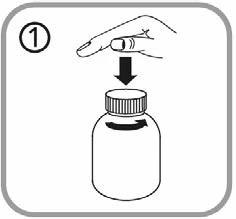
- Open the bottle: press down on the cap and turn it counterclockwise (Figure 1)
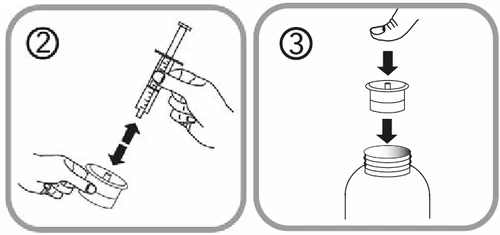
Before first use of Brivaracetam +pharma medicine, perform the following
steps:
- Separate the connector from the oral syringe (Figure 2).
- Push the connector onto the neck of the bottle (Figure 3). Make sure it is securely attached. There is no need to remove the connector after use.
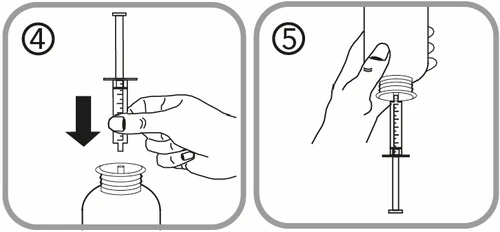
Each time you use Brivaracetam +pharma medicine, perform the following
steps:
- Insert the oral syringe into the opening of the connector (Figure 4).
- Turn the bottle upside down (Figure 5).
- Hold the inverted bottle with one hand, and use the other hand to fill the oral syringe.
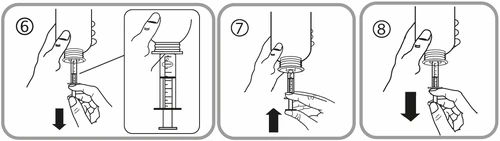
- Pull the plunger down slightly to draw a small amount of solution into the oral syringe (Figure 6).
- Then, by pushing the plunger, remove any air bubbles from the syringe (Figure 7).
- Pull the plunger down to the mark on the syringe scale corresponding to the dose prescribed by your doctor in millilitres (mL) (Figure 8). After administering the first dose, the plunger may rise again inside the barrel of the syringe. Therefore, before detaching the oral syringe from the bottle, ensure that the plunger is in the correct position.
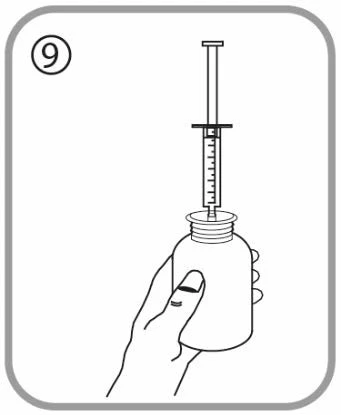
- Turn the bottle upright (Figure 9).
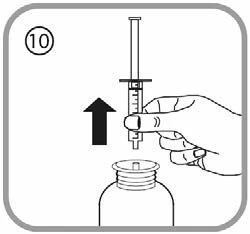
- Remove the oral syringe from the connector (Figure 10).
The medicine can be taken in two ways:
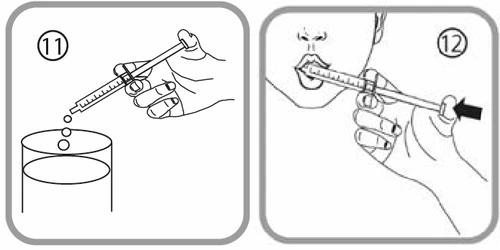
- Push the plunger fully to empty the contents of the oral syringe into water (or juice), then drink all the liquid (add enough water so it can be easily consumed) or
- Drink the solution directly from the oral syringe without water – drink the entire contents of the syringe (Figure 11).
- Close the bottle with the plastic cap (there is no need to remove the connector).
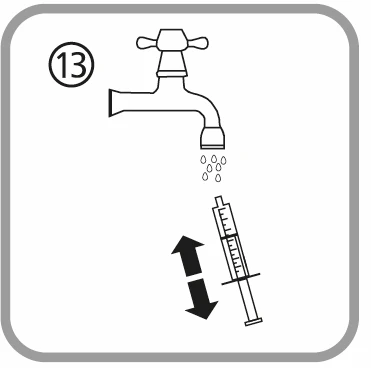
- To clean the oral syringe, rinse it with clean cold water only, moving the plunger up and down several times to draw in and expel water, without separating the two parts of the syringe (Figure 13).
- Store the bottle, oral syringe, and package leaflet in the cardboard box.
How long to take Brivaracetam +pharma
Brivaracetam +pharma is intended for long-term use – it should be taken until your doctor
decides that treatment should be stopped.
Taking more than the recommended dose of Brivaracetam +pharma
If you take more than the recommended dose of Brivaracetam +pharma, contact your doctor immediately.
Symptoms may include dizziness and drowsiness. Other possible symptoms include: nausea, vertigo,
problems with balance, anxiety, extreme tiredness, irritability, aggression, insomnia, depression,
and thoughts or attempts of self-harm or suicide.
Missing a dose of Brivaracetam +pharma
- If you miss a dose, take it as soon as possible.
- Take the next dose at the usual time.
- Do not take a double dose to make up for a missed dose.
- If in doubt, consult your doctor or pharmacist.
Stopping treatment with Brivaracetam +pharma
- Do not stop taking this medicine unless your doctor advises otherwise. Stopping treatment may lead to an increase in the number of epileptic seizures.
- If your doctor decides to discontinue this medicine, the dose will be gradually reduced. This helps prevent recurrence or worsening of seizures.
If you have any further questions about the use of this medicine, consult your doctor or pharmacist.
4. Possible adverse effects
Like all medicines, this medicine can cause adverse effects, although they do not occur in everyone.
Very common: may occur in more than 1 out of 10 people
- drowsiness or dizziness.
Common: may occur in less than 1 out of 10 people
- influenza
- feeling very tired
- seizures, sensation of spinning (dizziness)
- nausea, constipation
- depression, anxiety, insomnia, irritability
- nose and throat infections (e.g. cold), cough
- decreased appetite
Uncommon: may occur in less than 1 out of 100 people
- allergic reactions;
- disturbances in thinking and (or) loss of contact with reality (psychotic disorders), aggression, agitation;
- thoughts of self-harm or suicide, or such attempts – in such a case, contact your doctor immediately;
- decrease in white blood cell count (neutropenia) – confirmed in blood tests.
Unknown: frequency cannot be estimated from available data
- widespread rash with blisters and peeling of the skin, particularly around the mouth, nose, eyes and genital organs (Stevens-Johnson syndrome).
Additional adverse effects in children
Common: may occur in less than 1 out of 10 people
- restlessness and hyperactivity (excessive psychomotor activity).
Reporting of adverse effects
If any adverse effects occur, including any adverse effects not listed in this leaflet, inform your doctor or pharmacist. Adverse effects can be reported directly to the Department of Monitoring of Adverse Drug Reactions of the Office for Registration of Medicinal Products, Medical Devices and Biocidal Products, Al. Jerozolimskie 181C, 02-222 Warsaw, Tel.: +48 22 49 21 301, Fax: +48 22 49 21 309, Website: https://smz.ezdrowie.gov.pl.
Adverse effects can also be reported to the marketing authorization holder or the representative of the marketing authorization holder in Poland.
By reporting adverse effects, additional information on the safety of the medicine's use can be collected.
5. How to store Brivaracetam +pharma
Keep this medicine out of sight and reach of children.
Do not use this medicine after the expiry date stated on the outer carton or bottle after "EXP:". The expiry date refers to the last day of the specified month.
No special storage instructions apply for this medicine.
Shelf life after first opening the bottle: 10 months.
Medicines must not be disposed of via the sewage system or household waste. Ask your pharmacist how to dispose of medicines no longer required. Such measures will help protect the environment.
6. Contents of the pack and other information
What Brivaracetam +pharma contains
The active substance is brivaracetam.
Each millilitre (mL) contains 10 milligrams (mg) of brivaracetam.
The other ingredients are: sorbitol (liquid, non-crystallising), glycerol, sodium carmellose,
methyl parahydroxybenzoate, sodium citrate, sucralose, raspberry flavour (propylene glycol ~81%, triacetin ~1.3%), citric acid, purified water.
What Brivaracetam +pharma looks like and contents of the pack
Brivaracetam +pharma 10 mg/mL is a slightly viscous, clear, colourless solution.
A 300 mL amber glass bottle (type III) or an amber plastic bottle (PET), with a white child-resistant cap (PP/HDPE), accompanied by an oral syringe (PP, PE) marked in increments of 5 mL and 10 mL, and a syringe adapter made of PE.
All presented in a cardboard carton.
Marketing Authorisation Holder
+pharma arzneimittel gmbh
Hafnerstrasse 211
8054 Graz
Austria
Manufacturer
Labomed Pharmaceutical Company S.A.
Metaxa Ioanni 84
194 41 Kropia
Greece
Vianex S.A.
Plant A, 12th km. National Road Athens - Lamia
14451 Metamorfossi
Greece
PharmaPath S.A.
28is Oktovriou 1
12351 Agia Varvara
Greece
Genericon Pharma Ges.m.b.H.
Hafnerstrasse 211
8054 Graz
Austria
This medicinal product is authorised in the Member States of the European Economic Area under the following names:
Hungary: Litrunga 10 mg/ml oral solution
Austria: Brivaracetam Genericon 10 mg/ml solution for oral use
Poland: Brivaracetam +pharma
For further information about this medicinal product, please contact the local representative of the Marketing Authorisation Holder:
+pharma Polska sp. z o.o.
ul. Podgórska 34
31-536 Kraków, Poland
Tel: +48 12 262 32 36
Email: [email protected]