Bonevum
Poland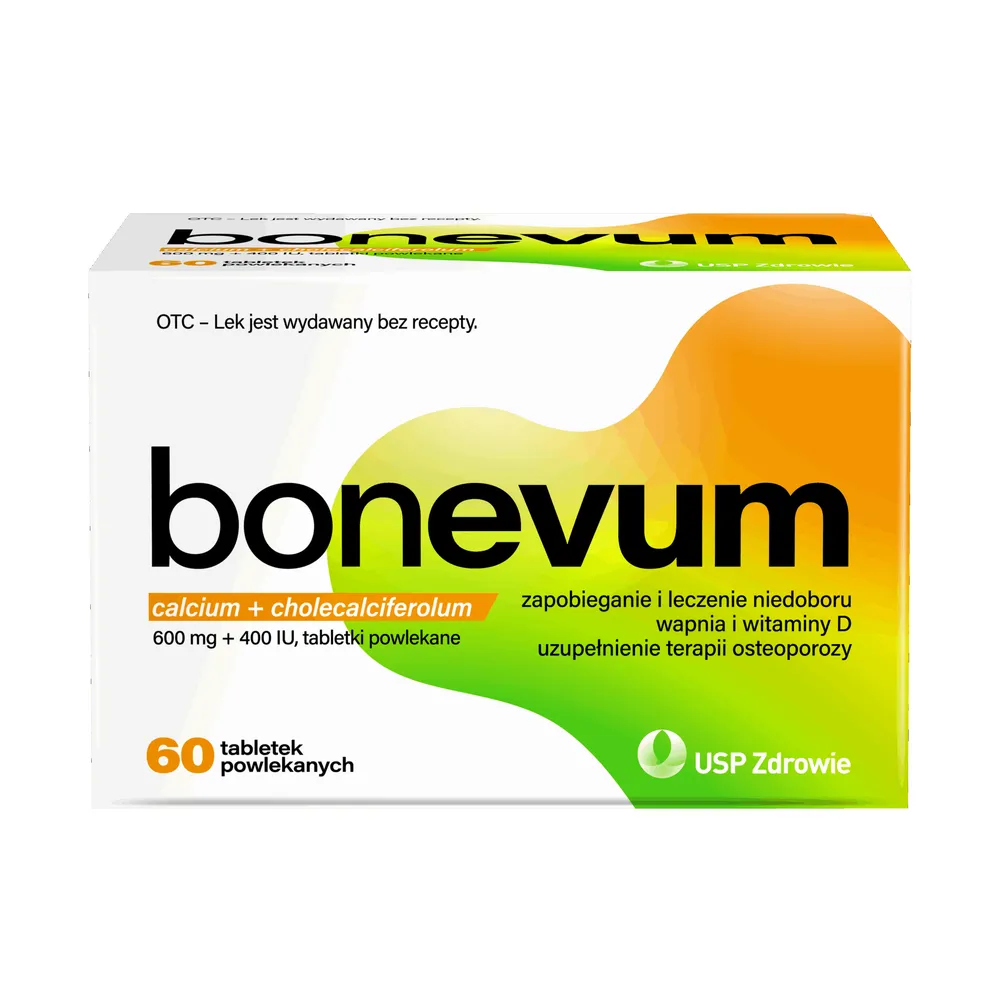
Table of Contents
bonevum
calcium + cholecalciferol
600 mg + 400 IU, film-coated tablets
Please read the entire leaflet carefully before taking the medicine, as it contains
important information for the patient.
This medicine should always be taken exactly as described in the patient leaflet or as advised by
the physician or pharmacist.
- Keep this leaflet, as you may need to read it again.
- If you need advice or further information, consult your pharmacist.
- If you experience any adverse reactions, including any possible side effects not listed in this leaflet, inform your doctor or pharmacist. See section 4.
- If there is no improvement after one month, or if you feel worse, contact your doctor.
Contents of the leaflet:
- What bonevum is and what it is used for
- Important information before taking bonevum
- How to take bonevum
- Possible side effects
- How to store bonevum
- Contents of the pack and other information
1. WHAT BONEVUM IS AND WHAT IT IS USED FOR
This is a combination medicine containing calcium (as calcium carbonate) and cholecalciferol (vitamin D).
The medicine is recommended for elderly patients for the prevention and treatment of calcium and vitamin D deficiency, substances essential for bone formation and normal bone metabolism.
It is also recommended as an adjunct to specific osteoporosis treatment in patients at high risk of calcium and vitamin D deficiency.
2. IMPORTANT INFORMATION BEFORE TAKING BONEVUM
When not to take bonevum:
- if you are allergic to the active substances or to any of the other ingredients of this medicine (listed in section 6);
- if you have kidney stones;
- if you have renal insufficiency or impaired kidney function;
- if you have excessive levels of vitamin D in the blood;
- if you have chronically elevated levels of calcium in the urine;
- bonevum contains hydrogenated soybean oil. If you are allergic to soy or peanuts, this medicine should not be used.
Warnings and precautions
Before taking bonevum, consult your doctor or pharmacist if:
- you have a kidney disease or impaired kidney function;
- you suffer from sarcoidosis (an inflammatory disease of unknown origin, characterized by the formation of cellular clusters in various organs);
- you are prone to developing kidney stones;
- you are immobilized and suffer from osteoporosis.
Your doctor should decide whether calcium and/or vitamin D can be administered in such cases.
If you take bonevum without a doctor's prescription, you should always consult your doctor if treatment lasts longer than one month.
If you are to receive bonevum for the treatment of osteoporosis, your doctor may measure your blood calcium levels before starting treatment.
During long-term treatment, your doctor may regularly monitor your blood calcium levels and kidney function. Depending on the results, your doctor may reduce the dose or decide to discontinue treatment.
Children and adolescents
bonevum is not intended for use in children and adolescents.
bonevum with other medicines
Tell your doctor or pharmacist about all medicines you are currently taking or have recently taken, including those obtained without a prescription.
Consult your doctor if you are taking:
- other medicines containing vitamin D or calcium, as concomitant use with bonevum may lead to a significant increase in blood calcium levels and cause adverse effects. During treatment with bonevum, do not take any other calcium- or vitamin D-containing medicines without consulting your doctor;
- thiazide diuretics;
- systemic corticosteroids (anti-inflammatory medicines taken orally or intravenously);
- cardiac glycosides (used in the treatment of heart failure).
Exercise particular caution if you are taking:
- ion-exchange resins, e.g. cholestyramine, or laxatives such as liquid paraffin, as these may reduce intestinal absorption of vitamin D;
- medicines containing tetracyclines (antibiotics), because calcium carbonate may interfere with their absorption. Therefore, tetracycline-containing medicines should be taken at least two hours before or four to six hours after taking bonevum;
- medicines known as bisphosphonates (used in osteoporosis treatment) or sodium fluoride. If used together with bonevum, they should be taken at least three hours before taking bonevum;
- absorption of quinolone antibiotics may be reduced when taken with calcium. Quinolone antibiotics should be taken at least 2 hours before or at least 6 hours after taking a calcium-containing medicine;
- rifampicin (used in tuberculosis treatment), phenytoin (a medicine used in epilepsy), or barbiturates (medicines used in epilepsy or as sedatives), as they may reduce the effectiveness of vitamin D;
- estramustine (a medicine used in chemotherapy), thyroid hormones, or medicines containing iron, zinc, or strontium, as their absorption may be reduced. These should be taken at least 2 hours before or after taking bonevum.
bonevum with food and drink
Oxalic acid (found in spinach, sorrel, and rhubarb) and phytic acid (present in whole-grain cereal products) may inhibit calcium absorption. After consuming foods high in oxalic or phytic acid, you should not take bonevum for at least 2 hours.
Pregnancy, breastfeeding, and fertility
If you are pregnant or breastfeeding, think you may be pregnant, or are planning to have a baby, consult your doctor or pharmacist before using this medicine.
During pregnancy, daily intake of calcium should not exceed 1500 mg and vitamin D 600 IU (international units). Pregnant women should avoid overdosing on calcium and vitamin D, as prolonged hypercalcemia may adversely affect fetal development.
During pregnancy, bonevum may be used at the recommended doses only in cases of calcium and vitamin D deficiency. Otherwise, the daily dose of bonevum should not exceed one tablet.
bonevum may be used during breastfeeding, but your doctor should inform you that calcium and vitamin D pass into breast milk. This should be considered when administering additional vitamin D to the infant.
There are no data on the effect of bonevum film-coated tablets on fertility.
Driving and operating machinery
There are no data on the effect of this medicine on the ability to drive or operate machinery.
bonevum contains soybean oil and sucrose.
- bonevum contains hydrogenated soybean oil. If you are allergic to soy or peanuts, this medicine is not recommended.
- bonevum contains sucrose. If you have been previously diagnosed with intolerance to certain sugars, consult your doctor before starting this medicine.
3. HOW TO USE THE MEDICINAL PRODUCT BONEVUM
Bonevum should always be used according to the instructions provided in this leaflet or as directed by a physician. If in doubt, consult a doctor or pharmacist.
The usual dose for adults and elderly patients is one coated tablet twice daily.
It is recommended to swallow the coated tablets 1–1.5 hours after a meal, with a glass of water or juice, without chewing. If necessary, the tablet may be divided in half.
Continuous use of Bonevum is recommended for the duration of the indicated physiological condition or indicated disease (osteoporosis). Patients undergoing long-term treatment with Bonevum as a supplement in osteoporosis therapy should consult their physician at least once a year.
Use in children and adolescents
The Bonevum coated tablet is not intended for use in children and adolescents.
Use of a higher than recommended dose of Bonevum
Taking a higher than recommended dose may lead to calcium and vitamin D overdose.
Symptoms of calcium overdose: loss of appetite, thirst, nausea, vomiting, constipation, abdominal pain, muscle weakness, fatigue, psychiatric disturbances, excessive thirst, frequent urination, bone pain, kidney calcification, and in severe cases, cardiac arrhythmias.
Very high calcium overdose may lead to coma and death. Persistently elevated blood calcium levels may cause irreversible kidney failure and calcification of soft tissues.
Treatment: discontinue use of Bonevum and contact a physician immediately.
Missed dose of Bonevum
Do not take a double dose to make up for a missed tablet, as this may increase the risk of overdose.
Continue taking the medicine according to the prescribed schedule.
If you have any further questions about the use of this medicine, consult your doctor or pharmacist.
4. POSSIBLE ADVERSE REACTIONS
Like any medicine, Bonevum may cause adverse reactions, although not everyone experiences them.
The adverse reactions listed below are categorized according to system organ classes and frequency of occurrence.
Frequency is defined as follows:
- uncommon: (affects 1 to 10 per 1,000 patients)
- rare: (affects 1 to 10 per 10,000 patients)
- very rare: (affects less than 1 per 10,000 patients)
Uncommon: increased calcium levels in the blood (hypercalcaemia) – symptoms include: nausea, vomiting, loss of appetite, constipation, stomach pain, bone pain, excessive thirst, frequent urination, muscle weakness, drowsiness, confusion, and increased calcium excretion in urine (hypercalciuria).
Rare: constipation, bloating, nausea, abdominal pain, diarrhoea, itching, rash, urticaria.
Very rare: milk-alkali syndrome (occurs mainly in cases of overdose).
Reporting of adverse reactions
If any adverse reactions occur, including any adverse reactions not listed in this leaflet, consult a doctor or pharmacist. Adverse reactions can be reported directly to the Department of Monitoring Adverse Drug Reactions of the Office for Registration of Medicinal Products, Medical Devices and Biocidal Products, Al. Jerozolimskie 181C, 02-222 Warsaw, phone: +48 (22) 49 21 301, fax: +48 (22) 49 21 309, website: https://smz.ezdrowie.gov.pl
Adverse reactions can also be reported to the marketing authorization holder.
Reporting adverse reactions helps to provide more information on the safety of the medicine.
5. HOW TO STORE BONEVUM
Do not store above 25°C. Keep in the original packaging to protect from moisture.
Store in a place inaccessible and out of sight of children.
Do not use BONEVUM after the expiry date indicated on the packaging (EXP).
The expiry date refers to the last day of the specified month.
Medicines must not be disposed of via wastewater or household waste. Ask your pharmacist
how to dispose of medicines no longer required. This will help protect the environment.
6. PACK CONTENTS AND OTHER INFORMATION
What Bonevum contains
Active substances: 400 IU cholecalciferol (corresponding to 10 micrograms) (+10% overage for
stability), 600 mg calcium (as 1500 mg calcium carbonate) in each coated tablet.
Other ingredients:
Tablet core: magnesium stearate, crospovidone (type A), copovidone (K value: 25.2 – 30.8),
microcrystalline cellulose, sucrose, gelatin, all-rac-α-tocopherol (E 307), hydrogenated soybean
oil, corn starch.
Coating: iron oxide, yellow (E 172), hypromellose (15 mPa s), titanium dioxide (E 171), macrogol
3350, talc.
What Bonevum looks like and contents of the pack
Ochre-coloured, oval-shaped coated tablet with a breakline on one side. The fracture surface is white.
The breakline is intended to facilitate breaking the tablet for easier swallowing and is not intended
for dividing the tablet into equal parts.
The cardboard carton contains 10 coated tablets packed in transparent, colourless PVC/Al blisters of
3, 6 or 9 tablets.
Not all pack sizes may be marketed.
Marketing Authorisation Holder and Manufacturer
Marketing Authorisation Holder:
US Pharmacia Sp. z o.o.
ul. Ziębicka 40
50-507 Wrocław, Poland
Manufacturer:
Béres Pharmaceuticals Ltd.
H-5000 Szolnok, Nagysándor József út 39, Hungary
For further information on this medicinal product, please contact the representative of the
Marketing Authorisation Holder:
USP Zdrowie Sp. z o.o., ul. Poleczki 35, 02-822 Warsaw, tel.: +48 (22) 543 60 00.
This medicinal product is authorised in the European Economic Area countries under the
following names:
Poland: bonevum
Bulgaria, Hungary: CalciviD
Czech Republic: Videmel
Estonia: CalciviD 600 mg/400 IU
Latvia: CalciviD 600 mg/400 SV apvalkotā tablete
Romania: Calcium Colecalciferol Béres 600 mg/400 IU comprimat filmat
Slovakia: Kalcizen