Bleomedac
Poland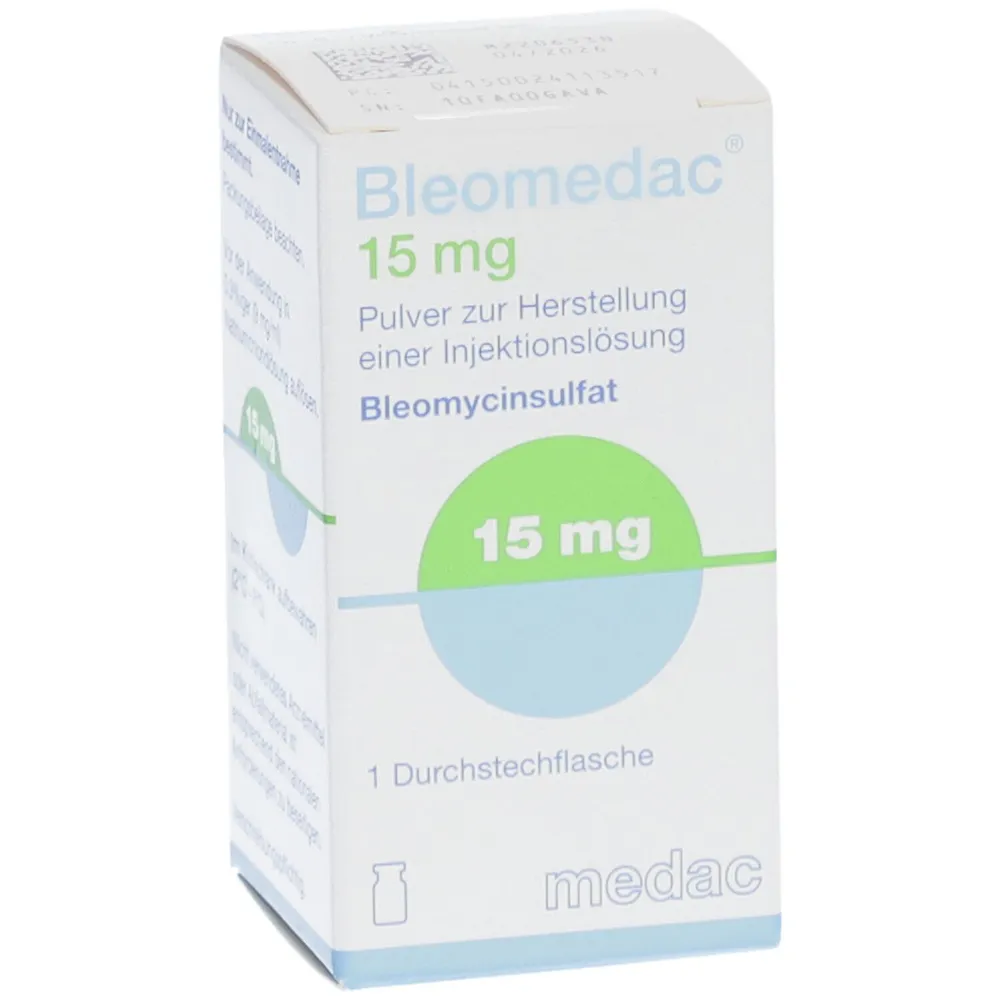
Table of Contents
- Package leaflet: Information for the user
- 1. What Bleomedac is and what it is used for
- 2. Important information before administering Bleomedac
- 3. How to administer Bleomedac
- 4. Possible adverse reactions
- 5. How to store Bleomedac
- 6. Contents of the pack and other information
- Information intended exclusively for medical professionals:
Package leaflet: Information for the user
Bleomedac 15000 IU (according to the European Pharmacopoeia) = 15 U (according to the United States Pharmacopeia)/vial
powder for solution for injection
bleomycin sulphate
Please read all of this leaflet carefully before this medicine is administered, because it contains important information for you.
- Keep this leaflet. You may need to read it again.
- If you have any further questions, ask your doctor, pharmacist, or nurse.
- If you get any side effects, talk to your doctor, pharmacist, or nurse. This includes any possible side effects not listed in this leaflet. See section 4.
Contents of the leaflet
- What Bleomedac is and what it is used for
- What you need to know before being given Bleomedac
- How Bleomedac is given
- Possible side effects
- How to store Bleomedac
- Contents of the pack and other information
1. What Bleomedac is and what it is used for
This medicine contains bleomycin sulphate. This substance belongs to a group of medicines called cytostatic agents. These are anticancer medicines, sometimes referred to as chemotherapy. They attack cancer cells and prevent them from dividing.
Bleomedac is usually used in combination with other anticancer medicines or radiotherapy. It is used to treat:
- Cancers of the head and neck, cervix, and external genital organs
- Hodgkin's disease and non-Hodgkin's lymphomas (lymph gland tumours)
- Testicular cancer
- Malignant fluid accumulation in the lungs (pleural effusion due to tumour)
2. Important information before administering Bleomedac
When not to administer Bleomedac
- If the patient is allergic to bleomycin or any of the other ingredients of this medicine (listed in section 6). An allergic reaction may manifest as rash, itching, difficulty breathing, or swelling of the face, lips, throat, or tongue.
- If the patient has lung inflammation or other lung problems.
- If the patient has previously experienced lung damage which was (or could have been) caused by bleomycin administration.
- If the patient has been diagnosed with ataxia-telangiectasia (a very rare inherited disorder causing movement difficulties and increased risk of infections).
- If the patient is breastfeeding.
Warnings and precautions
Before starting treatment with Bleomedac, discuss this with the doctor or pharmacist.
Special caution is required when administering Bleomedac:
- If the patient has impaired kidney or liver function.
- If the patient has a lung disease.
- If the patient has previously undergone radiotherapy to the chest area or is currently receiving radiotherapy during bleomycin treatment.
- If the patient is receiving oxygen therapy.
- If the patient is over 60 years of age.
Patients belonging to any of the above groups may be more susceptible to the harmful effects of bleomycin on the lungs.
The doctor will likely monitor the patient more frequently and (or) order chest X-rays.
Patients receiving bleomycin should undergo regular lung function tests to monitor for potential harmful effects of bleomycin on the lungs.
Immediately inform the doctor if the patient develops cough and (or) shortness of breath, as this may indicate harmful effects of bleomycin on the lungs.
Like other cytotoxic active substances, bleomycin may cause tumor lysis syndrome in patients with rapidly growing tumors. Appropriate supportive treatment and pharmacological measures may prevent or alleviate such complications.
Bleomedac and other medicines
Inform the doctor or pharmacist about all medicines the patient is currently taking, has recently taken, or plans to take.
This is particularly important for any of the following medicines, as they may interact with Bleomedac:
- carmustine, mitomycin C, cyclophosphamide, and methotrexate (a medicine used in the treatment of certain types of cancer, rheumatism, and severe skin disorders); increased risk of lung damage.
- vinca alkaloids (vincristine, vinblastine; a group of medicines used in the treatment of certain types of cancer); this combination may impair blood flow to fingers and toes and the nose. In severe cases, this may lead to tissue necrosis in these body parts.
- cisplatin (an anticancer medicine) and other medicines that damage the kidneys, as this increases the risk of adverse reactions following bleomycin administration.
- digoxin (a medicine used for heart conditions); the effect of digoxin may be reduced.
- phenytoin (used in the treatment of epilepsy).
- live vaccines, as they may lead to severe and fatal infections.
The medicinal products listed above may be known to the patient under different names, often their brand names. Always carefully read the information on the outer packaging or in the patient leaflet of the medicinal product to check which active substances it contains. Remember that the above-mentioned products may also include medicines taken recently or those the patient may take in the future.
Also inform the doctor if:
- the patient has recently undergone or will undergo radiotherapy to the chest area; the risk of adverse reactions in the lungs and (or) skin is increased;
- the patient will receive oxygen therapy; there is an increased risk of toxic effects on the lungs when oxygen is administered during general anesthesia. Nevertheless, the patient may still be able to receive Bleomedac. The doctor will decide on the appropriate management for the patient.
Pregnancy, breastfeeding, and effects on fertility
Pregnancy
If the patient is pregnant or breastfeeding, suspects she may be pregnant, or is planning to have a child, she should consult her doctor or pharmacist before receiving this medicine.
There are insufficient clinical data on Bleomedac to assess its potential harm during pregnancy. However, animal studies have shown that bleomycin has harmful effects on the fetus.
Bleomycin should not be used during pregnancy, especially during the first three months.
If a patient becomes pregnant during treatment with Bleomedac, she should discuss the potential risks to the unborn child with her doctor and be closely monitored.
If a patient is considering pregnancy after completing therapy, she should seek advice from a genetics specialist prior to conception.
Effective contraceptive methods should be used during treatment and for at least 6 months after treatment with this medicine has ended.
Breastfeeding
It is not known whether this medicine passes into human milk, but due to the potential harmful effects of bleomycin on the infant, breastfeeding should not be undertaken during treatment with Bleomedac. It may have harmful effects on the child.
Fertility
Men should seek advice regarding sperm cryopreservation, as treatment may lead to infertility.
Driving and operating machinery
Do not drive or operate machinery. This medicine may cause nausea and vomiting, which may affect the ability to drive.
3. How to administer Bleomedac
This medicine should always be administered according to the doctor's instructions. If in doubt,
contact the doctor or pharmacist.
If the effect of Bleomedac is too strong or too weak, consult the
doctor, pharmacist, or nurse.
Dosage
The recommended dose depends on the therapeutic indication, age, renal function, and combination
with other antineoplastic drugs. Therefore, administration may involve, for example, one or two
injections per week. The doctor will determine the bleomycin dose, duration of treatment, and number of
treatment sessions. These may vary depending on the individual patient.
There is a risk of severe hypersensitivity reactions, especially in patients diagnosed with lymphoma,
which may occur immediately after administration of the drug or somewhat later. Therefore, the doctor will administer a test dose and
observe the patient for 4 hours before initiating bleomycin treatment for the first time.
Method of administration
The doctor will administer bleomycin by intravenous or intra-arterial infusion or injection, subcutaneously, into the pleural space (intrapleurally), into the peritoneal cavity (intraperitoneally), intramuscularly, or directly into the tumor.
Accidental overdose of Bleomedac
Symptoms that may occur if the patient has received an overdose of Bleomedac include: low
blood pressure, fever, rapid heartbeat, and shock. If overdose is suspected, inform the doctor immediately and discontinue administration of the drug without delay.
Missed dose of Bleomedac
If the patient misses a dose, contact the doctor to determine whether and when the missed dose should be administered.
Stopping Bleomedac treatment
If the patient suddenly stops taking Bleomedac without consulting the doctor, symptoms that were present before starting treatment may recur.
If there are any further questions regarding the use of this medicine, consult the doctor, pharmacist, or nurse.
4. Possible adverse reactions
Like all medicines, this medicine can cause adverse reactions, although not everyone experiences them.
Serious adverse reactions
You should immediately inform your doctor if any of the following adverse reactions occur:
- Cough,
- Shortness of breath,
- Crackling or popping sounds during breathing. Discontinuation of treatment may be necessary.
The following adverse reactions have also been reported:
Very common (may occur in more than 1 in 10 people)
- Pneumonitis (inflammatory condition in the lungs). This may cause irreversible lung damage and may lead to death. If a patient develops cough and/or shortness of breath, this should be reported to the doctor immediately (see section 2 "Warnings and precautions").
- Stomatitis. Inflammation or ulceration of mucous membranes may worsen when radiotherapy or other drugs harmful to mucous membranes are administered concomitantly. Mucosal inflammation of the mouth rarely becomes severe and usually resolves after completion of treatment.
- Nausea, vomiting, loss of appetite, weight loss.
- Rash, itching, and skin thickening. Sensitivity and swelling of fingertips, skin fissures, hyperpigmentation (increased pigment production), blisters, nail changes, skin swelling in areas exposed to pressure (e.g. elbows), hair loss, red and peeling skin, and fever; skin problems on hands and feet, such as redness and rash, rarely become severe and usually resolve after completion of therapy.
Common (may occur in no more than 1 in 10 people)
- Severe hypersensitivity reactions. These reactions may occur immediately or several hours after the first or second dose. You should immediately inform your doctor if sudden wheezing, difficulty breathing, swelling of eyelids, face or lips, rash or itching (especially if affecting the whole body) occur.
- Allergic reactions.
- Acute respiratory failure (Acute Respiratory Distress Syndrome - ARDS).
- Pulmonary embolism.
- Fever (2 to 6 hours after the first injection), tumour pain, and headache.
Uncommon (may occur in no more than 1 in 100 people)
- Blood changes. These may be observed as unexpected bleeding and/or bruising. These symptoms resolve after completion of treatment.
- Changes in white blood cell count (detectable by tests performed by a doctor), called leukopenia (decreased number of white blood cells) and neutropenia (decreased number of neutrophils in the blood).
- Bleeding (haemorrhage).
- Diarrhoea.
Rare (may occur in no more than 1 in 1,000 people)
- Febrile neutropenia (fever caused by decreased number of white blood cells).
- Myocardial infarction, disorders of blood vessels of the heart.
- Cases of circulatory shock, elevated body temperature, and death associated with administration of bleomycin into the space surrounding the lung (intracavitary administration) have been reported.
- When doses higher than recommended were used, acute reactions accompanied by elevated body temperature and severe adverse reactions affecting the heart and respiratory system have been reported.
- Damage to blood vessels (e.g. impaired blood flow to the brain, inflammatory condition of blood vessels in the brain, and severe disorder affecting kidneys and blood, i.e. haemolytic-uraemic syndrome), arterial thrombosis.
- Liver function disorders.
Very rare (may occur in no more than 1 in 10,000 people)
- Tumour lysis syndrome (a condition following rapid breakdown of tumour cells).
Frequency not known (frequency cannot be estimated from available data)
- Infections, including systemic infections (sepsis).
- Marked decrease in blood cells (pancytopenia).
- Decreased number of red blood cells (anaemia).
- Muscle and limb pain.
- Abnormal sperm cells (aneuploid spermatozoa) may occur during and immediately after chemotherapy with bleomycin.
- Skin sclerosis.
- Low blood pressure.
- Blockage of a blood vessel.
- Reduced blood flow to fingers, toes, and tip of the nose (Raynaud's phenomenon).
- Unexplained sensations of tingling, itching, or numbness (paraesthesia).
- Abnormal increase in sensitivity to stimuli (hyperesthesia).
- Pain at injection site.
- Inflammation of blood vessels (thrombophlebitis).
Reporting of adverse reactions
If any adverse effects occur, including any adverse effects not listed
in this leaflet, you should inform your doctor, pharmacist, or nurse. Adverse reactions
can also be reported directly to the Department of Monitoring of Adverse Drug Reactions of the Office for Registration of Medicinal Products, Medical Devices and Biocidal Products:
Al. Jerozolimskie 181C, 02-222 Warsaw, tel.: + 48 22 49-21-301, fax: + 48 22 49-21-309,
website: https://smz.ezdrowie.gov.pl
Adverse reactions can also be reported to the marketing authorisation holder.
Reporting adverse reactions helps provide more information on the safety of the medicine.
5. How to store Bleomedac
Keep this medicine out of the sight and reach of children. The physician and (or)
hospital pharmacist are responsible for the proper storage, administration, and disposal of Bleomedac.
This medicine should be stored in its original packaging in a refrigerator at a temperature of
2°C–8°C.
After reconstitution
After reconstitution in the vial, chemical and physical stability has been demonstrated for 24 hours when stored at 2°C–8°C and for 72 hours at 25°C.
After dilution
After dilution, chemical and physical stability has been demonstrated for 72 hours at 25°C in glass bottles and polypropylene syringes.
From a microbiological point of view, the product should be used immediately. If not used immediately, the user is responsible for the storage conditions and duration prior to use, and the storage time should generally not exceed 24 hours at 2°C–8°C, provided that reconstitution/dilution was carried out under controlled and validated aseptic conditions.
Do not use this medicine after the expiry date stated on the label and carton following:
Expiry date. The expiry date refers to the last day of the stated month.
Do not administer this medicine if visible signs of deterioration of the product or vial are observed, such as a change in the color of the compressed powder cake, or damage to the vial, stopper, or aluminium cap.
Medicines must not be disposed of via sewage systems or household waste. Ask a pharmacist how to dispose of medicines no longer in use. Such measures will help protect the environment.
6. Contents of the pack and other information
What Bleomedac contains
The active substance is bleomycin sulfate. The medicine contains no other ingredients.
One 10 ml vial contains 15,000 IU (according to the European Pharmacopoeia) of bleomycin
(as bleomycin sulfate).
1 mg of dry powder corresponds to at least 1,500 IU (according to the European Pharmacopoeia).
What Bleomedac looks like and contents of the pack
Bleomedac is a powder ranging from white to yellowish-white in colour.
Bleomedac is available in cardboard packs containing 1 or 10 vials (made of type I glass).
Not all pack sizes may be marketed.
Marketing Authorisation Holder and Manufacturer
medac
Gesellschaft für klinische Spezialpräparate mbH
Theaterstr. 6
22880 Wedel
Germany
Tel: +49 4103 8006-0
Fax: +49 4103 8006-100
This medicine is authorised in the following names in the Member States of the European Economic Area:
Czech Republic Bleomedac
Estonia Bleomycin medac 15000 RÜ süstelahuse pulber
Netherlands Bleomedac, powder for solution for injection 15000 IU and 30000 IU (Ph. Eur.)
Lithuania Bleomycin medac 15000 TV milteliai injekciniam tirpalui
Latvia Bleomycin medac 15000 SV pulveris injekciju šķīduma pagatavošanai
Poland Bleomedac
Slovakia Bleomedac 15000 IU
Slovenia Bleomicin medac 15000 i.e. (Ph. Eur.), prašek za raztopino za injiciranje
Information intended exclusively for medical professionals:
Special precautions for removal and preparation of the medicinal product for use
Route of administration
Intramuscular and subcutaneous injection: dissolve the required dose in no more than 5 mL of a suitable diluent, e.g. sodium chloride solution 9 mg/mL (0.9%). If pain occurs at the injection site, a local anaesthetic suitable for injection (1% lidocaine solution) may be added to the ready-to-use solution.
Intravenous administration: dissolve the required dose in 5–1000 mL of sodium chloride solution 9 mg/mL (0.9%) and administer slowly by injection or add to an ongoing infusion.
Intra-arterial administration: slow infusion using sodium chloride solution 9 mg/mL (0.9%) is used.
Intrapleural injection: dissolve 60 x 10³ IU in 100 mL of sodium chloride solution 9 mg/mL (0.9%).
Local/intratumoural injections: bleomycin is dissolved in sodium chloride solution 9 mg/mL (0.9%) to achieve a concentration of 1–3 x 10³ IU/mL of solution.
Standard precautions for the preparation and administration of cytotoxic drugs must be observed. For safety measures and waste disposal procedures, applicable guidelines for safe handling of antineoplastic medicinal products must be followed. The product must be prepared by specially trained personnel. Pregnant women should be advised to avoid working with cytotoxic agents. The product must be prepared under aseptic conditions in a specifically designated area. Smoking, eating, or drinking are prohibited in this area. Protective gloves, mask, goggles, and protective clothing must be used. Use of a laminar airflow cabinet (LAF) is recommended. Gloves must be worn during administration of the drug. Waste disposal procedures must take into account the cytotoxic nature of this substance. Direct contact with skin, eyes, and mucous membranes must be avoided. In case of direct contact, the affected area must be immediately and thoroughly flushed with water. Soap may be used for washing the skin. Caution must be exercised when handling excreta and vomit.
Any unused medicinal product or waste material must be disposed of in accordance with local regulations.