Biotaksim
Poland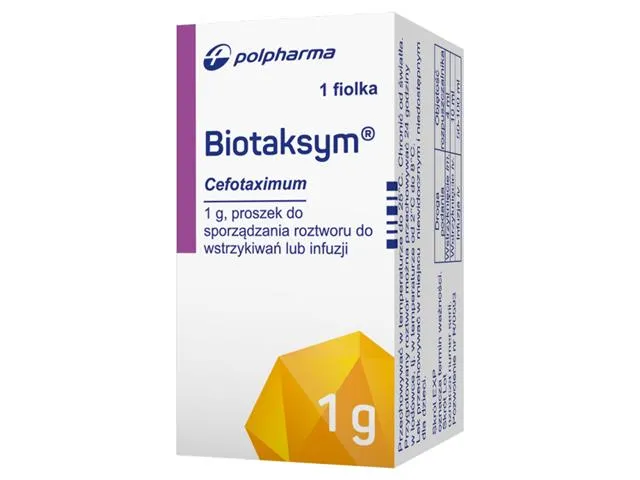
Table of Contents
- Package leaflet: Information for the user
- 1. What Biotaksym is and what it is used for
- 2. Important information before using Biotaksym
- 3. How to use Biotaksym
- 4. Possible adverse reactions
- 5. How to store Biotaksym
- 6. Package contents and other information
- Information intended exclusively for healthcare professionals
Package leaflet: Information for the user
BIOTAKSYM, 1 g, powder for solution for injection or infusion
BIOTAKSYM, 2 g, powder for solution for injection or infusion
Cefotaximum
Please read this leaflet carefully before using this medicine, as it contains
important information for you.
- Keep this leaflet, as you may need to read it again.
- If you have any questions, please consult your doctor or nurse.
- This medicine has been prescribed for a specific individual. Do not pass it on to others. It may harm someone else even if their symptoms are the same as yours.
- If you experience any adverse reactions, including any not listed in this leaflet, inform your doctor or nurse. See section 4.
Leaflet contents
- What Biotaksym is and what it is used for
- What you need to know before using Biotaksym
- How to use Biotaksym
- Possible side effects
- How to store Biotaksym
- Contents of the pack and other information
1. What Biotaksym is and what it is used for
Biotaksym contains a third-generation cephalosporin antibiotic – cefotaxime.
After dissolution and appropriate dilution, the medicine is administered intramuscularly or intravenously (by injection or infusion).
Cefotaxime is used:
- for the treatment of severe infections caused by susceptible bacteria:
- lower respiratory tract infections, including pneumonia;
- urinary tract infections;
- pelvic infections;
- sepsis;
- skin and soft tissue infections;
- intra-abdominal infections, including peritonitis;
- bone and joint infections;
- central nervous system infections, including meningitis;
- for the prevention of perioperative infections.
2. Important information before using Biotaksym
When not to use Biotaksym:
- if the patient is allergic to cefotaxime or other cephalosporins;
- if the patient is taking penicillins, due to the risk of cross-reactions (see section: "Biotaksym with other medicines");
- if the patient has ever experienced severe skin rash, skin peeling, blisters, or oral ulcers after taking cefotaxime or other cephalosporins;
- with lidocaine-containing formulation:
- in patients allergic to lidocaine or other amide-type local anesthetics;
- for intravenous administration;
- in infants under 30 months of age;
- in patients with severe heart failure or heart block (without a pacemaker).
Warnings and precautions
Before starting treatment with Biotaksym, discuss this with your doctor or nurse.
- If the patient has allergies, especially to cephalosporins and penicillins (and other beta-lactam antibiotics), special caution is required, as patients allergic to penicillins may also be allergic to cephalosporins (so-called cross-allergy). There is a risk of severe allergic reaction. If an allergic reaction occurs, treatment with cefotaxime must be stopped immediately and appropriate therapy initiated if necessary. In managing severe reactions, adrenaline and other anti-shock medications (circulatory support agents, corticosteroids, and antihistamines) may be required.
- Serious skin reactions have been reported during cefotaxime therapy, including Stevens-Johnson syndrome, toxic epidermal necrolysis, drug reaction with eosinophilia and systemic symptoms (DRESS syndrome), and acute generalized exanthematous pustulosis (AGEP). If any symptoms associated with these serious skin reactions (described in section 4) occur, cefotaxime must be discontinued immediately and medical advice sought without delay.
- If the patient has impaired kidney function, the doctor may recommend monitoring kidney function and, if necessary, reducing the dose.
- If neurological symptoms such as altered consciousness, abnormal movements, or seizures occur, the patient should consult a doctor before continuing treatment.
- With prolonged use of cefotaxime, as with other antibiotics, initially susceptible strains may become resistant and overgrowth of Enterococcus spp. may occur. The doctor may then recommend performing an antibiogram.
- If diarrhea occurs during treatment, the patient should consult a doctor for appropriate management. Very rarely, pseudomembranous colitis, characterized by diarrhea, may occur during or after antibiotic therapy. The condition may range from mild to severe. Mild cases usually resolve after discontinuation of the drug. In more severe cases, the doctor may prescribe metronidazole or vancomycin. Medications that inhibit peristalsis or have constipating effects should not be used.
- If the patient has a history of intestinal inflammation, particularly colitis.
- If the patient is treated for longer than 7 days, the doctor may recommend monitoring white blood cell count and liver function.
Children
Biotaksym should be administered intravenously only in children under 2 months of age.
Biotaksym with other medicines
Inform your doctor about all medicines currently used, recently taken, or planned for use.
Exercise caution when administering cefotaxime concomitantly with:
- bacteriostatic agents (e.g., tetracycline, erythromycin, chloramphenicol, sulfonamides) – may reduce the antibacterial effect of cefotaxime;
- aminoglycoside antibiotics (e.g., streptomycin) and potent diuretics (e.g., furosemide) – may increase nephrotoxic effects;
- probenecid – increases serum concentration of cefotaxime and prolongs its action.
Effect on laboratory test results
Cefotaxime use may cause:
- false-positive results in urine glucose reduction tests;
- false-positive Coombs test results.
Pregnancy and breastfeeding
If the patient is pregnant or breastfeeding, suspects she may be pregnant, or is planning to become pregnant, she should consult a doctor or pharmacist before using this medicine.
Pregnancy
The safety of cefotaxime use in pregnant women has not been established. Therefore, cefotaxime should not be used during pregnancy unless the expected benefits outweigh the potential risks.
Breastfeeding
Cefotaxime passes into human milk. Effects on the normal intestinal flora of breastfed newborns cannot be excluded, potentially leading to diarrhea and colonization with yeast-like fungi. An allergic reaction may also occur in the newborn.
The decision whether to discontinue breastfeeding or interrupt treatment should be discussed with the doctor, taking into account the benefits of breastfeeding for the child and the benefits of treatment for the mother.
Driving and operating machinery
There is no evidence that cefotaxime directly impairs the ability to drive or operate machinery. However, high doses of cefotaxime, particularly in patients with renal impairment, may cause disturbances in consciousness, motor disturbances, and seizures. In such cases, driving and operating machinery should be avoided.
Biotaksym contains sodium
The medicine contains 48 mg of sodium (main component of table salt) per gram. This corresponds to 2.4% of the maximum recommended daily dietary sodium intake for adults.
This should be taken into account in patients with impaired kidney function and in patients controlling sodium intake in their diet.
Preparation of the medicine for administration – see section: "Information intended exclusively for healthcare professionals" at the end of the leaflet. When calculating the total sodium content in the prepared diluted solution, sodium from the diluent must also be considered. For accurate information on sodium content in the solution used for dilution, refer to the patient leaflet of the diluent used.
3. How to use Biotaksym
This medicine should always be used as directed by the physician. In case of doubt, consult
your doctor.
The dosage and method of administration are determined by the physician according to the severity and type of infection, age, body weight, and renal function of the patient.
Detailed dosage instructions, as well as directions for use and preparation of the medicine for administration, are provided at the end of this leaflet, in the section entitled "Information intended exclusively for healthcare professionals".
Use of a higher than recommended dose of Biotaksym
If the patient suspects having received an excessive dose of Biotaksym, this should be reported to the doctor immediately. Overdose is particularly likely in patients with renal impairment. Symptoms may include seizures, tremor, and coma. In such cases, administration of the medicine should be discontinued and appropriate treatment initiated. Haemodialysis removes the drug from the body.
Missed dose of Biotaksym
If the patient suspects that a dose of Biotaksym has been missed, inform the doctor as soon as possible.
4. Possible adverse reactions
Like all medicines, this medicine can cause adverse reactions, although they do not occur in everyone.
Below are the adverse reactions and their frequency of occurrence.
Cefotaxime should be discontinued immediately and a doctor should be informed if the patient
experiences any of the following symptoms:
- Red, flat, target-shaped or circular spots on the trunk, often with central blisters, skin peeling, and ulcers in the mouth, throat, nose, genital organs, and eyes. These severe skin rashes may be preceded by fever and flu-like symptoms (Stevens-Johnson syndrome or toxic epidermal necrolysis).
- Extensive rash, high fever, and enlarged lymph nodes (DRESS syndrome or drug hypersensitivity syndrome).
- Red, scaly widespread rash with subcutaneous nodules and blisters, accompanied by fever. Symptoms usually appear at the beginning of treatment (acute generalized exanthematous pustulosis).
Very common (occurring in more than 1 in 10 patients):
- Pain at the injection site after intramuscular administration.
Uncommon (occurring in 1 to 10 in 1,000 patients):
- Decrease in white blood cell count, increase in eosinophils (a type of white blood cells), decrease in platelet count, Herxheimer reaction (symptoms appearing within a few weeks after starting Lyme disease treatment such as skin rash, itching, fever, leukopenia, breathing difficulties, joint complaints),
- Seizures,
- Diarrhea,
- Increased activity of liver enzymes (AlAT, AspAT, LDH, GGTP, alkaline phosphatase) and/or increased bilirubin concentration,
- Rash, skin itching, urticaria,
- Worsening of kidney function and/or increased creatinine concentration (when used with aminoglycosides),
- Fever, inflammatory reactions at the injection site including phlebitis or thrombophlebitis.
Frequency not known (cannot be estimated from available data):
- Superinfections, decreased neutrophil count (a type of white blood cells), including life-threatening (neutropenia), hemolytic anemia,
- Anaphylactic reactions, angioedema, bronchospasm, anaphylactic shock,
- Headaches, dizziness, encephalopathy (e.g. disturbances of consciousness, abnormal movements),
- Arrhythmia caused by rapid infusion via central venous catheter,
- Nausea, vomiting, abdominal pain,
- Pseudomembranous colitis, hepatitis (sometimes with jaundice), interstitial nephritis, systemic reactions to lidocaine after intramuscular administration (if the solution contains lidocaine).
Reporting of adverse reactions
If any adverse reactions occur, including any adverse reactions not listed
in this leaflet, inform your doctor, pharmacist, or nurse. Adverse reactions
can be reported directly to the Department of Monitoring of Adverse Drug Reactions of the Office for Registration of Medicinal Products, Medical Devices and Biocidal Products
Al. Jerozolimskie 181C
02-222 Warsaw
Tel.: + 48 22 49 21 301
Fax: + 48 22 49 21 309
Website: https://smz.ezdrowie.gov.pl
Adverse reactions can also be reported to the marketing authorization holder.
Reporting adverse reactions helps to gather more information on the safety of the medicine.
5. How to store Biotaksym
Unopened vial
Do not store above 25°C. Keep in the original packaging to protect from light.
Reconstituted solution
After reconstitution and dilution, the prepared solution can be stored at 2°C to 8°C for 24 hours or at temperatures below 25°C for 2 hours.
After reconstitution and dilution, the prepared solution does not require protection from light.
From a microbiological point of view, the medicinal product should be used immediately. If not used immediately, the user is responsible for the conditions and duration of storage.
Keep the medicine out of the sight and reach of children.
Do not use this medicine after the expiry date stated on the label. The expiry date refers to the last day of the stated month.
The marking on the packaging following the abbreviation EXP indicates the expiry date, and following the abbreviation Lot indicates the batch number.
Medicines must not be disposed of via wastewater or household waste. Ask your pharmacist how to dispose of medicines no longer required. Such measures will help protect the environment.
6. Package contents and other information
What Biotaksym contains
- The active substance is cefotaxime. Each vial contains either 1 g or 2 g of cefotaxime in the form of cefotaxime sodium. The medicinal product does not contain excipients.
What Biotaksym looks like and contents of the pack
The medicinal product is a white or slightly yellowish, hygroscopic powder.
Biotaksym is intended for preparation of a solution for injection or infusion.
Glass vial closed with a rubber stopper and sealed with an aluminium cap or
aluminium cap with a plastic flip-off seal, packed in a cardboard box.
The pack contains 1 or 10 vials.
Not all pack sizes may be marketed.
Marketing Authorisation Holder and Manufacturer
Marketing Authorisation Holder
Zakłady Farmaceutyczne POLPHARMA S.A.
ul. Pelplińska 19, 83-200 Starogard Gdański
tel. + 48 22 364 61 01
Manufacturer
Zakłady Farmaceutyczne POLPHARMA S.A.
ul. Pelplińska 19, 83-200 Starogard Gdański
Zakłady Farmaceutyczne POLPHARMA S.A.
Production Site in Duchnica
ul. Ożarowska 28/30, 05-850 Ożarów Mazowiecki
Information intended exclusively for healthcare professionals
BIOTAKSYM, 1 g, powder for solution for injection or infusion
BIOTAKSYM, 2 g, powder for solution for injection or infusion
Cefotaximum
Dosage
Adults and children over 12 years of age
For mild to moderate infections, 1 g every 12 hours is recommended.
For severe infections, the daily dose may be increased up to 12 g given in 3 or 4 divided doses.
Daily doses up to 6 g should be divided into at least two doses administered every 12 hours. Higher
daily doses should be divided into at least 3 to 4 doses administered every 8 or 6 hours.
Dosage guidelines are provided in the table below.
| Infection type | Single cefotaxime dose | Interval between doses | Daily cefotaxime dose |
| Typical infection when microorganism susceptibility has been confirmed or is suspected | 1 g | 12 hrs | 2 g |
| Infections in which multiple microorganisms with high or moderate susceptibility have been confirmed or are suspected | 2 g | 12 hrs | 4 g |
| Unexplained bacterial infections where the site of infection has not been localized and in which the patient's condition is critical | 2 to 3 g | 8 hrs 6 hrs | 6 g to 9 g 8 g to 12 g |
Infants and children up to 12 years of age
In infants and children up to 12 years of age, the recommended dose is 50 to 150 mg of cefotaxime per kg body weight per day, given in 2 or 4 divided doses.
In very severe infections, especially those life-threatening, it may be necessary to increase the daily dose of cefotaxime up to 200 mg/kg body weight per day in divided doses.
In children under 2 months of age, the drug should be administered intravenously only.
Premature infants and full-term newborns
The dose should not exceed 50 mg/kg body weight per day of cefotaxime, given in 2 to 4 divided doses.
In severe, life-threatening infections, it may be necessary to increase the daily dose to 150–200 mg/kg body weight per day, administered in divided doses.
In such cases, the dosing regimen recommended in the table below should be followed:
| Child's age | Daily dose of cefotaxime |
| From 0 to 7th day of life | 50 mg/kg b.w. every 12 hours intravenously |
| From 8th day to 1st month of life | 50 mg/kg b.w. every 8 hours intravenously |
Gonorrhoea
Uncomplicated gonorrhoea: single 1 g intramuscular injection of cefotaxime. Before initiating
treatment with cefotaxime, appropriate tests should be performed to ensure that there is no
concomitant syphilis infection.
Prophylaxis of perioperative infections
A single dose of 1 g cefotaxime should be administered 30 to 90 minutes before surgical procedure.
Depending on the risk of infection, administration of the drug may be continued after surgery.
Dosage in patients with renal impairment
Dose reduction is necessary only in cases of severe renal impairment (creatinine clearance less than 5 ml/min, serum creatinine concentration 751 micromoles/l). After the initial loading dose of 1 g, the daily dose should be halved without changing the frequency of administration, e.g., reduce dose from 1 g every 12 hours to 500 mg every 12 hours; from 1 g every 8 hours to 500 mg every 8 hours; from 2 g every 8 hours to 1 g every 8 hours, etc.
In some patients, further dose adjustment may be required depending on the course of infection and the patient's general condition.
Method of administration
After appropriate dilution, the drug should be administered intravenously over 3–5 minutes or intramuscularly—deeply into the upper, outer quadrant of the gluteus maximus muscle or the lateral part of the thigh. The drug may also be given by intravenous infusion.
Method of vial puncture
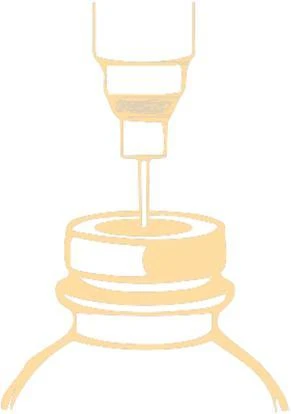
Puncture the vial stopper with a needle and inject the recommended volume of solvent into the vial. To puncture the stopper, use a needle with a diameter not exceeding 0.8 mm (21 G on the Gauge [G] scale). The needle should be inserted perpendicularly at a 90° angle into the centrally marked area, as shown in the diagram below:
After adding the solvent to the vial, shake it until the preparation is completely dissolved. After 1–2 minutes, the solution should be clear. Before administration, check that the solution is clear and free from insoluble particles. The drug solution may be colourless or pale yellow.
Preparation of solutions for injections and infusions
| Antibiotic content in the vial | Solvent volume | ||
| Intramuscular injection | Intravenous injection | Intravenous infusion | |
| 1 g | 4 ml | 10 ml | 40-100 ml |
| 2 g | 10 ml | 40-100 ml | |
Intramuscular injection
The medicinal product should be administered deep intramuscularly into the upper outer quadrant of the gluteus maximus muscle or the lateral part of the thigh. The contents of the vial should be dissolved in 4 ml of water for injections, 0.9% sodium chloride solution, or 1% lidocaine solution.
Do not administer intravenously the solution containing lidocaine.
Intravenous injection (over 3 to 5 minutes)
The contents of the vial should be dissolved in 10 ml of water for injections, 0.9% sodium chloride solution, or 5% glucose solution.
Intravenous infusion (over 20 to 60 minutes)
To prepare intravenous infusion solutions, dissolve the powder in water for injections (as for intravenous injections). The resulting solution should then be diluted with one of the following solutions:
- 0.9% sodium chloride solution,
- 5% glucose solution,
- 5% glucose solution with 0.9% sodium chloride solution in a 1:1 ratio,
- 5% glucose solution with 0.9% sodium chloride solution in a 2:1 ratio,
- Ringer's solution,
- Ringer's lactate solution.
The use of infusion fluids containing sodium bicarbonate is not recommended, as cefotaxime is unstable in these solutions.
Cefotaxime and aminoglycosides should not be mixed in the same syringe or infusion fluid.
If simultaneous administration is necessary, these medicinal products should be injected at different sites.
Signature Not Verified
Document signed by
ARTUR ZUROWSKI
Date: 2026.01.28 13:28:54 CET