Bicalutamide accord
Poland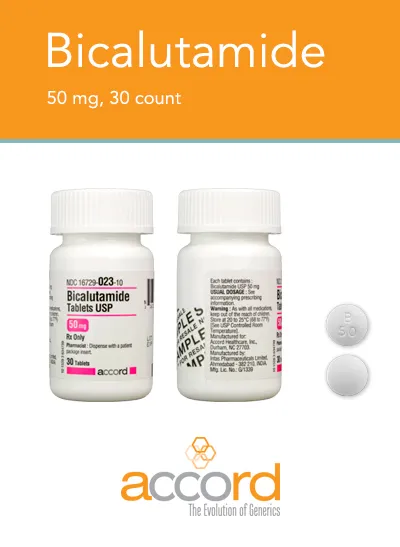
Table of Contents
- Package leaflet: Information for the user
- 1. What Bicalutamide Accord is and what it is used for
- 2. Important information before using Bicalutamide Accord
- 3. How to use Bicalutamide Accord
- 4. Possible adverse reactions
- 5. How to store Bicalutamide Accord
- 6. Contents of the packaging and other information
Package leaflet: Information for the user
Bicalutamide Accord, 150 mg, film-coated tablets
Bicalutamidum
Please read this leaflet carefully before taking this medicine, because it contains
important information for the patient.
- Keep this leaflet so that you can read it again if necessary.
- If you have any further questions, please consult your doctor or pharmacist.
- This medicine has been prescribed for a specific individual. Do not pass it on to others. This medicine may harm other people, even if their symptoms are the same.
- If the patient experiences any adverse reactions, including any not listed in this leaflet, they should inform their doctor or pharmacist. See section 4.
Leaflet contents:
- What Bicalutamide Accord is and what it is used for
- Important information before taking Bicalutamide Accord
- How to take Bicalutamide Accord
- Possible side effects
- How to store Bicalutamide Accord
- Contents of the pack and other information
1. What Bicalutamide Accord is and what it is used for
Bicalutamide Accord contains the active substance bicalutamide. Bicalutamide is a medicine belonging to the group of antiandrogens. Antiandrogens block the effects of androgens (male sex hormones).
Bicalutamide is used in the treatment of adult men with non-metastatic prostate cancer when surgical castration and other treatment methods are contraindicated or unacceptable.
It may be used in combination with radiotherapy or surgical treatment of the prostate gland as part of early treatment programmes.
2. Important information before using Bicalutamide Accord
When not to use Bicalutamide Accord:
- if the patient is allergic (hypersensitive) to bicalutamide or any of the other ingredients of this medicine (listed in section 6);
- in women;
- if the patient is currently taking cisapride (used to treat heartburn and gastro-oesophageal reflux), terfenadine or astemizole (used to treat allergies).
Bicalutamide Accord must not be used in children.
If any of the above situations apply, do not take Bicalutamide Accord. If in doubt, consult a doctor or pharmacist before taking Bicalutamide Accord.
Warnings and precautions
Before starting treatment with Bicalutamide Accord, discuss with your doctor or pharmacist if:
- the patient has impaired liver function; the doctor will recommend a blood test before and during treatment with bicalutamide;
- the patient has any heart or blood vessel disease, including heart rhythm disorders (arrhythmia), or is being treated with medicines for these conditions; the risk of heart rhythm disturbances may increase during treatment with bicalutamide;
- the patient is taking bicalutamide, he and (or) his partner should use effective contraception methods during treatment and for 130 days after the end of treatment with bicalutamide; if you have any questions about contraception, consult your doctor (see section "Pregnancy, breastfeeding and fertility").
If hospitalised, inform the medical staff that you are taking Bicalutamide Accord.
Children and adolescents
Bicalutamide Accord must not be used in children and adolescents.
Tests
Your doctor may order blood tests to monitor any changes in your blood count.
Bicalutamide Accord and other medicines
Tell your doctor or pharmacist about all medicines you are currently taking or have recently taken, as well as any medicines you plan to take. This includes medicines available without a prescription and herbal medicines. If you take Bicalutamide Accord together with other medicines, the effect of bicalutamide and/or the effect of other medicines may be altered.
Do not take Bicalutamide Accord if you are taking:
- cisapride (used to treat heartburn and gastro-oesophageal reflux),
- terfenadine or astemizole (used to treat allergies).
Bicalutamide Accord may interact with certain medicines used for heart rhythm disorders (e.g.: quinidine, procainamide, amiodarone and sotalol) or may increase the risk of heart rhythm disturbances when taken with other medicines [e.g. methadone (a painkiller and used as part of addiction treatment), moxifloxacin (an antibiotic), antipsychotics (used in severe mental illnesses)].
You should also tell your doctor or pharmacist if you are taking the following medicines:
- midazolam (used to relieve anxiety before surgery or other procedures, or as a sedative before and during surgery); if you are taking bicalutamide and are scheduled for surgery or experience severe anxiety while in hospital, inform your doctor or dentist;
- warfarin (a blood-thinning medicine);
- cyclosporine (a medicine that suppresses the immune system to prevent or treat rejection of transplanted organs or bone marrow); your doctor may recommend blood tests, as bicalutamide may increase cyclosporine plasma levels;
- cimetidine (used to treat gastro-oesophageal reflux or peptic ulcer disease);
- ketoconazole (used to treat fungal infections).
Pregnancy and breastfeeding
Bicalutamide Accord is contraindicated in women.
Effect on fertility
Bicalutamide Accord may cause transient infertility in men.
Driving and operating machinery
It is unlikely that Bicalutamide Accord affects the ability to drive or operate machinery. However, some patients may occasionally experience drowsiness after taking Bicalutamide Accord. If this occurs, contact your doctor or pharmacist.
Sunlight or ultraviolet (UV) radiation
Avoid direct exposure to sunlight or ultraviolet (UV) radiation if you are taking bicalutamide.
Bicalutamide Accord contains lactose
If the patient has previously been diagnosed with intolerance to certain sugars, consult a doctor before taking this medicine.
Bicalutamide Accord contains sodium
This medicine contains less than 1 mmol (23 mg) of sodium per tablet; therefore, this medicine is considered "sodium-free".
3. How to use Bicalutamide Accord
This medicine should always be used as directed by the physician. If in doubt, consult
your doctor or pharmacist.
The recommended dose is one tablet daily. The tablet should be swallowed whole with water.
Try to take the medicine at the same time each day. Do not stop taking this
medicine, even if the patient feels well, unless otherwise advised by the doctor.
Use in children and adolescents
Bicalutamide Accord must not be used in children.
Taking more Bicalutamide Accord than prescribed
If more tablets have been taken than recommended, contact a doctor immediately or
go directly to a hospital.
Missing a dose of Bicalutamide Accord
If the patient forgets to take a dose, that dose should be omitted and the next tablet should be taken at the usual time.
Do not take a double dose to make up for a forgotten dose.
If you have any further doubts regarding the use of this medicine, consult your
doctor or pharmacist.
4. Possible adverse reactions
Like all medicines, this medicine can cause adverse reactions, although not everyone will experience them.
If the patient experiences any of the following adverse reactions, a doctor should be contacted immediately,
as urgent medical care may be necessary.
Allergic reactions (not very common, affect less than 1 in 100 patients).
Include sudden onset of:
- rash, itching, hives;
- swelling of the face, lips, tongue, throat, or other parts of the body;
- difficulty breathing, wheezing, and breathing difficulties.
Not very common (affects less than 1 in 100 patients):
- severe shortness of breath or sudden worsening of breathlessness, sometimes accompanied by cough and fever. These may be symptoms of lung inflammation known as interstitial lung disease.
Other possible adverse reactions
Very common (affects more than 1 in 10 patients):
- skin rash;
- breast swelling and tenderness;
- feeling of weakness.
Common (affects less than 1 in 10 patients):
- yellowing of the skin or whites of the eyes (jaundice); these symptoms may be due to liver disease or, in rare cases (affects less than 1 in 1000 patients), liver failure;
- abdominal pain;
- haematuria (blood in the urine);
- hot flushes;
- nausea;
- itching;
- dry skin;
- difficulty achieving or maintaining an erection (erectile dysfunction);
- weight gain;
- reduced sex drive and reduced fertility;
- hair loss;
- abnormal hair growth or excessive hair growth;
- decreased number of red blood cells in the blood (anaemia), which may cause fatigue and pale skin;
- loss of appetite;
- depression;
- drowsiness;
- indigestion;
- dizziness;
- constipation;
- flatulence (passing wind);
- chest pain;
- oedema (swelling).
Rare (affects less than 1 in 1000 patients):
- increased sensitivity of the skin to sunlight.
Frequency not known (cannot be estimated from the available data):
- changes in ECG (prolongation of the QT interval).
Your doctor may order blood tests to monitor changes in the patient's blood count.
Reporting of adverse reactions
If any adverse symptoms occur, including any adverse symptoms not listed
in this leaflet, inform your doctor or pharmacist. Adverse reactions can be reported
directly to the Department of Monitoring of Adverse Drug Reactions at the Office for Registration of Medicinal Products, Medical Devices and Biocidal Products
Al. Jerozolimskie 181C
02-222 Warsaw
Tel.: +48 22 49 21 301
Fax: +48 22 49 21 309
Website: https://smz.ezdrowie.gov.pl
Adverse reactions can also be reported to the marketing authorisation holder.
Reporting adverse reactions helps provide more information on the safety of this medicine.
5. How to store Bicalutamide Accord
Keep this medicine out of the sight and reach of children.
Do not use this medicine after the expiry date stated on the carton and blister pack following: EXP.
The expiry date refers to the last day of the specified month.
No special storage conditions apply for this medicine.
Medicines should not be disposed of via wastewater or household waste. Ask your pharmacist how to dispose of medicines no longer required. These measures will help protect the environment.
6. Contents of the packaging and other information
What Bicalutamide Accord contains
The active substance is bicalutamide. One coated tablet contains 150 mg of bicalutamide.
Other ingredients are:
Tablet core: lactose monohydrate, sodium carboxymethyl starch (Type A), povidone K30, magnesium stearate.
Coating Opadry 02B580014 white: hypromellose 5 mPas, titanium dioxide (E 171), polyethylene glycol 400.
What Bicalutamide Accord looks like and contents of the pack
White or almost white, round, biconvex coated tablets with a diameter of approximately 10 mm, embossed with "IO1" on one side and smooth on the other.
The tablets are packed in transparent PVC/PVDC/Aluminium blisters and cardboard boxes.
Pack sizes: 7, 28, 30, 60, 90 or 100 tablets.
Not all pack sizes may be marketed.
Marketing Authorisation Holder
Accord Healthcare Polska Sp. z o.o.
Taśmowa Street 7
02-677 Warsaw
Tel: +48 22 577 28 00
Manufacturer/Importer
Accord Healthcare Polska Sp. z o.o.
Lutomierska Street 50
95-200 Pabianice
Pharmadox Healthcare Ltd.
KW20A Kordin Industrial Park, Paola
PLA 3000, Malta
Laboratori Fundació DAU
C/ C, 12-14 Pol. Ind. Zona Franca,
08040 Barcelona, Spain
| Accord Healthcare Single Member S.A. | |
| 64th Km National Road Athens, Lamia, | |
| 32009, Greece | |
This medicinal product is authorised for marketing in the Member States of the European Economic Area under the following names:
| Member State Name | Medicinal Product Name |
| Austria | Bicalutamide Accord 150 mg Film Tablets |
| Denmark | Bicalutamide Accord |
| Estonia | Bicalutamide Accord |
| Finland | Bicalutamide Accord |
| Spain | Bicalutamide Accord 150 mg Film-Coated Tablets EFG |
| Netherlands | Bicalutamide Accord 150 mg Film-Coated Tablets |
| Iceland | Bicalutamide Accord |
| Lithuania | Bicalutamide Accord 150 mg Film-Coated Tablets |
| Latvia | Bicalutamide Accord 150 mg Film-Coated Tablets |
| Norway | Bicalutamide Accord |
| Poland | Bicalutamide Accord |
| Portugal | Bicalutamide Accord 150 mg Film-Coated Tablets |
| Slovenia | Bicalutamide Accord 150 mg Film-Coated Tablets |
| Sweden | Bicalutamide Accord |
| Italy | Bicalutamide AHCL 150 mg Film-Coated Tablets |