Betadine
Poland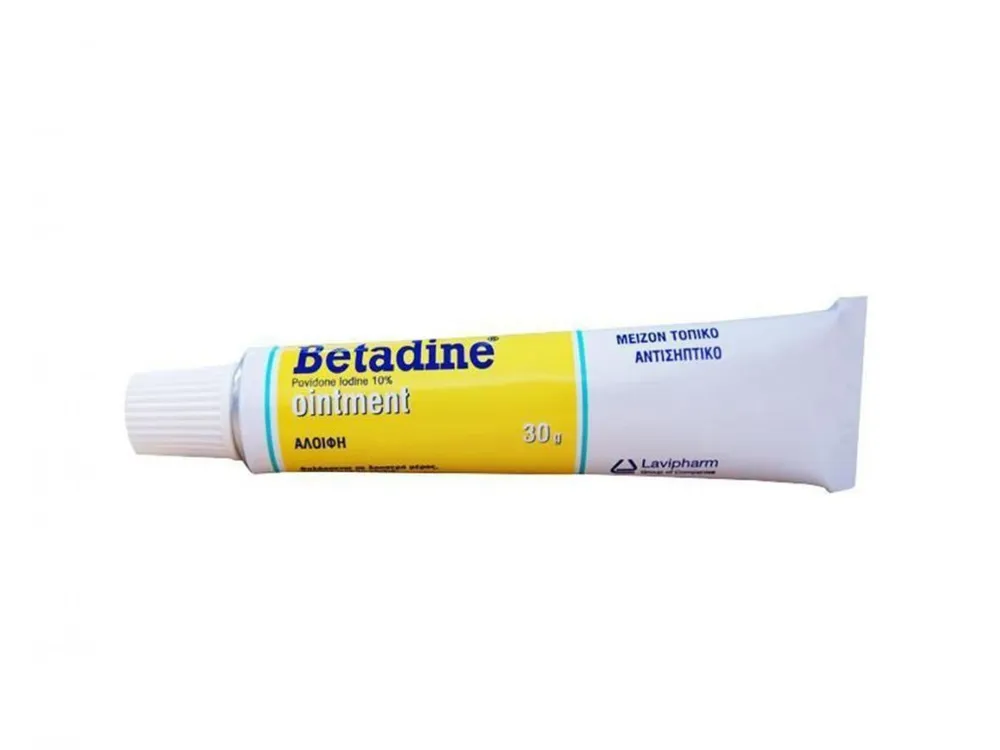
Table of Contents
PACKAGE LEAFLET: INFORMATION FOR THE USER
Warning! Keep the leaflet; the information on the immediate packaging is in a foreign language!
Betadine
100 mg/g, ointment
Povidone iodine
Please read this leaflet carefully, as it contains important information for the
patient.
- This medicine should always be used exactly as described in this patient leaflet or as directed by the doctor, pharmacist, or nurse.
- Keep this leaflet, so that you can read it again if necessary.
- If you need advice or further information, please consult your pharmacist.
- If you experience any adverse reactions, including any possible side effects not listed in this leaflet, inform your doctor, pharmacist, or nurse. See section 4. If there is no improvement after 5 days of treatment, or if you feel worse, consult your doctor.
Contents of the leaflet:
- What Betadine is and what it is used for
- Important information before using Betadine
- How to use Betadine
- Possible side effects
- How to store Betadine
- Contents of the pack and other information
1. What Betadine is and what it is used for
Betadine 100 mg/g ointment is intended for topical use only. The active substance, povidone iodine, is a complex of iodine and the polymer polyvinylpyrrolidone, from which iodine is gradually released over a period of time after application of Betadine. Free iodine has strong antiseptic properties – it acts against viruses, fungi, and certain protozoa. Betadine is an antiseptic agent.
Betadine is used for local treatment of burns, wounds, abrasions, trophic ulcers, and skin infections.
2. Important information before using Betadine
When not to use Betadine
- if the patient is allergic to the active substance povidone-iodine or to any of the other ingredients of this medicine (listed in section 6),
- in hyperthyroidism,
- in patients with thyroid disorders (particularly in patients with colloid nodular goitre, endemic goitre, and Hashimoto's thyroiditis),
- in dermatitis herpetiformis Duhring,
- before and after radioactive iodine treatment and scintigraphy.
Warnings and precautions
Before starting to use Betadine, discuss this with your doctor or pharmacist.
- Patients with renal impairment should not use the medicine long-term unless otherwise directed by a doctor.
- After prolonged use, thyroid function tests should be performed.
- Long-term use may cause skin irritation, contact dermatitis, allergic reactions, and in rare cases, severe skin reactions. If irritation or allergic reactions occur, discontinue use of the medicine.
- Do not heat the medicine before applying it to the skin.
- Patients with thyroid disorders should not use the medicine long-term or over large areas of skin, as iodine absorbed from Betadine may cause hyperthyroidism. In these patients, the doctor should monitor thyroid function and tailor treatment individually.
- If symptoms indicating hyperthyroidism occur after treatment, thyroid function tests should be performed.
- Avoid using Betadine in patients receiving lithium therapy.
Children and adolescents
In children, treatment duration should be as short as possible and the dose used should be as low as possible.
If necessary, thyroid function tests should be performed.
Do not allow the medicine to be swallowed by a child.
Other medicines and Betadine
Inform your pharmacist about all medicines currently used, recently used, or planned to be used.
- Medicines containing mercury, silver, hydrogen peroxide, benzoic acid, or taurolidine may interact with povidone-iodine; therefore, their simultaneous use with Betadine should be avoided.
- During use of Betadine, various diagnostic agents may give false-positive laboratory test results (e.g. toluidine and guaiac resin tests for detection of haemoglobin or glucose in faeces and urine).
- Absorbed iodine from Betadine may interfere with thyroid function tests.
- Concurrent use of Betadine with enzymatic ointments for wound treatment may reduce the effectiveness of both medicines.
- Application of Betadine to the same or adjacent skin area simultaneously or immediately after antiseptic products containing octenidine may cause transient skin discoloration.
Pregnancy and breastfeeding
During pregnancy, breastfeeding, if pregnancy is suspected, or when planning pregnancy, consult your doctor or pharmacist before using any medicine.
Betadine may be used during pregnancy and breastfeeding only when diagnosis is certain and there are absolute indications for its use. If the doctor decides to use the medicine, the dose and duration of treatment should be kept to a minimum, because absorbed iodine may cross the placenta and pass into breast milk. Use of the medicine may cause transient hyperthyroidism in the foetus or newborn. Thyroid function tests in the child may be necessary. Children should be protected from situations where they might take the medicine into their mouth or swallow it.
Driving and operating machinery
The use of Betadine does not affect the ability to drive or operate machinery.
3. How to use Betadine
This medicine should always be used exactly as described in the patient leaflet or as directed by a doctor or pharmacist. If in doubt, consult a doctor or pharmacist.
For topical use on the skin only.
In the treatment of infections: apply the ointment once or twice daily for up to 14 days. The affected skin area should be cleaned and dried thoroughly. Apply the ointment to the affected skin area.
A dressing or bandage may be applied.
Use of a higher than recommended dose of Betadine
If overdose is suspected, medical advice should be sought immediately.
Excess iodine may cause goiter, hypothyroidism, or hyperthyroidism.
Absorption of iodine into the body following repeated application of Betadine to large wounds or burns may lead to symptoms of iodine poisoning, such as metallic taste in the mouth, salivation, burning or pain in the throat and oral cavity, eye irritation and swelling, skin reactions, gastrointestinal disturbances and diarrhea, circulatory failure, breathing difficulties, pulmonary edema, metabolic disturbances (metabolic acidosis, hypernatremia), renal failure, and anuria.
4. Possible adverse reactions
Like all medicines, this medicine can cause adverse reactions, although not everyone will experience them.
Adverse reactions are classified according to their frequency of occurrence.
Rare (affects up to 1 in 10,000 people)
Allergic reactions, contact dermatitis (with symptoms such as skin redness, small blisters, and skin itching).
Very rare (affects less than 1 in 10,000 people)
Anaphylactic reaction (a severe allergic reaction causing, among others, breathing difficulties, dizziness, and low blood pressure), hyperthyroidism (may cause increased appetite, weight loss, sweating, rapid heartbeat, or motor restlessness in patients with thyroid disease), angioedema (a severe allergic reaction causing swelling of the face or throat).
Frequency not known (cannot be estimated from the available data)
Hypothyroidism (may occur after prolonged or intensive use of the medicine, causing, for example, fatigue, weight gain, or slower heartbeat), kidney function disorders, chemical skin burn (may occur due to pooling of the medicine under the patient during surgical preparation), electrolyte disturbances, metabolic acidosis, acute kidney failure, abnormal blood osmolality (may occur after administration of very large amounts of the medicine, for example in burn treatment).
Reporting of adverse reactions
If any adverse reactions occur, including any not listed in this leaflet, inform your doctor, pharmacist, or nurse. Adverse reactions can be reported directly to the Department of Monitoring Adverse Drug Reactions of the Office for Registration of Medicinal Products, Medical Devices and Biocidal Products, Al. Jerozolimskie 181C, 02-222 Warsaw, Tel.: +48 22 49 21 301, Fax: +48 22 49 21 309, Website: https://smz.ezdrowie.gov.pl
Reporting adverse reactions helps to provide more information on the safety of this medicine.
5. How to store Betadine
Store below 25°C. Keep in the original packaging to protect from light.
Do not store in the refrigerator or freeze.
Do not use this medicine after the expiry date stated on the container. The expiry date refers to the last day of the stated month.
Shelf-life after first opening: 24 months.
Keep out of sight and reach of children.
Medicines should not be disposed of via wastewater or household waste. Ask your pharmacist how to dispose of medicines no longer required. This will help protect the environment.
6. Package contents and other information
What Betadine contains
The active substance is povidone-iodine. Each gram of ointment contains 100 mg of povidone-iodine.
Other components: sodium hydrogen carbonate, polyethylene glycol 400, polyethylene glycol 4000, polyethylene glycol 1000, polyethylene glycol 1500, purified water.
What Betadine looks like and contents of the pack
Brown ointment with a characteristic odour. The package contains 20 g of ointment in an aluminium tube within a cardboard box.
For more detailed information, please contact the responsible party or the parallel importer.
Responsible party in the Czech Republic, country of export:
Egis Pharmaceuticals PLC
Keresztúri út 30-38.
1106 Budapest
Hungary
Manufacturer:
Egis Pharmaceuticals PLC
Mátyás Király u. 65.
9900 Körmend
Hungary
Parallel importer:
Medezin Sp. z o.o.
ul. Zbąszyńska 3
91-342 Łódź
Repackaged in:
Medezin Sp. z o.o.
ul. Zbąszyńska 3
91-342 Łódź
CEFEA Sp. z o.o. Sp. komandytowa
ul. Działkowa 56
02-234 Warsaw
SHIRAZ PRODUCTIONS Sp. z o.o.
ul. Tymiankowa 24/28
95-054 Ksawerów
CANPOLAND SPÓŁKA AKCYJNA
ul. Beskidzka 190
91-610 Łódź
Czech Republic marketing authorisation number (country of export): 32/387/92-S/C
Parallel import authorisation number: 303/22