Benelyte
Poland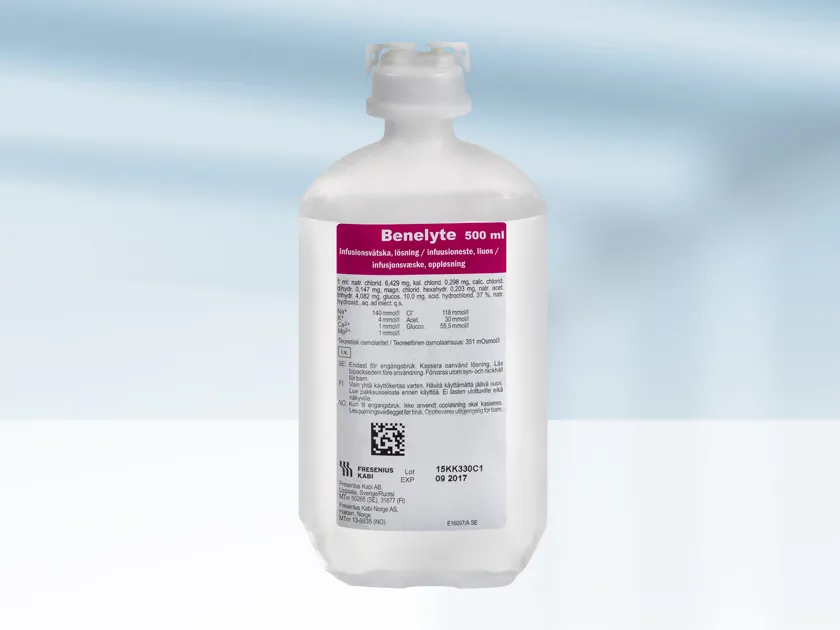
Table of Contents
- Package leaflet: Information for the user
- 1. What Benelyte is and what it is used for
- 2. Important information before using Benelyte
- 3. How to use Benelyte
- 4. Possible adverse reactions
- 5. How to store Benelyte
- 6. Contents of the pack and other information
- Information intended exclusively for medical professionals:
Package leaflet: Information for the user
Benelyte, infusion solution
Compound product
Please read all of this leaflet carefully before using this medicine, because it contains
important information for the patient.
- Keep this leaflet, as you may need to read it again.
- If you have any further questions, please consult your doctor, pharmacist, or nurse.
- If the patient experiences any adverse reactions, including any not listed in this leaflet, inform your doctor, pharmacist, or nurse. See section 4.
Table of contents
- What Benelyte is and what it is used for
- Important information before using Benelyte
- How to use Benelyte
- Possible side effects
- How to store Benelyte
- Contents of the package and other information
1. What Benelyte is and what it is used for
Benelyte is a solution for intravenous infusion (into the vein). It contains mineral components called electrolytes, which affect the body's water content and other essential processes. It also contains carbohydrates.
Benelyte is indicated for use in newborns (from 0 to ≤28 days), infants (from 28 days to ≤2 years), children (from 2 to ≤12 years), and adolescents (from 12 to ≤14 years), because:
- it helps restore normal fluid and electrolyte (salts) balance in the body after surgery; it also contains glucose, which is an energy source;
- it acts as a plasma volume substitute used to restore normal blood volume;
- it helps correct fluid and electrolyte deficits;
- it serves as a diluent for other electrolytes and medicines.
2. Important information before using Benelyte
When not to use Benelyte
- if the patient is allergic (hypersensitive) to sodium chloride, potassium chloride, calcium chloride, magnesium chloride, sodium acetate, glucose, or any of the other ingredients of this medicine (listed in section 6);
- in premature infants and newborns (age ≤28 days): the antibiotic named ceftriaxone must not be administered intravenously at the same time as this medicine;
- if the patient has excess body water (overhydration).
Warnings and precautions
Before starting treatment with Benelyte, tell the doctor, pharmacist, or nurse if the patient has:
- decreased acid levels in the body (metabolic alkalosis);
- increased blood sugar levels (hyperglycemia);
- low potassium levels in the blood (hypokalemia);
- high sodium levels in the blood (hypernatremia);
- high chloride levels in the blood (hyperchloremia);
- kidney failure or impaired kidney function;
- treatment with the antibiotic ceftriaxone; this must not be mixed or co-administered with any calcium-containing solutions given by intravenous infusion. Being aware of this, the doctor will not recommend administering them simultaneously, even through separate infusion lines or different infusion sites;
- however, in patients over 28 days of age, the doctor may administer calcium and ceftriaxone consecutively, one after the other, provided that the infusion lines are placed in different locations, or are replaced or thoroughly flushed with physiological saline solution between infusions to prevent precipitation. In cases where the adult patient or child has low blood volume, the doctor will not recommend administering calcium and ceftriaxone consecutively.
During treatment, the doctor will periodically monitor serum electrolyte levels, fluid balance, blood glucose levels, and acid-base balance.
Due to the risk of lactic acidosis (increased lactic acid levels in the body), particular caution should be exercised when administering this medicine to children, especially newborns and infants. This should be taken into account in children with disorders of lactate metabolism.
Benelyte with other medicines
Tell the doctor or pharmacist about all medicines the patient is currently taking, has recently taken, or plans to take.
- Concomitant use of Benelyte with intravenous ceftriaxone (antibiotic) is not recommended (see Warnings and precautions).
Pregnancy and breastfeeding
Benelyte is intended for use exclusively in children and adolescents (up to 14 years of age).
3. How to use Benelyte
Benelyte will be administered by a doctor or another member of medical personnel
as an intravenous infusion (intravenous drip).
Dosage
The doctor will determine the amount of medicine the patient will receive based on age, body weight, clinical condition, and concomitant medications. When determining the dose, the doctor will take into account the individual requirements for fluids, electrolytes, and energy. The doctor will decide the appropriate dose of medicine to be administered to the patient.
This medicine should always be used as directed by the doctor or pharmacist. If in doubt,
consult the doctor or pharmacist.
Administration of a higher than recommended dose of Benelyte
Since this medicine will be administered by a doctor or other medical personnel,
the use of an incorrect dose is unlikely.
Overdose may lead to excess fluid in the body (fluid overload) and high blood sugar levels (hyperglycaemia).
The doctor will initiate treatment aimed at normalizing the patient's condition. Treatment may include
stopping the infusion, monitoring blood electrolyte levels, and administering appropriate symptomatic treatment (e.g. diuretics, insulin).
4. Possible adverse reactions
Like all medicines, this medicine can cause adverse reactions, although not everybody gets them.
Frequency unknown (cannot be estimated from the available data)
Local reactions related to the route of administration:
- fever;
- infection at the infusion site;
- irritation and inflammation of the vein at the infusion site; this may cause redness, pain or burning sensation, and swelling along the vein into which the solution is administered;
- formation of a blood clot (venous thrombosis) at the infusion site, causing pain, swelling, or redness at the site of clot formation;
- leakage of the medicine into surrounding tissues (extravasation); this may lead to tissue damage and scarring.
Reporting of adverse reactions
If any adverse reactions occur, including any adverse reactions not listed
in this leaflet, inform your doctor, pharmacist, or nurse. Adverse reactions
can be reported directly to the Department of Monitoring Adverse Drug Reactions, Office for Registration of Medicinal Products, Medical Devices and Biocidal Products
Al. Jerozolimskie 181C
02-222 Warsaw
Phone: +48 22 49 21 301
Fax: +48 22 49 21 309
Website: https://smz.ezdrowie.gov.pl
Adverse reactions can also be reported to the marketing authorization holder.
Reporting adverse reactions helps to provide more information on the safety of the medicine.
5. How to store Benelyte
Keep this medicine out of the sight and reach of children.
Do not use this medicine after the expiry date stated on the label or carton after EXP. The expiry date refers to the last day of the stated month.
No special storage instructions apply for this medicine.
Use only clear solution, free from visible solid particles, and provided the container is undamaged.
Use immediately after first opening. From a microbiological point of view, the medicine must be used immediately. If the medicine is not used immediately, responsibility for the duration and conditions of storage prior to use lies with the user. The storage period should not exceed 24 hours at a temperature of 2°C to 8°C, unless the opening and storage of the medicine took place under controlled and validated aseptic conditions.
When administering together with other infusion solutions, general current guidelines regarding compatibility of medicines should be considered (e.g. aseptic conditions, compatibility, and accuracy of the mixture).
Medicines must not be disposed of via wastewater or household waste. Ask your pharmacist how to dispose of medicines no longer required. Such measures will help protect the environment.
6. Contents of the pack and other information
What Benelyte contains
One ml of Benelyte infusion solution contains:
sodium chloride 6.429 mg
potassium chloride 0.298 mg
calcium chloride dihydrate 0.147 mg
magnesium chloride hexahydrate 0.203 mg
sodium acetate trihydrate 4.082 mg
glucose monohydrate 11.0 mg
(corresponds to glucose 10.0 mg)
The other ingredients are: hydrochloric acid 37% (for pH adjustment), sodium hydroxide (for pH adjustment),
and water for injections.
What Benelyte looks like and contents of the pack
Benelyte is a clear, aqueous infusion solution, colourless to slightly yellow.
Benelyte is available in LDPE bottles (KabiPac) with a capacity of 100 ml, 250 ml and 500 ml,
with a closure made of PE or PE/PP, containing a polyisoprene stopper.
Pack sizes:
40 bottles of 100 ml
20 bottles of 250 ml
10 bottles of 500 ml.
Not all pack sizes may be marketed.
Marketing Authorisation Holder
Fresenius Kabi Polska Sp. z o.o.
Al. Jerozolimskie 134
02-305 Warsaw
Poland
Manufacturer
Fresenius Kabi Polska Sp. z o.o.
ul. Sienkiewicza 25
99-300 Kutno
Poland
For further information on this medicinal product, please contact the Marketing Authorisation Holder:
Fresenius Kabi Polska Sp. z o.o.
Al. Jerozolimskie 134
02-305 Warsaw
Poland
tel.: +48 22 345 67 89
This medicinal product is authorised in the European Economic Area countries and in the United Kingdom (Northern Ireland) under the following names:
Austria ELO-MEL paediatric Infusionslösung
Belgium Benelyte oplossing voor infusie/solution pour perfusion/Infusionslösung
Bulgaria Бенелайт инфузионен разтвор
Benelyte solution for infusion
Croatia Benelyte otopina za infuzij
Czech Republic Benelyte
Denmark Benelyte
Estonia Benelyte
Finland Benelyte Infuusioneste, liuos
France Benelyte, solution pour perfusion
Spain Benelyte solución para perfusión
Netherlands Benelyte oplossing voor infusie
Ireland Paedisol solution for infusion
Latvia Benelyte šķīdums infūzijām
Lithuania Benelyte infuzinis tirpalas
Luxembourg Benelyte Infusionslösung
Germany Benelyte Infusionslösung
Norway Benelyte
Poland Benelyte
Portugal Benelyte
Romania Benelyte soluție perfuzabilă
Slovakia Benelyte
Slovenia Benelyte raztopina za infundiranje
Sweden Benelyte
Hungary Benelyte oldatos infúzió
United Kingdom (Northern Ireland) Minorsol solution for infusion
Information intended exclusively for medical professionals:
For additional information, please refer to the Summary of Product Characteristics.
Dosage
The dosage for perioperative intravenous infusion depends on the patient's requirements for fluids, electrolytes, and glucose: initially 10–20 mL/kg body weight/hour for the first hour, followed by adjustment according to the patient's basic and corrected requirements, with monitoring of appropriate cardiovascular and laboratory parameters.
Fluid requirements are determined based on the following reference values:
Newborns (from 0 to ≤28 days), infants (from 28 days to ≤1 year):
100–140 mL/kg body weight per day.
Infants from 1 year to ≤2 years of age:
80–120 mL/kg body weight per day.
Children from 2 to ≤5 years of age:
80–100 mL/kg body weight per day.
Children from 5 to ≤10 years of age:
60–80 mL/kg body weight per day.
Children from 10 to ≤12 years of age and adolescents from 12 to ≤14 years of age:
50–70 mL/kg body weight per day.
In short-term replacement of intravascular volume, the dose should be individually determined according to fluid requirements.
In the treatment of isotonic dehydration in children and adolescents, infusion rate and daily dosage should be individually adjusted based on the nature and severity of water-electrolyte imbalance, with monitoring of appropriate cardiovascular and laboratory parameters.
If Benelyte is administered simultaneously with other infusion solutions, the dosage for the selected age group should take into account current guidelines regarding total fluid intake.
Particularly in preterm infants and newborns with low birth weight, as well as in other exceptional therapeutic situations, individual requirements for water, electrolytes, and carbohydrates should be appropriately calculated and modified. The balance of requirements should be more precise the greater the degree of prematurity, the younger the patient, and the lower the birth weight.
Administration method
Intravenous administration.
Duration of administration
The duration of administration depends on the patient's requirements for fluids and electrolytes.
Pharmaceutical incompatibilities
Before adding any medicinal product, its compatibility with Benelyte must be verified.
The following medicinal products (groups) must not be mixed with Benelyte:
- Medicinal products that may form poorly soluble precipitates with components of the solution. (Benelyte contains Ca++ ions. Addition of inorganic phosphates, bicarbonates/carbonates, or oxalates may result in precipitation.)
- Medicinal products with poor stability at acidic pH, those not exhibiting optimal efficacy, or those undergoing degradation.
- Medicinal products or parenteral nutrition solutions whose compatibility has not been studied.
Infusion solutions containing glucose must not be administered simultaneously with blood through the same infusion set due to the risk of pseudoagglutination.