Belkyra
Poland
Table of Contents
- Package leaflet: Information for the user
- 1. What Belkyra is and what it is used for
- 2. Important information before using Belkyra
- 3. How to use Belkyra
- 4. Possible adverse reactions
- 5. How to store Belkyra
- 6. Contents of the pack and other information
- Information intended exclusively for healthcare professionals:
Package leaflet: Information for the user
Belkyra, 10 mg/ml, solution for injection
Deoxycholic acid
Please read all of this leaflet carefully before using this medicine because it contains
important information for you.
- Keep this leaflet. You may need to read it again.
- If you have any further questions, ask your doctor, pharmacist, or nurse.
- This medicine has been prescribed for you personally. Do not pass it on to others. It may harm them even if their symptoms are the same as yours.
- If you get any side effects, talk to your doctor, pharmacist, or nurse. This includes any side effects not listed in this leaflet. See section 4.
Contents of the leaflet
- What Belkyra is and what it is used for
- What you need to know before using Belkyra
- How to use Belkyra
- Possible side effects
- How to store Belkyra
- Contents of the pack and other information
1. What Belkyra is and what it is used for
The active substance in Belkyra is deoxycholic acid. Deoxycholic acid is naturally
produced in the human body to help digest fats.
This medicine is used in adults to treat excess submental fat (unwanted fat under the chin) when it has a significant impact on the patient's psychological well-being.
Belkyra contains deoxycholic acid that is not derived from human or animal sources and is identical to the naturally occurring deoxycholic acid. Belkyra is an injectable medicine administered by a doctor or nurse.
2. Important information before using Belkyra
When not to use Belkyra:
- if the patient is allergic to deoxycholic acid or to any of the other ingredients of this medicine (listed in section 6);
- if the patient has an infection of the chin or in the neck area where the medicine will be injected.
Warnings and precautions
Before starting treatment with Belkyra, discuss this with your doctor, pharmacist or nurse.
Before each procedure, your doctor or nurse will assess your health status. Before each treatment session, inform your doctor or nurse about any medical conditions you currently have.
Your doctor or nurse will pay special attention to the area around the neck, as particular caution is required in case of pre-existing diseases or previous surgeries (e.g. scarring, liposuction, swallowing difficulties, enlarged thyroid gland or lymph nodes).
- Temporary damage to the marginal mandibular nerve may occur, leading to an asymmetric smile or facial muscle weakness.
- Damage to the tissue around the treated area (e.g. skin erosion, ulceration, skin necrosis) may occur. This may result in scarring. In case of ulceration or necrosis, Belkyra treatment must never be repeated in the patient (see section 4).
- Infection around the treated area may occur, which may require additional treatment. If redness or pain develops, speak to your doctor, pharmacist or nurse.
Belkyra must not be used if the patient is obese or suffers from body dysmorphic disorder (distorted perception of one's own appearance).
Children and adolescents
This medicine is not intended for use in children and adolescents.
Belkyra and other medicines
Tell your doctor or nurse about all medicines the patient is currently taking or has recently taken, as well as any medicines the patient plans to take.
Pregnancy and breastfeeding
The effect of the medicine in pregnant or breastfeeding women is unknown. As a precaution, use of Belkyra during pregnancy is not recommended.
If the patient is pregnant or breastfeeding, suspects she may be pregnant, or is planning to have a baby, she should consult her doctor or nurse before using this medicine.
Driving and operating machinery
Belkyra is not expected to affect the ability to drive or operate machinery.
Belkyra contains sodium
The medicine contains 4.23 mg of sodium (a main component of table salt) per 1 ml. This corresponds to 0.2% of the maximum recommended daily intake of sodium in the diet for adults.
3. How to use Belkyra
How to administer Belkyra
Belkyra will be administered by a doctor (or, if permitted by national regulations, by a trained medical professional under the supervision of a doctor) directly under the skin ("subcutaneous administration").
Belkyra will be injected in small amounts at multiple sites within the treatment area, that is, into the fatty tissue located directly beneath the skin under the chin.
Before and after the injection, the doctor or nurse may take certain measures to help reduce pain.
Recommended dose
The doctor will decide how much Belkyra should be injected.
During a single procedure, the patient will receive multiple injections. The total number of injections and the number of procedures required to achieve a satisfactory treatment response depend on individual patient needs and will be determined by the doctor. Treatment may be repeated several times, but should not be performed more than 6 times. Usually, 2–4 treatments are sufficient. The interval between consecutive procedures should be at least 4 weeks.
Use of a higher than recommended dose of Belkyra
Administering more Belkyra than recommended may lead to an increase in adverse reactions (see section 4). If this occurs, consult your doctor or nurse immediately.
Additional information on use and handling instructions for trained medical personnel is provided at the end of this leaflet.
If you have any further questions about the use of this medicine, consult your doctor or nurse.
4. Possible adverse reactions
Like all medicines, this medicine can cause adverse reactions, although not everyone will experience them.
- Temporary damage to the mandibular nerve may occur, leading to an asymmetric smile or weakness of the facial muscles.
- Damage to the tissue around the treatment site (i.e. skin erosion, ulceration, skin necrosis) may occur. This may lead to scarring.
If any of the above adverse reactions occur, contact your doctor or nurse immediately.
Below is a list of observed adverse reactions together with their frequency of occurrence:
Very common (may affect more than 1 in 10 people):
- Reactions at the injection site:
- pain
- fluid accumulation in tissue (edema) and swelling
- sensory-related symptoms (paresthesia): loss of sensation, reduced sensation, numbness, tingling and prickling sensation, abnormal sensation
- local small, round nodules (nodules)
- bruising
- hardness or thickening of tissue (induration)
- redness of the skin (erythema)
- itching
Common (may affect up to 1 in 10 people):
- Reactions at the injection site:
- bleeding
- discomfort
- sensation of warmth
- change in skin color
- nerve damage around the jaw
- skin tightness
- difficulty swallowing (dysphagia)
- nausea (nausea)
- headache
Uncommon (may affect up to 1 in 100 people):
- taste disturbances (dysgeusia)
- speech difficulties (dysphonia)
- Reactions at the injection site:
- hair loss (alopecia)
- itchy rash (urticaria)
- skin lesions (ulcers)
- allergic reaction (hypersensitivity)
- scarring
Frequency not known (cannot be estimated from the available data):
- decreased sensation in the oral cavity or abnormal sensation in the oral cavity (e.g. lips, tongue) [oral hypoesthesia, paresthesia (oral sensory disturbances)]
- reaction at the injection site (see "Warnings and precautions"):
- reduced sensitivity to touch or sensory disturbances in the cheek area
- tissue damage and cell death (necrosis) around the injection site
- infection, including redness, swelling or pain (inflammation of connective tissue) or pus-filled pocket (abscess)
- vascular injury due to accidental injection into an artery or vein.
Most of the observed adverse reactions resolved during the 4-week interval between procedures. However, some injection site reactions may persist for a longer period.
Reporting of adverse reactions
If any adverse reactions occur, including any adverse reactions not listed in this leaflet, inform your doctor or nurse. Adverse reactions can be reported directly to the Department for Monitoring Adverse Drug Reactions of the Office for Registration of Medicinal Products, Medical Devices and Biocidal Products
Al. Jerozolimskie 181C
02-222 Warsaw
Tel.: + 48 22 49 21 301
Fax: + 48 22 49 21 309
Website: https://smz.ezdrowie.gov.pl
Adverse reactions can also be reported to the responsible entity.
By reporting adverse reactions, more information on the safety of this medicine can be collected.
5. How to store Belkyra
Keep this medicine out of the sight and reach of children.
Do not use this medicine after the expiry date stated on the label and cardboard box following the term "EXP". The expiry date refers to the last day of the stated month.
There are no special storage instructions for this medicine. After opening, the injectable solution should be used immediately.
Do not use the medicine if visible solid particles are present.
6. Contents of the pack and other information
What Belkyra contains
- The active substance is deoxycholic acid. 1 ml of injection solution (injection) contains 10 mg of deoxycholic acid. One 2 ml vial contains 20 mg of deoxycholic acid.
- Other components of the medicinal product are: disodium phosphate anhydrous, sodium chloride, hydrochloric acid (for pH adjustment), sodium hydroxide (for dissolution and pH adjustment), water for injections.
What Belkyra looks like and contents of the pack
Belkyra is a clear, colourless, sterile solution for injection.
Pack size:
The medicinal product is supplied in vials containing 2 ml of solution for injection, placed in a cardboard box.
The vial is made of glass (type I), with a chlorobutyl rubber stopper and an aluminium seal with a flip-top cap made of polypropylene.
Marketing Authorisation Holder
AbbVie Sp. z o.o.
ul. Postępu 21B
02-676 Warsaw
tel. 22 372 78 00
Manufacturer/Importer
Allergan Pharmaceuticals International Ltd.
Clonshaugh Business & Technology Park,
Dublin 17,
D17 E400,
Ireland
Information intended exclusively for healthcare professionals:
Before using the injectable solution, it should be inspected visually. Only clear, colorless solution free from particulate matter should be used.
Dosage
The total injected volume and number of treatment sessions should be adjusted according to the patient's submental fat distribution and desired treatment outcomes.
Inject 0.2 mL (2 mg) of the medicinal product at each injection site spaced 1 cm apart. The maximum dose of 10 mL (100 mg of deoxycholic acid, equivalent to 50 injections) must not be exceeded during a single treatment session.
A maximum of 6 treatment sessions may be performed. Most patients experience improvement after 2–4 sessions. The interval between consecutive treatments should be at least 4 weeks.
To improve patient comfort during injections, healthcare professionals may decide to administer oral analgesics or non-steroidal anti-inflammatory drugs (NSAIDs), apply local anesthetics (e.g., lidocaine) via topical or injectable routes for local anesthesia, and/or cool the injection sites using cold gel packs.
Administration method
The medicinal product is intended solely for subcutaneous administration.
Belkyra medicinal product is supplied as ready-to-use single-use vials. Before use, gently rotate the vial several times. Do not dilute.
The Belkyra medicinal product should be prepared for injection as follows:
- Remove the flip-off cap from the vial and disinfect the puncture site on the vial. Do not use if the vial, closure, or flip-off cap is damaged.
- Attach a sterile, large-bore needle to a sterile, single-use 1 mL syringe.
- Insert the sterile, large-bore needle into the vial's puncture site and withdraw 1 mL of Belkyra medicinal product into the 1 mL syringe.
- Replace the large-bore needle with a 30 G (or smaller) ½-inch needle. Before injecting the medicinal product into the subcutaneous fat layer, remove any air bubbles from the syringe barrel.
- To withdraw the remaining medicinal product from the vial, repeat steps 3 and 4.
The Belkyra medicinal product must be administered only by appropriately qualified physicians who have adequate experience in performing the procedure and knowledge of submental anatomy. In countries where regulations permit, Belkyra may be administered by appropriately qualified healthcare professionals under the supervision of a physician. The safety and efficacy of Belkyra depend on proper patient selection, including understanding the patient's medical history regarding prior medical interventions and their potential impact on altering the anatomy of the neck region. Caution should be exercised when using Belkyra in patients with excessive skin laxity, prominent platysma muscle, or other conditions in which reduction of submental fat may lead to an undesirable outcome.
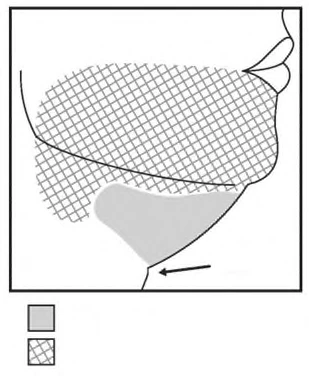
To perform the Belkyra injection, position the needle perpendicular to the skin. Correct needle placement relative to the mandible is crucial, as it reduces the risk of injury to the mandibular branch of the facial nerve—the motor branch of the facial nerve. Nerve injury may result in an asymmetric smile due to paralysis of the depressor anguli oris muscle.
To avoid injury to the mandibular branch:
- Do not perform injections above the inferior border of the mandible.
- Do not perform injections within the area defined by a 1–1.5 cm line below the inferior border (from the mandibular angle to the chin).
- Perform Belkyra injections only within the targeted submental fat treatment area (see Figure 1 and 3). Figure 1. Avoid the area of the mandibular branch of the facial nerve
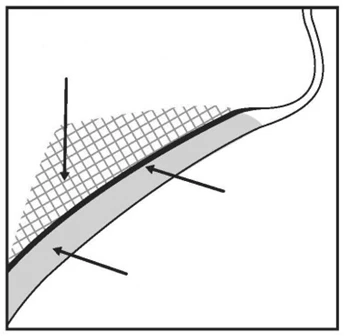
Avoid injecting into the platysma muscle. Prior to each procedure, palpate the submental area to confirm the presence of adequate fat tissue and to identify the subcutaneous fat layer located between the skin and the platysma muscle within the target treatment area (Figure 2).
Figure 2. Sagittal cross-section of the platysma muscle (m. platysma) area
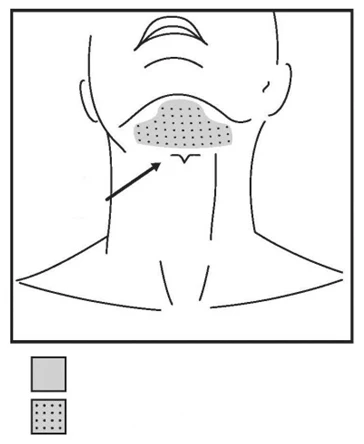
Mark the planned treatment area with a surgical marker and place a 1 cm grid to identify injection sites (Figures 2 and 3).
Figure 3. Treatment area and injection pattern
Do not inject Belkyra outside the designated injection sites.
Each vial is intended for use in a single patient only. After use, any unused product should be discarded.