Beduo
Poland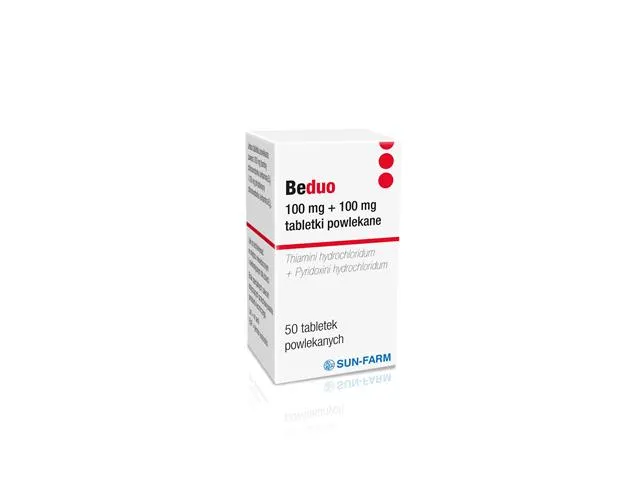
Instructions for Use
Package leaflet: Information for the user
Beduo, 100 mg + 100 mg, coated tablets
Thiamini hydrochloridum + Pyridoxini hydrochloridum
Please read all of this leaflet carefully before taking this medicine, because it contains
important information for you.
- Keep this leaflet, as you may need to read it again.
- If you have any further questions, please ask your doctor or pharmacist.
- This medicine has been prescribed for a specific individual. Do not pass it on to others. It may harm other people even if their symptoms are the same.
- If you experience any adverse reactions, including any not listed in this leaflet, tell your doctor or pharmacist. See section 4.
Contents of the leaflet
- What Beduo is and what it is used for
- What you need to know before taking Beduo
- How to take Beduo
- Possible side effects
- How to store Beduo
- Contents of the pack and other information
1. What Beduo is and what it is used for
Beduo is a combination medicine belonging to the B group of vitamins. It contains vitamin B₁ and vitamin B₆.
Beduo is used for the treatment of nervous system disorders caused by a documented deficiency of vitamin B₁ and B₆.
Note:
Deficiency of vitamin B₁ and B₆ rarely occurs in isolation. Therefore, before starting therapy, it should be verified whether deficiency of another vitamin is present.
Consult your doctor if there is no improvement or if symptoms worsen.
2. Important information before taking Beduo
When not to use Beduo
- if the patient is allergic to thiamine hydrochloride, pyridoxine hydrochloride, or any of the other ingredients of this medicine (listed in section 6).
Warnings and precautions
Before starting Beduo, discuss this with your doctor or pharmacist.
In cases of hypersensitivity reactions such as skin rashes, urticaria,
photosensitivity, anaphylactic reactions (acute allergic reactions), treatment should be discontinued.
If necessary, the treating physician will initiate appropriate therapy.
Children and adolescents
The safety and efficacy of Beduo in children have not been established.
Beduo and other medicines
You should tell your doctor or pharmacist about all medicines you are currently taking or have recently taken, as well as any medicines you plan to take.
Effect of other medicines on Beduo
Reduced effect
Concomitant administration of drugs known as pyridoxine antagonists (which inhibit vitamin B action), such as hydralazine, isoniazid, cycloserine, D-penicillamine, may increase the requirement for vitamin B.
Vitamin B is ineffective when used concomitantly with the cytostatic drug 5-fluorouracil (used in cancer treatment).
Drugs that neutralize gastric acid reduce the absorption of vitamin B.
Vitamin B deficiency may occur during long-term treatment with furosemide (used to increase urine production), as it increases excretion of vitamin B in urine.
Effect of Beduo on other medicines
Vitamin B in daily doses of 5 mg or more may reduce the effectiveness of levodopa (a drug used in the treatment of Parkinson's disease).
Beduo with food and drink
Alcohol and tea reduce the absorption of vitamin B.
Concomitant consumption of beverages containing sulfites, such as wine, may lead to degradation of vitamin B and consequently result in lack of its effect.
Drinking alcohol and long-term use of oral contraceptives containing estrogens may lead to vitamin B deficiency.
Pregnancy and breastfeeding
If the patient is pregnant or breastfeeding, suspects she may be pregnant, or plans to become pregnant, she should consult her doctor before taking this medicine.
During pregnancy and breastfeeding, daily vitamin requirements should be met through a balanced diet.
Pregnancy
Inform your treating physician about pregnancy. Beduo may be used during pregnancy only if the physician considers it absolutely necessary.
The recommended daily intake of vitamin B during pregnancy is approximately 1.4–1.6 mg, and vitamin B 2.4–2.6 mg. These doses may be increased only if deficiency of vitamin B or B is confirmed, as the safety of higher-than-recommended doses has not been established.
Breastfeeding
During breastfeeding, the recommended daily intake of vitamin B is approximately 1.4–1.6 mg, and vitamin B 2.4–2.6 mg. These doses may be increased only if deficiency of vitamin B or B is confirmed, as the safety of higher-than-recommended doses has not been established.
Vitamins B and B pass into breast milk.
High doses of vitamin B may inhibit milk production.
Inform your treating physician about breastfeeding. The physician will decide whether to use Beduo after evaluating the benefits for the mother and the potential risks.
Driving and operating machinery
No special precautions are required.
3. How to take Beduo
This medicine should always be taken exactly as described in the patient leaflet or as advised by your doctor or pharmacist. If in doubt, consult your doctor or pharmacist.
The recommended dose for adults is 1 coated tablet of Beduo per day (corresponding to 100 mg of vitamin B(_6) and 100 mg of vitamin B(_1)).
Method of administration
Beduo coated tablets should be taken with or without food, swallowed whole (without chewing), and taken with an adequate amount of liquid, preferably a glass of water (200 ml).
Duration of treatment
After four weeks of treatment, your doctor should decide whether alternative treatment methods are necessary (see section 2. "Warnings and precautions").
Taking more Beduo than recommended
Vitamin B(_6) has a wide therapeutic margin.
Prolonged use (months or years) of vitamin B(_6) at doses exceeding 50 mg per day, as well as short-term use (2 months) at doses exceeding 1 g per day, may lead to neurotoxic symptoms (see section 2. "Warnings and precautions").
The main symptom of vitamin B(_6) overdose is sensory neuropathy, sometimes accompanied by ataxia (coordination disorders). Very high doses may cause seizures. In newborns and infants, marked sedation, hypotonia (low muscle tone), and respiratory disturbances [dyspnoea (shortness of breath), apnoea (cessation of breathing)] may occur (see section 2. "Warnings and precautions").
Treatment of overdose
In case of overdose, seek immediate medical advice so that appropriate treatment can be initiated.
If you miss a dose of Beduo
Do not take a double dose to make up for the missed dose.
Continue taking the medicine as prescribed.
Stopping Beduo
This should be discussed with your doctor.
If you have any doubts about how to use this medicine, consult your doctor or pharmacist.
4. Possible adverse reactions
Like all medicines, this medicine can cause adverse reactions, although not everyone will experience them.
The following adverse reactions have been observed:
Immune system disorders:
Very rare (may occur in no more than 1 in 10,000 patients): hypersensitivity reactions, such as skin rashes, urticaria, photosensitivity, anaphylactic reactions (acute hypersensitivity reactions).
Nervous system disorders:
Rare (may occur in no more than 1 in 1,000 patients): peripheral neuropathy (nerve-related symptoms such as numbness of hands or feet).
Gastrointestinal disorders:
Very rare (may occur in no more than 1 in 10,000 patients): In clinical trials, isolated cases of gastrointestinal disturbances such as nausea and other gastrointestinal complaints have been documented. However, their frequency did not differ significantly from the placebo group. A causal relationship with vitamin B and B intake has not yet been sufficiently established and may be dose-dependent.
Overdose of vitamin B (dose exceeding 1 g/day for more than 2 months) causes nerve damage.
Reporting of adverse reactions
If any adverse reactions occur, including any adverse reactions not listed in this leaflet, inform your doctor or pharmacist. Adverse reactions can be reported directly to the Department of Monitoring Adverse Drug Reactions at the Office for Registration of Medicinal Products, Medical Devices and Biocidal Products:
Al. Jerozolimskie 181C
02-222 Warsaw
Phone: +48 22 49 21 301
Fax: +48 22 49 21 309
e-mail: [email protected]
Adverse reactions can also be reported to the marketing authorization holder.
Reporting adverse reactions helps provide more information on the safety of the medicine.
5. How to store Beduo
Keep this medicine out of sight and reach of children.
Storage conditions
No special requirements for storage of this medicinal product.
Do not use this medicine after the expiry date stated on the packaging. The expiry date refers to the last day of the stated month.
Medicines must not be disposed of via the sewage system or household waste. Ask your pharmacist how to dispose of medicines no longer required. Such practices will help protect the environment.
6. Contents of the pack and other information
What Beduo contains
- The active substances are: thiamine hydrochloride and pyridoxine hydrochloride. One tablet contains 100 mg of thiamine hydrochloride (vitamin B ) and 100 mg of pyridoxine hydrochloride (vitamin B ).
- Other components are:
Tablet core: microcrystalline cellulose, crospovidone (Type A), hypromellose, talc, magnesium stearate, colloidal anhydrous silica.
Tablet coating: hypromellose, microcrystalline cellulose, stearic acid (Type 50), stearic acid macrogol ester (Type I), propylene glycol, calcium carbonate, iron oxide red (E172), iron oxide yellow (E172), macrogol 35000.
What Beduo looks like and contents of the pack
Round, orange, convex coated tablets with a diameter of approximately 9 mm.
The medicine Beduo is available in brown glass bottles (Type III), closed with a PP screw cap containing a desiccant, with a tamper-evident seal, containing 20, 50 or 100 coated tablets, packed in a cardboard box.
Not all pack sizes may be marketed.
Marketing Authorisation Holder and Manufacturer
Marketing Authorisation Holder
SUN-FARM Sp. z o.o.
ul. Dolna 21
05-092 Łomianki
Manufacturer
mibe GmbH Arzneimittel
Münchener Straße 15
06796 Brehna
Germany
Similar Medications
-
Benfonerv
Form: tablets, film-coated
Active substance Dosage benfotiamine 40 mg pyridoxine hydrochloride 90 mg cyanocobalamin 0.25 mg Manufacturer: Mako Pharma Sp. z o.o.
This page has been machine-translated and may contain inaccuracies. The original data is available in the manufacturing country's language.
Last data check: June 04, 2026 · Data source: Rejestr Produktów Leczniczych (URPL)