Bcg vaccine ajvaccines
Poland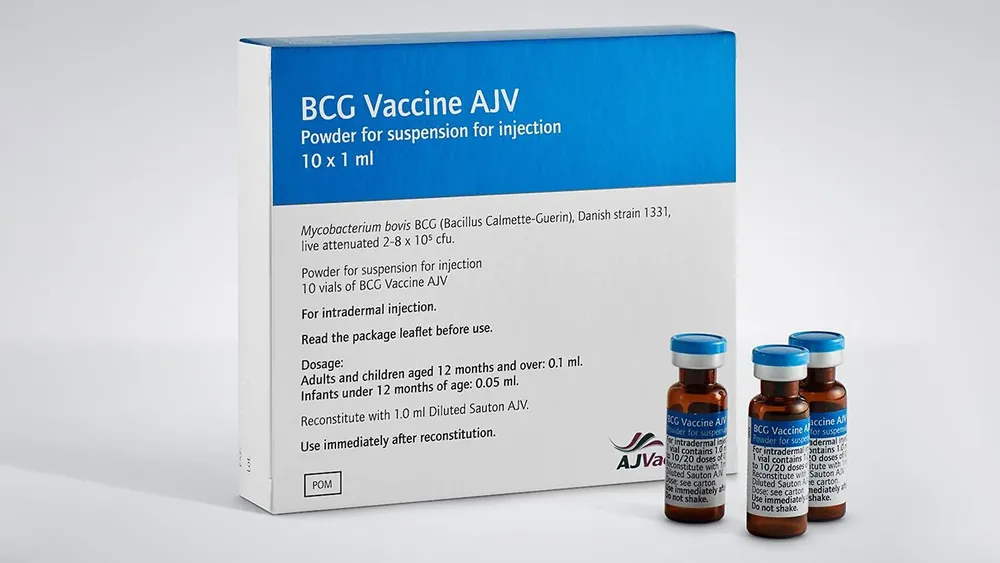
Table of Contents
- Package leaflet: Information for the user
- 1. What BCG AJVaccines Vaccine is and what it is used for
- 2. Important information before using BCG Vaccine AJVaccines
- 3. How to use BCG Vaccine AJVaccines
- 4. Possible adverse reactions
- 5. How to store BCG Vaccine AJVaccines
- 6. Contents of the pack and other information
- INFORMATION INTENDED EXCLUSIVELY FOR MEDICAL PERSONNEL
Package leaflet: Information for the user
BCG AJVaccines Vaccine
Powder and solvent for suspension for injection.
Mycobacterium bovis BCG (Bacillus Calmette-Guérin), Danish strain 1331, live attenuated.
Please read all of this leaflet carefully before the vaccine is administered, because
it contains important information for you.
- Keep this leaflet, so that you can read it again if necessary.
- If you have any further questions, please ask your doctor, pharmacist or nurse.
- This vaccine has been prescribed for a specific individual. Do not pass it on to others.
- If you experience any adverse reactions after vaccination, including any adverse reactions not listed in this leaflet, tell your doctor, pharmacist or nurse. See section 4.
Contents of the leaflet
- What BCG AJVaccines Vaccine is and what it is used for
- Important information before using BCG AJVaccines Vaccine
- How to use BCG AJVaccines Vaccine
- Possible side effects
- How to store BCG AJVaccines Vaccine
- Contents of the pack and other information
1. What BCG AJVaccines Vaccine is and what it is used for
BCG AJVaccines Vaccine contains Mycobacterium bovis BCG bacilli and is a vaccine used to protect against tuberculosis (TB).
2. Important information before using BCG Vaccine AJVaccines
Do not administer BCG Vaccine AJVaccines:
- if the patient is allergic to Mycobacterium bovis or to any of the other components of this vaccine (listed in section 6),
- if the patient has an acute, severe illness with fever or generalized skin infection – in such cases, vaccination should be postponed,
- if the patient has been diagnosed with weakened immunity to infections or an immunological disorder,
- if the patient is undergoing treatment with, for example, corticosteroids or other therapies that suppress the immune system (including radiotherapy),
- if the patient has been exposed to immunosuppressive agents in utero or via breastfeeding (e.g. treatment with TNF-α antagonists),
- if the patient has any malignant neoplasm (e.g. lymphoma, leukemia, or Hodgkin's disease),
- if the patient's immune status is unknown,
- if the patient has been diagnosed with HIV infection,
- if the patient is taking anti-tuberculosis (TB) medications.
Warnings and precautions
Talk to a doctor, pharmacist, or nurse before receiving BCG Vaccine AJVaccines.
The doctor or nurse will exercise particular caution when administering BCG Vaccine AJVaccines
- if the patient has been diagnosed with eczema. BCG Vaccine AJVaccines may be administered, but only at a site free of skin lesions.
- if the patient has had a positive tuberculin skin test. Vaccination in individuals with a positive tuberculin test provides no benefit and, on the contrary, may lead to severe local reactions.
BCG Vaccine AJVaccines and other medicines
Tell the doctor or pharmacist about all medicines the patient is currently taking, has recently taken, or plans to take.
Other vaccines may be administered simultaneously with BCG Vaccine AJVaccines, but at different injection sites.
Pregnancy, breastfeeding, and fertility
If the patient is pregnant or breastfeeding, suspects she may be pregnant, or is planning to have a child, she should consult a doctor or pharmacist before receiving BCG Vaccine AJVaccines.
Vaccination during pregnancy and breastfeeding is not recommended, although no harmful effects of BCG Vaccine AJVaccines on the unborn child or on breastfed infants have been reported.
Driving and operating machinery
BCG Vaccine AJVaccines has no influence on the ability to drive or operate machinery.
BCG Vaccine AJVaccines contains potassium and sodium
BCG Vaccine AJVaccines contains less than 1 mmol of potassium (39 mg) per dose and is therefore essentially considered potassium-free.
BCG Vaccine AJVaccines contains less than 1 mmol of sodium (23 mg) per dose and is therefore essentially considered sodium-free.
3. How to use BCG Vaccine AJVaccines
The vaccine is administered by a healthcare professional via an intradermal injection into the superficial layer of the skin.
Recommended dose:
Infants under 12 months of age: 0.05 ml
Adults and children aged 12 months and older: 0.1 ml
To facilitate healing, it is best to leave the injection site uncovered.
Reactions that may occur after vaccination:
- slight swelling, redness, and tenderness at the injection site, progressing to a skin lesion
- over the following weeks, the skin lesion develops into a small ulcer
- after several months, the ulcer heals, leaving only a small, flat scar
- slight swelling of the lymph nodes in the armpit may occur
These are common reactions to the vaccine.
If you have any further doubts regarding the use of this vaccine, consult your doctor, pharmacist, or nurse.
4. Possible adverse reactions
Like all medicines, BCG Szczepionka AJVaccines can cause adverse reactions, although they do not occur in
everyone.
Severe allergic reactions (such as redness of the face and neck, swelling of the face, throat and neck,
skin rash, breathing difficulties, collapse) may occur rarely (in less than 1 in 1,000 patients).
If any of the above-mentioned reactions occur, contact a doctor immediately.
Other adverse reactions include:
Adverse reactions occurring not very commonly (may affect up to 1 in 100 people)
- fever
- swelling of the lymph nodes in the armpit with a diameter greater than 1 cm
- inflammation of the lymph nodes, sometimes with draining ulceration and pus
- draining ulcer at the injection site
- headache
Adverse reactions occurring rarely (may affect up to 1 in 1,000 people)
- abscess at the injection site
- infection with vaccine-derived mycobacteria, which may progress to generalized infection, including bone infection
Syncope, seizures and convulsions have been observed among patients receiving vaccination.
In premature infants (born at or before week 28 of pregnancy), prolonged breathing pauses may occur within 2–3 days after vaccination.
Reporting of adverse reactions
If any adverse reactions occur, including any adverse reactions not listed in the leaflet, inform a doctor, pharmacist or nurse. Adverse reactions can be reported directly to the Department of Monitoring Adverse Drug Reactions of the Office for Registration of Medicinal Products, Medical Devices and Biocidal Products, Al. Jerozolimskie 181C, 02-222 Warsaw, Tel. +48 22 492 13 01, Fax: +48 22 492 1309, Website: https://smz.ezdrowie.gov.pl
Adverse reactions can also be reported to the responsible entity. Reporting adverse reactions allows further information on the safety of the medicine to be collected.
5. How to store BCG Vaccine AJVaccines
Keep the vaccine out of the sight and reach of children.
Store in a refrigerator (2 – 8°C).
Store in the original packaging to protect from light.
Do not freeze.
Do not use after the expiry date stated on the carton after "Exp".
The expiry date refers to the last day of the stated month.
Medicines must not be disposed of via wastewater or household waste. Ask your pharmacist how to dispose of medicines no longer required. These measures will help protect the environment.
6. Contents of the pack and other information
What BCG Vaccine AJVaccines contains
The active substance is a lyophilized powder containing live, attenuated (avirulent)
Mycobacterium bovis BCG (Bacillus Calmette-Guérin), Danish strain 1331.
1 ml of reconstituted vaccine contains 2 to 8 million bacilli.
Other ingredients are: monosodium glutamate, magnesium sulfate heptahydrate, dipotassium phosphate,
L-asparagine monohydrate, iron(III)-ammonium citrate, glycerol 85%, citric acid monohydrate,
water for injections.
What BCG Vaccine AJVaccines looks like and contents of the pack
BCG Vaccine AJVaccines consists of a powder and solvent for preparing a suspension for injection (2–8 x 10^6 bacteria/0.1 ml or 1–4 x 10^6 bacteria/0.05 ml).
Pack sizes, powder: packs containing 1, 5 or 10 vials, and a pack containing 1 vial with one syringe and two needles (one long needle for drawing up the solvent, one short needle for intradermal injection).
The powder in the amber glass vial is white and crystalline. The powder may be difficult to see due to the small quantity present in the vial.
The solvent in the clear vial is a colourless solution without any visible particles.
The reconstituted vaccine drawn into the syringe should be a uniform, slightly opalescent, colourless suspension.
Pack sizes, solvent: packs containing 1, 5 or 10 vials, and a pack containing 1 vial in a single-dose injection set.
Not all pack types may be marketed.
Marketing Authorisation Holder and Manufacturer
AJ Vaccines A/S
5, Artillerivej
DK-2300 Copenhagen S
Denmark
Tel: +45 7229 7000
Email: [email protected]
This medicinal product is authorised in the European Economic Area countries and the United Kingdom (Northern Ireland) under the following names:
DK: BCG Vaccine “AJ Vaccines”
EL, FI: BCG Vaccine AJVaccines
FR: VACCIN BCG AJVaccines
NO: BCG-vaksine AJVaccines
PL: BCG Szczepionka AJVaccines
SE: BCG-vaccin AJVaccines
UK: BCG Vaccine AJV
INFORMATION INTENDED EXCLUSIVELY FOR MEDICAL PERSONNEL
Special warnings and precautions for use
The vaccine must be administered strictly intradermally.
BCG vaccine should be administered by medical personnel trained in intradermal injections.
Incorrect administration, e.g., subcutaneously or intramuscularly, increases the risk of lymphadenitis and abscess formation.
Individuals with a positive tuberculin skin test should not be vaccinated, as this may lead to a severe local reaction.
Although anaphylactic reactions are rare, emergency medical treatment required in case of such reactions must always be readily available during vaccination.
Whenever possible, the vaccinated individual should remain under observation for approximately 15–20 minutes after vaccination in case of allergic reactions.
BCG Vaccine may be administered simultaneously with other inactivated or live vaccines, including combined measles, mumps, and rubella vaccine.
If other vaccines are not administered simultaneously, at least a 4-week interval should be maintained before administering another live vaccine.
For at least 3 months, no other vaccine should be injected into the arm where BCG Vaccine AJVaccines was administered.
Preparation for administration
The rubber stopper must not be wiped with any antiseptic or detergent. If alcohol is used to clean the rubber stopper of the vial, allow it to evaporate completely before inserting the syringe needle.
Using a syringe with a long needle, withdraw the solvent (volume indicated on the label) and transfer it to the vial containing the powder. Do not use other solvents, as they may destroy the vaccine. Gently invert the vial several times to completely dissolve the lyophilized BCG Vaccine AJVaccines.
Do not shake the vial.
Before withdrawing each subsequent dose, gently rotate the vial containing the suspension.
After reconstitution, the vaccine drawn into the syringe should be a uniform, slightly opalescent, colorless suspension.
After reconstitution, the vaccine must be used within 4 hours.
Method of administration:
BCG vaccine should be administered by medical personnel trained in intradermal injection techniques.
The injection site should be clean and dry.
If alcohol or similar antiseptic agents are used to disinfect the skin prior to injection, wait until they have completely evaporated.
The vaccine must be injected strictly intradermally into the arm, over the distal attachment of the deltoid muscle to the humerus (in the upper third of the arm), as follows:
- Grasp the skin between the thumb and index finger.
- Insert the needle slowly at a depth of approximately 2 mm into the superficial layers of the skin, with the needle held almost parallel to the skin surface and the bevel facing upward. The needle should remain visible through the epidermis during insertion.
- Inject slowly.
- The formation of a pale, raised bleb at the injection site indicates correct intradermal injection.
- It is best to leave the injection site uncovered to promote healing.
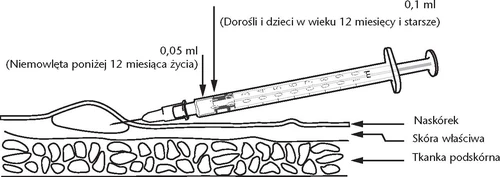
After reconstitution, the vaccine should be administered using a 1 ml syringe graduated in hundredths of a milliliter (0.01 ml), fitted with a short needle with a cut bevel (25G/0.50 mm or 26G/0.45 mm).
The vaccine must not be administered using jet injectors or multi-puncture devices.
Overdose or incorrect administration
Overdose increases the risk of suppurative lymphadenitis and may lead to the formation of an excessively large scar.
Overdose increases the risk of adverse complications.
Administering the vaccine too deeply increases the risk of ulceration, lymphadenitis, and abscess formation.
Management of complications following BCG Vaccine AJVaccines vaccination
Expert advice should be sought regarding the appropriate management of generalized infections or persistent local infections resulting from BCG Vaccine AJVaccines vaccination.
Sensitivity of BCG strain to antibiotics:
The table below provides minimum inhibitory concentrations (MIC) for selected anti-tuberculosis drugs against BCG strain Danish 1331 [determined using Bactec 460].
The MIC for isoniazid is 0.4 mg/L. There is no consensus on whether Mycobacterium bovis BCG should be classified as sensitive, moderately sensitive, or resistant to isoniazid when the MIC is 0.4 mg/L. However, based on criteria established for Mycobacterium tuberculosis, the strain may be considered moderately sensitive.
| Drug | Minimum Inhibitory Concentration (MIC) |
| Isoniazid | 0.4 mg/l |
| Streptomycin | 2.0 mg/l |
| Rifampicin | 2.0 mg/l |
| Ethambutol | 2.5 mg/l |
The BCG Danish strain 1331 is resistant to pyrazinamide.