Barium sulfuricum medana
Poland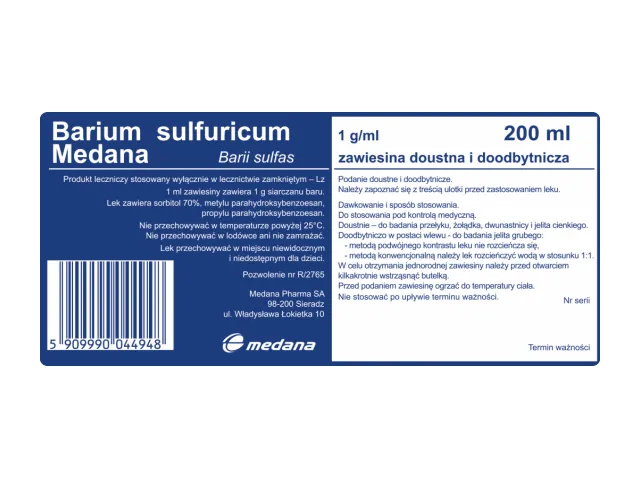
Table of Contents
- Patient Information Leaflet
- 1. What Barium sulfuricum Medana is and what it is used for
- 2. Important information before using Barium sulfuricum Medana
- 3. How to use Barium sulfuricum Medana
- 4. Possible adverse reactions
- 5. How to store Barium sulfuricum Medana
- 6. Contents of the pack and other information
Patient Information Leaflet
Barium sulfuricum Medana, 1 g/ml, oral and rectal suspension
Barium sulfate
Please read all of this leaflet carefully before using this medicine, because it contains
important information for you.
- Keep this leaflet, as you may need to read it again.
- If you have any further questions, please ask your doctor or nurse.
- This medicine has been prescribed for you personally. Do not pass it on to others. It may harm them even if their symptoms are the same as yours.
- If you experience any side effects, including any not listed in this leaflet, inform your doctor or nurse. See section 4.
Leaflet Contents
- What Barium sulfuricum Medana is and what it is used for
- Important information before taking Barium sulfuricum Medana
- How to take Barium sulfuricum Medana
- Possible side effects
- How to store Barium sulfuricum Medana
- Contents of the pack and other information
1. What Barium sulfuricum Medana is and what it is used for
Barium sulfuricum Medana suspension is a positive contrast agent used in X-ray diagnostics of the gastrointestinal tract. It is insoluble in water and is not absorbed from the gastrointestinal tract. Unlike soluble barium salts, it does not cause poisoning. Its mechanism of action is based on its ability to absorb X-rays. After administration of the contrast agent (orally or as a rectal enema), the mucosal pattern and lumen of the gastrointestinal tract become visible on X-ray imaging, allowing detection of pathological changes in the esophagus, stomach, small intestine or large intestine.
The drug does not affect secretory or motor functions of the gastrointestinal tract.
It is excreted unchanged in the feces.
Indications
This medicine is intended solely for radiological diagnostics.
Radiological examinations of the gastrointestinal tract: esophagus, stomach, small intestine and large intestine.
2. Important information before using Barium sulfuricum Medana
When not to use Barium sulfuricum Medana:
- if the patient is allergic to barium sulfate or any of the other ingredients of this medicine (listed in section 6);
- if the patient has intestinal obstruction, peritonitis, septic shock;
- if the patient has suspected or diagnosed perforation of the gastrointestinal tract;
- if the patient has ulcerative colitis;
- if the patient has a tracheoesophageal fistula.
Warnings and precautions
Before starting treatment with Barium sulfuricum Medana, please discuss this with your doctor or
nurse.
Special caution is required when using Barium sulfuricum Medana:
- if the patient is prone to constipation;
- when administered to children, patients over 65 years of age, or patients who are debilitated or dehydrated;
- if the patient has asthma, cystic fibrosis, hypertension, advanced heart disease, allergies, or hypersensitivity reactions to contrast agents, or swallowing disorders;
- if the patient has hereditary fructose intolerance.
Barium sulfuricum Medana and other medicines
Inform your doctor or pharmacist about all medicines currently used or recently used, as well as any medicines you plan to take.
Pregnancy and breastfeeding
If the patient is pregnant or breastfeeding, suspects she may be pregnant, or is planning to have a
child, she should consult her doctor before using this medicine.
Pregnancy
Radiological examinations should not be performed in pregnant women due to potential risk to the fetus.
The safe use conditions of this medicine in pregnant women have not been established.
Breastfeeding
This medicine may be used during breastfeeding; however, prior medical consultation is recommended.
Driving and operating machinery
This medicine does not affect the ability to drive or operate machinery.
Barium sulfuricum Medana contains sorbitol (E 420), methyl parahydroxybenzoate (E 218),
propyl parahydroxybenzoate (E 216), ethanol (from flavouring), and sodium.
The medicine contains 33 mg of sorbitol in each ml of suspension. Sorbitol is a source of fructose. If
the patient (adult or child) has previously been diagnosed with intolerance to certain sugars or hereditary fructose intolerance, a rare genetic disorder in which the body cannot metabolize fructose, the patient should contact a doctor before taking the medicine or giving it to a child. When the dose of sorbitol ingested with Barium sulfuricum Medana exceeds 140 mg/kg body weight per day, sorbitol may cause gastrointestinal discomfort and may have a mild laxative effect.
The medicine contains 0.75 mg of methyl parahydroxybenzoate in each ml of suspension.
The medicine contains 0.25 mg of propyl parahydroxybenzoate in each ml of suspension. This medicine may
cause allergic reactions (including delayed-type reactions).
The medicine contains 162 mg of sodium (the main component of table salt) per bottle (200 ml suspension).
This corresponds to 8.1% of the maximum recommended daily dietary intake of sodium for adults.
The medicine contains 0.04 mg of alcohol (ethanol) in each ml of suspension. The amount of alcohol in 200 ml of this medicine
is equivalent to 0.2 ml of beer or 0.08 ml of wine. The small amount of alcohol in this medicine will not cause noticeable effects.
3. How to use Barium sulfuricum Medana
This medicine should always be used according to the instructions given by the doctor or pharmacist. If you have any doubts,
you should consult your doctor or pharmacist.
This medicine is intended solely for diagnostic radiological examinations.
Use under medical supervision.
The amount of suspension administered should always be determined by the physician performing the examination.
The usual dose of Barium sulfuricum Medana is 80–200 g (45–112 ml) of suspension,
depending on the segment of the gastrointestinal tract being examined, the patient's body weight, duration of
the examination, etc.
To obtain a uniform suspension, the bottle should be shaken several times before opening.
The medicine should be warmed to body temperature before administration.
Orally – for examination of the esophagus, stomach, duodenum, and small intestine.
Rectally as an enema – for examination of the large intestine:
- for double-contrast technique, the preparation is not diluted;
- for conventional technique, the preparation should be diluted with water in a 1:1 ratio.
After completion of the gastrointestinal examination, measures should be taken to eliminate the remaining contrast agent
(e.g. adequate hydration, and if necessary, use of laxatives) to prevent complications associated with barium sulfate retention in the gastrointestinal tract.
Use of a higher than recommended dose of Barium sulfuricum Medana
If more medicine has been taken than recommended, medical advice must be sought (see
section 4).
If you have any further doubts concerning the use of this medicine, consult your doctor or nurse.
4. Possible adverse reactions
Like all medicines, this medicinal product can cause adverse reactions, although not everyone will experience them.
Adverse reactions associated with the use of Barium sulfuricum Medana most commonly result from improper administration technique or the presence of diseases impairing the strength of the gastrointestinal tract wall. Adverse reactions are very rare and usually mild.
Nervous system disorders
Very rare (occurring in fewer than 1 in 10,000 patients, including single cases):
Migraine-type headaches. Accidental intravascular administration of barium sulfate may lead to irreversible brain damage.
Cardiac disorders
Very rare (occurring in fewer than 1 in 10,000 patients, including single cases):
Changes in ECG, hypotension. Accidental intravascular administration of barium sulfate (e.g. during administration of a rectal enema) may lead to complications such as cardiac arrest, cardiac arrhythmias, ventricular fibrillation, bradycardia, or asystole.
Vascular disorders
Accidental intravascular administration of barium sulfate (e.g. during administration of a rectal enema) may lead to disseminated intravascular coagulation (DIC).
Respiratory, thoracic and mediastinal disorders
Accidental intravascular administration of barium sulfate (e.g. during administration of a rectal enema) may lead to complications such as pulmonary embolism or respiratory failure.
Gastrointestinal disorders
Dysphagia (difficulty swallowing), constipation, diarrhea, gastrointestinal obstruction, cramping abdominal pain, barium granuloma, appendicitis. Cramping abdominal pain and diarrhea may result from using too large a dose of the medicinal product in a rectal enema. In elderly patients, barium sulfate may persist for up to 4–6 days after administration.
Improperly performed rectal enema may lead to colitis, proctitis, or colonic perforation, following which the contrast medium may cause peritonitis.
Skin and subcutaneous tissue disorders
Hypersensitivity reactions – urticaria, pruritus, erythema, generalized rash, periorbital edema, contact dermatitis. These symptoms may occur immediately or with some delay after completion of the examination.
Reporting of adverse reactions
If any adverse reactions occur, including any adverse reactions not listed in this leaflet, inform your doctor or pharmacist. Adverse reactions can be reported directly to the Department of Monitoring of Adverse Drug Reactions of the Office for Registration of Medicinal Products, Medical Devices and Biocidal Products
Al. Jerozolimskie 181C
02-222 Warsaw
Phone: +48 22 49 21 301
Fax: +48 22 49 21 309
Website: https://smz.ezdrowie.gov.pl
Adverse reactions may also be reported to the marketing authorization holder.
Reporting adverse reactions helps to provide more information on the safety of the medicinal product.
5. How to store Barium sulfuricum Medana
Keep the medicine out of the sight and reach of children.
Do not store above 25°C.
Do not store in a refrigerator or freeze.
Do not use this medicine after the expiry date stated on the packaging.
The marking on the packaging following the abbreviation EXP indicates the expiry date, and following the abbreviation Lot indicates the batch number.
Medicines must not be disposed of via wastewater or household waste. Ask your pharmacist how to dispose of medicines no longer in use. This will help protect the environment.
6. Contents of the pack and other information
What Barium sulfuricum Medana contains
- The active substance is barium sulfate. Each ml of suspension contains 1 g of barium sulfate.
- The other ingredients are: sodium carmellose; pectin; citric acid monohydrate; sodium carbonate decahydrate; sorbitol 70% (E420), methyl parahydroxybenzoate (E218), propyl parahydroxybenzoate (E216); flavouring agent, peppermint flavour; purified water.
What Barium sulfuricum Medana looks like and contents of the pack
Colourless PET bottle closed with a polyethylene screw-cap, equipped with a tamper-evident ring
and a sealing ring or sealing insert.
The bottle contains 200 ml of suspension.
Marketing Authorisation Holder and Manufacturer
Marketing Authorisation Holder
POLPHARMA Pharmaceuticals S.A.
Pelplińska 19, 83-200 Starogard Gdański
tel. + 48 22 364 61 01
Manufacturer
POLPHARMA Pharmaceuticals S.A.
Medana Plant in Sieradz
Władysława Łokietka 10, 98-200 Sieradz