Azithromycin
Poland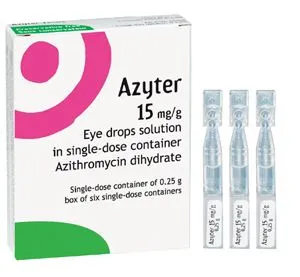
Table of Contents
Package leaflet: Information for the patient
Warning! Keep the leaflet. Information on the immediate packaging in a foreign language.
Azyter, 15 mg/g, eye drops, solution in a single-dose container
Azithromycinum dihydricum
Please read the entire leaflet carefully before using the medicine, as it contains
important information for the patient.
- Keep this leaflet for future reference.
- If you have any doubts, consult your doctor, the doctor treating the child, pharmacist, or nurse.
- This medicine has been prescribed for a specific individual. Do not pass it on to others. The medicine may harm someone else, even if their symptoms are the same.
- If any adverse reactions occur in the patient, including any adverse reactions not listed in this leaflet, inform your doctor, pharmacist, or nurse. See section 4.
Table of contents of the leaflet:
- What Azyter is and what it is used for
- Important information before using Azyter
- How to use Azyter
- Possible side effects
- How to store Azyter
- Contents of the pack and other information
1. What Azyter is and what it is used for
Azyter contains azithromycin, an antibiotic belonging to the macrolide group.
Azyter is used in the local treatment of various bacterial eye infections in adults (including elderly people) and children from birth up to 17 years of age.
- Bacterial conjunctivitis,
- Trachomatous conjunctivitis (a bacterial eye infection caused by Chlamydia trachomatis, occurring in developing countries).
2. Important information before using Azyter
When NOT to use Azyter:
- if the patient is allergic to azithromycin, other antibiotics of the macrolide group, or to medium-chain triglycerides.
Warnings and precautions
Before starting treatment with Azyter, consult a physician, the child's treating doctor, pharmacist, or nurse:
- If an allergic reaction occurs, discontinue use of the medicine and seek medical advice.
- If there is no improvement after three days of treatment, or if unusual symptoms occur, consult a doctor.
- If there is an eye infection, wearing contact lenses is not recommended. This medicine is intended for ocular use only. Do not inject or take orally.
Azyter and other medicines
If other eye medications need to be used, follow these steps:
Page 1 of 5

apply the other eye medicine first,
wait 15 minutes,

then instill Azyter as the last medication.
Inform your doctor, the child's treating physician, or pharmacist about all medicines currently or recently used, as well as any medicines planned for future use.
Pregnancy
Azyter may be used during pregnancy.
The treating physician may prescribe Azyter to a pregnant woman if deemed necessary.
Breast-feeding
Limited data indicate that azithromycin passes into breast milk.
This medicine may be used during breast-feeding.
If the patient is pregnant or breast-feeding, suspects she may be pregnant, or is planning to become pregnant, she should consult a doctor or pharmacist before using this medicine.
Driving and operating machinery
Blurred vision may occur temporarily after instillation. In such cases, wait until symptoms have resolved before driving or operating machinery.
3. How to use Azyter
Azyter should be used only in the eye (ophthalmic administration).
This medicine should always be used exactly as prescribed by the doctor. If in doubt, consult
your doctor, the doctor treating the child, or a pharmacist.
Dosage
The recommended dose for adults (including elderly patients) and children from birth to 17 years of age is 1 drop twice daily into the affected eye(s): one drop in the morning and one drop in the evening.
The duration of treatment is 3 days.
Because the medicine has a prolonged effect, it is not necessary to use it for longer than 3 days, even if mild symptoms of infection persist.
Method of administration:
To correctly administer Azyter, follow these steps:
- Wash your hands carefully before and after instilling the drops.
- Look upwards and gently pull down the lower eyelid; instill one drop into the affected eye.
- Do not touch the surface of the eye or eyelids with the tip of the single-dose container.
- After use, the single-dose container must be discarded. Do not store it for reuse.
DO NOT INJECT, DO NOT SWALLOW
If you miss a dose of Azyter
Do not use a double dose to make up for a missed dose.
Stopping treatment with Azyter
Page 2 of 5
Always consult your doctor before deciding to stop treatment.
If you have any further questions about the use of this medicine, consult your doctor, pharmacist, or nurse.
4. Possible adverse reactions
Like all medicines, this medicine can cause adverse reactions, although not everyone will experience them.
You must inform your doctor immediately if any of the following symptoms occur after using this medicine,
as these symptoms may be severe.
Not common: may affect 1 in 100 patients:
- severe allergic reaction causing swelling of the face or throat (angioedema).
Frequency not known: frequency cannot be estimated from the available data:
- severe skin reactions: skin rash, skin lesions, blisters on the skin, mouth, eyes, and genital organs (Stevens-Johnson Syndrome (SJS) or Toxic Epidermal Necrolysis (TEN)), skin rash accompanied by other symptoms such as fever, swollen lymph nodes, and increased eosinophil count (a type of white blood cell), appearance of rash consisting of small, itchy red bumps (Drug Reaction with Eosinophilia and Systemic Symptoms (DRESS)), generalized erythema with widespread skin peeling (exfoliative dermatitis), skin lesions characterized by rapid development of red skin areas covered with small pustules (small blisters filled with white-yellow fluid) (Acute Generalized Exanthematous Pustulosis (AGEP)). If any of these skin symptoms occur, azithromycin use must be discontinued and medical advice must be sought immediately or emergency care sought.
The following adverse reactions have been reported after use of the medicine:
Very common: may affect more than 1 in 10 people:
- transient eye discomfort (itching, burning, stinging).
Common: may affect up to 1 in 10 people:
- blurred vision,
- sticky sensation of eyelids,
- sensation of foreign body in the eye.
Not common: may affect 1 in 100 people:
- allergic reactions (hypersensitivity),
- conjunctival inflammation (possibly due to infection or allergy) (conjunctivitis),
- allergic conjunctivitis,
- keratitis,
- itching of the skin of the eyelids (eyelid dermatitis),
- dryness, redness, and swelling of the eyelids (eyelid edema),
- eye hypersensitivity,
- tearing of the eyes,
- redness of the eyelids (eyelid erythema),
- redness of the conjunctiva (conjunctival hyperemia).
Reporting of adverse reactions
Page 3 of 5
If any adverse reactions occur, including any not listed in this leaflet, you should inform your doctor, the doctor treating your child, pharmacist, or nurse. Adverse reactions can be reported directly to the Department of Monitoring Adverse Drug Reactions, Office for Registration of Medicinal Products, Medical Devices and Biocidal Products
Al. Jerozolimskie 181C, 02-222 Warsaw
Tel: +48 22 49 21 301
Fax: +48 22 49 21 309
Website: https://smz.ezdrowie.gov.pl
By reporting adverse reactions, additional information on the safety of this medicine can be collected.
5. How to store Azyter
Keep the medicine out of the sight and reach of children.
Do not use this medicine after the expiry date stated on the outer packaging
and on the single-dose container. The expiry date refers to the last day of the stated month.
- Do not store above 25°C.
- Store the single-dose containers in the sachet to protect from light.
Each single-dose container should be immediately discarded after first use,
even if not all of the contents have been used. Do not store for reuse.
Medicines should not be disposed of via wastewater or household waste. Ask your pharmacist
how to dispose of medicines no longer required. This will help protect the environment.
6. Contents of the package and other information
What Azyter contains
- The active substance is azithromycin dihydrate. One gram of solution contains 15 mg of azithromycin dihydrate, equivalent to 14.3 mg of azithromycin. Each single-dose container contains 3.75 mg of azithromycin dihydrate in 250 mg of solution.
- The other ingredient is medium-chain triglycerides.
What Azyter looks like and contents of the pack
Azyter is a solution for ocular administration (eye drops, solution) in single-dose containers made of LDPE, containing 0.25 g of medicinal product, packed in a sachet within a cardboard box. Azyter is a clear, colourless to slightly yellowish, oily liquid.
The cardboard box contains 6 single-dose containers in a sachet, sufficient for one course of treatment.
For further information, please contact the Marketing Authorisation Holder or the Parallel Importer.
Marketing Authorisation Holder in Greece, the country of export:
Laboratoires THEA, 12, rue Louis Blériot, 63017 Clermont-Ferrand Cedex 2, France
Manufacturer:
Laboratoire UNITHER, 1 rue de l’Arquerie, 50200 Coutances, France
Page 4 of 5
Parallel Importer:
Delfarma Sp. z o.o., ul. Św. Teresy od Dzieciątka Jezus 111, 91-222 Łódź
Repackaged in:
Delfarma Sp. z o.o., ul. Św. Teresy od Dzieciątka Jezus 111, 91-222 Łódź
Marketing Authorisation number in Greece, the country of export: 56059/25-08-2015
Parallel Import Licence number: 152/24
This medicinal product is authorised for marketing in the European Economic Area countries under the following trade names:
Austria, Bulgaria, Cyprus, Czech Republic, Denmark, Finland, France, Germany, Greece, Iceland, Ireland, Italy, Luxembourg, Netherlands, Norway, Poland, Portugal, Romania, Slovenia, Sweden, United Kingdom ....................................................................................................................... – Azyter
Spain ..................................................................................................................... – AZYDROP
Page 5 of 5