Azitrolek 500
Poland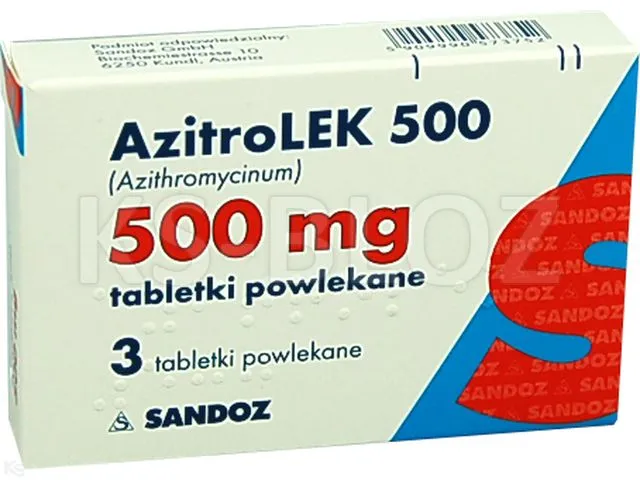
Table of Contents
Package leaflet: information for the patient
Warning! Keep this leaflet! The information on the immediate packaging is in a foreign language.
AzitroLEK 500 (Azithromycin 500 - 1 A Pharma)
500 mg, film-coated tablets
Azithromycinum
AzitroLEK 500 and Azithromycin 500 - 1 A Pharma are different trade names of the
same medicinal product.
Please read this leaflet carefully before using the medicine, as it contains
important information for the patient.
- Keep this leaflet so that you can read it again if necessary.
- If you have any further questions, please consult your doctor or pharmacist.
- This medicine has been prescribed for a specific individual. Do not pass it on to others. The medicine may harm another person, even if their symptoms are the same.
- If the patient experiences any adverse reactions, including any adverse reactions not listed in this leaflet, inform your doctor or pharmacist. See section 4.
Table of contents of the leaflet:
- What AzitroLEK 500 is and what it is used for
- Important information before taking AzitroLEK 500
- How to take AzitroLEK 500
- Possible side effects
- How to store AzitroLEK 500
- Contents of the pack and other information
1. What AzitroLEK 500 is and what it is used for
AzitroLEK 500 is an antibiotic belonging to a group called macrolides. It is used to treat bacterial infections.
This medicine is usually prescribed for the treatment of:
- chest infections, such as chronic bronchitis, pneumonia;
- tonsillitis, pharyngitis, and sinusitis;
- ear infections (acute otitis media);
- skin and soft tissue infections (excluding burn wound infections);
- urethral and cervical infections caused by Chlamydia.
2. Important information before using AzitroLEK 500
Do not use this medicine if the patient is allergic (hypersensitive) to:
- azithromycin;
- erythromycin;
- any other macrolide or ketolide antibiotic;
- any of the other ingredients of this medicine (listed in section 6).
Warnings and precautions
Before starting treatment with AzitroLEK 500, discuss the following with a doctor or pharmacist:
- liver function disorders: the doctor may need to assess liver function or discontinue treatment;
- kidney function disorders: if the patient has severe kidney impairment, a dose adjustment may be necessary;
- neurological or psychiatric disorders;
- a specific type of muscle weakness called myasthenia gravis;
- if the patient has previously had infections caused by pathogens resistant to azithromycin, erythromycin, clindamycin, and/or lincomycin, or methicillin-resistant staphylococci (possibility of cross-resistance).
Azithromycin may increase the risk of heart rhythm disturbances. Therefore, if the patient has any of the following conditions, inform the doctor before starting treatment:
- heart disorders such as heart failure, very slow heart rate, irregular heartbeat, or abnormal electrocardiogram (ECG) findings known as "prolonged QT interval";
- low blood potassium or magnesium levels.
If the patient develops diarrhoea or loose stools during or after treatment, immediately inform the doctor. Do not use any anti-diarrhoeal medication without first consulting a doctor. If diarrhoea persists, inform the doctor.
Inform the doctor if:
- the patient experiences worsening of symptoms during or shortly after treatment [possible superinfection and/or resistance].
Azithromycin is not suitable for the treatment of severe infections requiring rapid achievement of high antibiotic blood concentrations.
AzitroLEK 500 and other medicines
Tell the doctor or pharmacist about all medicines the patient is currently taking or has recently taken, including those obtained without a prescription, as well as any medicines the patient plans to take. This is particularly important before starting treatment with this medicine.
- Theophylline (used to treat bronchial asthma): the effect of theophylline may be enhanced.
- Warfarin or other similar anticoagulant medicines: concomitant use may increase the risk of bleeding.
- Ergotamine, dihydroergotamine (used to treat migraine): ergotism (tingling in limbs, painful muscle spasms, and gangrene of hands and feet due to poor blood circulation) may occur. Therefore, combined treatment is not recommended.
- Cyclosporine (used to suppress the immune system to prevent and treat organ or bone marrow transplant rejection): if combined treatment is necessary, the doctor will recommend regular blood tests and may adjust the dose.
- Digoxin (a medicine used in heart failure): digoxin blood levels may increase. The doctor will recommend monitoring these levels.
- Colchicine (used to treat gout and familial Mediterranean fever).
- Medicines that neutralize gastric acid (used for indigestion): see section 3.
- Cisapride (used for stomach disorders), terfenadine (used for hay fever), pimozide (used to treat certain psychiatric disorders), citalopram (used to treat depression), fluoroquinolones (antibiotics used to treat bacterial infections, e.g. moxifloxacin and levofloxacin): concomitant use with azithromycin may cause heart function disturbances, therefore combined treatment is not recommended.
- Medicines used for irregular heartbeat (so-called antiarrhythmics).
- Zidovudine (used to treat HIV infections): concomitant use may increase the risk of adverse effects.
- Nelfinavir (used in HIV infections): concomitant use may increase azithromycin's adverse effects.
- Alfentanil (used for anaesthesia) or astemizole (used for hay fever): concomitant use with azithromycin may enhance the effects of these medicines.
- Rifabutin (used to treat tuberculosis): the doctor may order regular blood tests and monitoring of blood drug levels.
- Statins (such as atorvastatin, used to lower blood lipid levels): concomitant use with azithromycin may lead to muscle disorders.
- Certain medicines (such as hydroxychloroquine) known to cause heart rhythm disturbances, e.g. QT interval prolongation on electrocardiogram: concomitant use may increase the risk of arrhythmias.
AzitroLEK 500 with food and drink
Tablets may be taken regardless of meals.
Pregnancy and breastfeeding
If the patient is pregnant or breastfeeding, suspects she may be pregnant, or is planning to have a child, she should consult a doctor or pharmacist before using this medicine. This medicine should not be used during pregnancy or breastfeeding unless specifically prescribed by a doctor.
This medicine passes into breast milk. If the patient is breastfeeding, she should consult a doctor before using this medicine.
Driving and operating machinery
It is unlikely that AzitroLEK 500 will impair the ability to drive or operate machinery. However, visual disturbances and blurred vision may affect the ability to drive or operate machinery. The medicine may cause adverse effects such as dizziness or convulsions. These effects may impair the ability to perform certain activities, including driving or operating machinery.
AzitroLEK 500 contains lactose monohydrate and sodium
If the patient has previously been diagnosed with intolerance to certain sugars, the patient should consult a doctor before taking this medicine.
This medicine contains less than 1 mmol (23 mg) of sodium per dose, meaning it is considered "sodium-free".
3. How to take AzitroLEK 500
This medicine should always be taken as directed by the physician. In case of doubt, consult a doctor or pharmacist. The dosages indicated below are intended for adults and children with body weight over 45 kg. Tablets should not be administered to children with lower body weight.
The following products are available on the market: AzitroLEK 250 (250 mg) and AzitroLEK 500 (500 mg).
Recommended dosage:
AzitroLEK is administered in a 3- or 5-day regimen.
- 3-day regimen: 500 mg (2 tablets of 250 mg or 1 tablet of 500 mg) once daily.
- 5-day regimen:
- on day 1: 500 mg (2 tablets of 250 mg);
- on days 2, 3, 4, and 5: 250 mg (1 tablet of 250 mg).
For urethritis and cervicitis caused by Chlamydia, the medicine is administered in a single-day regimen.
- 1-day regimen: single dose of 1000 mg (4 tablets of 250 mg or 2 tablets of 500 mg). Tablets should be taken at once, on the same day.
Patients with renal or hepatic impairment
If the patient has impaired kidney or liver function, inform the physician. The physician may decide to adjust the dosage.
Swallow the tablets with water.
- Tablets may be taken regardless of meals.
- AzitroLEK 500 tablets may be divided into halves if necessary.
Concomitant use of AzitroLEK 500 with antacids
If antacids (medicines that neutralize gastric acid) are required, AzitroLEK tablets should be taken at least 2 hours before or after the antacid.
Missed dose of AzitroLEK 500
If a dose is missed, take it as soon as possible, then continue taking the medicine according to the prescribed schedule. Do not take more than one dose per day.
Overdose of AzitroLEK 500
Taking too many tablets may cause malaise. Adverse effects such as transient deafness, nausea, vomiting, and diarrhea may also occur. In such a case, seek immediate medical advice or go to the nearest hospital. If possible, bring the tablets or the medicine packaging to show to the doctor.
Discontinuation of AzitroLEK 500
The medicine should be taken for the full duration of the prescribed treatment course, even if the patient feels better. Premature discontinuation of treatment may lead to recurrence of infection. Moreover, bacteria may become resistant to the medicine, which could cause difficulties in future treatment.
If you have any further questions regarding the use of this medicine, consult your doctor or pharmacist.
4. Possible adverse reactions
Like all medicines, this medicine can cause adverse reactions, although not everyone experiences them.
Serious adverse reactions
If any of the following symptoms of a severe allergic reaction occur, stop taking the medicine and contact a doctor immediately or go to the nearest hospital:
- sudden difficulty in breathing, speaking or swallowing;
- swelling of the lips, tongue, face and neck;
- severe dizziness or fainting;
- severe or itchy skin rash, especially in the form of blisters, accompanied by eye pain, mouth sores or genital pain;
If any of the following adverse reactions occur, seek medical advice as soon as possible:
- severe diarrhoea that lasts a long time or contains blood, accompanied by stomach pain or fever; this may be a sign of a serious intestinal inflammation, which rarely occurs after antibiotic treatment;
- yellowing of the skin or whites of the eyes, caused by liver function disorders;
- pancreatitis causing severe abdominal and back pain;
- increased or decreased urine output or blood in the urine, caused by kidney function disorders;
- skin rash caused by photosensitivity;
- unusual bruising or bleeding;
- irregular or rapid heartbeat.
These are serious adverse reactions and may require immediate medical attention. Serious adverse reactions occur uncommonly (may occur in less than 1 in 100 people), rarely (may occur in less than 1 in 1000 people), or their frequency cannot be determined from available data.
Other possible adverse reactions
Very common adverse reactions (may occur in more than 1 in 10 people):
- diarrhoea
Common adverse reactions (may occur in less than 1 in 10 people):
- headache
- vomiting, indigestion, abdominal cramps, nausea
- low lymphocyte count (a type of white blood cell), increased eosinophil count (a type of white blood cell), low bicarbonate levels in blood, increased basophil, monocyte and neutrophil counts (types of white blood cells)
Uncommon adverse reactions (may occur in less than 1 in 100 people):
- fungal and bacterial infections, especially of the mouth, throat, nose, lungs, intestines and vagina
- low leukocyte count (a type of white blood cell), low neutrophil count (a type of white blood cell), increased eosinophil count (a type of white blood cell)
- swelling, allergic reactions of varying severity
- loss of appetite
- nervousness, insomnia
- dizziness, drowsiness, taste disturbances
- visual disturbances
- sensation of spinning
- skin rash, sweating (hot flushes)
- difficulty breathing, nosebleeds
- constipation, gas, indigestion, stomach inflammation, difficulty swallowing, bloating, dry mouth, burping, mouth ulcers, excessive salivation
- hepatitis
- itchy rash, skin inflammation, dry skin, sweating
- joint inflammation, muscle, back and neck pain
- difficulty and pain during urination, kidney pain
- genital bleeding, testicular disorders
- skin swelling, weakness, facial swelling, chest pain, fever, pain
- abnormal laboratory test results (e.g. blood, liver and kidney function tests)
- complications following treatment
Rare adverse reactions (may occur in less than 1 in 1000 people):
- restlessness, feeling of unreality
- abnormal liver function
- tingling or numbness in hands or feet
- hearing impairment
- palpitations
- general malaise, fatigue
- photosensitivity
- skin eruption characterized by rapid appearance of red skin areas covered with small blisters filled with white or yellow fluid
- delayed allergic reaction (up to several weeks after exposure) with rash and other possible symptoms such as facial swelling, enlarged lymph nodes and abnormal test results, e.g. liver function tests and increased counts of certain white blood cells (drug reaction with eosinophilia and systemic symptoms, DRESS)
Frequency not known (frequency cannot be determined from available data):
- decreased platelet count, increasing the risk of bleeding or bruising
- decreased red blood cell count, causing pale-yellow skin discoloration, weakness or shortness of breath
- feelings of aggression, anxiety, severe confusion, hallucinations
- seizures, fainting, reduced skin sensitivity to touch, hyperactivity, smell disturbances, loss of smell or taste, muscle weakness (myasthenia)
- hearing disturbances, deafness or ringing in the ears
- abnormal ECG reading
- low blood pressure
- tongue discoloration
- joint pain
- vision problems (blurred vision)
Reporting of adverse reactions
If any adverse reactions occur, including any not listed in this leaflet, inform your doctor or pharmacist. Adverse reactions can be reported directly to the Department of Monitoring Adverse Reactions of Medicinal Products at the Office for Registration of Medicinal Products, Medical Devices and Biocidal Products, Al. Jerozolimskie 181C, 02-222 Warsaw, tel.: +48 22 49 21 301, fax: +48 22 49 21 309, website: https://smz.ezdrowie.gov.pl.
Reporting adverse reactions helps to provide more information on the safety of the medicine.
5. How to store AzitroLEK 500
Keep this medicine out of the sight and reach of children.
Do not use this medicine after the expiry date stated on the packaging. The expiry date refers to the last day of the stated month.
Translation of some information on the immediate packaging:
Ch.-B./verwendbar bis: siehe Prägung – batch number/expiry date – see embossing.
No special storage instructions are required.
Medicines must not be disposed of via wastewater or household waste. Ask your pharmacist how to dispose of medicines no longer required. Such measures will help protect the environment.
6. Contents of the packaging and other information
What AzitroLEK 500 contains
- The active substance is azithromycin. Each coated tablet contains 500 mg of azithromycin (as azithromycin dihydrate).
- Other components are: tablet core: microcrystalline cellulose, maize starch, sodium carboxymethyl starch (type A), colloidal anhydrous silica, sodium lauryl sulfate, magnesium stearate; coating: hypromellose, titanium dioxide (E 171), lactose monohydrate, macrogol 4000.
What AzitroLEK 500 looks like and contents of the packaging
White, elongated tablets with a break line on one side and engraved "A 500".
The tablet can be divided into equal doses.
Packaging contains 3 coated tablets.
For more detailed information about the medicine, please contact the marketing authorization holder or the parallel importer.
Marketing Authorization Holder in Germany, the country of export:
1 A Pharma GmbH
Industriestraße 18
83607 Holzkirchen
Germany
Manufacturer:
S.C. SANDOZ S.R.L.
7A “Livezeni” Street
540472, Târgu Mureş
Mureş County
Romania
Salutas Pharma GmbH
Otto-von-Guericke-Allee 1
39179 Barleben
Germany
Parallel Importer:
InPharm Sp. z o.o.
ul. Strumykowa 28/11
03-138 Warsaw
Repackaged by:
InPharm Sp. z o.o. Services sp. k.,
ul. Chełmżyńska 249
04-458 Warsaw
Marketing Authorization Number in Germany, the country of export: 60506.01.00
Parallel Import Authorization Number: 438/22
This medicinal product is authorized for marketing in the European Economic Area member states under the following names:
Austria Azithromycin Sandoz 500 mg – Filmtabletten
Czech Republic Azitromycin Sandoz
Denmark Azitromycin ″Sandoz″
Estonia Azithromycin Sandoz 500 mg
Finland Azithromycin Sandoz 500 mg, kalvopäällysteinen tabletti
Ireland Pn Azithromycin 500mg Tablets
Hungary Azi Sandoz 500 mg filmtabletta
Italy AZITROMICINA SANDOZ
Lithuania Azithromycin Sandoz 500 mg plėvele dengtos tabletės
Latvia Azithromycin Sandoz 500 mg apvalkotās tabletes
Netherlands Azitromycine Sandoz 500 mg, filmomhulde tabletten
Poland AZITROLEK 500
Portugal AZITROMICINA SANDOZ
Sweden Azithromycin Sandoz 500 mg filmdragerade tabletter
Slovenia Azitromicin Sandoz 500 mg filmsko obložene tablete
Slovakia Azithromycin Sandoz 500 mg filmom obalené tablety
Last approved:
19.12.2022