Aviorexan
Poland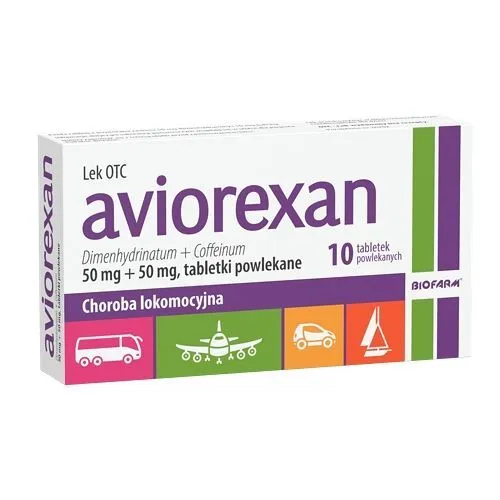
Table of Contents
Package leaflet: Information for the user
Aviorexan, 50 mg + 50 mg, coated tablets
Dimenhydrinate + Caffeine
Please read this leaflet carefully before taking this medicine, as it contains important information for you.
This medicine should always be used exactly as described in this patient leaflet or as directed by your doctor or pharmacist.
- Keep this leaflet, as you may need to read it again.
- If you need advice or further information, consult your pharmacist.
- If you experience any adverse reactions, including any not listed in this leaflet, inform your doctor or pharmacist. See section 4.
- If there is no improvement or if you feel worse, contact your doctor.
Leaflet contents:
- What Aviorexan is and what it is used for
- Important information before taking Aviorexan
- How to take Aviorexan
- Possible side effects
- How to store Aviorexan
- Contents of the pack and other information
1. What Aviorexan is and what it is used for
Aviorexan is a combination medicine containing two active substances: dimenhydrinate and caffeine.
Dimenhydrinate belongs to a group of medicines called antihistamines. Caffeine has a stimulating effect on the central nervous system. Both substances help reduce symptoms of motion sickness. Caffeine reduces the sedative effect of dimenhydrinate.
This medicine is indicated for the prevention and treatment of symptoms associated with motion sickness (nausea, vomiting, dizziness).
Onset of action occurs within 15–30 minutes. Therapeutic effects last for 3 to 6 hours after administration.
2. Important information before taking Aviorexan
When not to take Aviorexan:
- if you are allergic to dimenhydrinate, caffeine, or any of the other ingredients of this medicine (listed in section 6);
- if you have:
- porphyria,
- acute asthma attack,
- severe cardiovascular disorders,
- uncontrolled hypertension,
- insomnia or anxiety states,
- epilepsy,
- gastric and/or duodenal ulcers,
- severe liver impairment,
- narrow-angle glaucoma,
- pheochromocytoma.
Aviorexan is not recommended for use in children and adolescents under 12 years of age.
Warnings and precautions
Discuss with your doctor or pharmacist before starting Aviorexan.
Exercise caution in patients with hypersensitivity to other antihistamines, as cross-reactivity may occur.
Use with caution in patients with:
- hypersensitivity to antiallergic drugs (antihistamines) or xanthine derivatives (e.g. theophylline and aminophylline used in asthma and chronic obstructive pulmonary disease),
- benign prostatic hyperplasia,
- difficulty in urination,
- peptic ulcer with pyloric stenosis or pyloric obstruction,
- hyperthyroidism,
- closed-angle glaucoma,
- bronchial and/or lung diseases: chronic bronchitis, bronchial asthma, obstructive lung disease, pulmonary emphysema,
- cardiac arrhythmias,
- ischemic heart disease,
- diabetes mellitus.
Elderly patients may be more susceptible to adverse effects caused by dimenhydrinate.
Aviorexan with other medicines
Tell your doctor or pharmacist about all medicines you are currently taking, have recently taken, or plan to take.
Aviorexan should not be used with the following medicines:
- barbiturates (medicines often used as sedatives), sedatives and tranquilizers (medicines used to treat nervous tension, depression, and anxiety), atropine (a muscle-relaxing agent, often used during ophthalmological examinations) – concomitant use may cause fatigue or drowsiness;
- tricyclic antidepressants (used in the treatment of depression and anxiety) – Aviorexan may enhance their effects;
- photosensitizing agents (medicines that increase skin sensitivity to sunlight and cause allergic reactions upon sun exposure) – Aviorexan may enhance their effects;
- aminoglycosides (a type of antibiotic) – these may damage the inner ear, and such damage may be masked during treatment with Aviorexan;
- disulfiram (used in the treatment of alcoholism) – caffeine may intensify alcohol withdrawal syndrome;
- MAO inhibitors (used in the treatment of depression) – concomitant use may cause increased blood pressure and rapid heart rate (tachycardia);
- lithium (used in the treatment of bipolar disorder) – caffeine may increase renal excretion of lithium;
- theophylline (used in the treatment of asthma and chronic obstructive pulmonary disease) – caffeine may reduce its excretion.
Oral contraceptives slow down caffeine metabolism in the liver.
Additionally, Aviorexan may alter skin reactions to allergens during skin testing. Do not take Aviorexan for at least three days before planned allergy tests.
Food and drink with Aviorexan
Taking Aviorexan with food may reduce the risk of gastrointestinal irritation.
During treatment with Aviorexan, alcohol consumption should be avoided, as it may alter and intensify the effects of the medicine's components.
Pregnancy and breastfeeding
If you are pregnant or breastfeeding, think you may be pregnant, or are planning to have a baby, consult your doctor or pharmacist before using this medicine.
Do not use Aviorexan during the third trimester of pregnancy. In the first and second trimesters of pregnancy, and during breastfeeding, Aviorexan should only be used if, in the opinion of the doctor, the benefits of treatment outweigh the potential risks to the child.
The medicine passes into breast milk; it should be used cautiously, only after careful consideration of the benefit to the mother versus the risk to the nursing infant.
Driving and operating machinery
Dimenhydrinate impairs psycho-motor performance; therefore, it should not be used by people who drive vehicles or operate machinery.
3. How to take Aviorexan
This medicine should always be taken exactly as described in this patient information leaflet or as directed by your doctor or pharmacist. If in doubt, consult your doctor or pharmacist.
Adults and adolescents aged above 12 years
The recommended dose is 1–2 tablets.
If necessary, the dose may be repeated after 4–6 hours.
Do not exceed 8 tablets per day.
For prophylaxis of motion sickness symptoms, the first dose should be taken no later than 30 minutes before the planned journey.
Use in children under 12 years of age
Aviorexan is not recommended for use in children under 12 years of age.
Patients with hepatic or renal impairment and elderly patients
Caution is advised in patients with impaired liver and/or kidney function, as well as in elderly patients.
Aviorexan is contraindicated in patients with severe hepatic impairment.
Method of administration
Oral administration.
The tablet should be swallowed whole with water or milk.
Overdose of Aviorexan
In case of ingestion of more than the recommended dose of Aviorexan or accidental ingestion by a child, contact your doctor or pharmacist immediately.
Missed dose of Aviorexan
If a dose of Aviorexan is missed, continue taking the medicine according to the regular dosing schedule. Do not take a double dose to make up for the missed dose.
Stopping Aviorexan
If you have any further questions about the use of this medicine, consult your doctor or pharmacist.
4. Possible adverse effects
Like all medicines, this medicine can cause adverse effects, although not everyone will experience them.
The following adverse effects may occur during treatment with Aviorexan:
Adverse effects associated with dimenhydrinate use:
Rare (may occur in no more than 1 in 1,000 people)
- anaemia,
- leucopenia (reduced white blood cell count),
- thrombocytopenia (reduced platelet count),
- pancytopenia (reduction in all types of blood cells: white cells, red cells, and platelets),
- agranulocytosis (severe reduction or absence of granulocytes, a type of white blood cells, in the blood).
Very rare (may occur in no more than 1 in 10,000 people)
- paradoxical excitation (especially in children, paradoxical reactions such as insomnia, restlessness, confusion, seizures, irritability, euphoria, delirium, palpitations, and convulsions may occur),
- tachycardia (increased heart rate)*,
- cardiac arrhythmias* (including extrasystoles - additional heartbeats, heart block),
- increased arterial pressure,
- decreased arterial pressure,
- increased bronchial secretion which may lead to breathing difficulties.
*Reactions usually associated with dimenhydrinate overdose
Frequency not known (frequency cannot be estimated from available data)
- anaphylactic reactions,
- allergic reactions,
- decreased appetite,
- excitation,
- sleep disturbances,
- anxiety,
- tremor,
- drowsiness,
- sedation,
- dizziness,
- headache,
- visual disturbances,
- increased intraocular pressure,
- nausea,
- vomiting,
- diarrhoea,
- constipation,
- abdominal pain,
- dry mouth,
- skin allergic reactions,
- photosensitivity,
- skin inflammation,
- itching,
- rash,
- erythema,
- difficulty in urination,
- sexual dysfunction,
- exacerbation of porphyria,
- feeling of fatigue.
Adverse effects associated with caffeine use:
Common (may occur in up to 1 in 10 people)
- insomnia,
- excitation,
- increased arterial pressure,
- decreased arterial pressure,
Uncommon (may occur in up to 1 in 100 people)
- decreased blood glucose level,
- increased blood glucose level,
- anxiety (use of high doses may cause nervousness and anxiety),
- irritability,
- headache,
- tinnitus,
- hot flushes,
- tachycardia (increased heart rate),
- cardiac arrhythmias,
- palpitations (unpleasant sensation of irregular and/or forceful heartbeat),
- increased respiratory rate,
- nausea,
- vomiting,
- diarrhoea,
- abdominal pain,
- pollakiuria (need to urinate more frequently than usual).
Reporting of adverse effects
If any adverse effects occur, including any not listed in this leaflet, inform your doctor or pharmacist. Adverse effects can be reported directly to the Department of Monitoring Adverse Drug Reactions at the Office for Registration of Medicinal Products, Medical Devices and Biocidal Products:
Al. Jerozolimskie 181 C, 02-222 Warsaw
Tel.: +48 22 49 21 301,
Fax: +48 22 49 21 309
Website: https://smz.ezdrowie.gov.pl
Adverse effects can also be reported to the marketing authorization holder.
Reporting adverse effects helps to provide more information on the safety of the medicine.
5. How to store Aviorexan
Keep this medicine out of the sight and reach of children.
No special storage instructions apply to this medicine.
Do not use this medicine after the expiry date stated on the carton after: EXP.
The expiry date refers to the last day of the stated month.
Medicines should not be disposed of via wastewater or household waste. Ask your pharmacist
how to dispose of medicines no longer required. These measures help protect the environment.
6. Contents of the packaging and other information
What Aviorexan contains
The active substances in Aviorexan are dimenhydrinate and caffeine.
Each coated tablet contains 50 mg of dimenhydrinate (Dimenhydrinatum) and 50 mg of caffeine (Coffeinum).
- Other components are: Tablet core: microcrystalline cellulose, crospovidone Type A, povidone K 29/32, colloidal anhydrous silica, magnesium stearate. Tablet coating: hypromellose, titanium dioxide (E 171), macrogol 6000, talc.
What Aviorexan looks like and contents of the pack
Aviorexan is a white, round, biconvex coated tablet with an embossed "NC" on one side.
Packs contain PA/Aluminum/PVC/Aluminum blisters in a cardboard box.
Pack contents: 10 coated tablets.
Marketing Authorisation Holder
Biofarm Sp. z o.o.
Wałbrzyska Street 13
60-198 Poznań
Tel. +48 61 66 51 500
e-mail: [email protected]
Manufacturer
Laboratorios Normon, S.A.
Ronda de Valdecarrizo 6
28760 Tres Cantos - Madrid
Spain