Avaxim 160 iu
Poland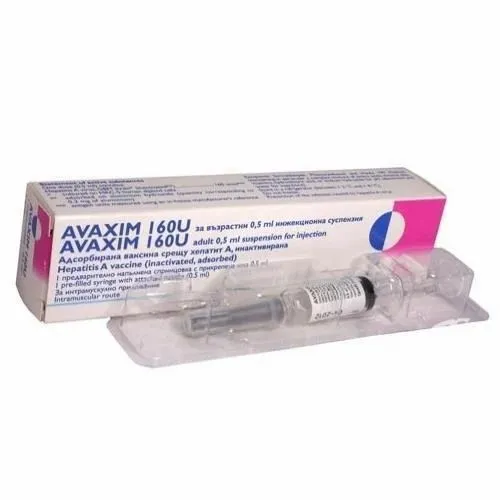
Table of Contents
Package leaflet: Information for the user
AVAXIM 160 U, suspension for injection in pre-filled syringe
Inactivated adsorbed hepatitis A vaccine
Please read all of this leaflet carefully before vaccination, because it contains
important information for the patient.
- Keep this leaflet, as you may need to read it again.
- If you have any further questions, please ask your doctor, pharmacist or nurse.
- This vaccine has been prescribed for a specific individual. Do not pass it on to others.
- If any adverse reactions occur in the patient, including any adverse reactions not listed in this leaflet, inform your doctor, pharmacist or nurse. See section 4.
Contents of the leaflet:
- What AVAXIM 160 U is and what it is used for
- What you need to know before vaccination with AVAXIM 160 U
- How to use AVAXIM 160 U
- Possible side effects
- How to store AVAXIM 160 U
- Contents of the pack and other information
1. What AVAXIM 160 U is and what it is used for
This medicinal product is a vaccine presented as a 0.5 ml suspension for injection in a pre-filled syringe, packed in a box containing 1 dose.
AVAXIM 160 U vaccine is indicated for active immunisation against hepatitis A virus (hepatitis A) in adolescents from the age of 16 years and in adults.
It does not protect against infections caused by other types of hepatitis viruses or by other known microorganisms causing liver disease.
The vaccine should be used in accordance with official recommendations.
2. Important information before using AVAXIM 160 U vaccine
When not to use AVAXIM 160 U vaccine:
- if the patient has a fever, acute infection, or a chronic illness in an exacerbation phase (it is advisable to postpone vaccination);
- if the patient is allergic to the active substance or to any of the other components of the vaccine (listed in section 6), or if the patient experienced hypersensitivity following previous administration of the vaccine.
Warnings and precautions
- Do not inject intravenously. Before injection, ensure that the needle is not located within a blood vessel;
- The vaccine should not be administered into the gluteal muscle due to variable fat tissue content, nor should it be given intradermally, as these routes of administration may result in a reduced immunological response;
- Immunosuppressive therapy or immunocompromised conditions may lead to a diminished immune response to the vaccine;
- If the vaccine is administered during the incubation period of hepatitis A virus, it may not prevent the development of viral hepatitis A;
- In patients with liver diseases;
- In patients allergic to neomycin (each dose of the vaccine contains trace amounts of neomycin).
Fainting may occur (particularly in adolescents) during or even before any injection.
Therefore, inform your doctor or nurse if you or your child has previously fainted following an injection.
Pregnancy and breastfeeding
The effect of the vaccine on fetal development is unknown. As with other inactivated viral vaccines, no adverse effects on the fetus are expected. However, the vaccine is not recommended for pregnant women.
Similarly, as with other medicinal products, the benefit-risk ratio should be considered when deciding whether to vaccinate a pregnant or breastfeeding woman.
The use of the vaccine during breastfeeding is not recommended, as no studies have been conducted on its administration in breastfeeding women.
Driving and operating machinery
It is unlikely that the vaccine will have any influence on the ability to drive or operate machinery.
However, no specific studies have been conducted on this matter.
AVAXIM 160 U contains ethanol, phenylalanine, potassium, and sodium
AVAXIM 160 U contains 2 mg of alcohol (ethanol) in each 0.5 ml dose.
The small amount of alcohol in this vaccine will not cause noticeable effects.
AVAXIM 160 U contains 10 micrograms of phenylalanine in each 0.5 ml dose, equivalent to 0.17 micrograms/kg for a person weighing 60 kg. Phenylalanine may be harmful in patients with phenylketonuria, a rare genetic disorder in which phenylalanine accumulates because the body cannot properly eliminate it.
AVAXIM 160 U contains less than 1 mmol of potassium (39 mg) and sodium (23 mg) per dose, meaning the product is essentially “potassium-free” and “sodium-free”.
Important information about certain vaccine components:
Excipients that may affect the patient:
formaldehyde.
AVAXIM 160 U and other medicines
The vaccine may be administered simultaneously with immunoglobulins, provided it is injected at two different sites of the body.
AVAXIM 160 U is inactivated and, when administered simultaneously with other inactivated vaccines at separate injection sites, generally does not cause any interactions.
This vaccine may be given at the same time, but at separate sites, as the recombinant vaccine against hepatitis B virus (HBV) or the polysaccharide vaccine against typhoid fever.
AVAXIM 160 U may also be administered simultaneously with the live vaccine against yellow fever, but at separate injection sites.
AVAXIM 160 U may be used as a booster dose in individuals who previously received primary vaccination with another inactivated hepatitis A (HAV) vaccine.
Inform your doctor about all medicines you have recently taken, including those obtained without a prescription.
3. How to use AVAXIM 160 U
Dosage
Recommended dose: 0.5 ml for individuals from the age of 16 years.
Primary protection is achieved after administration of a single dose of the vaccine.
Immunity against hepatitis A virus is obtained approximately 14 days after the first dose.
To achieve long-term protection, a second (booster) dose should ideally be administered between 6 and 12 months after the first vaccination, but may be given up to 36 months after the first vaccination. This booster dose will provide protection against hepatitis A for more than 10 years.
This vaccine may also be administered as a booster dose for hepatitis A vaccination in individuals who received a primary vaccination with a combined typhoid fever (purified Vi polysaccharide) and hepatitis A (inactivated) vaccine between 6 and 36 months previously.
Method of administration
It is recommended that this vaccine be administered intramuscularly (im.) to minimize local adverse reactions.
The recommended site for vaccine administration is the deltoid muscle.
Do not inject AVAXIM 160 U vaccine intravenously. Before injection, ensure that the needle has not entered a blood vessel.
AVAXIM 160 U vaccine should not be administered into the gluteal muscle due to the variable amount of fatty tissue, nor should it be administered intradermally, as these routes of administration may result in a reduced immune response.
In exceptional cases, this vaccine may be administered subcutaneously in patients with thrombocytopenia (insufficient platelet count, which are essential for blood clotting) or in patients at risk of bleeding.
AVAXIM 160 U vaccine must not be mixed with other vaccines in the same syringe.
Shake well before use until a uniform suspension is obtained.
Any unused vaccine or waste material should be disposed of in accordance with local regulations.
Administration of a higher than recommended dose of AVAXIM 160 U vaccine
Not applicable.
Missed dose of AVAXIM 160 U vaccine
Not applicable.
4. Possible adverse reactions
Like any medicinal product, the AVAXIM 160 U vaccine may cause adverse reactions, although
they do not occur in everyone.
Severe allergic reactions
Severe or even life-threatening allergic reactions (anaphylactic reactions, including shock) may
occur at any time, although they are very rare.
If an allergic reaction occurs, seek immediate medical advice from a doctor or healthcare
professional, or go immediately to the nearest hospital emergency department.
Allergic reactions may occur immediately or within a few days after vaccination, and symptoms may
include:
- difficulty breathing, bluish discoloration of the tongue or lips
- dizziness (low blood pressure) and possible fainting
- rapid heartbeat and weak pulse, cold skin
- swelling of the face and neck
- itching and skin rash
Other adverse reactions
Very common reactions (reported in more than 1 in 10 people):
- mild pain at the injection site
- general weakness (asthenia)
Common reactions (reported in less than 1 in 10, but more than 1 in 100 people):
- headache
- nausea or vomiting
- loss of appetite
- diarrhoea and/or stomach pain (abdominal pain)
- muscle and joint pain
- mild fever
Uncommon reactions (reported in less than 1 in 100, but more than 1 in 1000 people):
- redness (erythema) at the injection site
Rare reactions (reported in less than 1 in 1000, but more than 1 in 10000 people):
- formation of a lump at the injection site (nodule at injection site)
- mild and transient changes in blood tests measuring liver function (increased transaminase activity)
Reactions with unknown frequency (cannot be estimated from available data):
- fainting in response to injection
- rashes, sometimes raised and itchy (including urticaria)
- swelling of lymph nodes
Reporting of adverse reactions
If any adverse reactions occur, including any adverse reactions not listed in this leaflet, inform your
doctor, pharmacist, or nurse. Adverse reactions can be reported directly to the Department of Monitoring Adverse Drug Reactions of the Office for Registration of Medicinal Products, Medical Devices and Biocidal Products
Al. Jerozolimskie 181C
02-222 Warszawa
Tel.: + 48 22 49 21 301
Faks: + 48 22 49 21 309
Website: https://smz.ezdrowie.gov.pl
Adverse reactions may also be reported to the marketing authorization holder.
Reporting adverse reactions helps provide more information on the safety of the vaccine.
5. How to store the AVAXIM 160 U vaccine
AVAXIM 160 U should be stored out of sight and reach of children.
Do not use this vaccine after the expiry date stated on the outer cardboard packaging and on the syringe label after: EXP. The expiry date refers to the last day of the stated month.
Do not use this vaccine if solid particles are present.
Store in a refrigerator (2°C – 8°C). Do not freeze. Discard the vaccine if it has been frozen.
Store in the original packaging to protect from light.
Medicines should not be disposed of via wastewater or household waste. Ask your pharmacist how to dispose of medicines no longer required. These measures will help protect the environment.
6. Contents of the package and other information
What AVAXIM 160 U vaccine contains
The active substance is:
Hepatitis A virus, strain GBM* (inactivated**) …………… 160 ELISA*** antigen units
* propagated in human diploid cells (MRC-5)
** adsorbed on hydrated aluminium hydroxide, 0.3 mg Al
*** antigen units measured relative to an in-house standard
The other components (excipients) are:
- 2-phenoxyethanol
- anhydrous ethanol
- formaldehyde
- Hanks' 199 medium*
- water for injections
- polysorbate 80
- hydrochloric acid and sodium hydroxide to adjust pH
* Hanks' 199 medium (without phenol red) is a complex mixture of amino acids (including phenylalanine), mineral salts, vitamins and other components.
What AVAXIM 160 U vaccine looks like and contents of the pack
Injection suspension in a pre-filled syringe.
Pack:
1 pre-filled syringe of 0.5 ml with attached needle, in a cardboard box.
Marketing Authorisation Holder
Sanofi Winthrop Industrie
82 Avenue Raspail
94250 Gentilly, France
Manufacturer
Sanofi Winthrop Industrie, 1541 avenue Marcel Mérieux, 69280 Marcy l’Etoile, France
Sanofi Winthrop Industrie, Voie de l’Institut - Parc Industriel d’Incarville, B.P 101, 27100 Val de Reuil, France
Sanofi-Aventis Zrt., Building DC5, Campona Utca 1., Budapest XXII 1225, Hungary