Autoinjector morphine for pain
PolandTable of Contents
- 1. What Autoinjector Morphine for Pain is and what it is used for
- 2. Important information before using the medicine Autostrzykawka Morfina Przeciwko Bólowi
- 3. How to use the medicine Autostrzykawka Morfina Przeciwko Bólowi
- 4. Possible adverse reactions
- 5. How to store the medicine Autostrzykawka Morfina Przeciwko Bólowi
- 6. Contents of the package and other information
- Information intended exclusively for healthcare professionals:
AUTOINJECTOR MORPHINE FOR PAIN,
20 mg/2mL, solution for injection
Morphine hemisulfate 2.5-hydrate
Please read the entire leaflet carefully before using the medicine, as it contains
important information for the patient.
- Keep this leaflet, so that you can read it again if necessary.
- If you have any doubts, please consult your doctor, pharmacist, or nurse.
- This medicine has been prescribed strictly for a specific individual. Do not pass it on to others. The medicine may harm another person, even if their symptoms are identical.
- If the patient experiences any adverse reactions, including any adverse reactions not listed in this leaflet, inform your doctor, pharmacist, or nurse. See section 4.
Table of contents
- What Autoinjector Morphine for Pain is and what it is used for
- Important information before using Autoinjector Morphine for Pain
- How to use Autoinjector Morphine for Pain
- Possible side effects
- How to store Autoinjector Morphine for Pain
- Contents of the pack and other information
1. What Autoinjector Morphine for Pain is and what it is used for
Autoinjector Morphine for Pain is an autoinjector intended for intramuscular use in cases of severe pain caused by extensive body injuries. Morphine acts on certain receptors in the central nervous system, thereby relieving pain.
2. Important information before using the medicine Autostrzykawka Morfina Przeciwko Bólowi
When not to use the medicine Autostrzykawka Morfina Przeciwko Bólowi
- if the patient is allergic to morphine or any of the other ingredients of this medicine (listed in section 6),
- if the patient has been diagnosed with acute abdomen (abdominal rigidity and severe abdominal wall tension, abdominal pain, vomiting, nausea, and retention of gas and stool),
- if the patient has a pheochromocytoma,
- if the patient has breathing difficulties or a disease causing difficulty in breathing or shortness of breath,
- if the patient has acute pain in the right upper quadrant under the ribs (which may be a symptom of hepatic colic),
- if the patient has acute alcohol intoxication,
- if the patient is taking or has taken within the last 2 weeks antidepressant medicines known as monoamine oxidase inhibitors (MAOIs),
- if the patient has diseases associated with seizures,
- if the patient has a head injury,
- if the patient has increased intracranial pressure (symptoms: headache, disturbances in consciousness, balance, vision),
- undergoing spasmolytic therapy (muscle-relaxing therapy),
- if the patient is in coma.
The contraindications listed above should be considered with regard to the acceptable potential risk versus the therapeutic benefits in cases of severe pain caused by extensive bodily injuries.
Warnings and precautions
Before starting treatment with Autostrzykawka Morfina Przeciwko Bólowi, discuss this with your doctor or nurse.
Opioid analgesic medicines should be administered cautiously in patients:
- with reduced thyroid function (hypothyroidism) or Addison's disease (adrenal insufficiency),
- with reduced adrenal cortex function (insufficient hormone production),
- with asthma or other breathing problems, e.g. emphysema, COPD, severe obesity,
- with benign prostatic hyperplasia or difficulty urinating,
- with low blood pressure,
- in patients diagnosed with heart failure,
- in shock (sudden drop in blood pressure and reduced blood flow through body tissues),
- after severe head injury,
- with predisposition to seizures,
- with inflammatory bowel diseases or impaired intestinal patency,
- with muscle weakness (myasthenia),
- with drug abuse,
- with biliary tract disorders (morphine may exacerbate pain symptoms),
- with impaired liver function, since morphine metabolism occurs mainly in the liver,
- with impaired kidney function, as morphine has caused prolonged severe respiratory depression,
- in patients over 65 years of age,
- in debilitated patients.
Autostrzykawka Morfina Przeciwko Bólowi should not be used concomitantly with benzodiazepines due to the risk of respiratory depression, coma, and even death.
Autostrzykawka Morfina Przeciwko Bólowi should not be used during poisoning with chemical warfare agents belonging to organophosphorus compounds with paralytic-seizure effects.
The action of organophosphorus agents combined with simultaneous administration of morphine may lead to respiratory arrest.
Cases of acute generalized pustular eruption (AGEP) have been reported during treatment with Autostrzykawka Morfina Przeciwko Bólowi. Symptoms usually occur within the first 10 days of treatment. Inform your doctor if, after taking Autostrzykawka Morfina Przeciwko Bólowi or other opioids, the patient ever experienced severe skin rash, skin peeling, blistering and/or oral mucosal ulceration. Discontinue use of Autostrzykawka Morfina Przeciwko Bólowi immediately and contact your doctor promptly if the patient notices any of the following symptoms: blister formation, extensive skin peeling, or pustular lesions accompanied by fever.
Sleep-related breathing disorders
The medicine Autostrzykawka Morfina Przeciwko Bólowi may cause sleep-related breathing disorders such as sleep apnea (interruptions in breathing during sleep) and hypoxemia (low oxygen levels in blood). Symptoms may include breathing pauses during sleep, nocturnal awakenings due to breathlessness, difficulty maintaining sleep, or excessive daytime sleepiness. If the patient or another person observes these symptoms, contact the doctor.
The doctor may consider reducing the dose of the medicine.
Contact your doctor if the patient develops severe upper abdominal pain radiating to the back, nausea, vomiting, or fever, as these may be symptoms associated with pancreatitis and biliary tract disorders.
If any of the following symptoms occur during treatment with Autostrzykawka Morfina Przeciwko Bólowi, consult your doctor:
- increased sensitivity to pain despite increasing the dose of the medicine (hyperalgesia). The doctor will decide whether dosage adjustment or use of a stronger analgesic is necessary.
- weakness, fatigue, loss of appetite, nausea, vomiting, or low blood pressure. These may be symptoms indicating insufficient cortisol production by the adrenal glands, and hormone supplementation may be required.
- loss of libido, impotence, or amenorrhea. This may be caused by reduced secretion of sex hormones.
- if the patient has previously been addicted to drugs or alcohol. Also inform the doctor if the patient notices becoming dependent on Autostrzykawka Morfina Przeciwko Bólowi during treatment. For example, when frequently thinking about taking another dose even when not needed for pain relief.
- symptoms of withdrawal or dependence. The most common withdrawal symptoms are listed in section 3. In such a case, the doctor may change the medicine or the interval between doses.
Tolerance, dependence, and addictive use
This medicine contains morphine, which is an opioid. Repeated use of opioids may lead to reduced effectiveness of the medicine (the patient becomes accustomed to it, known as drug tolerance). Repeated use of Autostrzykawka Morfina Przeciwko Bólowi may also lead to dependence, abuse, and addictive use, which may result in life-threatening overdose. The risk of these adverse effects may increase with higher doses and prolonged duration of use.
Dependence or addictive use may cause the patient to lose control over how much medicine to take or how often to take it.
The risk of dependence or addictive use varies among individuals. The risk of becoming dependent on Autostrzykawka Morfina Przeciwko Bólowi or its addictive use may be higher if:
- the patient or any of their relatives have ever abused or been addicted to alcohol, prescription medicines, or narcotics ("addiction");
- the patient smokes cigarettes;
- the patient has ever had mood disorders (depression, anxiety disorders, or personality disorders) or has been treated by a psychiatrist for other mental illnesses.
If any of the above symptoms occur during treatment with Autostrzykawka Morfina Przeciwko Bólowi, this may indicate dependence or addictive use:
- the patient must take this medicine longer than recommended by the doctor;
- the patient must take a higher dose than recommended;
- the patient uses this medicine for reasons other than those for which the doctor prescribed it, e.g., "to calm down" or "to fall asleep";
- the patient has made several unsuccessful attempts to stop or control the use of this medicine;
- after stopping the medicine, the patient feels unwell and feels better when taking the medicine again ("withdrawal effect").
If any of these symptoms are observed, discuss with the doctor the best treatment strategy for the patient, including when it is appropriate to discontinue treatment and how to safely stop (see section 3 "Discontinuation of the medicine" Autostrzykawka Morfina Przeciwko Bólowi).
When administering morphine in the pre-, peri-, and postoperative period, remember the risk of paralytic intestinal obstruction or respiratory center depression.
The analgesic effect of morphine may mask many intra-abdominal complications, e.g., intestinal perforation.
Children and adolescents
The medicine is not intended for use in children and adolescents.
Autostrzykawka Morfina Przeciwko Bólowi and other medicines
Inform your doctor or pharmacist about all medicines currently or recently taken, as well as any medicines the patient plans to use.
This is particularly important when using medicines such as:
- monoamine oxidase inhibitors (antidepressants and medicines used in Parkinson's disease), e.g., moclobemide, especially if the patient has taken these medicines within the last 2 weeks. Do not use medicines from this group with morphine – see section 2., subsection: "When not to use the medicine Autostrzykawka Morfina Przeciwko Bólowi",
- general anesthetics,
- hypnotics (sleep medicines),
- sedatives, anxiolytics, e.g., diazepam,
- psychotropic medicines (used in treatment of depression, psychosis, neurosis),
- antihistamines (antiallergic medicines),
- β-adrenolytics (medicines used in treatment of hypertension, coronary heart disease, cardiac arrhythmias), other medicines used in treatment of hypertension,
- phenothiazine derivatives (antipsychotic medicines),
- smooth muscle relaxants and heart rhythm regulators, e.g., atropine,
- ciprofloxacin,
- prokinetic agents (accelerating gastrointestinal transit), e.g., cisapride, antiemetics (metoclopramide, domperidone);
- dopaminergic agents, e.g., selegiline used in Parkinson's disease;
- mexiletine (antiarrhythmic medicine);
- cimetidine (medicine for gastric or duodenal ulcers);
- rifampicin – used in tuberculosis treatment.
The central nervous system depressant effect of morphine is enhanced by substances such as alcohol, anesthetics, hypnotics, sedatives, anxiolytics, tricyclic antidepressants, antihistamines, beta-adrenolytics, and phenothiazine derivatives.
Concomitant use of Autostrzykawka Morfina Przeciwko Bólowi and sedatives, e.g., benzodiazepines or their derivatives, increases the risk of drowsiness, breathing difficulties (respiratory depression), or coma, which may be life-threatening. Therefore, do not use simultaneously with sedatives without consulting a doctor. Combined treatment may be considered by the doctor only when no other treatment methods are available. If Autostrzykawka Morfina Przeciwko Bólowi is used together with sedatives, the doctor should limit the dose and duration of concomitant use. The patient should inform the doctor about all sedative medicines being taken and strictly follow the prescribed dosage. It may be helpful to inform a relative or close friend of the patient about the possibility of the above-mentioned symptoms. If the described symptoms occur, consult the doctor.
Some medicines used in the treatment of blood clots (e.g., clopidogrel, prasugrel, ticagrelor) may have delayed and reduced effects when taken together with morphine.
Many medicines may interact with morphine sulfate dihydrate for injection, which may significantly alter their effects. These include:
- Gabapentin or pregabalin used in the treatment of epilepsy and pain caused by nervous system disorders (neuropathic pain).
Autostrzykawka Morfina Przeciwko Bólowi and alcohol
Do not drink alcohol during morphine treatment, as it may enhance the central nervous system depressant effects of morphine (including respiratory center depression).
Pregnancy, breastfeeding, and fertility
If the patient is pregnant or breastfeeding, suspects she may be pregnant, or plans to have a child, she should consult a doctor before using this medicine.
Pregnancy
In pregnant women, the doctor may administer morphine only in cases of absolute necessity, when the potential risk is acceptable in relation to the therapeutic benefits.
Morphine is not recommended during childbirth.
If morphine was used during pregnancy for a prolonged period, there is a risk of neonatal withdrawal syndrome symptoms, which should be treated by a doctor.
Breastfeeding
Morphine passes into breast milk. If the doctor prescribes morphine, breastfeeding must be discontinued.
Fertility
Animal studies have shown that morphine may reduce fertility.
Driving and operating machinery
Morphine may cause drowsiness and impair psycho-physical performance.
Do not drive or operate machinery while taking this medicine.
Autostrzykawka Morfina Przeciwko Bólowi contains sodium metabisulfite.
The medicine may rarely cause severe hypersensitivity reactions and bronchospasm, leading to breathing difficulties.
Autostrzykawka Morfina Przeciwko Bólowi contains sodium
1 mL of Autostrzykawka Morfina Przeciwko Bólowi contains 3.4 mg of sodium; thus, a 2 mL autoinjector contains less than 23 mg of sodium per dose, meaning the medicine is considered "sodium-free".
3. How to use the medicine Autostrzykawka Morfina Przeciwko Bólowi
This medicine should be used in cases of severe pain caused by extensive bodily injuries.
Autostrzykawka Morfina Przeciwko Bólowi delivers a single dose of 20 mg via intramuscular administration. The medicine is intended for single use only.
The administered dose is sufficient to provide analgesic effect in an adult patient weighing approximately 70 kg. Pain relief begins within 15 to 20 minutes, and full effect should be achieved within 1 hour after administration.
A single dose is adequate for most patients of standard body size.
Before starting treatment and regularly during therapy, the doctor will discuss with the patient what to expect from using Autostrzykawka Morfina Przeciwko Bólowi, when and for how long it should be used, when to contact a doctor, and when to discontinue the medicine (see also "Discontinuation of Autostrzykawka Morfina Przeciwko Bólowi" in this section).
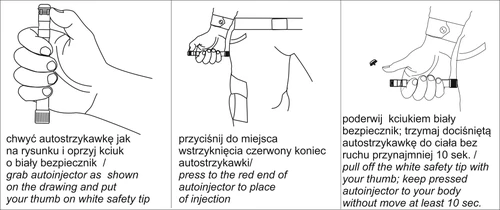
The medicine Autostrzykawka Morfina Przeciwko Bólowi should be used as follows: remove it from the outer packaging (polyethylene tube – to open the tube, unscrew the cap, breaking the seal which acts as a tamper-evident closure), press the red end of the autoinjector against the injection site, pull off the white safety guard, and hold firmly against the body without moving for 10 seconds.
Proceed according to the illustration:
Use of a higher than recommended dose of Autostrzykawka Morfina Przeciwko Bólowi
In case of morphine overdose, the following symptoms may occur: pinpoint pupils, breathing difficulties, low blood pressure (hypotension), increased heart rate, dizziness, feeling cold (hypothermia), and muscle relaxation. In severe cases, the following may occur: low blood pressure leading to impaired blood pumping throughout the body (circulatory failure), progressively deepening coma, rapid breakdown of muscle tissue (characterized by darkening of urine and muscle tenderness, stiffness, and pain), leading to kidney failure.
If a higher than recommended dose of Autostrzykawka Morfina Przeciwko Bólowi has been administered, aspiration pneumonia caused by vomiting or foreign bodies may occur. Symptoms may include shortness of breath, cough, and fever.
Additionally, overdose symptoms may include breathing difficulties leading to loss of consciousness, and even death.
Discontinuation of Autostrzykawka Morfina Przeciwko Bólowi
Withdrawal symptoms may include body aches, convulsions, diarrhea, stomach pain, nausea, flu-like symptoms, rapid heartbeat, and dilated pupils. Psychological symptoms may include intense feelings of dissatisfaction, anxiety, and irritability.
4. Possible adverse reactions
Like all medicines, this medicine can cause adverse reactions, although not everyone will experience them.
You should contact a doctor immediately if any of the serious adverse reactions listed below occur.
- severe allergic reactions following intravenous administration of morphine (which occur rarely – less frequently than in 1 in 1,000 patients) and anaphylactoid reactions (frequency unknown), causing urticaria, itching, swelling of the face, lips, tongue, or throat, leading to difficulty in breathing or swallowing, dizziness, or loss of consciousness
- severe skin reaction with blistering, widespread peeling of the skin, pustular eruptions accompanied by fever. This may be a condition called acute generalized exanthematous pustulosis (AGEP)
- breathing difficulties leading to loss of consciousness
- withdrawal symptoms or dependence (symptoms are described in section 3: "Discontinuation of Autostrzykawka Morfina Przeciwko Bólowi")
During morphine treatment, the following adverse reactions with unknown frequency (cannot be estimated from available data) may also be observed:
anxiety, depressed mood, hallucinations, drowsiness, confusion, increased intracranial pressure, dizziness, unpleasant sensations in response to a stimulus which in healthy individuals does not cause pain, hyperalgesia, excessive sweating, miosis, bradycardia, palpitations, hypotension, orthostatic hypotension, dry mouth, constipation, nausea, vomiting, biliary tract spasm, urticaria, itching, muscle rigidity, difficulty in urination, ureteral spasm, antidiuretic effect (inhibition of water excretion in urine), facial flushing, sweating, contact dermatitis, pain and irritation at the injection site,
as well as: sleep apnoea (episodes of breathing cessation during sleep), symptoms related to inflammation of the pancreas and biliary tract, e.g. severe upper abdominal pain radiating to the back, nausea, vomiting, or fever.
Reporting of adverse reactions
If any adverse reactions occur, including any not listed in this leaflet, inform your doctor, pharmacist, or nurse. Adverse reactions can be reported to the Department of Monitoring Adverse Drug Reactions of the Office for Registration of Medicinal Products, Medical Devices and Biocidal Products, Al. Jerozolimskie 181C, 02-222 Warsaw,
tel. (22) 49 21 301, fax (22) 49 21 309,
Website: https://smz.ezdrowie.gov.pl
Adverse reactions can also be reported to the marketing authorization holder.
Reporting adverse reactions helps to provide more information on the safety of the medicine.
5. How to store the medicine Autostrzykawka Morfina Przeciwko Bólowi
Keep this medicine out of the sight and reach of children.
Do not use this medicine after the expiry date stated on the label following: EXP.
The expiry date refers to the last day of the specified month. The code Lot on the packaging indicates the batch number.
Store below 25°C. Do not freeze.
6. Contents of the package and other information
What Autostrzykawka Morfina Przeciwko Bólowi contains
The active substance is morphine hemisulphate 2.5-hydrate. 2 mL of injection solution contain
20 mg of morphine hemisulphate 2.5-hydrate.
Other ingredients: sodium chloride, sodium metabisulphite (E 223), disodium edetate, water for
injections.
What Autostrzykawka Morfina Przeciwko Bólowi looks like and contents of the pack
The pre-filled syringe with a single-chamber polypropylene (PP) cartridge containing a transparent, colourless or pale yellow solution, closed on one side with an elastomer stopper, on the other side with an elastomer plunger, and with a stainless steel needle inside.
The pre-filled syringe is placed in a semi-transparent polyethylene tube closed with a tamper-evident cap with a security seal.
The pack contains 1 pre-filled syringe with 20 mg of morphine hemisulphate 2.5-hydrate in 2 mL of solution.
Marketing Authorisation Holder and Manufacturer
Ravimed Sp. z o.o.
ul. Polna 54
05-119 Łajski
Tel.: +48 22 782-21-67
Information intended exclusively for healthcare professionals:
Morphine salts show physicochemical incompatibility with the following medicinal substances: sodium salt of acyclovir, aminophylline (theophylline – ethylenediamine), sodium salt of amobarbital, cefepime hydrochloride, sodium salt of chlorothiazide, sodium salt of floxacillin, furosemide, sodium salt of heparin, meperidine hydrochloride, sodium salt of methicillin, minocycline hydrochloride, gallium nitrate, sodium salt of phenobarbital, sodium salt of phenytoin, sargramostim, sodium bicarbonate, sodium salt of thiopental. Physicochemical incompatibility (precipitate formation) has been demonstrated between solutions of morphine sulfate sesquihydrate and 5-fluorouracil.