Aurogastro
Poland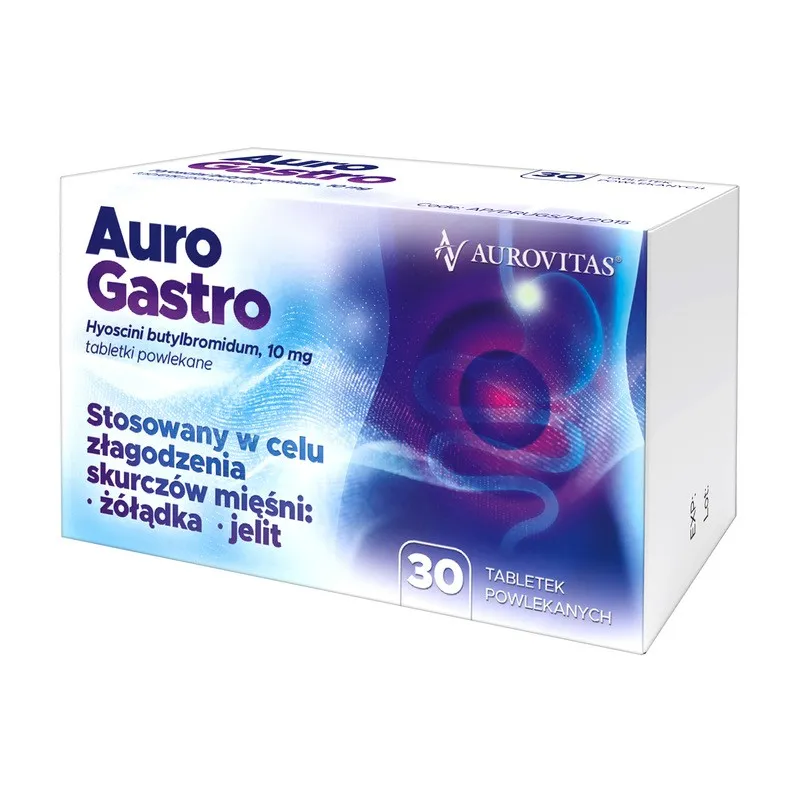
Table of Contents
Package leaflet: Information for the user
AuroGastro, 10 mg, coated tablets
Hyoscini butylbromidum
Please read the entire leaflet carefully before using the medicine, as it contains
important information for the patient.
This medicine should always be used exactly as described in the patient leaflet or as directed by a
physician or pharmacist.
- Keep this leaflet, as you may need to read it again.
- If you need advice or further information, please consult your pharmacist.
- If any adverse reactions occur, including any possible adverse reactions not listed in this leaflet, inform your doctor or pharmacist. See section 4.
- If there is no improvement after 3 days, or if the patient feels worse, discontinue use of the medicine and consult a doctor.
Table of contents of the leaflet:
- What AuroGastro is and what it is used for
- Important information before taking AuroGastro
- How to take AuroGastro
- Possible side effects
- How to store AuroGastro
- Contents of the pack and other information
1. What AuroGastro is and what it is used for
AuroGastro contains the active substance hyoscine butylbromide. It belongs to a group of medicines called "antispasmodics".
AuroGastro is used to relieve muscle spasms in the:
- stomach
- intestines.
2. Important information before using AuroGastro
When not to use AuroGastro
-
if the patient has hypersensitivity (allergy) to butylscopolamine bromide or to any of the other ingredients of the medicine (listed in section 6)
-
if the patient has benign prostatic hyperplasia (enlarged prostate gland)
-
if the patient has urinary retention or any disorders related to the urinary tract and prostate gland
-
if the patient has a mechanical obstruction of the gastrointestinal tract (narrowing of the gastrointestinal tract) or pyloric stenosis
-
if the patient has paralytic or obstructive intestinal obstruction (intestinal paralysis)
-
if the patient has tachycardia
-
if the patient has glaucoma (an eye condition)
-
if the patient has a disease called myasthenia gravis (a very rare condition causing muscle weakness)
-
in patients with colonic dilation (megacolon, significant widening of a segment of the large intestine)
-
if the patient has a rare inherited disorder which may prevent the use of any of the excipients contained in this medicine
Do not use this medicine if any of the above conditions apply to the patient.
If in doubt, consult a doctor or pharmacist before using this medicine.
Warnings and precautions
Talk to a doctor or pharmacist before using the medicine if:
- the patient has a rapid heartbeat or other heart conditions
- the patient has thyroid problems, such as hyperthyroidism
- the patient has difficulty or pain when passing urine, for example, men with an enlarged prostate gland (prostate)
- the patient has constipation
- the patient has a fever
If in doubt whether any of the above apply to the patient, talk to a doctor or pharmacist before using AuroGastro.
Contact a doctor or pharmacist immediately if the patient develops unexplained abdominal pain that persists or worsens, or occurs together with:
- fever
- malaise
- feeling unwell
- changes in bowel habits
- abdominal tenderness
- low blood pressure
- feeling faint or
- blood in the stool.
AuroGastro and other medicines
Tell your doctor or pharmacist about all medicines the patient is currently taking or has recently taken. This includes medicines available without a prescription and herbal medicines. This is because AuroGastro tablets may affect the action of certain other medicines. Likewise, other medicines may affect how AuroGastro works.
In particular, inform the doctor or pharmacist if the patient is taking any of the following medicines:
- Medicines used to treat depression known as “tricyclic and tetracyclic antidepressants”, such as doxepin.
- Medicines for allergies and motion sickness known as “antihistamines”.
- Medicines controlling heart rhythm, such as quinidine or disopyramide.
- Medicines used in severe psychiatric disorders known as “antipsychotics”, such as haloperidol or fluphenazine.
- Medicines usually used for breathing problems, such as tiotropium, ipratropium or drugs similar to atropine.
- Amantadine – a medicine for Parkinson’s disease and influenza.
- Metoclopramide – a medicine for nausea.
If in doubt whether any of the above apply to the patient, consult a doctor or pharmacist before using AuroGastro.
Pregnancy and breastfeeding
If the patient is pregnant or breastfeeding, suspects she may be pregnant, or is planning to have a baby, she should consult a doctor or pharmacist before using this medicine.
Pregnancy
To date, experience with the use of butylscopolamine in pregnant women is insufficient. There are not enough animal studies indicating possible adverse or harmful effects in pregnant women. Therefore, butylscopolamine bromide should not be used during pregnancy.
Breastfeeding
Excretion of butylscopolamine bromide, the active substance of the medicine, into breast milk has not been studied. Medicines of this type may inhibit milk production, and infants may be sensitive to such medicines. When deciding whether to discontinue breastfeeding or treatment with butylscopolamine bromide, the physician must weigh the benefits of breastfeeding for the child against the benefits of treatment for the mother.
Driving and operating machinery
Administration of butylscopolamine bromide may cause adverse effects such as confusion, blurred vision, drowsiness, etc., which may affect the ability to drive and operate machinery.
No studies have been conducted on the effect of the medicine on the ability to drive and operate machinery.
AuroGastro contains sucrose
If the patient has previously been diagnosed with intolerance to certain sugars, the patient should consult a doctor before taking this medicine.
3. How to use AuroGastro
This medicine should always be used as directed by a doctor or pharmacist. In case of
doubt, consult a doctor or pharmacist.
AuroGastro should not be taken continuously for a prolonged period.
Adults and children over 12 years of age
The usual dose of AuroGastro for adults and children over 12 years of age is:
1 to 2 tablets (10 mg to 20 mg), 3 to 5 times daily.
Tablets should be swallowed whole (without chewing or breaking), with liquid.
Effect may be observed 15 minutes after administration.
AuroGastro should not be used daily, continuously, or for a long time without investigating
the cause of abdominal pain.
Dose adjustment is not necessary in patients with renal and/or hepatic impairment.
Children aged 6–12 years
The usual dose is 1 tablet 3 times daily.
AuroGastro is not recommended for use in children under 6 years of age.
Taking more AuroGastro than recommended
Do not take more than the recommended dose of AuroGastro.
If an overdose is taken, certain adverse reactions described in section 4, "Possible side effects," may occur.
In such a case, stop using AuroGastro and contact a doctor immediately.
Additionally, appropriate treatment will be administered if necessary.
Missed dose of AuroGastro
- If a dose is missed, take it as soon as possible. However, if it is almost time for the next dose, skip the missed dose.
- Do not take a double dose to make up for a missed dose.
If you have further questions about the use of this medicine, consult your doctor or
pharmacist.
4. Possible adverse effects
Like all medicines, AuroGastro may cause adverse effects, although not everyone experiences them. The following adverse effects may occur during the use of this medicine. Many of the adverse effects of AuroGastro are related to its anticholinergic properties. They are usually mild and transient. These may include:
Uncommon (affects less than 1 in 100 patients):
- rapid heartbeat,
- dry mouth,
- reduced sweating,
- skin reactions (urticaria, itching).
Rare (affects less than 1 in 1,000 patients):
- urinary retention.
Frequency not known (frequency cannot be estimated from the available data):
- anaphylactic shock (sudden and severe allergic reaction characterized by breathing difficulties, circulatory collapse, and sudden swelling),
- anaphylactic reactions with episodes of respiratory disturbances, skin reactions (rash, redness), and other hypersensitivity reactions.
Reporting of adverse effects
If any adverse effects occur, including any adverse effects not listed in this leaflet, consult a doctor or pharmacist. Adverse effects can be reported directly to the Department of Monitoring of Adverse Drug Reactions of the Office for Registration of Medicinal Products, Medical Devices and Biocidal Products, Al. Jerozolimskie 181C, 02-222 Warsaw, phone: +48 22 49 21 301, fax: +48 22 49 21 309, website: https://smz.ezdrowie.gov.pl
Reporting adverse effects helps to collect more information on the safety of using the medicine.
Adverse effects can also be reported to the responsible entity.
5. How to store AuroGastro
Keep the medicine out of the sight and reach of children.
Do not use AuroGastro after the expiry date stated on the label, carton, and
blister after: EXP. The expiry date refers to the last day of the stated month.
Store below 30°C.
Medicines must not be disposed of via wastewater or household waste. Ask your
pharmacist how to dispose of medicines no longer required. This will help protect
the environment.
6. Contents of the packaging and other information
What AuroGastro contains
- The active substance is butylscopolamine bromide (hyoscine butylbromide). Each coated tablet contains 10 mg of butylscopolamine (butylbromide hyoscine).
- Other components of the medicine are:
Tablet core: calcium hydrogen phosphate, corn starch, tartaric acid, colloidal anhydrous silica, stearic acid.
Coating:
sucrose, talc (E 553b), hypromellose 2910 (5 mPa·s) (E 464), macrogol 4000 (E 1521),
glycerol monostearate (E 471), medium-chain triglycerides, polysorbate 80 (E 433).
What AuroGastro looks like and contents of the pack
White or almost white, sugar-coated, round, biconvex tablets, smooth on both sides.
AuroGastro coated tablets are available in blister packs contained in cardboard boxes.
Pack sizes
Blister packs of: 10, 20, 30, 40, 50, 60 and 100 coated tablets.
Not all pack sizes may be marketed.
Marketing Authorisation Holder and Manufacturer
Marketing Authorisation Holder:
Aurovitas Pharma Polska Sp. z o.o.
ul. Sokratesa 13D, lok. 27
01-909 Warszawa
Poland
Manufacturer/Importer:
APL Swift Services (Malta) Ltd.
HF26, Hal Far Industrial Estate, Hal Far
Birzebbugia, BBG 3000
Malta
Generis Farmacêutica, S.A.
Rua João de Deus 19, Venda Nova
2700-487 Amadora
Portugal
This medicinal product is authorised in the Member States of the European Economic Area under the following names:
Belgium: Butylhyoscine bromide AB 10 mg omhulde tabletten / comprimés enrobés / überzogene Tabletten
Germany: Butylscopolamin PUREN 10 mg überzogene Tabletten
Italy: Scopolamina Aurobindo
Poland: AuroGastro
Portugal: Butilescopolamina Conforpam
Spain: Butilescopolamina Aurovitas 10 mg comprimidos recubiertos EFG