Augmentin es
Poland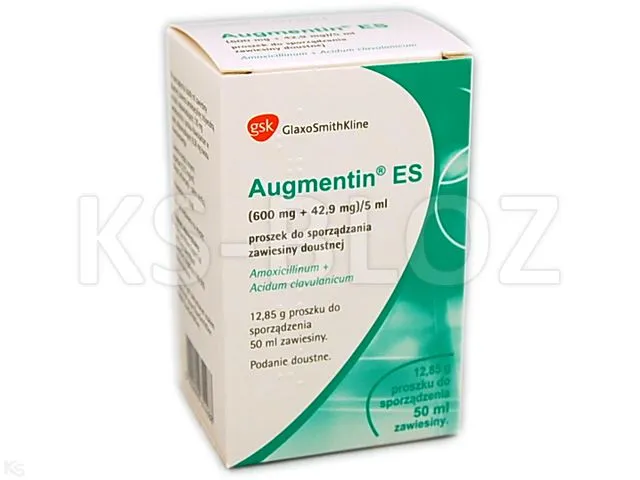
Table of Contents
Package leaflet: Information for the user
Augmentin ES, (600 mg + 42.9 mg)/5 ml, powder for the preparation of oral suspension
Amoxicillin + Clavulanic acid
Please read all of this leaflet carefully before starting to take this medicine, because it
contains important information for you.
- Keep this leaflet, as you may need to read it again.
- If you have any questions, please ask your doctor or pharmacist.
- This medicine is usually prescribed for infants or children. Do not give it to others. This medicine may harm another person, even if their symptoms are the same as your child's.
- If any side effects occur, including any not listed in this leaflet, tell your doctor or pharmacist. See section 4.
Leaflet contents
- What Augmentin ES is and what it is used for
- What you need to know before taking Augmentin ES
- How to take Augmentin ES
- Possible side effects
- How to store Augmentin ES
- Contents of the pack and other information
1. What Augmentin ES is and what it is used for
Augmentin ES is an antibiotic that acts bactericidally against bacteria causing infections.
Augmentin ES contains two different active substances: amoxicillin and clavulanic acid. Amoxicillin belongs
to a group of medicines known as "penicillins", whose action may sometimes be inhibited
(inactivated). The second active component (clavulanic acid) counteracts this inactivation.
Augmentin ES is used in infants and children to treat the following infections:
- middle ear infections
- lung infections.
2. Important information before using Augmentin ES
When not to give Augmentin ES to a child
- If the patient is allergic to amoxicillin, clavulanic acid, penicillin, or any of the other ingredients of this medicine (listed in section 6).
- If the patient has ever experienced severe allergic reactions to any other antibiotic. These may include skin rash or swelling of the face or throat.
- If the patient has ever had liver problems or jaundice (yellowing of the skin) associated with taking an antibiotic. If any of the above situations apply to the patient, Augmentin ES must not be used. If in doubt, consult the doctor or pharmacist before starting treatment with Augmentin ES.
Warnings and precautions
Before starting treatment with Augmentin ES in a child, consult a doctor or pharmacist if the patient:
- has infectious mononucleosis
- is being treated for liver or kidney disease
- urinates irregularly.
If in doubt whether any of the above conditions apply to the patient, consult a doctor or pharmacist before starting Augmentin ES.
In some cases, the doctor may investigate which type of bacteria caused the infection. Depending on the results, the patient may receive Augmentin ES at a different dose or a different medicine.
Conditions to be aware of
Treatment with Augmentin ES may worsen the course of certain diseases or cause serious adverse effects, including allergic reactions, seizures, and colitis. Be vigilant for specific symptoms during treatment with Augmentin ES to reduce the risk of complications. See 'Conditions to be aware of' in section 4.
Blood and urine tests
If the patient is scheduled for blood tests (such as red blood cell count or liver function tests) or urine tests (for glucose), inform the doctor or nurse that the patient is taking Augmentin ES. Augmentin ES may affect the results of such tests.
Augmentin ES and other medicines
Inform the doctor or pharmacist about all medicines currently used or recently used, as well as any medicines the patient plans to take.
If the patient is taking allopurinol (used in gout) together with Augmentin ES, skin allergic reactions may be more likely.
If the patient is taking probenecid (used in gout), the doctor may decide to adjust the dose of Augmentin ES.
If the patient is taking anticoagulant medicines (such as warfarin) together with Augmentin ES, additional blood tests may be required.
Augmentin ES may affect the action of methotrexate (a medicine used in cancer or rheumatic diseases).
Augmentin ES may affect the action of mycophenolate mofetil (a medicine used to prevent transplant rejection).
Pregnancy and breastfeeding
Inform the doctor or pharmacist if the patient is pregnant or breastfeeding.
Always consult a doctor or pharmacist before taking any medicine.
Augmentin ES contains aspartame, maltodextrin, and sodium
- This medicine contains 2.72 mg of aspartame per millilitre. Aspartame is a source of phenylalanine. It may be harmful for patients with phenylketonuria (PKU), a rare genetic disorder in which phenylalanine accumulates in the body due to impaired excretion.
- Augmentin ES contains maltodextrin (glucose). If the patient has previously been diagnosed with intolerance to certain sugars, the patient should contact the doctor before taking this medicine.
- This medicine contains less than 1 mmol (23 mg) of sodium per ml; therefore, the medicine is considered "sodium-free".
3. How to use Augmentin ES
This medicine should always be used exactly as directed by your doctor or pharmacist. If in doubt,
consult your doctor or pharmacist.
Adults and children weighing 40 kg or more
- This suspension is not usually recommended for use in adults and children weighing 40 kg or more. Please consult your doctor or pharmacist for advice.
Children weighing less than 40 kg
All doses are determined according to the child's body weight in kilograms.
- Your doctor will advise you on the appropriate dose of Augmentin ES for your child.
- A plastic measuring spoon is provided with the medicine. Use it to administer the correct dose to your child.
- The usual dose is (90 mg + 6.4 mg) per kilogram of body weight per day, given in two divided doses. Augmentin ES is not recommended for use in children under 3 months of age.
Patients with kidney or liver disease
- If the patient has kidney problems, the dose of the medicine may need to be adjusted. Your doctor may prescribe a different dose of Augmentin ES or an alternative medicine.
- If the patient has liver disease, blood tests may be performed more frequently to monitor liver function.
How to administer Augmentin ES
- Always shake the bottle well before administering each dose.
- The medicine should be taken with food.
- Maintain regular intervals of at least 4 hours between doses during the day. Do not administer two doses within one hour.
- Do not give Augmentin ES to a child for longer than 2 weeks. If the patient still does not feel better, contact your doctor again.
Overdose of Augmentin ES
If a patient takes more Augmentin ES than recommended, symptoms such as stomach and intestinal irritation (nausea, vomiting, or diarrhoea) or seizures may occur. Contact your doctor immediately. Keep the cardboard packaging of the medicine and show it to the doctor.
Missed dose of Augmentin ES
If a dose is missed, give it as soon as you remember. Do not give the next dose too soon; wait approximately 4 hours before administering the next dose. Do not double the dose to make up for a missed dose.
Stopping Augmentin ES treatment
Continue giving Augmentin ES for the full duration of the prescribed treatment, even if the patient starts to feel better. All doses are necessary to eliminate the infection. If some bacteria survive, they may cause the infection to return.
If you have any further questions about the use of this medicine, consult your doctor or pharmacist.
4. Possible side effects
Like all medicines, this medicine can cause side effects, although not everybody will get them.
The side effects of this medicine are listed below.
Symptoms to be aware of
Allergic reactions:
- skin rash
- vasculitis, which may appear as red or purple raised spots on the skin, but may affect other organs
- fever, joint pain, swelling of glands in the neck, armpits or groin
- swelling, sometimes involving the face or throat (angioedema), causing difficulty breathing
- fainting
- chest pain related to an allergic reaction, which may be a sign of an allergy leading to heart attack (Kounis syndrome).
If any of these symptoms occur, seek immediate medical attention
and discontinue use of Augmentin ES.
Inflammation of the large intestine
Inflammation of the large intestine causing watery diarrhoea, usually with blood and mucus, abdominal
pain and (or) fever.
Drug-induced enterocolitis syndrome (DIES)
Drug-induced enterocolitis has occurred mainly in children receiving amoxicillin with clavulanic acid.
This is a type of allergic reaction, the main symptom of which is recurrent vomiting (1 to 4 hours after taking the medicine). Other symptoms may include abdominal pain, lethargy, diarrhoea and low blood pressure.
Acute pancreatitis
If the patient has severe and persistent pain in the stomach area, this may be a sign of acute pancreatitis.
If any of these symptoms occur, contact your doctor as soon as possible
for advice.
Very common side effects
May occur in more than 1 in 10 patients
- diarrhoea (in adults).
Common side effects
May occur in up to 1 in 10 patients
- fungal infections (candidiasis – yeast infections of the vagina, mouth or skin folds)
- nausea, especially when high doses are used; if this occurs, administer Augmentin ES with food
- vomiting
- diarrhoea (in children).
Uncommon side effects
May occur in up to 1 in 100 patients
- skin rash, itching
- raised, itchy rash (urticaria)
- indigestion
- dizziness
- headache.
Uncommon side effects that may appear in blood test results:
- increased activity of certain substances (enzymes) produced in the liver.
Rare side effects
May occur in up to 1 in 1000 patients
- skin rash, possibly with blisters and resembling target lesions (dark spot in the centre surrounded by a lighter ring with a dark ring around the edge – erythema multiforme). If the patient notices any of these symptoms, they should contact a doctor urgently.
Rare side effects that may appear in blood test results:
- low number of cells involved in blood clotting (thrombocytes)
- low number of white blood cells.
Side effects with unknown frequency
Frequency cannot be estimated from the available data.
- Allergic reactions (see above).
- Inflammation of the large intestine (see above).
- Inflammation of the membranes surrounding the brain and spinal cord (aseptic meningitis).
- Severe skin reactions:
- widespread skin rash, possibly with blisters and peeling of the skin, particularly around the mouth, nose, eyes and genital organs (Stevens-Johnson syndrome), and a more severe form causing extensive skin peeling (over 30% of body surface – toxic epidermal necrolysis)
- widespread red rash with small pus-filled blisters (bullous exfoliative dermatitis)
- red, scaly rash with subcutaneous nodules and blisters (acute generalized exanthematous pustulosis)
- flu-like symptoms with rash, fever, swollen lymph nodes and abnormal blood test results (including increased white blood cells (eosinophilia) and increased liver enzyme activity); drug reaction with eosinophilia and systemic symptoms (DRESS)
- red rash usually observed on both buttocks, inner upper thighs, under the arms and on the neck (symmetrical, intertriginous and flexural exanthema induced by drugs (SDRIFE)).
If any of these symptoms occur in the patient, seek immediate medical attention.
- Blistering rash arranged in a ring-like pattern with crusts in the central area or resembling a string of pearls (linear IgA dermatosis).
- Inflammation of the liver.
- Jaundice, caused by increased levels of bilirubin (a substance produced in the liver) in the blood, which may cause yellowing of the skin and whites of the eyes.
- Inflammation of the kidney tubules.
- Prolonged blood clotting time.
- Hyperkinesia.
- Seizures (in patients receiving high doses of Augmentin ES or with kidney disease).
- Black hairy tongue.
- Tooth discoloration (in children), which can usually be removed by brushing.
Side effects that may appear in blood or urine test results:
- severe decrease in white blood cells
- low number of red blood cells (haemolytic anaemia)
- crystals in urine leading to acute kidney injury.
Reporting of side effects
If any side effects occur, including any not listed in this leaflet, inform your doctor or pharmacist. Side effects can be reported directly to the Department of Monitoring Adverse Drug Reactions, Office for Registration of Medicinal Products, Medical Devices and Biocidal Products, Al. Jerozolimskie 181C, 02-222 Warsaw
tel.: +48 22 49 21 301
fax: +48 22 49 21 309, website: https://smz.ezdrowie.gov.pl
Side effects can also be reported to the marketing authorization holder.
Reporting side effects helps provide more information on the safety of this medicine.
5. How to store Augmentin ES
Keep this medicine out of the sight and reach of children.
Dry powder
Store in the original container to protect it from moisture.
Do not store above 25°C.
Do not use Augmentin ES after the expiry date stated on the packaging following:
EXP. The expiry date refers to the last day of the month indicated. The code
'Lot' on the packaging indicates the batch number.
Reconstituted suspension (medicine after adding water)
Store the reconstituted suspension in a refrigerator (at a temperature of 2°C to 8°C). Do not freeze.
The suspension is stable for 10 days.
Medicines should not be disposed of via wastewater or household waste. Ask your pharmacist how to dispose of medicines no longer required. These measures will help protect the environment.
6. Contents of the pack and other information
What Augmentin ES contains
- The active substances are amoxicillin and clavulanic acid. Each millilitre of reconstituted oral suspension contains amoxicillin trihydrate equivalent to 120 mg of amoxicillin and potassium clavulanate equivalent to 8.58 mg of clavulanic acid.
- Other ingredients: aspartame (E951), xanthan gum, silicon dioxide, anhydrous colloidal silica, sodium carboxymethylcellulose and strawberry flavour (containing maltodextrin).
- For further information on aspartame (E951) and maltodextrin – see section 2.
What Augmentin ES looks like and contents of the pack
Augmentin ES (600 mg + 42.9 mg)/5 ml, powder for oral suspension, is a white powder supplied in a clear glass bottle. A plastic dosing spoon is included with the pack.
After adding water, the bottle contains 50 ml, 75 ml, 100 ml or 150 ml of a white to light brown liquid mixture, known as a suspension.
Not all pack sizes may be marketed.
Marketing Authorisation Holder and Manufacturer
Marketing Authorisation Holder Manufacturer
GlaxoSmithKline Trading Services Limited Glaxo Wellcome Production
12 Riverwalk ZI de la Peyenniere
Citywest Business Campus 53100 Mayenne
Dublin 24 France
D24 YK11
Ireland
For further information about this medicine, please contact the local representative of the Marketing Authorisation Holder:
GSK Services Sp. z o.o.
tel.: (22) 576-90-00
This medicine is authorised for sale in the European Economic Area under the following names:
Bulgaria – Augmentin ES
Cyprus – Augmentin ES
Poland – Augmentin ES
Portugal – Augmentin ES
Romania – Augmentin ES
Slovakia – Augmentin ES
Medical education
Antibiotics are used to treat bacterial infections. They are ineffective in treating viral infections.
Sometimes bacterial infections do not respond to antibiotic treatment.
One of the most common reasons for this is that bacteria are resistant to the antibiotic administered.
This means that bacteria can survive or multiply despite the use of the antibiotic.
Bacteria may become resistant to antibiotics for various reasons. Careful use of antibiotics may help reduce the risk of bacterial resistance developing.
The antibiotic prescribed by your doctor is intended solely for the treatment of your current illness. Paying attention to the following advice may help prevent the development of resistant bacteria that could impair the effectiveness of antibiotics.
- It is very important to take the antibiotic at the correct dose, at the right time, and for the prescribed number of days. Please read the instructions provided in the package leaflet, and if any are unclear, ask your doctor or pharmacist for clarification.
- Do not take an antibiotic unless it has been specifically prescribed for you. You should take it only to treat the infection for which it was prescribed.
- Do not take an antibiotic prescribed for someone else, even if they had a similar infection.
- Do not give your prescribed antibiotics to other people.
- If any antibiotic remains after completing the treatment as directed by your doctor, return it to a pharmacy for proper disposal.
Instructions for preparing the medicine for use
Unscrew the cap. Before use, check that the protective seal on the bottle has not been broken. Screw the cap back on.
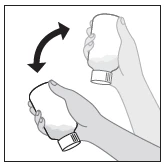
- Shake the bottle to loosen the powder.
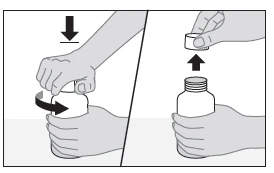
- Unscrew the cap.
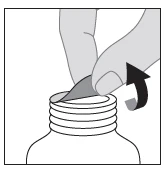
- Remove the protective seal.
- To prepare the suspension, use boiled water cooled to room temperature. Add water (volume given below). Replace the cap, invert the bottle and shake well.
Alternative method for preparing the suspension: Fill the bottle with water to just below the mark indicated on the label. Replace the cap, invert the bottle and shake thoroughly, then top up with water exactly to the level of the mark. Replace the cap, invert the bottle and shake thoroughly again.
| Package size (ml) | Volume of water to be added to prepare the suspension (ml) |
| 50 | 50 |
| 75 | 70 |
| 100 | 90 |
| 150 | 135 |