Atrovent
Poland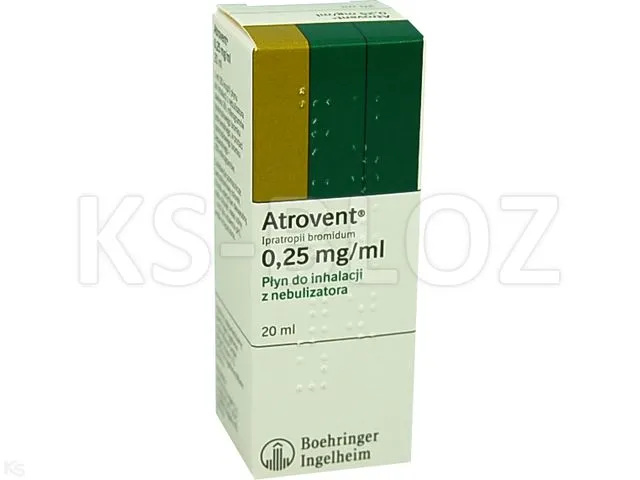
Instructions for Use
Patient Information Leaflet
ATROVENT, 0.25 mg/ml, solution for nebulisation
Ipratropii bromidum
Please read this leaflet carefully before using this medicine because it contains important information for you.
- Keep this leaflet, as you may need to read it again.
- If you have any further questions, please ask your doctor or pharmacist.
- This medicine has been prescribed for a specific individual. Do not pass it on to others. This medicine may harm someone else, even if their symptoms are the same.
- If you experience any side effects, including any not listed in this leaflet, tell your doctor or pharmacist. See section 4.
Leaflet Contents:
- What Atrovent is and what it is used for
- What you need to know before using Atrovent
- How to use Atrovent
- Possible side effects
- How to store Atrovent
- Contents of the pack and other information
1. What Atrovent is and what it is used for
Atrovent is a bronchodilator with anticholinergic properties. Atrovent is indicated as a bronchodilator for maintenance treatment of bronchospasm in chronic obstructive pulmonary disease (COPD), including chronic bronchitis and emphysema, and in bronchial asthma.
2. Important information before using Atrovent
When not to use Atrovent
- if the patient is allergic to atropine or its derivatives (such as the active substance ipratropium bromide) or to any of the other ingredients of this medicine (listed in section 6).
Warnings and precautions
Before starting treatment with Atrovent, discuss with your doctor:
- if the patient has narrow-angle glaucoma (increased pressure in the eye),
- if the patient has urinary retention,
- if the patient has cystic fibrosis: gastrointestinal motility disorders may occur.
Contact your doctor immediately:
- if bronchospasm is triggered by inhalation: stop using Atrovent immediately, as this may be life-threatening. Seek medical advice for alternative treatment.
- if eye-related complications occur, such as: eye pain or discomfort, blurred vision, seeing halos around lights, or changes in color vision together with redness of the eyes; consult your doctor promptly to determine whether these symptoms may be due to complications (such as pupil dilation, increased intraocular pressure, narrow-angle glaucoma).
- if breathing difficulties do not improve or worsen: contact your doctor, who will reassess the treatment plan. The doctor may consider adding further medications.
Never use a higher dose than prescribed, as this may lead to severe adverse effects.
- Hypersensitivity reactions of the immediate type may occur after administration, confirmed by rare cases of urticaria, angioedema (sudden swelling of the skin or mucous membranes, possibly causing breathing difficulties), rash, bronchospasm, swelling of the oral mucosa and throat, and rapidly progressing, life-threatening allergic reactions.
Avoid contact of the solution or the inhaled mist with the eyes. It is recommended that the nebulized solution be administered via a mouthpiece. If a mouthpiece is not available and a nebulization mask is used, it must be properly fitted.
Atrovent and other medicines
Inform your doctor or pharmacist about all medicines the patient is currently taking or has recently taken, as well as any medicines the patient plans to take.
Unless explicitly directed by a physician, avoid prolonged concurrent use of Atrovent with other medicines belonging to the so-called "anticholinergic" group.
Beta-2-adrenergic agonists and xanthine derivatives (theophylline) may enhance bronchodilating effects.
When Atrovent is used concurrently with beta-adrenergic agonists, there is a risk of acute glaucoma in patients with narrow-angle glaumia (see section Warnings and precautions).
Pregnancy and breastfeeding
If the patient is pregnant or breastfeeding, suspects she might be pregnant, or is planning to become pregnant, she should consult her doctor before using this medicine.
Although non-clinical studies have not shown adverse effects of ipratropium bromide on the unborn child, Atrovent should only be used during pregnancy if the physician considers it necessary.
It is not known whether ipratropium passes into human milk. Therefore, Atrovent should only be used in breastfeeding women if the physician considers it necessary.
Driving and operating machinery
No studies have been conducted on the effects on the ability to drive or operate machinery. However, during treatment with Atrovent, adverse effects such as dizziness, visual disturbances, pupil dilation, and blurred vision may occur. Therefore, caution is advised when driving or operating machinery.
Atrovent contains benzalkonium chloride
The medicine contains 0.1 mg of benzalkonium chloride per ml of solution.
This medicine may cause respiratory disturbances and bronchospasm (especially in patients with bronchial asthma).
3. How to use Atrovent
Atrovent should always be used as directed by the physician. If in doubt, consult your doctor or pharmacist.
20 drops = approximately 1 ml; 1 drop = 0.0125 mg of anhydrous ipratropium bromide
The doctor will adjust the dosage according to the individual needs of the patient. The following dosages are recommended:
Maintenance treatment:
Adults (including elderly patients) and adolescents over 14 years of age:
2.0 ml (40 drops = 0.5 mg anhydrous ipratropium bromide) 3 to 4 times daily
Children aged 6 to 14 years:
Due to limited data on use in this age group, nebulization according to the recommended dosage below should be performed under medical supervision:
1.0 ml (20 drops = 0.25 mg anhydrous ipratropium bromide) 3 to 4 times daily
Children under 6 years of age:
Due to limited data on use in this age group, nebulization according to the recommended dosage below should be performed under medical supervision:
0.4 – 1.0 ml (8 – 20 drops = 0.1 – 0.25 mg anhydrous ipratropium bromide) 3 to 4 times daily
Administration of doses exceeding 2 mg anhydrous ipratropium bromide per day in adults and adolescents over 14 years of age, and 1 mg in children under 14 years of age, should be performed under medical supervision.
Method of administration
Atrovent should be used exactly as described below:
Atrovent is intended for inhalation using appropriate nebulization devices. Do not take Atrovent orally. Atrovent can be administered using commercially available nebulizing devices. Patients should follow the manufacturer's instructions regarding proper use, storage, and cleaning of the nebulizer.
The dosage may depend on the method of inhalation and nebulization efficiency. The duration of inhalation can be adjusted by the volume of the diluted solution.
The recommended dose should be diluted with physiological saline to a final volume of 3–4 ml, nebulized using a nebulizing device, and inhaled until the solution is completely used. Do not dilute Atrovent with distilled water. The diluted solution should be used immediately after preparation. Any unused diluted solution must be discarded. The solution should be diluted immediately before each use.
Atrovent may be used concomitantly with inhalations of other nebulization solutions that facilitate mucus secretion and liquefaction, e.g., Mucosolvan Inhalations, solution for nebulization.
Do not use Atrovent and sodium cromoglicate simultaneously in the same nebulizer, as this may cause precipitation.
Use of a higher than recommended dose of Atrovent
If a higher than recommended dose is taken, seek immediate medical advice from a doctor or pharmacist.
Mild symptoms of ipratropium bromide overdose may occur, such as dryness of the oral mucosa, disturbances in visual acuity, and increased heart rate.
Missed dose of Atrovent
If Atrovent has been prescribed for regular use and a dose is missed, take it as soon as possible. However, do not take a double dose to make up for the missed dose. Take the next dose at the usual time.
Discontinuation of Atrovent
If treatment with Atrovent is discontinued, breathing difficulties may recur or worsen. Therefore, continue using Atrovent for as long as prescribed by the doctor.
In any case, consult your doctor before stopping Atrovent treatment.
If you have any further questions about the use of this medicine, consult your doctor or pharmacist.
4. Possible adverse effects
Like all medicines, this medicine can cause adverse effects, although not everyone will experience them.
Similarly to all inhaled medicines, Atrovent may cause symptoms of local irritation. The most commonly reported adverse effects observed in clinical trials were: headache, sore throat, cough, dryness of the oral mucosa, gastrointestinal motility disorders (including constipation, diarrhoea and vomiting), nausea, and dizziness.
The following adverse effects have been reported during the use of Atrovent in clinical trials and in post-marketing safety monitoring.
The frequency of adverse effects is classified as follows:
Very common: affects more than 1 in 10 people
Common: affects more than 1 in 100 and up to 1 in 10 people
Uncommon: affects more than 1 in 1,000 and up to 1 in 100 people
Rare: affects more than 1 in 10,000 and up to 1 in 1,000 people
Very rare: affects less than 1 in 10,000 people
Frequency not known (frequency cannot be estimated from the available data)
Common (affects more than 1 in 100 and up to 1 in 10 people):
- headache,
- dizziness,
- sore throat,
- cough,
- dryness of the oral mucosa,
- nausea,
- gastrointestinal motility disorders.
Uncommon (affects more than 1 in 1,000 and up to 1 in 100 people):
- rapidly progressing, life-threatening allergic reactions (anaphylactic reactions),
- hypersensitivity,
- angioedema (sudden swelling of the skin or mucous membranes, which may cause breathing difficulties), of the tongue, lips and face,
- palpitations,
- supraventricular tachycardia (excessively rapid heartbeat),
- bronchoconstriction,
- inhalation-induced (paradoxical) bronchoconstriction,
- laryngospasm (sudden spasms of the vocal cords, which may affect breathing and speech),
- pharyngeal mucosal oedema (swelling of the upper part of the throat),
- blurred vision,
- pupillary dilation,
- increased intraocular pressure,
- glaucoma,
- eye pain,
- visual aura,
- conjunctival hyperaemia,
- corneal oedema (swelling of the protective outer layer of the eye),
- dry throat,
- diarrhoea,
- constipation,
- vomiting,
- stomatitis,
- oral oedema,
- urinary retention,
- rash,
- pruritus.
Rare (affects more than 1 in 10,000 and up to 1 in 1,000 people):
- atrial fibrillation (very fast, irregular heartbeat),
- increased heart rate,
- accommodation disorders (visual acuity disturbances),
- urticaria.
Reporting of adverse effects
If any adverse effects occur, including any adverse effects not listed in this leaflet, please inform your doctor, pharmacist, or nurse. Adverse effects can be reported directly to the Department of Monitoring Adverse Drug Reactions of the Office for Registration of Medicinal Products, Medical Devices and Biocidal Products: Al. Jerozolimskie 181C, 02-222 Warsaw, telephone: +48 22 49-21-301, fax: +48 22 49-21-309, website: https://smz.ezdrowie.gov.pl. Adverse effects may also be reported to the marketing authorisation holder or its representative. Reporting adverse effects helps to provide more information on the safety of the medicine.
5. How to store Atrovent
No special precautions for storage are required.
The medicine should be stored in a place inaccessible to and out of sight of children.
Do not use this medicine after the expiry date stated on the label and carton after EXP.
The expiry date refers to the last day of the stated month.
Medicines must not be disposed of via wastewater or household waste. Ask your pharmacist how to properly dispose of medicines no longer in use. Such measures help protect the environment.
6. Contents of the pack and other information
What Atrovent contains
- The active substance is ipratropium bromide (Ipratropii bromidum). 1 ml (20 drops) contains 261 micrograms of ipratropium bromide monohydrate, equivalent to 250 micrograms of anhydrous ipratropium bromide.
- The other components are: benzalkonium chloride, disodium edetate dihydrate, sodium chloride, hydrochloric acid, concentrated (for pH adjustment), purified water.
What Atrovent looks like and contents of the pack
1 bottle contains 20 ml of solution for nebulisation.
Marketing Authorisation Holder and Manufacturer
Marketing Authorisation Holder:
Boehringer Ingelheim International GmbH
Binger Strasse 173
D-55216 Ingelheim/Rhein
Germany
Manufacturer:
Istituto de Angeli S.r.l.
Localita Prulli, 103/C
I-50066 Reggello (FI)
Italy
For further information, contact the Marketing Authorisation Holder's representative:
Poland
Boehringer Ingelheim Sp. z o.o.
Tel.: +48 22 699 0 699
This page has been machine-translated and may contain inaccuracies. The original data is available in the manufacturing country's language.
Last data check: June 04, 2026 · Data source: Rejestr Produktów Leczniczych (URPL)