Atropinum sulfuricum wzf 1%
Poland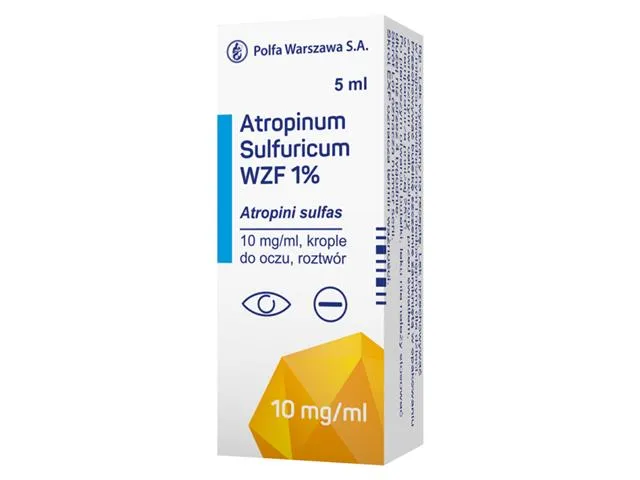
Table of Contents
- Patient Information Leaflet
- 1. What Atropinum Sulfuricum WZF 1% is and what it is used for
- 2. Important information before using Atropinum Sulfuricum WZF 1%
- 3. How to use Atropinum Sulfuricum WZF 1%
- 4. Possible adverse reactions
- 5. How to store Atropinum Sulfuricum WZF 1%
- 6. Contents of the pack and other information
Patient Information Leaflet
Atropinum Sulfuricum WZF 1%, 10 mg/ml, eye drops, solution
Atropini sulfas
Please read all of this leaflet carefully before using this medicine because it contains important information for you.
- Keep this leaflet. You may need to read it again.
- If you have any further questions, ask your doctor or pharmacist.
- This medicine has been prescribed for a specific individual. Do not pass it on to others. It may harm them even if their symptoms are the same.
- If you experience any side effects, including any not listed in this leaflet, inform your doctor or pharmacist. See section 4.
Table of Contents
- What Atropinum Sulfuricum WZF 1% is and what it is used for
- Important information before using Atropinum Sulfuricum WZF 1%
- How to use Atropinum Sulfuricum WZF 1%
- Possible side effects
- How to store Atropinum Sulfuricum WZF 1%
- Contents of the pack and other information
1. What Atropinum Sulfuricum WZF 1% is and what it is used for
The medicine contains atropine, which when applied locally to the eye causes dilation of the pupil and paralysis of accommodation (the eye's ability to adjust for clear vision of objects at varying distances).
This medicine is used:
- for prolonged dilation of the pupil during diagnostic eye examinations and in refraction testing (performed to determine refractive errors) in young children;
- in the treatment of inflammation of the iris and ciliary body, to prevent complications known as posterior synechiae (iris-lens adhesions).
2. Important information before using Atropinum Sulfuricum WZF 1%
When not to use Atropinum Sulfuricum WZF 1%:
- if the patient is allergic to atropine sulfate or to other substances with similar action (called anticholinergics), or to any of the other ingredients of this medicine (listed in section 6);
- if the patient has primary glaucoma (increased pressure in the eye) with a tendency to angle closure;
- if the patient has narrow-angle glaucoma.
Warnings and precautions
Before starting treatment with Atropinum Sulfuricum WZF 1%, discuss this with your doctor or pharmacist.
- After administration of atropine, the eyes should be protected from light.
- Due to the type of active substance, the eye drops may temporarily impair vision.
- Because of the risk of inducing high fever, atropine should be used with great caution when ambient temperature is high or when the patient has a fever.
- Caution is advised in patients with tachycardia (accelerated heart rate).
- Adverse effects may occur or intensify in elderly patients.
- Pupil dilation may trigger an attack of glaucoma in individuals over 60 years of age.
Children
In children under 6 years of age, use of a lower concentration atropine-containing preparation is recommended.
Particular caution is advised when administering atropine to infants and young children, as adverse effects may occur or intensify.
Atropinum Sulfuricum WZF 1% and other medicines
Inform your doctor or pharmacist about all medicines currently or recently taken, as well as any medicines planned for future use.
The effect of atropine may be enhanced by drugs with anticholinergic activity, e.g. amitriptyline (an antidepressant), haloperidol and chlorpromazine (medicines used in psychiatric disorders), hydroxyzine, clemastine (antiallergic medicines belonging to first-generation antihistamines), and certain medicines used in Parkinson's disease.
When atropine is used concomitantly with physostigmine, neostigmine, or pilocarpine (medicines used, for example, in glaucoma treatment), mutual antagonism of effects occurs.
Pregnancy and breastfeeding
If the patient is pregnant or breastfeeding, suspects she might be pregnant, or is planning to become pregnant, she should consult a doctor or pharmacist before using this medicine.
This medicine may be used during pregnancy only if, in the opinion of the physician, the benefit to the mother outweighs the potential risk to the fetus.
It is not known whether atropine passes into human breast milk; use of this medicine in breastfeeding women requires caution.
Driving and operating machinery
Atropine causes prolonged visual disturbances (lasting up to 5–7 days after administration).
During treatment and as long as visual disturbances persist after administration, patients should not drive or operate machinery.
Atropinum Sulfuricum WZF 1% contains benzalkonium chloride
The medicine contains 0.1 mg of benzalkonium chloride per ml of solution. Benzalkonium chloride may be absorbed by soft contact lenses and may alter their color. Contact lenses should be removed before instillation and at least 15 minutes should elapse before reinsertion. Benzalkonium chloride may also cause eye irritation, especially in individuals with dry eye syndrome or corneal disorders (the transparent layer at the front of the eye). If abnormal sensations in the eye, such as stinging or pain, occur after administration of the medicine, consult a doctor.
3. How to use Atropinum Sulfuricum WZF 1%
This medicine should always be used exactly as directed by a doctor or pharmacist. If in doubt,
consult a doctor or pharmacist.
For ophthalmic examinations, the dosage is determined by the doctor.
Usually, the medicine is used as described below.
Ophthalmic examination in children:
- Children aged 6 years and older: 1 drop of the medicine twice daily for 3 days. An additional dose may be administered immediately before the ophthalmic examination.
- In children under 6 years of age, it is recommended to use a preparation containing atropine in a lower concentration.
Therapeutically, one drop should be administered into the conjunctival sac up to 2 times daily.
Method of administration
Atropinum Sulfuricum WZF 1% is intended for external use – apply locally to the eye(s).
Do not allow the dropper tip to touch the eye, eyelids, or any other surfaces, as this may contaminate the drops. Using contaminated drops may lead to dangerous complications, including loss of vision. During instillation, take great care to avoid getting the medicine into the mouth.
- Wash hands thoroughly before instilling the medicine.
- Unscrew the cap from the bottle.
- Tilt the head backward and gently pull down the lower eyelid to form a pouch between the eyelid and the eyeball.
- Invert the bottle and gently press with the thumb or index finger on the side of the bottle until one drop of the medicine is dispensed into the eye. Do not let the dropper tip touch the eye or eyelids. If the drop misses the eye, instill another drop.
- Immediately after instillation of Atropinum Sulfuricum WZF 1%, gently press on the inner corner of the eye for about 1 minute. This helps reduce the risk of systemic adverse effects.
- If the doctor has instructed instillation into the other eye, repeat steps 3, 4, and 5.
- The dropper is designed to accurately measure drops; therefore, do not enlarge the dropper opening.
- After instillation, replace the cap on the bottle. Do not overtighten.
- Wash hands thoroughly after using the drops.
Use of a higher than recommended dose of Atropinum Sulfuricum WZF 1%
If an excessive amount of atropine sulfate is absorbed into the systemic circulation, symptoms may include: impaired balance, behavioral disturbances, dizziness, increased heart rate, arrhythmia (change in normal heart rhythm), fever, hallucinations (visual, auditory), skin rash, abdominal distension (in infants), intense thirst, dry mouth, drowsiness, fatigue, weakness, dry skin, and urinary retention. Additionally, skin inflammation (eczema), severe generalized reactions with hypotension, and worsening respiratory disturbances may occur. If any of these symptoms occur or if the medicine has been used incorrectly (e.g. swallowed), the patient should contact a doctor immediately for appropriate treatment.
Missed dose of Atropinum Sulfuricum WZF 1%
If a dose is missed, administer it as soon as possible. If it is almost time for the next dose, skip the missed dose and continue with the regular dosing schedule. Do not use a double dose to make up for a missed dose.
4. Possible adverse reactions
Like all medicines, this medicine can cause adverse reactions, although not everyone experiences them.
If the patient experiences allergic reactions, including rash, swelling of the face, lips, tongue and (or)
throat, which may cause difficulty in breathing or swallowing, or if other serious adverse reactions occur,
the use of Atropinum Sulfuricum WZF 1% must be discontinued immediately and the patient should
contact a doctor or the nearest hospital Emergency Department without delay.
The frequency of adverse reactions is unknown (cannot be estimated from the available data). Possible reactions include:
- visual disturbances and accommodation disorders, increased intraocular pressure, especially in patients with narrow-angle (closed-angle) glaucoma, conjunctivitis (symptoms: foreign body sensation under the eyelids, stinging, burning, presence of discharge), itching, eyelid swelling, lacrimation, photophobia (when pupils are dilated, eyes should be protected from bright light). Local irritation, transient burning, hyperaemia, eyelid swelling and conjunctivitis may occur after prolonged use of the medicine.
- skin rash (as a sign of hypersensitivity);
- severe ataxia (loss of coordination), restlessness, agitation and hallucinations, especially in infants and elderly patients;
- dry mouth, difficulty in swallowing and speaking, skin redness and dryness, transient bradycardia progressing to tachycardia, palpitations and cardiac arrhythmias, reduced bronchial secretions, urinary urgency and urinary retention, as well as constipation;
- confusion – marked disturbances of consciousness (especially in elderly patients), nausea, vomiting and dizziness.
During treatment, systemic effects and the symptoms listed above may occur (see section "Use of a dose higher than recommended for Atropinum Sulfuricum WZF 1%").
Reporting of adverse reactions
If any adverse reactions occur, including those not listed in this leaflet, inform a doctor, pharmacist or nurse. Adverse reactions can be reported directly to the Department of Monitoring of Adverse Drug Reactions of the Office for Registration of Medicinal Products, Medical Devices and Biocidal Products
Al. Jerozolimskie 181C
02-222 Warszawa
Tel.: + 48 22 49 21 301
Fax: + 48 22 49 21 309
Website: https://smz.ezdrowie.gov.pl
Adverse reactions can also be reported to the marketing authorization holder.
Reporting adverse reactions helps to provide more information on the safety of the medicine.
5. How to store Atropinum Sulfuricum WZF 1%
Keep the bottle tightly closed in the outer packaging to protect from light, at a temperature below 25 °C.
The medicine should be stored out of sight and reach of children.
After first opening the bottle, the medicine should not be used for longer than 4 weeks.
Do not use this medicine after the expiry date stated on the carton and bottle.
The expiry date refers to the last day of the stated month.
The labelling on the packaging shows EXP followed by the expiry date and Lot followed by the batch number.
Medicines must not be disposed of via wastewater or household waste. Ask your pharmacist how to dispose of medicines no longer required. This will help protect the environment.
6. Contents of the pack and other information
What Atropinum Sulfuricum WZF 1% contains
- The active substance is atropine sulfate. Each ml of solution contains 10 mg of atropine sulfate.
- The other ingredients are: hydroxyethylcellulose, boric acid, disodium edetate, benzalkonium chloride solution, hydrochloric acid 10% (for pH adjustment), purified water.
What Atropinum Sulfuricum WZF 1% looks like and contents of the pack
Atropinum Sulfuricum WZF 1% is a sterile eye drop solution in the form of a clear,
colourless or yellow liquid.
The medicine is available in polyethylene bottles containing 5 ml of solution, packed in a cardboard box.
Marketing Authorisation Holder
Zakłady Farmaceutyczne POLPHARMA S.A.
ul. Pelplińska 19, 83-200 Starogard Gdański
tel. +48 22 364 61 01
Manufacturer
Warszawskie Zakłady Farmaceutyczne Polfa S.A.
ul. Karolkowa 22/24; 01-207 Warszawa