Atrodil
Poland
Table of Contents
Package leaflet: Information for the patient
Atrodil, 20 micrograms/dose, inhalation aerosol, solution
Ipratropii bromidum
Please read this leaflet carefully before using the medicine, because it contains
important information for the patient.
- Keep this leaflet so that you can read it again if necessary.
- If you have any questions, please consult your doctor or pharmacist.
- This medicine has been prescribed for a specific individual. Do not pass it on to others. The medicine may harm another person, even if their symptoms are the same.
- If the patient experiences any adverse reactions, including any adverse reactions not listed in this leaflet, inform the doctor or pharmacist. See section 4.
Table of contents
- What Atrodil is and what it is used for
- Important information before using Atrodil
- How to use Atrodil
- Possible side effects
- How to store Atrodil
- Contents of the pack and other information
1. What Atrodil is and what it is used for
Atrodil is an aerosol inhalation solution under pressure. The medicine contains ipratropium bromide, which
belongs to a group of medicines known as bronchodilators.
Atrodil is indicated as a bronchodilator for maintenance treatment of bronchospasm in
chronic obstructive pulmonary disease (COPD), including chronic bronchitis and pulmonary emphysema, as well as in bronchial asthma.
2. Important information before using Atrodil
When not to use Atrodil
- if the patient is allergic to ipratropium bromide or any of the other ingredients of this medicine (listed in section 6);
- if the patient is allergic to similar medicines containing atropine or its derivatives.
Warnings and precautions
Before starting treatment with Atrodil, discuss this with your doctor or pharmacist.
Special caution is required when using Atrodil:
- if the patient experiences eye pain or discomfort, blurred vision, seeing halos around lights, or altered colour vision together with redness of the eyes, immediate medical advice should be sought. A doctor will assess whether these symptoms may be due to complications (such as pupil dilation, increased intraocular pressure, or narrow-angle glaucoma);
- if the patient has narrow-angle glaucoma (increased pressure in the eye) or is predisposed to developing glaucoma. Symptoms may worsen if the medicine is accidentally sprayed into the eye;
- if the patient has an enlarged prostate causing difficulty in passing urine (in men only);
- if the patient has urinary outflow obstruction;
- if the patient has cystic fibrosis; gastrointestinal motility disorders (e.g. constipation, diarrhoea) may occur;
- if breathing difficulties do not improve or worsen: contact a doctor immediately, who will reassess the treatment plan. The doctor may recommend additional medications. Never exceed the prescribed dose, as this may lead to serious adverse effects. Avoid getting Atrodil into the eyes.
Atrodil and other medicines
Tell your doctor or pharmacist about all medicines currently used, recently used, or planned to be used.
Some medicines may interact with Atrodil. This may alter the effect of Atrodil or other medicines. In particular, inform your doctor if you are taking any of the following medicines:
- other bronchodilators, such as salbutamol;
- beta-blockers used in the treatment of heart disease and hypertension, e.g. atenolol, bisoprolol;
- xanthine derivatives, e.g. theophylline, aminophylline;
- other anticholinergic medicines, e.g.
- pridinol, biperiden (used in Parkinson's disease);
- scopolamine (an antiemetic and used in spastic conditions of the gastrointestinal or urinary tract).
Pregnancy and breastfeeding
If the patient is pregnant or breastfeeding, suspects she may be pregnant, or is planning to become pregnant, she should consult her doctor or pharmacist before using this medicine.
The safety of using this medicine during pregnancy has not been established. Atrodil should only be used during pregnancy if considered necessary by a doctor.
It is not known whether ipratropium bromide passes into human breast milk. Therefore, Atrodil should only be used in breastfeeding women if considered necessary by a doctor.
Driving and operating machinery
No studies have been conducted on the effects of the medicine on the ability to drive or operate machinery. If dizziness or visual disturbances (blurred vision, seeing halos around lights) occur during treatment with Atrodil, the patient should refrain from performing the above activities.
Atrodil contains ethanol
This medicine contains small amounts of ethanol (alcohol), less than 100 mg per dose. One measured dose (spray) contains 8.42 mg of anhydrous ethanol.
3. How to use Atrodil
This medicine should always be used exactly as directed by your doctor. If in doubt, consult your doctor or pharmacist.
Your doctor will adjust the dosage according to your individual needs. If not otherwise advised, the medicine should be used as follows:
Adults and children over 6 years of age
2 doses (sprays) per administration, 4 times daily, but no more than 12 sprays per day.
Do not exceed the recommended daily dose.
If treatment does not lead to significant improvement or if your condition worsens, consult your doctor to determine a new treatment plan.
In case of sudden or rapidly worsening shortness of breath (difficulty breathing), seek medical advice immediately.
Atrodil aerosol should be used in children only under the supervision of an adult.
Administration method
To achieve the best treatment results, it is important to use the inhalation aerosol correctly, as described below. If you have any doubts after reading these instructions, consult your doctor, pharmacist, or nurse.
Checking the inhaler
- Shake the inhaler before use. Do not shake too vigorously.
- If the inhaler is new or has not been used for at least three days, shake it and then release two doses into the air to ensure proper functioning.
Instructions for use
- Remove the protective cap from the mouthpiece, see Figure 1.

- Shake the inhaler.
- Holding the inhaler, breathe out deeply,
and then immediately…
- Place the mouthpiece in your mouth and hold it with your lips. As you begin a slow, deep breath in through your mouth, press firmly on the aerosol container as shown below to release the Atrodil dose. Then continue inhaling. See Figure 2.
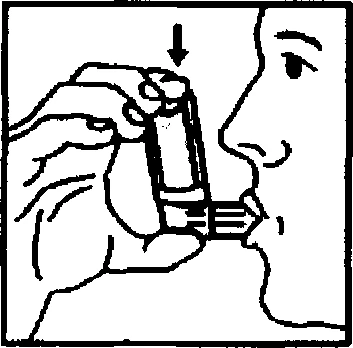
Figure 2
- Hold your breath for a few seconds, or as long as possible without discomfort, then remove the mouthpiece from your mouth and breathe out.
- If more than one dose is prescribed, wait at least one minute, shake the inhaler again, and repeat steps 3, 4, and 5.
- After use, replace the protective cap on the mouthpiece.
The container is not transparent. Therefore, you cannot see when it is empty. The inhaler contains 200 doses. After these doses have been used, a small amount of solution may still remain in the container. However, you should replace the inhaler with a new one, as continued use may not deliver the correct dose of medicine.
Cleaning the inhaler
The inhaler mouthpiece should be cleaned at least once a week. It is important to keep it clean to ensure that the medicine does not deposit on the mouthpiece walls and block the inhaler.
To clean the inhaler mouthpiece, first remove the protective cap and take the medicine container out of the inhaler. Rinse the mouthpiece with warm water until all visible dirt is removed – see Figure 3.
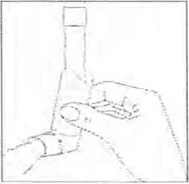
Figure 3
After washing, shake off the water and leave the mouthpiece to dry in the air. Do not use any drying devices. When the inhaler mouthpiece is dry, reinsert the medicine container into the inhaler and replace the protective cap – see Figure 4.
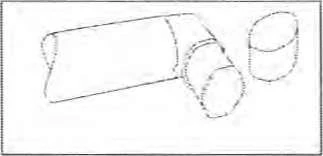
Figure 4
Note:
The plastic mouthpiece has been specially designed for use with the Atrodil inhalation aerosol to ensure delivery of the correct dose each time. The mouthpiece must never be used with any other inhalation aerosol, and conversely, the Atrodil inhalation aerosol must not be used with any mouthpiece other than the one supplied with this medicine. Since the container is under pressure, never use force to open it and do not expose it to temperatures above 50°C.
If using the inhaler is difficult, Atrodil should be used with an AeroChamber inhalation spacer.
The patient should read the instructions for use of the AeroChamber inhalation spacer provided in the package for detailed information on its proper use.
Use of a higher than recommended dose of Atrodil
If you accidentally use more than the recommended dose, consult your doctor immediately.
Mild symptoms of ipratropium bromide overdose may occur, such as dryness of the oral mucosa, blurred vision, and increased heart rate.
Missed dose of Atrodil
If you miss a dose, take it as soon as possible. However, if it is almost time for your next dose, skip the missed dose and take the next dose at the regular time. Do not use a double dose to make up for a missed dose. Continue using the medicine as before.
Stopping use of Atrodil
If you stop using Atrodil, breathing difficulties may recur or worsen. Therefore, continue using Atrodil for as long as your doctor has instructed.
If you have any further questions about the use of this medicine, consult your doctor or pharmacist.
4. Possible adverse reactions
Like all medicines, this medicine can cause adverse reactions, although not everyone experiences them.
You should immediately stop using the medicine and see a doctor if the patient experiences:
- difficulty breathing or sudden worsening of wheezing,
- angioedema (sudden swelling of the skin or mucous membranes, which may cause difficulty breathing and swallowing),
- rapidly progressing, life-threatening allergic reactions (anaphylactic reactions), manifested by swelling of the tongue, lips, and face or sudden difficulty breathing,
- blurred vision, pupil dilation, increased intraocular pressure, glaucoma, eye pain, seeing rainbow-colored halos around light sources, conjunctival hyperemia (redness of the white part of the eye), corneal edema (swelling of the protective outer layer of the eye).
Atrodil may cause the following symptoms:
Common (occur in less than 1 in 10 patients):
- headache, dizziness,
- cough, throat irritation,
- dryness of the oral mucosa,
- nausea, gastrointestinal motility disorders.
Uncommon (occur in less than 1 in 100 patients):
- palpitations, supraventricular tachycardia (excessively rapid heartbeat),
- blurred vision, pupil dilation, increased intraocular pressure, glauoma, eye pain, seeing rainbow-colored halos around light sources, conjunctival hyperemia (redness of the white part of the eye), corneal edema (swelling of the protective outer layer of the eye),
- airway narrowing, including paradoxical bronchoconstriction caused by inhalation, laryngospasm (sudden spasms of the vocal cords affecting breathing and speech), pharyngeal mucosal edema, dry throat,
- diarrhea, constipation, vomiting, stomatitis (inflammation of the oral mucosa), oral cavity edema,
- urinary retention,
- rash, itching,
- angioedema, hypersensitivity, severe allergic reactions (anaphylactic reactions).
Rare (occur in less than 1 in 1,000 patients):
- atrial fibrillation (very rapid, irregular heartbeat), increased heart rate,
- accommodation disorders (impaired visual focus),
- urticaria.
Reporting of adverse reactions
If any adverse reactions occur, including any adverse reactions not listed in this leaflet, inform your doctor or pharmacist. Adverse reactions can be reported directly to the Department of Monitoring of Adverse Drug Reactions of the Office for Medicinal Products, Medical Devices and Biocidal Products
Al. Jerozolimskie 181C
02-222 Warsaw
Phone: +48 22 49 21 301
Fax: +48 22 49 21 309
Website: https://smz.ezdrowie.gov.pl
Adverse reactions can also be reported to the marketing authorization holder.
Reporting adverse reactions helps provide more information on the safety of the medicine.
5. How to store Atrodil
Keep the medicine out of the sight and reach of children.
Protect from direct sunlight and do not freeze.
Do not store at temperatures above 30°C.
Do not pierce or burn, even if the container appears to be empty.
Do not use this medicine after the expiry date stated on the packaging. The expiry date refers to the last day of the stated month.
The marking on the packaging following the abbreviation EXP indicates the expiry date, and the abbreviation Lot indicates the batch number.
Medicines must not be disposed of via wastewater or household waste. Ask your pharmacist how to dispose of medicines no longer in use. This will help protect the environment.
6. Contents of the pack and other information
What Atrodil contains
- The active substance is ipratropium bromide. Each metered dose contains 21 micrograms of ipratropium bromide monohydrate, equivalent to 20 micrograms of ipratropium bromide.
- The other ingredients are: 1,1,1,2-tetrafluoroethane, anhydrous citric acid, purified water, anhydrous ethanol. This medicine contains fluorinated greenhouse gases. Each 200-dose inhaler contains 11.37 g of 1,1,1,2-tetrafluoroethane, which corresponds to 0.0163 tonnes of CO* equivalent (global warming potential GWP = 1430).
What Atrodil looks like and contents of the pack
An aluminium container with an FCP (fluorocarbon polymer) coating, equipped with a 50 µl metering valve,
with a mouthpiece made of PP and a closure made of PP, in a cardboard box. Each container is filled with 10 ml
of colourless, clear solution, corresponding to approximately 200 doses.
Marketing Authorisation Holder and Manufacturer
Marketing Authorisation Holder
Zakłady Farmaceutyczne POLPHARMA S.A.
ul. Pelplińska 19, 83-200 Starogard Gdański
tel. +48 22 364 61 01
Manufacturer
Zakłady Farmaceutyczne POLPHARMA S.A.
ul. Pelplińska 19, 83-200 Starogard Gdański
| LABORATORIO ALDO-UNIÓN S.L. | |
| Baronesa de Maldá, No 73 | |
| 08950 Esplugues de Llobregat (Barcelona) | |
| Spain | |
Other sources of information
The detailed instructions for use of the inhalation aerosol are available by scanning with a smartphone
the QR code below. The same information is also available on the website:
www.instrukcjeatrodil.pl
(QR code)
QR