Atossa
Poland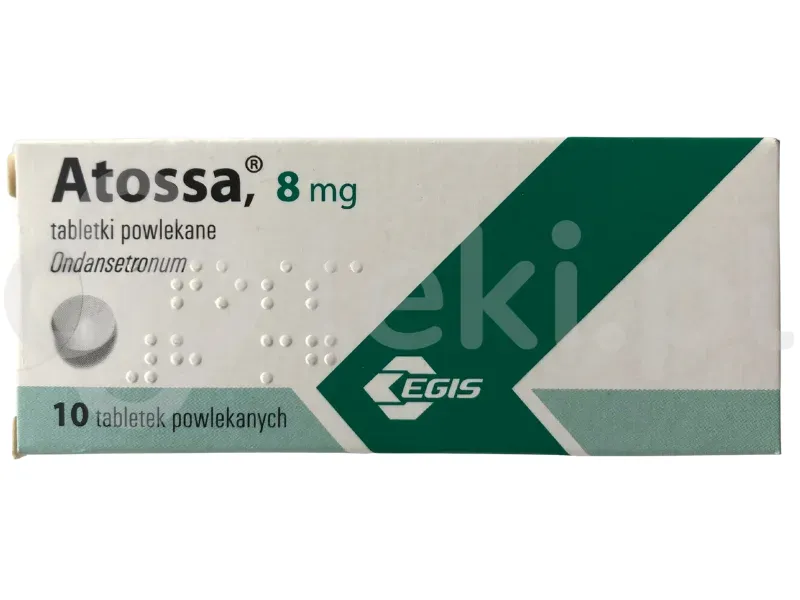
Table of Contents
Package leaflet: Information for the patient
Atossa, 8 mg, coated tablets
Ondansetron
Please read carefully the entire leaflet before using the medicine, as it contains
important information for the patient.
- Keep this leaflet, so that you can read it again if necessary.
- If you have any further questions, please consult your doctor, pharmacist, or nurse.
- This medicine has been prescribed for a specific individual. Do not pass it on to others. It may harm other people, even if their symptoms are the same.
- If you experience any adverse reactions, including any possible adverse reactions not listed in this leaflet, inform your doctor, pharmacist, or nurse. See section 4.
Table of contents of the leaflet
- What Atossa is and what it is used for
- Important information before taking Atossa
- How to take Atossa
- Possible side effects
- How to store Atossa
- Contents of the pack and other information
1. What Atossa is and what it is used for
Atossa contains the active substance ondansetron, which belongs to a group of antiemetic medicines
known as selective serotonin receptor antagonists (5HT ).
Indications
Atossa is indicated:
- for the prevention and treatment of nausea and vomiting caused by chemotherapy (in adults and children with body surface area greater than 1.2 m ) and by radiotherapy in cancer (in adults),
- for the prevention of postoperative nausea and vomiting (in adults).
Please consult your doctor, pharmacist, or nurse if you require additional
information regarding the use of this medicine.
2. Important information before using Atossa
When not to use Atossa:
- if the patient is allergic to ondansetron or any of the other ingredients of this medicine (listed in section 6),
- if the patient is taking apomorphine (used in the treatment of Parkinson's disease). If any of the above situations apply, the patient should discuss this with a doctor before using Atossa.
Warnings and precautions
Before starting treatment with Atossa, the patient should discuss the following with a doctor or pharmacist:
- if the patient is allergic to other medicines similar to ondansetron, such as granisetron or palonosetron,
- if the patient has or may develop QT interval prolongation (a segment measured on an ECG). Atossa causes dose-dependent QT interval prolongation (manifested as heart rhythm disturbances). Cases of life-threatening ventricular tachycardia of the Torsade de Pointes type have been rarely observed in patients taking this medicine. This mainly concerns patients with electrolyte imbalances (abnormal levels of potassium, sodium, and magnesium in the body), congenital long QT syndrome (a heart condition causing irregular heartbeat), congestive heart failure, bradycardia (abnormally slow and irregular heartbeat), or those taking medicines causing QT interval prolongation,
- if the patient has ever had heart problems (e.g. congestive heart disease causing shortness of breath and ankle swelling),
- if the patient is taking medicines belonging to the group of selective serotonin reuptake inhibitors (SSRIs), serotonin-norepinephrine reuptake inhibitors (SNRIs) (used in the treatment of depression and/or anxiety disorders), or buprenorphine (used in the treatment of opioid dependence or severe pain) at the same time. Concurrent use of Atossa with these medicines may lead to serotonin syndrome. If simultaneous use of Atossa and these medicines is necessary, the patient will be under appropriate medical supervision. Symptoms of serotonin syndrome include headache, hallucinations, accelerated thought process, confusion, restlessness, insomnia, transient difficulty concentrating, elevated body temperature, muscle stiffness, seizures, excessive sweating, high blood pressure, rapid heartbeat, nausea, vomiting, diarrhea, skin flushing, and dilated pupils. If any of these symptoms occur, the patient should inform their doctor immediately,
- if the patient has intestinal obstruction,
- if the patient has recently had their tonsils removed, as treatment with ondansetron may mask symptoms of internal bleeding,
- if the patient has impaired liver function – in such patients, Atossa should not exceed 8 mg per day.
Before using Atossa, hypokalemia (low potassium levels in the blood) and hypomagnesemia (low magnesium levels in the blood) should be corrected.
The patient should immediately inform their doctor or pharmacist if any of the following symptoms occur during or after treatment with Atossa:
- sudden chest pain or pressure in the chest (myocardial ischemia).
Children and adolescents
When ondansetron is used in children and adolescents in combination with hepatotoxic chemotherapy, the doctor should carefully monitor for any signs of impaired liver function.
Atossa and other medicines
The patient should inform their doctor or pharmacist about all medicines currently or recently used, as well as any medicines they plan to use. This is important because Atossa may affect the action of certain medicines. Likewise, some other medicines may affect the action of Atossa.
In particular, the patient should inform their doctor, pharmacist, or nurse if they are taking:
- apomorphine – concomitant use of this medicine with apomorphine (used in the treatment of Parkinson's disease) is contraindicated, as it may cause a drop in blood pressure and loss of consciousness;
- phenytoin or carbamazepine used in the treatment of epilepsy, as they may reduce ondansetron blood levels;
- rifampicin used in the treatment of infections such as tuberculosis, as it may reduce ondansetron blood levels;
- tramadol – a painkiller, as tramadol's effect may be weakened;
- antiarrhythmic medicines used in the treatment of heart rhythm disorders;
- beta-blockers used in the treatment of certain heart or eye conditions, anxiety, and prevention of migraines;
- medicines affecting the heart, including those affecting the QT interval;
- medicines causing electrolyte imbalances;
- anticancer medicines (especially anthracyclines and trastuzumab);
- antibiotics (such as erythromycin) or antifungal medicines (such as ketoconazole);
- selective serotonin reuptake inhibitors (SSRIs) used in the treatment of depression and/or anxiety disorders, including fluoxetine, paroxetine, sertraline, fluvoxamine, citalopram, escitalopram;
- serotonin-norepinephrine reuptake inhibitors (SNRIs) used in the treatment of depression and/or anxiety disorders, including venlafaxine and duloxetine;
- buprenorphine (used in the treatment of opioid dependence or severe pain).
If the patient is unsure whether any of the above situations apply, they should consult a doctor, nurse, or pharmacist before using Atossa.
Atossa with food and drink
Atossa may be taken with food and drink. Tablets should be taken with a glass of water.
Pregnancy, breastfeeding, and fertility
Atossa should not be used during the first trimester of pregnancy, as Atossa may slightly increase the risk of cleft lip and/or cleft palate [an opening or fissure in the upper lip and/or palate]. If the patient is already pregnant, suspects pregnancy, or plans to become pregnant, she should consult a doctor or pharmacist before taking Atossa.
If the patient could become pregnant, she will be advised to use effective contraception.
Breastfeeding should be avoided during treatment with Atossa, as small amounts of ondansetron pass into breast milk. The patient should consult a doctor or midwife.
Driving and operating machinery
It has not been shown that Atossa impairs the ability to perform tasks or causes sedation.
Atossa contains lactose monohydrate.
If the patient has previously been diagnosed with intolerance to certain sugars, they should consult their doctor before taking this medicine.
3. How to use Atossa
This medicine should always be used exactly as directed by the doctor. In case of doubt, consult
your doctor or pharmacist.
The doctor will decide the appropriate dose for the patient. The prescribed dose depends on the
treatment being administered to the patient.
The Atossa 8 mg tablet should be swallowed whole with water.
Atossa 8 mg tablets are indivisible – do not split them.
Oral medicines containing ondansetron at lower strengths (4 mg) are also available on the market.
There are also medicines containing ondansetron available for rectal and parenteral administration.
Prevention of nausea and vomiting induced by moderately emetogenic chemotherapy and radiotherapy for cancer
Adults
On the day of chemotherapy or radiotherapy:
- the recommended oral dose is 8 mg taken one hour or two hours before chemotherapy or radiotherapy, followed by another 8 mg orally after 12 hours,
On subsequent days:
- the recommended oral dose is 8 mg twice daily, which may be continued for up to 5 days.
In highly emetogenic chemotherapy
If chemotherapy or radiotherapy may cause severe nausea or vomiting, the doctor may decide to
administer the first dose of ondansetron as an injection or rectally.
The dose will be determined by the doctor. On subsequent days, treatment continues as for
moderately emetogenic chemotherapy (see above).
Children aged 6 months and adolescents
The doctor will determine the dose based on the child's size (body surface area) or body weight.
Atossa 8 mg tablets are not suitable for use in children.
In such cases, the doctor will prescribe ondansetron in the form of syrup or injection.
Prevention of postoperative nausea and vomiting
Adults
The recommended oral dose is 16 mg of ondansetron one hour before surgery.
For treatment of nausea and vomiting in the postoperative period, intravenous or intramuscular
administration of ondansetron is recommended.
Children above 1 month of age and adolescents
For prevention of postoperative nausea and vomiting in children, ondansetron is administered by
injection (slow intravenous injection).
Special patient populations
Elderly patients
Dose adjustment or change in frequency of administration is usually not necessary.
Patients with moderate or severe hepatic impairment
The dose should not exceed 8 mg of ondansetron per day.
Atossa should start working within one to two hours after taking the dose.
If vomiting occurs within one hour of taking the dose:
- take another identical dose of the medicine;
- in other cases, do not take a higher dose than prescribed by the doctor. If the patient still experiences nausea, inform the doctor or nurse.
Taking more Atossa than prescribed
If an adult or child takes more Atossa than prescribed, contact a doctor immediately or go to a
hospital.
Bring the medicine packaging with you.
In most cases of overdose, symptoms observed are similar to adverse reactions (see section 4).
Missing a dose of Atossa
If the patient misses a dose and experiences nausea or vomiting:
- take Atossa as soon as possible,
- then take the next tablet at the usual time (as directed by the doctor),
- do not take a double dose to make up for the missed dose.
If the patient misses a dose but does not have nausea:
- take the next dose at the usual time (as directed by the doctor),
- do not take a double dose to make up for the missed dose.
Stopping Atossa treatment
Nausea and vomiting may recur.
If you have any further questions about the use of this medicine, consult your doctor or pharmacist.
4. Possible adverse reactions
Like all medicines, this medicine may cause adverse reactions, although not everyone experiences them.
Some adverse reactions may be serious
You should DISCONTINUE taking Atossa and seek immediate medical help if any of the following symptoms occur in the patient:
Severe allergic reactions: occur rarely in people taking ondansetron. Symptoms may include:
- sudden wheezing, chest pain or chest tightness,
- swelling of the eyelids, face, lips, mouth or tongue,
- skin rash with red spots or lumps (urticaria) appearing in various parts of the body,
- fainting.
Myocardial ischaemia. Symptoms include:
- sudden chest pain or
- chest tightness.
Other possible adverse reactions:
Other possible adverse reactions include the following. Inform your doctor, pharmacist or healthcare professional if these symptoms become severe.
Very common (occurring in more than 1 in 10 patients)
- headache.
Common (may occur in no more than 1 in 10 patients)
- feeling of warmth (flushing) or hot sensation;
- constipation;
- changes in liver function test results (if Atossa tablets are taken with cisplatin; in other cases, this adverse reaction occurs uncommonly).
Uncommon (may occur in no more than 1 in 100 patients)
- convulsions;
- involuntary body movements or tremors, rolling of the eyes;
- irregular heartbeat (arrhythmia);
- slow heartbeat (bradycardia);
- chest pain;
- low blood pressure, which may cause fainting or dizziness;
- hiccups;
- changes in liver function test results.
Rare (may occur in no more than 1 in 1,000 patients)
- dizziness,
- visual disturbances, such as blurred vision.
- heart rhythm disorders (sometimes leading to sudden loss of consciousness), including life-threatening ventricular tachycardia of the type Torsade de Pointes.
Very rare (may occur in no more than 1 in 10,000 patients)
- extensive blistering rash with skin peeling affecting a large part of the body (toxic epidermal necrolysis)
- visual impairment or transient visual loss, usually resolving within 20 minutes.
Reporting of adverse reactions
If any adverse reactions occur, including any not listed in this leaflet, inform your doctor, pharmacist or nurse. Adverse reactions can be reported directly to the Department of Monitoring of Adverse Drug Reactions, Office for Registration of Medicinal Products, Medical Devices and Biocidal Products
Al. Jerozolimskie 181C, 02-222 Warsaw
Tel.: +48 22 49 21 301
Fax: +48 22 49 21 309
Website: https://smz.ezdrowie.gov.pl
Adverse reactions can also be reported to the marketing authorization holder.
Reporting adverse reactions helps to provide more information on the safety of the medicine.
5. How to store Atossa
Store below 25 °C and protect from moisture.
Keep the medicine out of sight and reach of children.
Do not use this medicine after the expiry date stated on the carton. The expiry date refers to the last day of the stated month.
Medicines must not be disposed of via wastewater or household waste. Ask your pharmacist how to dispose of medicines you no longer use. This will help protect the environment.
6. Contents of the pack and other information
What Atossa contains
- The active substance is ondansetron (in the form of ondansetron dihydrochloride dihydrate). Each tablet contains 8 mg of ondansetron.
- Other excipients: monohydrate lactose, microcrystalline cellulose, pregelatinized corn starch, colloidal silicon dioxide, magnesium stearate, hypromellose, macrogol 6000, glycerol, titanium dioxide (E171), yellow iron oxide (E172).
What Atossa looks like and contents of the pack
Yellow, smooth, biconvex tablets.
One pack contains 10 tablets in blisters made of aluminium/PCV foil, packed in a cardboard box.
Marketing Authorisation Holder and Manufacturer
Marketing Authorisation Holder
Egis Pharmaceuticals PLC
Keresztúri út 30-38
1106 Budapest, Hungary
Manufacturer
Egis Pharmaceuticals PLC
1106 Budapest
Bökényföldi út 118-120
Hungary
For further information, please contact the local representative of the Marketing Authorisation Holder:
EGIS Polska Sp. z o.o.
ul. Komitetu Obrony Robotników 45 D
02-146 Warszawa
Telephone number: +48 22 417 92 00