Atosiban accord
Poland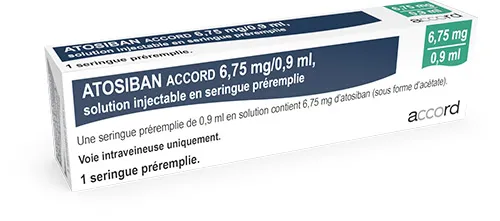
Table of Contents
Package leaflet: Information for the user
Atosiban Accord, 6.75 mg/0.9 ml, solution for injection in pre-filled syringe
Atosibanum
Please read all of this leaflet carefully before using this medicine because it contains
important information for you.
- Keep this leaflet. You may need to read it again.
- Please consult your doctor, midwife, or pharmacist if you have any questions.
- If you experience any adverse reactions, including any possible adverse reactions not listed in this leaflet, inform your doctor or pharmacist.
Contents of the leaflet:
- What Atosiban Accord is and what it is used for
- What you need to know before using Atosiban Accord
- How to use Atosiban Accord
- Possible side effects
- How to store Atosiban Accord
- Contents of the pack and other information
1. What Atosiban Accord is and what it is used for
Atosiban Accord contains the active substance atosiban. Atosiban Accord may be used to delay premature birth.
Atosiban Accord is used in adult pregnant women, from week 24 to week 33 of pregnancy.
Atosiban Accord works by reducing the strength and frequency of uterine contractions. This occurs because it blocks the action of a natural hormone in the woman's body called "oxytocin", which causes uterine contractions.
2. Important information before using Atosiban Accord
When not to use Atosiban Accord
- if pregnancy is less than 24 weeks,
- if pregnancy is more than 33 weeks,
- if the amniotic membranes have ruptured prematurely (premature rupture of membranes) and pregnancy is 30 full weeks or longer,
- if the unborn baby (fetus) has an abnormal heart rate,
- if the patient has vaginal bleeding and the doctor determines that immediate delivery of the unborn baby is required,
- if the patient has a condition called "severe pre-eclampsia" and the doctor determines that immediate delivery of the unborn baby is required; severe pre-eclampsia is a condition characterized by high blood pressure, fluid retention, and (or) protein in the urine,
- if the patient has a condition called "eclampsia", which is similar to "severe pre-eclampsia", but the patient also has seizures; this would mean that immediate delivery of the unborn baby is required,
- if the unborn baby has died,
- if the patient has an infection or suspected infection of the uterus,
- if the placenta covers the birth canal,
- if the placenta is detaching from the uterine wall,
- if the patient or the unborn baby is in any other condition where continuing the pregnancy would be dangerous,
- if the patient is allergic to atosiban or any of the other ingredients of this medicine (listed in section 6).
Do not use Atosiban Accord if any of the above conditions apply to the patient. If the patient is unsure, she should inform her doctor, midwife, or pharmacist before using Atosiban Accord.
Warnings and precautions
Before starting treatment with Atosiban Accord, consult a doctor, midwife, or pharmacist:
- if the patient suspects that her waters may have broken (premature rupture of membranes),
- if the patient has kidney or liver function disorders,
- if the patient is between 24 and 27 weeks pregnant,
- if the patient is pregnant with more than one baby,
- if the patient experiences recurrent uterine contractions, treatment with Atosiban Accord may be repeated up to three times,
- if the unborn baby is small for gestational age,
- the patient's uterus may have reduced ability to contract after delivery; this may lead to bleeding,
- if the patient is pregnant with more than one baby and (or) is taking medications that may delay delivery, such as drugs used to treat high blood pressure. This may increase the risk of pulmonary oedema (fluid accumulation in the lungs).
If the patient has any of the conditions listed above (or is unsure), she should inform her doctor, midwife, or pharmacist before using Atosiban Accord.
Children and adolescents
Studies with Atosiban Accord have not been conducted in pregnant women under 18 years of age.
Atosiban Accord and other medicines
Tell your doctor, midwife, or pharmacist about all medicines currently used, recently used, or planned for use.
Pregnancy and breastfeeding
If the patient is pregnant and breastfeeding, she should stop breastfeeding during treatment with Atosiban Accord.
3. How to use Atosiban Accord
Atosiban Accord is administered to the patient in hospital by a doctor, nurse, or midwife. They decide what dose is required for the patient. They also ensure that the solution is clear and does not contain any solid particles.
Atosiban Accord is given intravenously (into a vein) in three stages:
- an initial bolus dose of 6.75 mg in 0.9 ml is injected slowly into a vein over 1 minute,
- followed by a continuous intravenous infusion at a dose of 18 mg per hour for 3 hours,
- then a further continuous intravenous infusion at a dose of 6 mg per hour for up to 45 hours or until uterine contractions cease. The total duration of treatment should not exceed 48 hours.
Repeated treatment with Atosiban Accord may be used if uterine contractions recur. Treatment with Atosiban Accord may be repeated up to three times.
During treatment with Atosiban Accord, uterine contractions and fetal heart rate may be monitored. It is recommended that repeated treatment during pregnancy should not exceed three courses.
4. Possible side effects
Like all medicines, this medicine can cause side effects, although not everybody will experience them.
Adverse reactions observed in mothers are usually of moderate intensity.
There are no known adverse effects in unborn or newborn babies.
The following side effects may occur during treatment with this medicine:
Very common (affects more than 1 in 10 people)
- feeling sick (nausea)
Common (affects less than 1 in 10 people)
- headache
- dizziness
- hot flushes
- vomiting
- rapid heartbeat
- low blood pressure; symptoms may include dizziness or feeling faint
- reaction at the injection site
- high blood sugar levels
Uncommon (affects less than 1 in 100 people)
- high temperature (fever)
- difficulty sleeping (insomnia)
- itching
- rash
Rare (affects less than 1 in 1000 people)
- the uterus may have reduced ability to contract after delivery; this may lead to bleeding
- allergic reactions
The patient may develop shallow breathing or pulmonary oedema (fluid accumulation in the lungs), particularly if the patient is pregnant with more than one fetus and/or is taking medications that may delay delivery, such as drugs used to treat high blood pressure.
Reporting of side effects
If any side effects occur, including any not listed in this leaflet, inform your doctor or pharmacist. Side effects can be reported directly to the Department of Monitoring Adverse Drug Reactions, Office for Registration of Medicinal Products, Medical Devices and Biocidal Products
Al. Jerozolimskie 181C
02-222 Warsaw
Phone: +48 22 49 21 301
Fax: +48 22 49 21 309
Website: https://smz.ezdrowie.gov.pl
Side effects can also be reported to the marketing authorization holder.
Reporting side effects helps provide more information on the safety of the medicine.
5. How to store Atosiban Accord
Keep this medicine out of sight and reach of children.
Do not use this medicine after the expiry date stated on the carton after EXP. The expiry date refers to the last day of the stated month.
Store in a refrigerator (2°C - 8°C).
Keep in the original packaging to protect from light.
Do not use this medicine if you notice the presence of particulate matter or any change in colour.
Medicines must not be disposed of via wastewater or household waste. Ask your pharmacist how to dispose of medicines no longer required. Such measures help protect the environment.
6. Contents of the pack and other information
What Atosiban Accord contains
- The active substance is atosiban.
- One pre-filled syringe of Atosiban Accord 6.75 mg/0.9 ml solution for injection contains atosiban acetate, equivalent to 6.75 mg of atosiban in 0.9 ml.
- The other ingredients are: mannitol, hydrochloric acid (concentrated) and water for injections.
What Atosiban Accord looks like and contents of the pack
Atosiban Accord 6.75 mg/0.9 ml solution for injection is a clear, colourless solution free from solid particles. Each pack contains one pre-filled syringe containing 0.9 ml of solution.
Marketing Authorisation Holder
Accord Healthcare Polska Sp. z o.o.
ul. Taśmowa 7
02-677 Warsaw
Tel: +48 22 577 28 00
Manufacturer/Importer
Accord Healthcare B.V.
Winthontlaan 200
3526 KV Utrecht
The Netherlands
Accord Healthcare Polska Sp. z o.o.
ul. Lutomierska 50
95-200 Pabianice
Poland
This medicinal product is authorised in the member states of the European Economic Area under the following names:
| Member State | Medicinal Product Name |
| Austria | Atosiban Accord 6.75 mg/0.9 ml Injection Solution in a Pre-filled Syringe |
| Germany | Atosiban Accord 6.75 mg/0.9 ml Injection Solution in a Pre-filled Syringe |
| Denmark | Atosiban Accord 6.75 mg/0.9 ml |
| Finland | Atosiban Accord 6.75 mg/0.9 ml injection solution in a pre-filled syringe |
| Ireland | Atosiban Accord 6.75 mg Solution for Injection in pre-filled syringe |
| Italy | Atosiban Accord |
| Lithuania | Atosiban Accord 6.75 mg/0.9 ml injection solution in a pre-filled syringe |
| Malta | Atosiban Accord 6.75 mg Solution for Injection in pre-filled syringe |
| Netherlands | Atosiban Accord 6.75 mg/0.9 ml solution for injection in pre-filled syringe |
| Norway | Atosiban Accord |
| Poland | Atosiban Accord |
| Portugal | Atosibano Accord |
| Sweden | Atosiban Accord 6.75 mg/0.9 ml injection liquid, solution in pre-filled syringe |
| United Kingdom | Atosiban Accord 6.75 mg Solution for Injection in pre-filled syringe |
| Spain | Atosiban Accord 6.75 mg/0.9 ml, Injectable Solution in Pre-filled Syringe |
| France | Atosiban Accord 6.75 mg/0.9 ml, Injectable Solution in Pre-filled Syringe |
Information intended exclusively for healthcare professionals: (See also section 3)
Instructions for proper use
Before using Atosiban Accord, inspect the solution to ensure it is
clear and free of particles.
Atosiban Accord is administered intravenously in three consecutive stages:
- an initial intravenous dose of 6.75 mg in 0.9 ml is injected slowly into a vein over 1 minute,
- a continuous intravenous infusion at a rate of 24 ml/hour is administered for 3 hours,
- a continuous intravenous infusion at a rate of 8 ml/hour is administered for up to 45 hours or until uterine contractions have ceased.
The total duration of treatment should not exceed 48 hours. Repeated treatment cycles with
Atosiban Accord may be administered if contractions recur. Repeated treatment is recommended
to be used no more than three times during pregnancy.