Atgam
Poland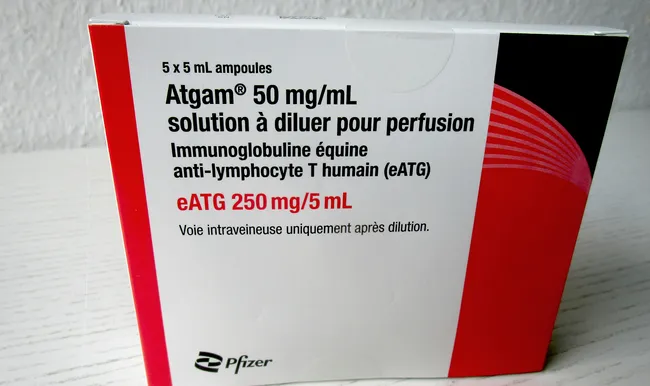
Table of Contents
- Package leaflet: Information for the user
- 1. What Atgam is and what it is used for
- 2. Important information before using Atgam
- 3. How to use Atgam
- 4. Possible adverse reactions
- 5. How to store Atgam
- 6. Contents of the pack and other information
- Information intended exclusively for healthcare professionals:
Package leaflet: Information for the user
Atgam, 50 mg/ml, concentrate for solution for infusion
equine immunoglobulin against human T lymphocytes (eATG)
This medicinal product is subject to additional monitoring. This will allow rapid identification of new safety information. You can also help by reporting any suspected adverse reactions that occur after use of the medicine. For information on how to report adverse reactions – see section 4.
Please read all of this leaflet carefully before taking this medicine, because it contains important
information for you.
- Keep this leaflet. You may need to read it again.
- If you have any further questions, please ask your doctor, pharmacist or nurse.
- If you experience any adverse reactions after taking this medicine, including any not listed in this leaflet, tell your doctor, pharmacist or nurse. See section 4.
Leaflet contents
- What Atgam is and what it is used for
- Important information before taking Atgam
- How to take Atgam
- Possible side effects
- How to store Atgam
- Contents of the pack and other information
1. What Atgam is and what it is used for
Atgam is produced by injecting human thymus cells into horses. It contains immunoglobulins (antibodies) that bind to certain immune system cells and destroy them. It is used in the treatment of a condition called aplastic anaemia. Aplastic anaemia occurs when the body's immune system mistakenly attacks its own cells, resulting in the bone marrow failing to produce sufficient red blood cells, white blood cells and platelets. When used together with other medicines, Atgam helps the bone marrow to resume production of these blood cells. It may also help to avoid blood transfusions. Immunosuppressive medicines do not cure aplastic anaemia. However, they may relieve symptoms of the disease and reduce complications. These medicines are often used in patients who are not eligible for haematopoietic stem cell or bone marrow transplantation, or who are awaiting such a transplant. Atgam may be used in children aged 2 years and older, as well as in adults.
2. Important information before using Atgam
When not to use Atgam
- If the patient is allergic to the active substance (equine antihuman T-lymphocyte immunoglobulin) or to any of the other ingredients of this medicine (listed in section 6).
- If the patient is allergic to any other product containing equine gamma-globulin.
Warnings and precautions
Only a physician experienced in immunosuppressive therapy should administer Atgam treatment. The medical facility should have trained staff and access to necessary medical resources. Patients will be continuously monitored during treatment with Atgam.
Before starting Atgam, discuss this with your doctor or nurse.
- If the patient suspects an infection or has symptoms suggesting infection, such as fever, sweating, chills, muscle pain, cough, shortness of breath, increased skin temperature or redness of the skin, skin pain or skin ulcers, diarrhea, or abdominal pain (or any other symptoms listed in section 4).
- If the patient needs to be vaccinated. The effectiveness of vaccines may be reduced if administered during treatment with Atgam. The doctor will determine the best time to administer the vaccine. Medicines derived from blood or plasma undergo specific measures to prevent transmission of infections to patients. These include:
- careful selection of blood and plasma donors to exclude individuals who may transmit infections;
- testing of each donation and plasma pool for signs of viruses/infections;
- implementation of virus inactivation or removal steps during the blood or plasma processing. Despite these measures, it cannot be completely excluded that infections may be transmitted by medicines prepared from blood or plasma. This also applies to unknown or newly emerging viruses and other types of infections. Particular caution is required during treatment with Atgam.
Immediately inform the doctor if the patient experiences any of the following severe and potentially life-threatening adverse reactions of Atgam (symptoms requiring immediate contact with a doctor are repeated in section 4):
- any severe infections, which may present with symptoms such as: fever, sweating, chills, muscle pain, cough, shortness of breath, increased skin temperature or red skin, skin pain or skin ulcers, diarrhea, or abdominal pain;
- allergic reactions, which may include: generalized rash, rapid heartbeat, breathing difficulties, decreased blood pressure, and weakness;
- serum sickness: an allergic reaction causing fever, joint pain, skin rash, and swollen lymph nodes;
- detachment of the epidermis (the top layer of skin) at any site on the body;
- fever, swelling, chills, rapid heartbeat, decreased blood pressure, and breathing difficulties. These symptoms may indicate an adverse reaction known as cytokine release syndrome.
Additional tests
Before starting Atgam treatment, during treatment, and after its completion, the doctor will order blood tests to determine whether the patient has reduced numbers of white blood cells, red blood cells, or platelets. If serious abnormalities in blood cell counts occur, treatment with Atgam may be discontinued.
To assess the risk of severe allergic reactions, skin tests may be performed before starting treatment. The results of these tests will help determine whether the patient is allergic to any component of Atgam. These results will assist the doctor in deciding whether Atgam can be administered.
Patients with aplastic anemia receiving Atgam may experience abnormalities in liver and kidney function tests.
Atgam and other medicines
Inform the doctor about all medicines the patient is currently taking or has recently taken, as well as any medicines the patient plans to take.
When the dose of corticosteroids and other immunosuppressive drugs is reduced, previously masked reactions to Atgam may occur. Patients will be closely monitored during Atgam infusion for such reactions.
Pregnancy and breastfeeding
Pregnancy
If the patient suspects she may be pregnant, she should inform her doctor.
It is not known whether Atgam affects the unborn child. Therefore, use of Atgam during pregnancy is not recommended.
If the patient becomes pregnant while receiving this medicine, she should immediately inform her doctor.
Women of childbearing potential must use effective contraception during treatment with Atgam and for up to 10 weeks after receiving the last dose. For information on appropriate contraceptive methods, consult the doctor.
Breastfeeding
If the patient is breastfeeding or planning to breastfeed, she should inform her doctor.
It is not known whether Atgam passes into human milk. Risk to breastfed infants cannot be excluded.
A decision must be made whether to discontinue breastfeeding or to discontinue Atgam therapy.
Driving and operating machinery
Atgam may affect the ability to drive and operate machinery. Caution should be exercised when driving or operating machinery during treatment with this medicine.
Atgam contains sodium
This medicine contains less than 1 mmol of sodium (23 mg) per total dose, meaning the medicine is considered "sodium-free." However, it may be prepared for administration with a solution containing sodium. Inform the doctor if the patient is on a low-salt (low-sodium) diet.
3. How to use Atgam
Atgam will be administered as an intravenous infusion by a doctor or a member of medical professional staff.
For further information, consult your doctor or pharmacist.
Detailed instructions for the preparation and infusion of Atgam are provided at the end of this leaflet.
This information is intended for medical professionals.
Dosing recommendations are based on body weight (BW).
The recommended total dose is 160 mg/kg body weight, as part of additional immunosuppressive therapy.
Patients may receive Atgam according to the following regimens:
- 16 mg/kg BW/day for 10 days, or
- 20 mg/kg BW/day for 8 days, or
- 40 mg/kg BW/day for 4 days.
Prior to administration of Atgam, patients may be given other medications (including corticosteroids and antihistamines) to prevent potential infusion-related adverse reactions.
Patients may also receive medication to reduce fever.
Accidental overdose of Atgam
Since Atgam will be administered by a doctor or nurse, it is highly unlikely that an overdose will occur. If you suspect that you have received more Atgam than prescribed, inform your doctor or nurse immediately.
If you have any further questions about the use of this medicine, consult your doctor or nurse.
Missed dose of Atgam
Since Atgam will be administered by a doctor or nurse, it is highly unlikely that a dose will be missed. If you suspect that Atgam has not been administered at the appropriate time, inform your doctor or nurse immediately.
If you have any further questions about the use of this medicine, consult your doctor or nurse.
4. Possible adverse reactions
Like all medicines, this medicine can cause adverse reactions, although not everyone will experience them.
You must tell the doctor immediately if the patient experiences any of the following
severe and potentially life-threatening adverse reactions of Atgam (symptoms requiring
immediate contact with a doctor are repeated in section 2 above):
- severe infections (very common), which may present with: fever, sweating, chills, muscle pain, cough, shortness of breath, warm or red skin, skin pain, skin ulcers, diarrhoea or abdominal pain;
- allergic reactions (not very common), which may present with: generalized rash, rapid heartbeat, difficulty breathing, low blood pressure and weakness;
- serum sickness (very common): an allergic reaction causing fever, joint pain, skin rash and swollen lymph nodes;
- detachment of the epidermis (the upper layer of skin) at any site on the body (frequency not known).
Other adverse reactions
Very common (may occur in more than 1 in 10 people)
- low white blood cell count
- skin rashes, skin redness, itching, skin irritation
- pain, including joint, back, chest, muscle, hand and foot pain, flank pain
- fever, chills, headache
- infections (bacterial and viral)
- increased or decreased blood pressure
- diarrhoea, abdominal pain, nausea, vomiting
- swelling of hands or feet
- abnormal liver function test results
Common (may occur in up to 1 in 10 people)
- haemolysis (breakdown of red blood cells)
- enlarged or swollen lymph nodes
- dizziness, fainting, malaise
- seizures
- tingling or numbness of the arms or legs
- rapid or slow heartbeat
- swelling and pain in a body part due to local blood clot in a vein
- shortness of breath or difficulty breathing, temporary cessation of breathing
- urticaria (hives)
- nosebleeds
- cough
- fluid accumulation in the lungs
- bleeding from the stomach or intestines
- mouth ulcers, mouth swelling, mouth pain
- increased blood glucose levels
- kidney dysfunction, kidney failure
Uncommon (may occur in up to 1 in 100 people)
- restlessness
- redness, swelling, pain at the infusion site
- swelling around the eyes
- low platelet count
Frequency not known (frequency cannot be estimated from the available data)
- painful swelling of the brain, painful swelling of blood vessels
- difficulty moving, muscle stiffness
- confusion, tremor
- heart failure
- blood clots in intestinal blood vessels, intestinal perforation
- throat spasm, hiccups
- excessive sweating, night sweats
- wound dehiscence (separation of wound edges)
- lack of cell development
- loss of strength or energy
Reporting of adverse reactions
If any adverse reactions occur, including any adverse reactions not listed
in this leaflet, tell the doctor, pharmacist or nurse. Adverse reactions
can be reported directly to the Department of Monitoring Adverse Drug Reactions of the Office for Registration of Medicinal Products, Medical Devices and Biocidal Products
Al. Jerozolimskie 181C
02-222 Warsaw
Tel.: + 48 22 49 21 301
Fax: + 48 22 49 21 309
Website: https://smz.ezdrowie.gov.pl
Adverse reactions can also be reported to the marketing authorization holder or the representative of the marketing authorization holder.
Reporting adverse reactions helps to provide more information on the safety of this medicine.
5. How to store Atgam
The medicine should be kept out of the sight and reach of children.
The following information is intended for the doctor or nurse responsible for storage, preparation, and disposal of the medicine Atgam.
Do not use this medicine after the expiry date stated on the carton after "EXP". The expiry date refers to the last day of the stated month.
Store the vials in a refrigerator (2°C - 8°C). Do not freeze. Keep the vials in their outer packaging to protect from light.
The diluted solution may be stored at room temperature (20°C - 25°C). The solution should be used within 24 hours (including the infusion time).
From a microbiological point of view, opened vials or medicine stored in syringes should be used immediately, unless the method of opening/dilution excludes the risk of microbiological contamination. If the medicine is not used immediately, the user is responsible for the storage duration and conditions prior to use. Dilution should be performed under controlled and validated aseptic conditions.
6. Contents of the pack and other information
What Atgam contains
- The active substance is equine immunoglobulin against human T lymphocytes. Each vial of sterile concentrate contains 250 mg of equine immunoglobulin against human T lymphocytes.
- Other ingredients: glycine, water for injections, sodium hydroxide (for pH adjustment), and hydrochloric acid (for pH adjustment) (see section 2, "Atgam contains sodium").
What Atgam looks like and contents of the pack
Atgam is a clear to slightly opalescent, colourless to light pink or light brown, sterile aqueous solution. A small amount of granular or floccular sediment may form during storage.
Supplied in a cardboard box containing 5 vials, each containing 5 ml of sterile concentrate.
Marketing Authorisation Holder
Pfizer Europe MA EEIG
Boulevard de la Plaine 17
1050 Bruxelles
Belgium
Manufacturer
Pfizer Service Company BV
Hermeslaan 11
1932 Zaventem
Belgium
For further information about this medicine, please contact the representative of the Marketing Authorisation Holder.
Pfizer Polska Sp. z o.o.
tel. 22 335 61 00
This medicine is authorised for marketing in the European Economic Area countries and in the United Kingdom (Northern Ireland) under the following names:
Austria, Belgium, Denmark, Finland, France, Germany, Ireland, Latvia, Atgam
Luxembourg, Netherlands, Norway, Poland, Romania, Slovenia, Sweden, United Kingdom (Northern Ireland)
Italy Equingam
Further information
Detailed information on this medicine is available at the website: http://www.urpl.gov.pl/
Information intended exclusively for healthcare professionals:
Preparation of the infusion solution
Since Atgam is an immunoglobulin, both the concentrate and the diluted solution should be inspected visually for the presence of particulate matter and discoloration prior to administration, as allowed by the solution and container. The concentrate and diluted solution are clear to slightly opalescent, colorless to pale pink or light brown; a small amount of granular or floccular precipitate may form during storage.
The Atgam medicinal product (both diluted and undiluted) must not be shaken, as this may cause excessive foaming and/or protein denaturation. Prior to infusion, the concentrate of Atgam medicinal product should be diluted by inverting the container with sterile diluent in such a way that the undiluted Atgam solution does not come into contact with air inside the container.
Add the total daily dose of Atgam medicinal product to an inverted vial or bag containing one of the following sterile diluents:
- 0.9% sodium chloride solution
- glucose solution / sodium chloride solution
- 50 mg/ml (5%) glucose in 0.45% (4.5 mg/ml) sodium chloride solution
- 50 mg/ml (5%) glucose in 0.225% (2.25 mg/ml) sodium chloride solution.
Dilution with glucose solution alone is not recommended due to the risk of precipitation of the Atgam medicinal product.
The recommended concentration of the diluted Atgam medicinal product solution is 1 mg/ml in the selected diluent. The concentration of Atgam medicinal product should not exceed 4 mg/ml.
After dilution, the solution should be mixed thoroughly by gentle rotational inversion or gentle swirling.
The diluted Atgam solution is intended for intravenous administration only.
Prior to starting the infusion, the diluted Atgam solution should reach room temperature (20°C–25°C). Infusion volumes of 250 ml to 500 ml may be used. Atgam should be administered into a large central vein through an in-line filter (0.2–1.0 micron).
An in-line filter (not supplied) should be used during each Atgam infusion to prevent the introduction of insoluble particles, which may have formed during storage, into the bloodstream.
It is recommended that the diluted solution be used immediately after preparation. If not used immediately, the diluted Atgam solution should be stored at room temperature (20°C–25°C). The total time from dilution to completion of use should not exceed 24 hours (including infusion time).
From a microbiological standpoint, unless the method of opening and dilution excludes the risk of microbiological contamination, this product should be used immediately.
Any unused portions or waste material of the medicinal product should be disposed of in accordance with local regulations.