Atenativ
Poland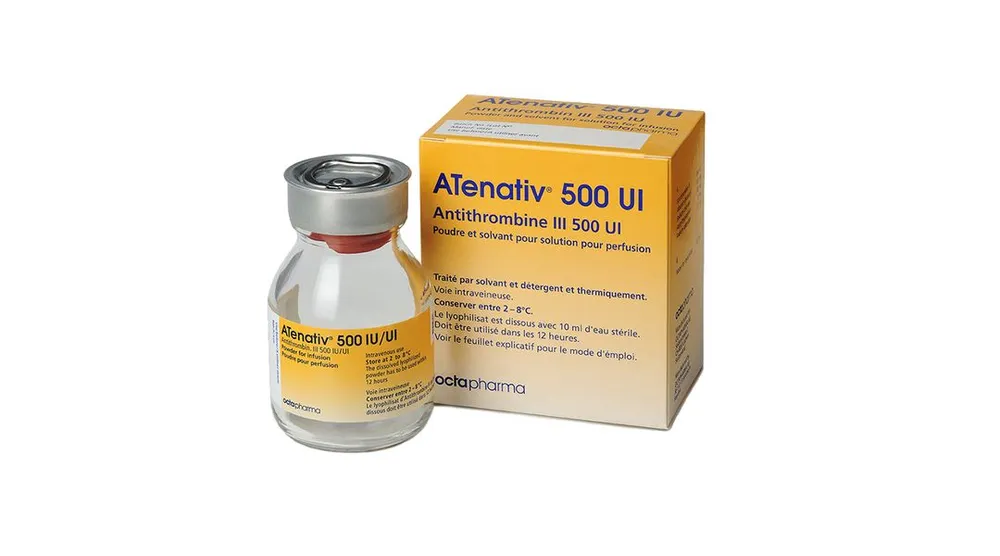
Table of Contents
Package leaflet: Information for the user
ATENATIV, 50 IU/ml, powder and solvent for solution for infusion
Human Antithrombin III
Please read all of this leaflet carefully before this medicine is administered, because it contains
important information for you.
- Keep this leaflet, as you may need to read it again.
- If you have any further questions, ask your doctor, pharmacist, or nurse.
- This medicine has been prescribed for you personally. Do not pass it on to others. It may harm other people, even if their symptoms are the same as yours.
- If you experience any side effects, including any not listed in this leaflet, tell your doctor, pharmacist, or nurse. See section 4.
Contents of the leaflet
- What Atenativ is and what it is used for
- What you need to know before using Atenativ
- How to use Atenativ
- Possible side effects
- How to store Atenativ
- Contents of the pack and other information
1. What Atenativ is and what it is used for
Atenativ is a so-called anticoagulant (blood-thinning) medicine which contains antithrombin isolated from human plasma. Antithrombin is a normal component of human plasma and an important inhibitor of blood coagulation.
Atenativ is used in the treatment of congenital antithrombin deficiency, particularly to prevent the formation and progression of deep vein thrombosis and embolism in clinical risk situations (e.g. during surgery or childbirth) in adults. Atenativ is also used in the treatment of acquired antithrombin deficiency.
2. Information before using Atenativ
When not to use Atenativ
- if the patient is allergic to human antithrombin III or to any of the other ingredients of this medicine (listed in section 6).
Warnings and precautions
Discuss any existing medical conditions with your doctor.
Before starting treatment with Atenativ, you should discuss this with your doctor.
Virological safety
For medicines derived from human blood or plasma, measures are taken to prevent transmission of infectious diseases. These measures include careful selection of blood and plasma donors to exclude carriers of infectious diseases, testing each donated blood unit and plasma pool for the presence of virus/infection, and applying virus inactivation or removal procedures during the processing of blood or plasma. Despite these measures, when administering medicines derived from human blood or plasma, the risk of transmitting infectious diseases cannot be completely excluded. This also applies to any unknown or emerging viruses or other types of infections.
The measures taken help prevent transmission of enveloped viruses, such as human immunodeficiency virus (HIV), hepatitis B virus, hepatitis C virus, and non-enveloped hepatitis A virus. However, these safety measures may have limited effectiveness against non-enveloped viruses such as parvovirus B19. Parvovirus B19 infection may be dangerous for pregnant women (fetal infection) and for individuals with immune disorders or certain types of anaemia (e.g. sickle cell anaemia or haemolytic anaemia).
It is strongly recommended that the name and batch number of Atenativ be recorded each time the medicine is administered, in order to maintain traceability of the batches used.
For patients receiving repeated or regular treatment with antithrombin products derived from human plasma, vaccination against hepatitis A and B is recommended.
Children and adolescents
There is no data available on the use of Atenativ in children.
Atenativ with other medicines
Tell your doctor or pharmacist about all medicines you are currently taking, have recently taken, or plan to take.
Treatment with Atenativ enhances the anticoagulant effect of heparin and may increase the risk of bleeding. In cases of increased bleeding risk, concomitant administration of heparin should be carefully considered. If your doctor decides that concomitant use of heparin is necessary, you should remain under strict laboratory monitoring.
Atenativ with food and drink
No effect observed.
Pregnancy and breastfeeding
If you are pregnant or breastfeeding, think you may be pregnant, or are planning to have a baby, you should consult your doctor or pharmacist before using this medicine.
Only limited data are available on the safety of using Atenativ during pregnancy or breastfeeding. Atenativ should be used during pregnancy and breastfeeding only if clearly necessary due to the increased risk of thromboembolic disorders in patients with congenital antithrombin deficiency.
Driving and using machines
No effect on the ability to drive or operate machinery has been observed. The patient should decide whether they are able to drive or perform tasks requiring high concentration.
Atenativ contains sodium.
This medicine contains 35 mg (Atenativ, 500 IU) or 71 mg (Atenativ, 1000 IU) of sodium (the main component of table salt) per vial. This corresponds to 1.8% or 3.6% of the recommended maximum daily intake of sodium for an adult.
3. How to use Atenativ
The decision on whether Atenativ treatment is necessary and the dosage are determined by a physician. Atenativ is administered by intravenous infusion by medical personnel. During treatment, the patient remains under required laboratory monitoring.
Use of a higher than recommended dose of Atenativ
Symptoms of Atenativ overdose have not been described.
Missed administration of Atenativ
The physician is responsible for overseeing drug administration, monitoring laboratory results, and maintaining them within normal ranges.
Discontinuation of Atenativ
The decision to discontinue Atenativ administration is made by the physician based on laboratory results and assessment of risk factors. If you have any further questions regarding the use of this medicine, consult your doctor, pharmacist, or nurse.
4. Possible adverse reactions
Like all medicines, this medicine can cause adverse reactions, although not everybody will experience them.
Administration of medicines derived from plasma may – although rarely – cause hypersensitivity reactions
(e.g. eye, facial or tongue swelling, burning and stinging sensation at the infusion site, skin inflammation,
fever, chills, urticaria (rash), nausea, vomiting, shortness of breath, headache, dizziness,
dyspnoea, wheezing, changes in blood pressure, rapid heartbeat, drowsiness, psychomotor agitation,
back pain, sweating, facial flushing, tingling, or even shock). In addition: anxiety, bleeding, abdominal pain, diarrhoea. (frequency not known)
If allergy or hypersensitivity reaction is suspected, manifested by the adverse reactions described above,
administration of the medicine should be stopped immediately. The physician should follow current
guidelines for the treatment of anaphylactic shock.
Reporting of adverse reactions
If any adverse reactions occur, including any adverse reactions not listed in this leaflet, inform your doctor,
pharmacist or nurse. Adverse reactions can be reported directly to the Department of Monitoring of Adverse Drug Reactions of the Office for Registration of Medicinal Products, Medical Devices and Biocidal Products
Al. Jerozolimskie 181C
02-222 Warsaw
Phone: +48 22 49 21 301
Fax: +48 22 49 21 309
Website: https://smz.ezdrowie.gov.pl
Adverse reactions can also be reported to the marketing authorization holder.
By reporting adverse reactions, additional information on the safety of this medicine can be collected.
5. How to store Atenativ
Keep this medicine out of sight and reach of children.
Store in a refrigerator (2 °C – 8 °C). Keep vials in the outer packaging to protect from light.
Do not use this medicine after the expiry date stated on the label and carton following: EXP.
The expiry date refers to the last day of the stated month.
During its shelf life, the product may be stored at room temperature (25°C) for one month, without returning it to the refrigerator during this period. If the product is not used within this time, it must be discarded.
After reconstitution, use the product as soon as possible. If the medicine is not used immediately after reconstitution, or within 12 hours if stored at 15–25 °C, the responsibility for storage time and conditions prior to administration lies with the user. If the reconstitution process was carried out under controlled aseptic conditions, the medicine may be stored at 2 to 8 °C for no longer than 24 hours. Any unused solution must be discarded.
Do not use Atenativ if the solution is cloudy or contains a precipitate.
Medicines must not be disposed of via wastewater or household waste. Ask your pharmacist how to dispose of medicines no longer required. Such practices help protect the environment.
6. Contents of the package and other information
What Atenativ contains
- The active substance is antithrombin III (human) (50 IU/ml).
- Other components are:
Powder: sodium chloride, human albumin, N-acetyltryphtophan and caprylic acid.
Solvent: water for injections.
What Atenativ looks like and contents of the pack
Powder and solvent for solution for infusion.
Atenativ is presented as a lyophilisate in the form of a white or almost white, hygroscopic, brittle mass or powder. The solvent used to reconstitute the lyophilized powder is water for injections, which is a clear, colourless liquid.
The powder is contained in a vial (Type II glass) with a stopper (bromobutyl rubber), and the solvent in a vial (Type I glass) with a stopper (bromobutyl rubber).
Atenativ, 500 IU: 1 vial of powder (500 IU) and 1 vial of water for injections (10 ml)
Atenativ, 1000 IU: 1 vial of powder (1000 IU) and 1 vial of water for injections (20 ml)
Marketing Authorisation Holder
Octapharma (IP) SPRL
Route de Lennik 451
1070 Anderlecht
Belgium
Manufacturer
Octapharma AB
Lars Forssells gata 23
SE-112 75 Stockholm
Sweden
This medicinal product is authorised in the Member States of the European Economic Area under the following names:
Austria, Croatia, Czech Republic, Denmark, Estonia, Finland, France, Germany, Hungary, Italy, Latvia, Lithuania, Spain, the Netherlands, Norway, Poland, Portugal, Romania, Slovakia, Slovenia, Spain, Sweden: Atenativ
Information intended exclusively for healthcare professionals:
Antithrombin should be administered only under the supervision of a physician specialised in coagulation disorders.
Dosage
In congenital deficiency, the dose should be individually determined for each patient, taking into account family history of thromboembolic events, current clinical risk factors, and laboratory test results.
The dosage and duration of replacement therapy in acquired deficiency depend on the plasma antithrombin level, signs of increased consumption, presence of underlying disease, and the patient's clinical condition. The dose and frequency of administration must always be adjusted according to clinical efficacy and laboratory test results in individual cases.
The number of antithrombin units administered is expressed in International Units (IU), corresponding to the current WHO standard for antithrombin. Plasma antithrombin activity is expressed as a percentage (relative to normal human plasma) or in International Units (referring to the international standard for antithrombin in plasma). One International Unit (IU) of antithrombin activity is equivalent to the amount of antithrombin present in one ml of normal human plasma. The required antithrombin dose is calculated based on the observation that 1 International Unit (IU) of antithrombin per kilogram of body weight increases plasma antithrombin activity by approximately 1% (correction factor).
The initial dose is calculated using the following formula:
Required number of units = body weight (kg) x (target concentration – actual antithrombin activity [%])
The target initial antithrombin activity depends on the clinical situation. When antithrombin replacement is indicated, the dose should be sufficient to achieve and maintain the target antithrombin activity at an effective concentration. The dose should be determined and monitored based on laboratory measurements of antithrombin activity, which should be performed at least twice daily until the patient is stabilised, and thereafter once daily, preferably immediately before the next infusion. Dose adjustments should take into account both signs of increased antithrombin consumption, as indicated by laboratory results and clinical course.
During treatment, antithrombin activity should be maintained above 80%, unless clinical circumstances suggest that another effective concentration is appropriate.
Typically, the initial dose in congenital deficiency is 30–50 IU/kg body weight. Subsequently, dosage, frequency, and duration of treatment should be adjusted according to biological data and clinical status.
Instructions for administration
The product must be administered intravenously.
The infusion rate in adult patients should not exceed 300 IU/min.
The lyophilized powder must be reconstituted with sterile water for injections.
After reconstitution, Atenativ may be mixed with isotonic sodium chloride solution (9 mg/ml) and isotonic glucose solution (50 mg/ml) in glass infusion bottles or plastic infusion containers.
Do not use Atenativ after the expiry date stated on the packaging.
The solution is typically clear or slightly opalescent. Do not use turbid solutions or solutions with precipitate.
Reconstitution time is up to 5 minutes. After preparation, the solution should be used as soon as possible and no later than within 12 hours if stored at 15–25°C. Unused solution must be discarded.
Any unused medicinal product or waste material should be disposed of in accordance with local regulations.