Atecortin
Poland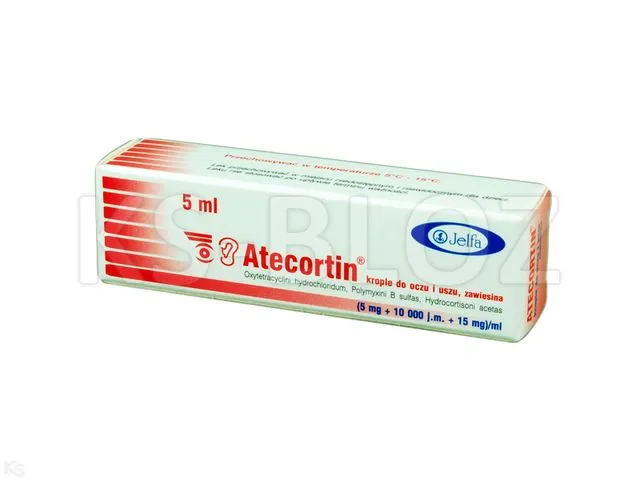
Table of Contents
Package leaflet: Information for the patient
ATECORTIN, (5 mg + 10,000 IU + 15 mg)/ml, eye and ear drops, suspension
(Oxytetracyclinum + Polymyxini B sulfas + Hydrocortisoni acetas)
Please read all of this leaflet carefully before using this medicine, because it contains important information for the patient.
- Keep this leaflet, as you may need to read it again.
- If you have any questions, please consult your doctor, pharmacist, or nurse.
- This medicine has been prescribed for a specific individual. Do not pass it on to others. It may harm someone else, even if their symptoms are the same.
- If you experience any adverse effects, including any not listed in this leaflet, inform your doctor, pharmacist, or nurse. See section 4.
Contents of the leaflet:
- What Atecortin is and what it is used for
- Important information before using Atecortin
- How to use Atecortin
- Possible side effects
- How to store Atecortin
- Contents of the pack and other information
1. What Atecortin is and what it is used for
Atecortin is a three-component medicinal product intended for local use in ophthalmology and otolaryngology.
Oxytetracycline is a tetracycline-group antibiotic. It acts bacteriostatically against both Gram-positive and Gram-negative bacteria.
Polymyxin B is a polypeptide antibiotic. It acts bactericidally, primarily against Gram-negative microorganisms, except for the genus Proteus. It is ineffective against staphylococci and streptococci.
Hydrocortisone acetate is a glucocorticosteroid with weak anti-inflammatory, antiallergic, and anti-exudative activity.
The effect of Atecortin results from the combined action of its components.
Indications for use
In ophthalmology:
- Bacterial conjunctivitis and blepharitis, dacryocystitis, keratitis;
- After surgical procedures on the eyeball (after complete wound healing, i.e., approximately 8 to 10 days post-operation).
In otology:
- Otitis externa.
2. Important information before using Atecortin
When not to use Atecortin:
- if the patient is allergic to the active substances or to any of the other ingredients of this medicine (listed in section 6);
- if the patient has fungal conjunctivitis, viral diseases (such as herpes, chickenpox, viral retinitis or keratitis);
- in primary glaucoma;
- in tuberculosis of the eye.
Warnings and precautions
Before starting to use Atecortin, discuss this with your doctor or pharmacist.
Before using this medicine, tell your doctor if the patient currently or in the past:
- had a perforated eardrum. The patient should consult a doctor if hearing disturbances or balance problems occur.
If the patient experiences blurred vision or other visual disturbances, contact a doctor.
The medicine should be used under the supervision of an ophthalmologist or an ENT specialist and must not be used for conditions other than those indicated by the doctor.
The medicine should be used for about 7 days, unless otherwise directed by a doctor.
Do not use in the absence of inflammation; do not instill into ears with perforated eardrum.
Children and adolescents
Atecortin should be used in children only when absolutely necessary.
Atecortin and other medicines
Tell your doctor about all medicines the patient is currently taking or has recently taken, including those obtained without a prescription, as well as any medicines the patient plans to take.
Some medicines may enhance the effect of Atecortin, and the doctor may wish to closely monitor the patient taking such medicines (including certain HIV medications: ritonavir, cobicistat).
No interactions with other medicines have been reported when using this formulation of the medicine.
However, if other eye drops are also being used, an interval of about 5–10 minutes should be maintained between administrations.
Pregnancy, breastfeeding and fertility
If the patient is pregnant or breastfeeding, suspects she may be pregnant, or is planning to become pregnant, she should consult a doctor or pharmacist before using this medicine.
Pregnancy
Use of this medicine during pregnancy is allowed only if absolutely necessary and if the use of a safer alternative medicine is impossible or contraindicated.
Use during pregnancy must be strictly under the supervision of a specialist doctor.
Breastfeeding
Use of this medicine is not recommended during breastfeeding.
Driving and operating machinery
Atecortin has no influence on the ability to drive or operate machinery. However, bear in mind that transient visual disturbances may occur immediately after administration.
3. How to use Atecortin
This medicine should always be used exactly as directed by the physician. If in doubt, consult your
doctor or pharmacist.
Recommended dose
In ophthalmology
Instill 1 to 2 drops into the conjunctival sac, 2 to 3 times daily.
The medicine should be used for approximately 7 days, unless otherwise directed by the physician.
In otology
Instill 2 to 4 drops into the ear, 3 times daily. The medicine should be used for approximately 7 days, unless
otherwise directed by the physician.
The suspension should be gently shaken before use.
Do not let the tube tip touch the eye, ear, or surrounding areas. This may contaminate the
solution with bacteria, which could lead to infection and potentially cause serious eye damage
or even vision loss. To prevent contamination of the suspension, avoid contact between the
tube tip and any surface.
How to administer the eye drops:
-
Wash your hands before instilling the drops.
-
Unscrew the cap of the tube.
-
Ensure that the tube tip does not touch anything.
-
Hold the tube between your thumb and index finger.
-
Tilt your head backward and, using the index finger of the other hand, gently pull down the lower eyelid.
-
Bring the dropper tip close to the eye—without touching the eye surface or eyelids—and gently squeeze the tube to instill one drop of the suspension into the eye.
-
Then close the eyelids and gently press with the index finger on the inner corner of the eye for 1 minute.
-
If the physician has prescribed drops for the other eye, repeat steps 4 to 7.
-
After use, replace the cap on the tube.
How to administer the ear drops:
- Unscrew the cap of the tube.
- Lie on your side so that the ear to be treated is uppermost.
- Instill the drops into the ear canal and remain lying down for approximately 15 minutes.
- If the physician has prescribed drops for the other ear, repeat steps 2 and 3.
- After use, replace the cap on the tube.
Use the medicine exactly as directed by the physician. Do not extend the duration of treatment beyond
that prescribed by the physician. Prolonged use of the medicine beyond approximately 7 days is not recommended.
If you miss a dose of Atecortin
Do not use a double dose to make up for a missed dose.
If you have any further questions about the use of this medicine, consult your doctor, pharmacist, or nurse.
4. Possible adverse reactions
Like all medicines, this medicine can cause adverse reactions, although not everyone experiences them.
If the patient experiences allergic reactions, including urticaria, facial swelling, swelling of the lips, tongue
and (or) throat, which may cause difficulty in breathing or swallowing, discontinue use of Atecortin immediately
and contact a doctor immediately.
Adverse reactions may occur with the following frequencies:
very common: more than 1 in 10 people
common: 1 to 10 in 100 people
uncommon: 1 to 10 in 1,000 people
rare: 1 to 10 in 10,000 people
very rare: less than 1 in 10,000 people
frequency not known: frequency cannot be estimated from available data
Eye disorders:
rare - allergic reactions (redness, itching);
frequency not known - conjunctival irritation, burning and itching around the eye after administration, blurred vision.
Prolonged use (more than 3 to 6 weeks) may lead to secondary fungal infection, increased intraocular pressure, and may result in the development of steroid-induced cataract.
Ear and labyrinth disorders:
frequency not known - hearing disturbances (hearing loss, deafness, tinnitus) or dizziness caused by blockage of the ear canal (see section 2 "Warnings and precautions").
Reporting of adverse reactions
If any adverse effects occur, including any adverse effects not listed in this leaflet, inform your doctor, pharmacist, or nurse. Adverse reactions can be reported directly to the Department of Monitoring of Adverse Drug Reactions of the Office for Registration of Medicinal Products, Medical Devices and Biocidal Products: Al. Jerozolimskie 181C, 02-222 Warsaw, phone: +48 22 49-21-301, fax: +48 22 49-21-309,
Website: https://smz.ezdrowie.gov.pl
Adverse reactions can also be reported to the marketing authorization holder.
Reporting adverse reactions helps to provide more information on the safety of the medicine.
5. How to store Atecortin
Keep this medicine out of sight and reach of children.
Store below 25°C. Do not freeze.
Expiry date:
28 days after first opening.
Do not use this medicine after the expiry date stated on the tube. The expiry date refers to the last day of the stated month.
After each use, the tube should be closed carefully.
Medicines must not be disposed of via wastewater or household waste. Ask your pharmacist how to dispose of medicines you no longer use. This will help protect the environment.
6. Contents of the pack and other information
What Atecortin contains
- The active substances are oxytetracycline (in the form of oxytetracycline hydrochloride), polymyxin B sulfate, and hydrocortisone acetate.
1 ml of suspension contains:
oxytetracycline as oxytetracycline hydrochloride 5 mg
polymyxin B sulfate 10,000 i.u.
hydrocortisone acetate 15 mg - Other ingredients are: aluminium distearate, liquid paraffin.
What Atecortin looks like and contents of the pack
Atecortin is a yellow, oily suspension.
Aluminium tube, internally lacquered, with HDPE cannula, protected with a cap made of 90% HDPE + 10% LDPE, in a cardboard box.
5 ml
Marketing Authorisation Holder
BAUSCH + LOMB IRELAND LIMITED
3013 Lake Drive
Citywest Business Campus
Dublin 24, D24PPT3
Ireland
Manufacturer:
Przedsiębiorstwo Farmaceutyczne Jelfa SA
58-500 Jelenia Góra, ul. Wincentego Pola 21