Atarax
Poland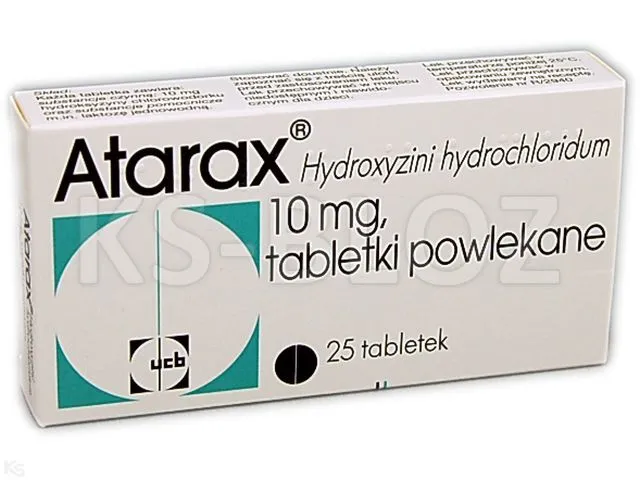
Table of Contents
Patient Information Leaflet
Caution! Please retain the leaflet. Information on the immediate packaging is in a foreign language.
Atarax, 25 mg, coated tablets
Hydroxyzini hydrochloridum
Please read this leaflet carefully before using the medicine, as it contains
important information for the patient.
- Keep this leaflet for future reference.
- If you have any questions, consult your doctor or pharmacist.
- This medicine has been prescribed for a specific individual. Do not pass it on to others. It may harm other people, even if their symptoms are the same.
- If you experience any adverse reactions, including any not listed in this leaflet, inform your doctor, pharmacist, or nurse. See section 4.
Table of Contents
- What Atarax is and what it is used for
- Important information before taking Atarax
- How to take Atarax
- Possible side effects
- How to store Atarax
- Contents of the pack and other information
1. What Atarax is and what it is used for
Atarax is an antihistamine medicine with sedative and anxiolytic properties.
Atarax is indicated for:
- symptomatic treatment of anxiety in adults,
- symptomatic treatment of pruritus (itching),
- premedication before surgical procedures.
2. Important information before using Atarax
When not to use Atarax
- if the patient is allergic to the active substance or to any of the other ingredients of Atarax,
- if the patient is allergic to cetirizine, other piperazine derivatives, aminophylline, or ethylenediamine,
- if the patient has porphyria,
- if the patient's ECG (electrocardiogram) shows a heart rhythm disorder known as "QT interval prolongation",
- if the patient has or has had cardiovascular disease or if the heart rate is very low,
- if the patient has low levels of electrolytes (e.g. low potassium or magnesium levels),
- if the patient is taking certain medicines used to treat heart rhythm disorders or medicines that may affect heart rhythm (see "Atarax with other medicines"),
- if someone in the patient's family has died suddenly due to heart disease,
- during pregnancy and while breastfeeding.
Warnings and precautions
Before starting treatment with Atarax, discuss the following with your doctor:
- if the patient has an increased tendency to seizures (seizures have been reported more frequently in children than in adults),
- if the patient has glaucoma, difficulty in urination due to obstruction of the bladder, reduced gastrointestinal motility, myasthenia gravis (a disease characterized by muscle weakness and fatigue of skeletal muscles after repeated effort; initial symptoms include drooping eyelids, double vision, nasal voice, difficulty chewing and swallowing, difficulty raising upper limbs and walking; rarely, respiratory muscle weakness may occur), or dementia,
- if Atarax is used concomitantly with other medicines that depress the central nervous system or with medicines having anticholinergic properties (in such patients, dose adjustment may be necessary).
Use of Atarax may be associated with an increased risk of life-threatening heart rhythm disturbances. Therefore, inform your doctor about any heart-related problems and about all other medicines you are taking, including those available without a prescription.
If heart-related symptoms such as rapid heartbeat (palpitations), breathing difficulties, or loss of consciousness occur during treatment with Atarax, seek medical advice immediately.
Treatment with hydroxyzine should also be discontinued.
Treatment should be discontinued at least 5 days before undergoing allergy tests or methacholine bronchial provocation tests to avoid interference with test results.
Atarax with other medicines
Inform your doctor about all medicines currently or recently taken, as well as any medicines you plan to take. Atarax may affect the action of other medicines, and other medicines may affect the action of Atarax.
This applies to the following medicines:
- medicines that depress the central nervous system or medicines with anticholinergic effects,
- alcohol and alcohol dehydrogenase inhibitors,
- betahistine and cholinesterase inhibitors,
- monoamine oxidase inhibitors (medicines used, among others, in depression),
- adrenaline,
- medicines that may cause heart rhythm disturbances.
Do not take Atarax if the patient is taking medicines used to treat:
- bacterial infections (e.g. antibiotics such as erythromycin, moxifloxacin, levofloxacin),
- fungal infections (e.g. pentamidine),
- heart diseases or high blood pressure (e.g. amiodarone, quinidine, disopyramide, sotalol),
- psychosis (e.g. haloperidol),
- depression (e.g. citalopram, escitalopram),
- gastrointestinal disorders (e.g. prucalopride),
- allergies,
- malaria (e.g. mefloquine, hydroxychloroquine),
- cancer (e.g. toremifene, vandetanib),
- drug dependence or severe pain (methadone).
Taking Atarax with alcohol
Concomitant use of Atarax and alcohol should be avoided.
Pregnancy, breastfeeding and effects on fertility
Atarax must not be used during pregnancy or while breastfeeding. Breastfeeding must be discontinued if treatment with Atarax is necessary.
In newborns whose mothers received hydroxyzine during late pregnancy and/or during delivery, the following symptoms may occur shortly after birth or within a few hours: tremors, muscle stiffness and/or weakness, breathing difficulties, and urinary retention.
Women of childbearing potential must use an appropriate method of contraception to prevent pregnancy during treatment with hydroxyzine.
Animal studies have not shown any adverse effects on fertility. Data on effects on human fertility are not available.
Driving and using machines
Patients should not drive, operate machinery, or use tools while taking Atarax, as the medicine may impair reaction ability and concentration.
Atarax contains lactose
Atarax tablets contain lactose. If the patient has been previously diagnosed with intolerance to certain sugars, the patient should consult a doctor before taking this medicine.
3. How to take Atarax
This medicine should always be taken exactly as prescribed by your doctor. If in doubt, consult your
doctor or pharmacist.
Atarax is available in the following strengths: 10 mg, 25 mg.
Atarax should be used at the lowest effective dose. The duration of treatment should be as short as
possible.
In adults and children with body weight above 40 kg, the maximum daily dose is 100 mg.
The following are the usual recommended doses of Atarax:
Adults
For symptomatic treatment of anxiety
50 mg/day in 2–3 divided doses.
In severe cases, oral doses up to 100 mg/day may be used.
For symptomatic treatment of pruritus (itching)
Treatment should be initiated with 25 mg at bedtime, and continued with dose increases as needed,
administering 25 mg 3 to 4 times daily.
For premedication before surgical procedures
50 mg given in two doses or 100 mg as a single oral dose.
Use in children (from 12 months of age) and adolescents
In children and adolescents with body weight up to 40 kg, the maximum daily dose is 2 mg/kg body weight.
In children and adolescents with body weight above 40 kg, the maximum daily dose is 100 mg.
For symptomatic treatment of pruritus
1 mg/kg to 2 mg/kg body weight per day in divided doses.
For premedication before surgical procedures
0.6 mg/kg body weight as a single oral dose.
The total daily dose should not exceed 2 mg/kg body weight per day.
Dosage adjustment
Dosage should be individually adjusted within the recommended dose range, depending on the
patient's response to treatment.
Elderly patients
Use of hydroxyzine in elderly patients is not recommended. If treatment is initiated, it is recommended
to start with half the recommended dose.
In elderly patients, the maximum daily dose is 50 mg.
Patients with renal impairment
In patients with moderate or severe renal impairment, due to reduced elimination of the drug's
metabolite, cetirizine, the administered doses should be reduced.
Patients with hepatic impairment
In patients with hepatic impairment, the daily dose should be reduced by 33%.
Use of a higher than recommended dose of Atarax
If a patient has taken or used more Atarax than prescribed, contact emergency services immediately,
especially if this involves a child. In case of overdose, symptomatic treatment may be applied.
ECG monitoring is recommended due to the possibility of cardiac rhythm disturbances [including
bradycardia (very slow heart rate)], such as QT interval prolongation or torsade de pointes.
Symptoms of Atarax overdose include: nausea, vomiting, tachycardia (increased heart rate), fever,
drowsiness, disturbances of pupillary reflex, tremor, confusion or hallucinations, followed by decreased
level of consciousness, respiratory depression, seizures, hypotension or cardiac arrhythmias, and
progressive coma leading to circulatory and respiratory collapse.
There is no specific antidote.
Missed dose of Atarax
Do not take a double dose to make up for a missed dose.
Stopping Atarax
If you have any further questions about the use of this medicine, consult your doctor or pharmacist.
4. Possible adverse reactions
Like all medicines, this medicine can cause adverse reactions, although not everyone will experience them.
Very common: may affect more than 1 in 10 people
- drowsiness
Common: may affect up to 1 in 10 people
- dry mouth
- fatigue
- headache
- sedation
Uncommon: may affect up to 1 in 100 people
- nausea
- malaise, fever
- dizziness, insomnia, tremor
- restlessness, confusion
Rare: may affect up to 1 in 1,000 people
- tachycardia (increased heart rate)
- accommodation disorders, blurred vision
- constipation, vomiting
- hypersensitivity reactions
- abnormal liver function test results
- seizures, dyskinesia (involuntary, uncoordinated movements of limbs and other body parts), disorientation, hallucinations
- urinary retention
- itching, erythematous rash, maculopapular rash, urticaria, dermatitis
- hypotension
Very rare: may affect up to 1 in 10,000 people
- anaphylactic shock (caused by a severe systemic allergic reaction; symptoms include: shortness of breath, laryngeal and throat swelling, skin itching and redness, headache, feeling of "pressure", dizziness, significant weakness, up to loss of consciousness); in severe cases, it may be life-threatening
- bronchospasm
- angioedema (skin lesions presenting as irregular patches, blisters, and swelling), increased sweating, persistent drug eruption, acute generalized exanthematous pustulosis (pustular rash on red skin, possibly accompanied by swelling and general symptoms such as fever), erythema multiforme (skin rash which may lead to blister formation and resemble target lesions (a dark center surrounded by a lighter area and a dark ring around it)), Stevens-Johnson syndrome (widespread rash with blisters and skin peeling, primarily affecting areas around the mouth, eyes, nose, and genital organs)
Frequency not known: frequency cannot be estimated from the available data
- QT interval prolongation on electrocardiogram, torsade de pointes type cardiac arrhythmias
- hepatitis
- loss of consciousness (fainting)
- bullous skin lesions [e.g.: toxic epidermal necrolysis (widespread rash with blisters and skin peeling, primarily affecting areas around the mouth, eyes, nose, and genital organs), pemphigoid (an autoimmune skin disease characterized by well-tensed blisters occurring within erythematous-edematous lesions or on apparently normal skin)]
- weight gain
If the patient experiences cardiac arrhythmias such as rapid heartbeat (palpitations), breathing difficulties, or loss of consciousness, the medicine should be discontinued immediately and medical advice should be sought without delay.
Additionally, the following adverse reactions associated with cetirizine, the main metabolite of hydroxyzine, have been observed and may also occur following hydroxyzine administration: decreased platelet count, aggression, depression, tics, involuntary movements, tingling, compulsive eye rolling with ocular rotation, diarrhea, difficulty in urination, urinary incontinence, asthenia (weakness, fatigue), edema, weight gain.
Other adverse reactions may occur in some individuals during treatment with Atarax.
If any of the adverse effects worsen or if any adverse effects not listed in this leaflet occur, inform your doctor, pharmacist, or nurse.
Reporting of adverse reactions
If any adverse reactions occur, including any not listed in this leaflet, inform your doctor, pharmacist, or nurse. Adverse reactions can be reported directly to the Department of Monitoring of Adverse Drug Reactions at the Office for Registration of Medicinal Products, Medical Devices and Biocidal Products
Al. Jerozolimskie 181C
02-222 Warsaw
Phone: +48 22 49 21 301
Fax: +48 22 49 21 309
Website: https://smz.ezdrowie.gov.pl
Reporting adverse reactions helps to provide more information on the safety of the medicine.
5. How to store Atarax
No special temperature storage instructions are required. Store in the outer packaging to protect from light.
Keep the medicine in a place out of sight and reach of children.
Do not use this medicine after the expiry date stated on the packaging. The expiry date refers to the last day of the stated month.
Medicines should not be disposed of via wastewater or household waste. Ask your pharmacist how to dispose of medicines no longer required. This will help protect the environment.
6. Contents of the package and other information
What Atarax contains
- The active substance is hydroxyzine hydrochloride (hydroxyzine dihydrochloride).
- The other ingredients are: monohydrate lactose, microcrystalline cellulose, magnesium stearate, colloidal anhydrous silica.
Coating composition: titanium dioxide (E 171), hypromellose 2910 5cP, macrogol 400.
What Atarax looks like and contents of the pack
Atarax 25 mg film-coated tablets are white, elongated tablets with a score line on one side.
The pack contains 25 film-coated tablets.
For further information, please contact the Marketing Authorisation Holder or the Parallel Importer.
Marketing Authorisation Holder in Spain, country of export:
UCB Pharma, S.A.
Plaza de Manuel Gómez Moreno, s/n
Edificio Bronce, Planta 5
28020 Madrid, Spain
Manufacturer:
UCB S.A. Pharma Sector
Chemin du Foriest
B-1420 Braine l’Alleud
Belgium
Parallel Importer:
Delfarma Sp. z o.o.
ul. Św. Teresy od Dzieciątka Jezus 111
91-222 Łódź
Poland
Repackaged in:
Delfarma Sp. z o.o.
ul. Św. Teresy od Dzieciątka Jezus 111
91-222 Łódź
Poland
Marketing Authorisation Number in Spain, country of export: 757427.9
Parallel Import Licence Number: 88/21