Astmodil
Poland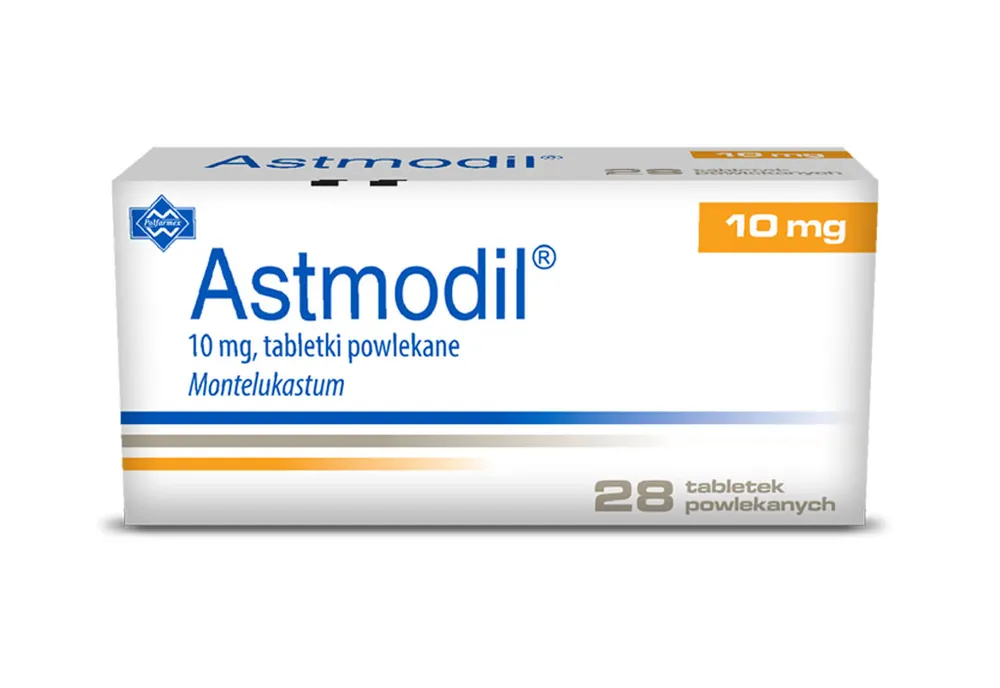
Table of Contents
Astmodil, 5 mg, chewable tablets
Montelukast
Read the entire package leaflet before taking this medicine.
- Keep this leaflet, as you may need to read it again.
- Consult your doctor or pharmacist if you have any further questions.
- This medicine has been prescribed for a specific individual. Do not give it to others. It may harm other people, even if their symptoms are similar.
- If any of the side effects worsen or if you notice any side effects not listed in this leaflet, inform your doctor or pharmacist immediately.
Package leaflet contents:
- What Astmodil is and what it is used for
- Important information before taking Astmodil
- How to take Astmodil
- Possible side effects
- How to store Astmodil
- Further information
1. WHAT ASTMODIL IS AND WHAT IT IS USED FOR
Astmodil contains the active substance montelukast. It works by blocking substances called leukotrienes. These substances cause swelling and narrowing of the airways, leading to asthma attacks.
By inhibiting the action of leukotrienes, Astmodil helps relieve asthma symptoms and control the condition.
Indications:
- Astmodil is indicated as add-on therapy for the treatment of mild to moderate persistent asthma in patients aged 6 to 14 years, in whom asthma control has not been achieved with previously used medications and additional treatment is required.
- Astmodil may also be used as an alternative to low-dose inhaled corticosteroids in patients aged 6 to 14 years with mild persistent asthma who have not recently experienced severe asthma attacks requiring oral corticosteroids and who are unable to use inhaled corticosteroids.
- Astmodil also helps prevent exercise-induced bronchoconstriction.
Your doctor will determine how to use Astmodil based on your child's symptoms and the severity of asthma.
Astmodil 5 mg is intended for use in children aged 6 to 14 years.
2. IMPORTANT INFORMATION BEFORE USING ASTMODIL
When not to use Astmodil
- If the patient is allergic (hypersensitive) to the active substance or to any of the other ingredients of Astmodil (see section 6: Other information).
When to exercise special caution with Astmodil
Inform the doctor about all diseases or allergic reactions currently present or experienced in the past by the child.
- If asthma symptoms worsen, consult a doctor immediately.
- Astmodil is not intended for the treatment of acute asthma attacks. If an attack occurs, use an inhaled medicine intended for asthma attacks or seek medical advice as soon as possible.
- It is important that the child takes all anti-asthma medicines prescribed by the doctor. Astmodil should not be used instead of other anti-asthma medicines prescribed for the child by a doctor.
- Do not take acetylsalicylic acid or anti-inflammatory medicines (so-called non-steroidal anti-inflammatory drugs - NSAIDs) if they worsen asthma symptoms in the patient.
- If symptoms such as fever, rash, weakness, malaise, tingling or numbness in hands or feet, or worsening of respiratory symptoms occur during treatment, contact a doctor immediately (see section 4: Possible side effects).
Patients should be informed that neuropsychiatric events (for example, changes in behavior and mood) have occurred in adults, adolescents, and children treated with Astmodil (see section 4). If such symptoms occur in a patient (including a child) during treatment with Astmodil, consult a doctor (or pediatrician).
Taking other medicines
Tell your doctor or pharmacist about all medicines currently taken or recently taken, including those obtained without a prescription.
Some medicines may affect the action of Astmodil or Astmodil may affect the action of other medicines.
Before starting treatment with Astmodil, inform the doctor if the patient is taking any of the following medicines:
- phenobarbital (a medicine used in epilepsy treatment),
- phenytoin (a medicine used in epilepsy treatment),
- rifampicin (an antibiotic used in the treatment of tuberculosis or certain other infections).
Taking Astmodil with food and drink
Astmodil should not be taken during meals; it should be taken 1 hour before or 2 hours after a meal.
Pregnancy and breastfeeding
Consult a doctor or pharmacist before taking any medicine.
Women who are pregnant or planning pregnancy, and women who are breastfeeding or intend to breastfeed, should consult their doctor before using Astmodil. The doctor will assess whether they may take Astmodil during this period.
Driving and operating machinery
If dizziness or drowsiness occurs, do not drive or operate machinery.
Important information about some ingredients of Astmodil
The medicine contains 0.625 mg of aspartame (E 951) per tablet. Aspartame is a source of phenylalanine.
It may be harmful for patients with phenylketonuria. This is a rare genetic disorder in which phenylalanine accumulates in the body due to improper excretion.
The medicine contains sodium. This medicine contains less than 1 mmol (23 mg) of sodium per tablet, meaning the medicine is considered "sodium-free".
Cherry K flavor, an ingredient of the medicine, contains:
- maltodextrin (a source of glucose) – if the patient has previously been diagnosed with intolerance to certain sugars, the patient should contact the doctor before taking the medicine;
- benzyl alcohol – the medicine contains 0.081 mg of benzyl alcohol per tablet. Benzyl alcohol may cause allergic reactions. Administration of benzyl alcohol to small children is associated with a risk of severe adverse reactions including respiratory disorders (so-called "gasping syndrome"). Pregnant or breastfeeding women and patients with liver or kidney disease should contact their doctor before using the medicine, as large amounts of benzyl alcohol may accumulate in their bodies and cause adverse effects (such as metabolic acidosis);
- ethanol – this medicine contains 0.041 mg of alcohol (ethanol) per tablet. The amount of alcohol in one tablet of this medicine is equivalent to less than 1 ml of beer or 1 ml of wine. The small amount of alcohol in this medicine will not cause noticeable effects;
- d-limonene.
3. HOW TO USE ASTMODIL MEDICINE
Astmodil medicine should be administered to a child under the supervision of an adult.
Astmodil should always be used in children according to the doctor's recommendations. In case of doubts,
contact a doctor or pharmacist.
Astmodil should be taken daily, even when asthma symptoms are not present, as well as during periods of worsening asthma symptoms.
The usual recommended dose is:
Children aged 6 to 14 years
1 chewable tablet of 5 mg once daily in the evening.
The medicine should be taken orally.
Astmodil should not be taken during meals; the medicine should be taken 1 hour before or 2 hours after a meal.
If a child is taking Astmodil, ensure that they are not also receiving other medicines containing the same active substance, montelukast.
Overdose of Astmodil
In case of overdose, contact a doctor immediately.
Symptoms of overdose may include: drowsiness, headache, excessive thirst, abdominal pain, vomiting, and increased motor hyperactivity.
Missed dose of Astmodil
If the patient forgets to take a dose of Astmodil but remembers within 12 hours of the usual time, they should take the tablet immediately and then take the next tablet at the regular time.
If the patient forgets for more than 12 hours, they should simply take the next dose at the regular time.
Do not take a double dose to make up for a missed dose.
Stopping treatment with Astmodil
Astmodil is effective in the treatment of asthma only when taken regularly.
Do not discontinue treatment without consulting a doctor. The decision to stop treatment should be made by a doctor.
In case of any further doubts regarding the use of this medicine, consult a doctor or pharmacist.
4. POSSIBLE ADVERSE REACTIONS
Like all medicines, Astmodil may cause adverse reactions, although not everyone experiences them.
Discontinue the medicine and contact your doctor immediately if any of the following adverse
reactions occur:
- allergic reactions (rash, swelling of the face, lips, tongue, and throat causing difficulty in breathing or swallowing),
- flu-like symptoms, fever, weakness, malaise, worsening of respiratory symptoms, wheezing, cough, shortness of breath, persistent cold, tingling or numbness in hands or feet, and (or) rash (Churg-Strauss syndrome). These adverse reactions are very rare.
Adverse reactions that are common (occur in 1 to 10 out of 100 people):
- headache,
- abdominal pain.
Adverse reactions that are very rare (may occur in fewer than 1 in 10,000 people):
- stuttering.
Other adverse reactions:
- upper respiratory tract infection,
- allergic reactions (rash, swelling of the face, lips, tongue, and throat causing difficulty in breathing or swallowing),
- increased tendency to bleed,
- sleep disorders, including nightmares, insomnia,
- sleepwalking,
- hallucinations (perceiving non-existent objects or people),
- irritability, anxiety, restlessness, especially motor restlessness, agitation, including aggressive behavior or hostility,
- tremor,
- depression,
- suicidal thoughts and behaviors (suicidal ideation),
- drowsiness, dizziness,
- tingling or numbness in hands and (or) feet,
- seizures,
- palpitations (irregular, rapid heartbeat),
- nosebleeds,
- dry mouth, dyspepsia (belching, heartburn, bloating, abdominal pain), nausea, vomiting, diarrhea,
- abnormal liver function tests (increased activity of liver enzymes AspAT and AlAT),
- hepatitis (including cholestatic, hepatocellular, and mixed etiology liver injury - yellowing of the skin and whites of the eyes, itching of the skin),
- joint pain, muscle pain, muscle cramps,
- sudden swelling of the face, limbs, or joints without angioedema,
- erythema nodosum (red, painful nodules on the lower legs),
- urticaria (pinkish, itchy wheals on the skin).
If any of the adverse reactions worsen or if any adverse reactions not listed in this leaflet occur, inform your doctor or pharmacist.
Reporting of adverse reactions
If any adverse reactions occur, including those not listed in this leaflet, inform your doctor, pharmacist, or nurse. Adverse reactions can be reported directly to the Department of Monitoring Adverse Drug Reactions of the Office for Registration of Medicinal Products, Medical Devices and Biocidal Products:
Al. Jerozolimskie 181C
02-222 Warsaw
Phone: +48 22 49 21 301
Fax: +48 22 49 21 309
Website: https://smz.ezdrowie.gov.pl
Adverse reactions can also be reported to the marketing authorization holder.
Reporting adverse reactions helps to provide more information on the safety of the medicine.
5. HOW TO STORE ASTMODIL
Keep out of the reach and sight of children.
Store below 25°C in the original packaging.
Do not use after the expiry date stated on the container. The expiry date refers to the last day of the specified month.
Shelf life after first opening the container: 30 days.
Medicines should not be disposed of via wastewater or household waste. Ask your pharmacist how to dispose of medicines no longer required. This will help protect the environment.
6. OTHER INFORMATION
What Astmodil contains
- The active substance is montelukast. Each 5 mg chewable tablet contains 5 mg of montelukast in the form of montelukast sodium.
- Other ingredients are: hydroxypropyl cellulose, microcrystalline cellulose, mannitol, sodium croscarmellose, aspartame (E 951), cherry flavour K (containing, among others, maltodextrin, potassium sorbate (E 202), benzyl alcohol, ethanol, gum arabic (E 414), d-limonene), magnesium stearate.
What Astmodil looks like and contents of the pack
Astmodil 5 mg is an uncoated tablet. The tablets are white to cream-coloured, round, biconvex, with the number "5" embossed on one side, free from spots and damage.
Pack contains 28 tablets.
Marketing Authorisation Holder and Manufacturer
Polfarmex S.A.
ul. Józefów 9
99-300 Kutno
Tel.: + 48 24 357 44 44
Fax: + 48 24 357 45 45
email: [email protected]