Astexana
Poland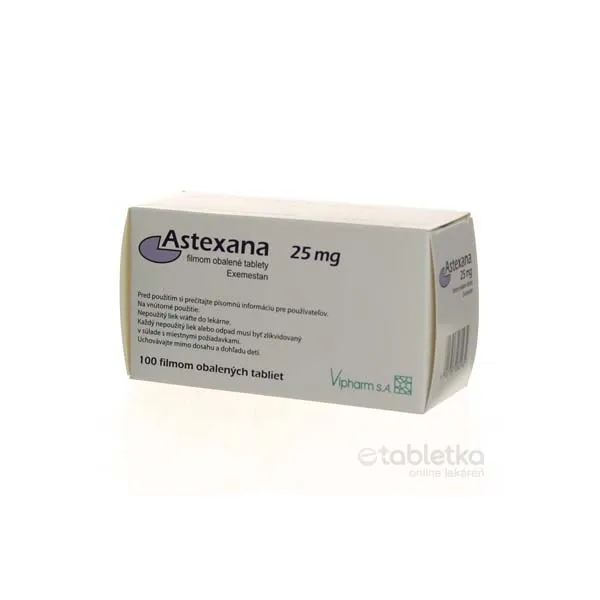
Table of Contents
Package leaflet: Information for the patient
Astexana, 25 mg, coated tablets
(Exemestanum)
Read the entire leaflet carefully before using the medicine, as it contains important information for the patient.
- Keep this leaflet for future reference.
- If in doubt, consult a doctor or pharmacist.
- This medicine has been prescribed for a specific individual. Do not share it with others. The medicine may harm another person, even if their symptoms are the same.
- If the patient experiences any adverse reactions, including any not listed in this leaflet, inform a doctor or pharmacist immediately. See section 4.
Table of contents:
- What Astexana is and what it is used for
- Important information before taking Astexana
- How to take Astexana
- Possible side effects
- How to store Astexana
- Contents of the pack and other information
1. What Astexana is and what it is used for
Astexana belongs to a group of medicines called aromatase inhibitors. These medicines act on a substance called aromatase, which is essential for the production of the female sex hormone estrogen, particularly in postmenopausal women. Reducing estrogen levels in the body is a method of treating hormone-dependent breast cancer.
Astexana is used in the treatment of early-stage hormone-dependent breast cancer in postmenopausal women, following completion of 2–3 years of tamoxifen therapy.
The medicine is also used in the treatment of advanced-stage hormone-dependent breast cancer in postmenopausal women in whom prior hormonal therapy has not been effective.
2. Important information before using Astexana
When not to use Astexana:
- if the patient has a known allergy (hypersensitivity) to exemestane (the active substance in Astexana) or to any of the other ingredients of Astexana (see section 6);
- in premenopausal women;
- in pregnant women, women who may be pregnant, or breastfeeding women.
Warnings and precautions
- before starting treatment with Astexana, the treating physician may recommend blood tests to confirm that the patient has undergone menopause.
- if the patient has kidney or liver problems, this should be reported to the treating physician before starting Astexana.
- if the patient has or has had bone-related disorders in the past. This is because drugs in this class reduce levels of female sex hormones, which may lead to decreased bone mineral density and consequently reduced bone strength. A bone density test may be necessary before or during treatment. The treating physician may recommend using medications that prevent or treat bone mineral loss.
Astexana and other medicines
Inform the doctor about all medicines the patient is currently taking, as well as any medicines the patient plans to take.
Astexana must not be used concurrently with hormone replacement therapy (HRT).
Caution is required when using the following medicines during Astexana treatment. Inform the doctor if the patient is taking any of the following:
- rifampicin (an antibiotic),
- carbamazepine or phenytoin (anticonvulsant medicines used in the treatment of epilepsy),
- herbal products containing St. John's wort (Hypericum perforatum).
Pregnancy, breastfeeding and fertility
Astexana is contraindicated in pregnant or breastfeeding women.
Inform the doctor immediately if pregnancy is suspected or confirmed. Women of childbearing age should use effective contraception during treatment with Astexana.
Driving and operating machinery
If you experience drowsiness, dizziness, or weakness while taking Astexana, do not drive or operate machinery.
Donesyn medicine contains sodium
The medicine contains less than 1 mmol (23 mg) of sodium per tablet, meaning the medicine is considered "sodium-free".
Donesyn medicine contains mannitol
The medicine may have a mild laxative effect.
3. How to use Astexana
Astexana should always be used as directed by the physician. If in doubt, consult your doctor or pharmacist again. The physician will decide how and for how long Astexana should be used.
Adults and elderly patients
The recommended dose of Astexana is one 25 mg tablet once daily.
Astexana coated tablets should be taken orally, after a meal, preferably at the same time each day.
Use in children and adolescents
Use in children and adolescents is not recommended.
Taking more Astexana than recommended
If you accidentally take more Astexana than recommended, contact your doctor immediately or go to the nearest emergency department, taking the medicine pack with you.
Missed dose of Astexana
Do not take a double dose to make up for a missed dose.
If the patient forgets to take the coated tablet, it should be taken as soon as possible.
If it is almost time for the next dose, the patient should take the next dose at the regular time.
Stopping Astexana treatment
The decision to discontinue treatment is made by the physician. Do not stop treatment without consulting your doctor.
4. Possible adverse reactions
Like all medicines, Astexana may cause adverse reactions, although not everyone experiences them.
Generally, exemestane is well tolerated and the following adverse reactions observed in patients treated with exemestane were mild to moderate in severity.
Most adverse reactions are related to reduced blood estrogen levels (e.g.: hot flushes).
Very common adverse reactions (occurring in more than 1 in 10 patients):
- insomnia,
- headaches,
- hot flushes,
- feeling unwell,
- increased sweating,
- muscle and joint pain (including: osteoarthritis, spinal pain, arthritis, and joint stiffness),
- feeling of excessive fatigue.
Common adverse reactions (occurring in less than 1 in 10 patients):
- loss of appetite,
- depressive states,
- dizziness, carpal tunnel syndrome (a combination of tingling, numbness, and pain in the hand, excluding the little finger),
- abdominal pain, vomiting, constipation, indigestion, diarrhoea,
- rash, alopecia (hair loss),
- decreased bone density, which may lead to weakened bones (osteoporosis), and in some cases to bone fractures,
- pain and swelling of hands and feet.
Uncommon adverse reactions (occurring in less than 1 in 100 patients):
- somnolence (drowsiness),
- muscle weakness.
Hepatitis (liver inflammation) may occur. Symptoms include: general malaise, nausea, jaundice (yellowing of the skin and eyes), itching, right-sided abdominal pain, and loss of appetite. If any of these symptoms occur, contact your doctor immediately.
If blood tests are performed, changes in liver function may be observed. Changes in the number of certain blood cells (lymphocytes) and platelets (cells involved in blood clotting) may occur, particularly in patients who previously had lymphopenia (reduced number of lymphocytes in the blood).
If any of the adverse reactions worsen, or if any adverse reactions not listed in this leaflet occur, inform your doctor or pharmacist.
Reporting of adverse reactions
If any adverse reactions occur, including those not listed in this leaflet, inform your doctor or pharmacist. Adverse reactions can be reported directly to the Department for Monitoring Adverse Drug Reactions of the Office for Registration of Medicinal Products, Medical Devices and Biocidal Products
Al. Jerozolimskie 181C
PL-02 222 Warsaw
Tel.: + 48 22 49 21 301
Fax: + 48 22 49 21 309
e-mail: https://smz.ezdrowie.gov.pl
Adverse reactions can also be reported to the marketing authorization holder.
Reporting adverse reactions helps to provide more information on the safety of the medicine.
5. How to store the medicine Astexana
Keep out of the sight and reach of children.
Do not use the medicine Astexana after the expiry date (EXP) stated on the packaging.
The expiry date refers to the last day of the stated month.
No special storage conditions are required for this medicine.
Medicines must not be disposed of via wastewater or household waste. Ask your pharmacist
what to do with medicines no longer required. This will help protect the environment.
6. Contents of the package and other information
What Astexana contains
The active substance is exemestane. Each coated tablet contains 25 mg of exemestane. Other
ingredients of the medicine are:
Tablet core:
mannitol, copovidone (K 28), crospovidone (type A), microcrystalline cellulose silicified, sodium starch glycolate (type A), magnesium stearate.
Coating (Aquarius Prime BAP218010 White):
hypromellose, macrogol 400, titanium dioxide.
What Astexana looks like and contents of the pack
Round, white coated tablets marked with the number “25” on one side and smooth on the other side.
Astexana is available in PVC-PVdC/aluminium blisters:
30, 90 and 100 coated tablets in blisters.
Not all pack sizes may be marketed.
Marketing authorisation holder
Vipharm S.A.
ul. A. i F. Radziwiłłów 9
05-850 Ożarów Mazowiecki
tel.: (+48 22) 679 51 35
fax: (+48 22) 678 92 87
e-mail: [email protected]
Manufacturer
EirGen Pharma Ltd.
Westside Business Park, Old Kilmeaden Road, Waterford
Ireland
Vipharm S.A.
ul. A. i F. Radziwiłłów 9
05-850 Ożarów Mazowiecki
This medicinal product has been authorised for marketing in the EEA Member States under
the following names:
CZ: Astexana 25 mg
PL: Astexana
SK: Astexana 25 mg