Aspirin
Poland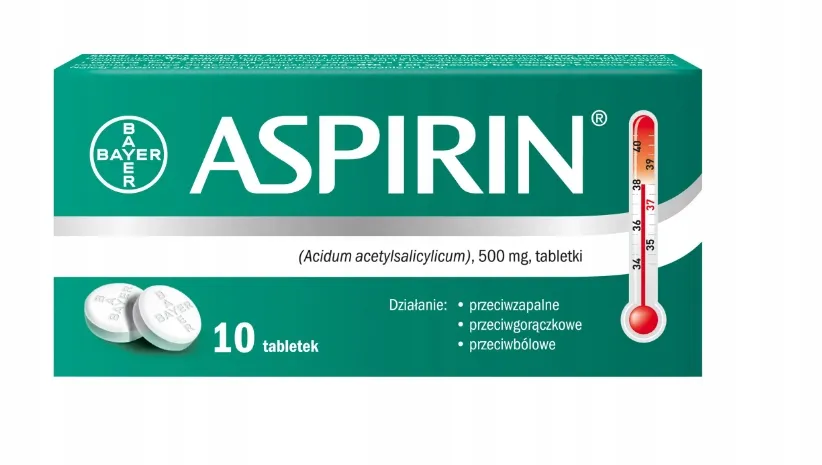
Table of Contents
Package leaflet: Information for the patient
Warning! Keep this leaflet! Information on the immediate packaging is in a foreign language.
Aspirin
500 mg, tablets
Acidum acetylsalicylicum
Please read this leaflet carefully before taking the medicine, as it contains important information for the patient.
This medicine should always be used exactly as described in this patient leaflet or as directed by a doctor or pharmacist.
- Keep this leaflet for future reference.
- If you need advice or further information, please consult your pharmacist.
- If you experience any adverse reactions, including any adverse reactions not listed in this leaflet, inform your doctor, pharmacist, or nurse. See section 4.
- If there is no improvement or if you feel worse after 3–5 days, consult your doctor.
Table of contents of the leaflet:
- What Aspirin is and what it is used for
- What you need to know before taking Aspirin
- How to take Aspirin
- Possible side effects
- How to store Aspirin
- Contents of the pack and other information
1. What Aspirin is and what it is used for
Aspirin contains acetylsalicylic acid, which has analgesic, anti-inflammatory, and antipyretic effects.
Indications:
- mild to moderate pain,
- fever.
2. Important information before using Aspirin
When not to use Aspirin
- if the patient is allergic to the active substance – acetylsalicylic acid, other salicylates, or any of the other ingredients of this medicine (listed in section 6),
- if the patient has a bleeding tendency,
- if the patient has acute gastric or duodenal ulcer,
- if the patient has severe heart failure, severe liver failure, or severe kidney failure,
- if the patient has previously experienced asthma attacks induced by salicylates or substances with similar action, particularly non-steroidal anti-inflammatory drugs (NSAIDs),
- if the patient is concurrently taking methotrexate (used, among others, in cancer treatment) at doses of 15 mg per week or higher,
- if the patient is in the third trimester of pregnancy,
- in children under 12 years of age.
Warnings and precautions
Before starting treatment with Aspirin, discuss it with your doctor or pharmacist:
- if the patient is hypersensitive to non-steroidal anti-inflammatory and anti-rheumatic drugs or other allergenic substances,
- if the patient is concurrently taking anticoagulant medicines,
- if the patient has impaired liver function,
- if the patient has impaired kidney function or circulatory disorders (e.g. renal vessel disease, congestive heart failure, reduced circulating blood volume, sepsis, severe bleeding), as acetylsalicylic acid may further increase the risk of kidney function disturbances and severe kidney failure,
- if the patient has a history of (chronic or recurrent) peptic ulcer disease or gastrointestinal bleeding,
- if the patient suffers from a genetic disorder involving deficiency of the enzyme glucose-6-phosphate dehydrogenase, as administration of acetylsalicylic acid may induce hemolysis or hemolytic anemia,
- if the patient is breastfeeding.
Do not use medicines containing acetylsalicylic acid in women during the first and second trimesters of pregnancy unless absolutely necessary.
Acetylsalicylic acid may cause bronchospasm and provoke asthma attacks or other hypersensitivity reactions. Patients with bronchial asthma, chronic respiratory diseases, hay fever, nasal polyps, or those who experience allergic reactions to other substances (e.g. skin reactions, itching, urticaria) are particularly at risk.
Patients undergoing surgical procedures (including minor procedures, e.g. tooth extraction) should inform their doctor about taking Aspirin.
Acetylsalicylic acid, even in small doses, reduces the excretion of uric acid from the body. In patients predisposed to reduced uric acid excretion, the drug may trigger an attack of gout.
During certain viral infections, particularly influenza A virus, influenza B virus, or varicella (chickenpox), mainly in children and adolescents, there is a risk of Reye's syndrome – a rare but life-threatening condition. Persistent vomiting during an infection may indicate the onset of Reye's syndrome, requiring immediate medical attention.
The risk of Reye's syndrome during viral infections may increase if acetylsalicylic acid is administered concurrently, although a causal relationship has not been proven.
Due to the above, medicines containing acetylsalicylic acid should not be used in children under 12 years of age. In adolescents over 12 years of age, medicines containing acetylsalicylic acid should be used only under medical supervision.
Long-term use of medicines containing acetylsalicylic acid may cause headache, which worsens with each subsequent dose.
Long-term use of analgesics, particularly those containing multiple active substances, may lead to severe kidney function disorders and kidney failure.
Aspirin and other medicines
Inform your doctor or pharmacist about all medicines you are currently taking, have recently taken, or plan to take.
Exercise particular caution when using Aspirin with the following medicines, as acetylsalicylic acid may enhance:
- the toxic effect of methotrexate on bone marrow; do not use acetylsalicylic acid concurrently with methotrexate administered at doses of 15 mg per week or higher; concurrent use of methotrexate at doses lower than 15 mg per week requires special caution;
- the effect of anticoagulants, thrombolytic drugs (clot-dissolving agents), and antiplatelet agents, which may increase the risk of prolonged bleeding time and hemorrhage;
- the risk of peptic ulcer disease and gastrointestinal bleeding when used concurrently with corticosteroids, other non-steroidal anti-inflammatory drugs (including other salicylates), or when alcohol is consumed during treatment;
- after discontinuation of systemic glucocorticosteroids (except hydrocortisone used as replacement therapy in Addison's disease), the risk of salicylate overdose increases;
- the effect of digoxin (a medicine used in heart diseases), as it increases its plasma concentration;
- the effect of antidiabetic medicines, e.g. insulin, sulfonylurea derivatives;
- the toxic effect of valproic acid (a medicine used, among others, in epilepsy), which in turn enhances the antiplatelet effect of acetylsalicylic acid;
- the effect of selective serotonin reuptake inhibitors (antidepressant medicines).
Exercise particular caution when using Aspirin with the following medicines, as acetylsalicylic acid may weaken their effect:
- uricosuric agents used in the treatment of gout that increase uric acid excretion from the body (e.g. benzbromarone, probenecid), which may exacerbate symptoms of gout;
- diuretics;
- certain antihypertensive medicines (from the group of so-called angiotensin-converting enzyme inhibitors).
Aspirin may be used concurrently with the above-mentioned medicines (except methotrexate at doses of 15 mg per week or higher) only after consultation with a doctor.
Aspirin with food, drink, or alcohol
See section 3 of the leaflet.
Warning! Alcohol may increase the risk of adverse effects on the gastrointestinal tract, such as mucosal ulceration or bleeding.
Pregnancy, breastfeeding, and fertility
During pregnancy and breastfeeding, or if pregnancy is suspected or planned, consult your doctor or pharmacist before using this medicine.
Aspirin is contraindicated in the third trimester of pregnancy, as it may cause complications in the perinatal period, both in the mother and the newborn. Medicines containing acetylsalicylic acid should not be used in women during the first and second trimesters of pregnancy unless absolutely necessary.
If acetylsalicylic acid must be used by women attempting to conceive or during the first and second trimesters of pregnancy, the lowest possible dose for the shortest possible duration should be used.
Aspirin belongs to a group of medicines that may adversely affect female fertility. This effect is reversible and resolves after discontinuation of therapy.
Acetylsalicylic acid passes into breast milk in small amounts.
Driving and operating machinery
This medicine does not affect the ability to drive or operate machinery.
3. How to use Aspirin
This medicine should always be used exactly as described in this patient information leaflet or as directed by a doctor or pharmacist. If in doubt, consult your doctor or pharmacist.
The recommended dose of Aspirin is:
- Adults: 1 to 2 tablets (i.e. 500–1000 mg of acetylsalicylic acid) at a time. If necessary, the single dose may be repeated no more frequently than every 4 to 8 hours. Do not take more than 8 tablets (i.e. 4000 mg of acetylsalicylic acid) per day.
- Adolescents over 12 years of age: Aspirin may be used in adolescents over 12 years of age only on medical advice. Take 1 tablet (i.e. 500 mg of acetylsalicylic acid) at a time. If necessary, the single dose may be repeated no more frequently than every 4 to 8 hours. Do not take more than 3 tablets (i.e. 1500 mg of acetylsalicylic acid) per day. Do not use the medicine for longer than 3–5 days without consulting a doctor.
The tablets should be taken orally, after meals, with plenty of water.
Taking more Aspirin than recommended
Poisoning with the active substance of Aspirin may result from long-term use of the medicine (mild poisoning) or overdose (severe poisoning), which may be life-threatening, for example after accidental ingestion by children or elderly individuals.
Symptoms of mild poisoning include: dizziness (including vertigo), tinnitus, hearing loss, excessive sweating, nausea and vomiting, headache, confusion (disturbances of consciousness with disorientation, impaired thinking and speech, hallucinations, illusions, anxiety, and psychomotor agitation), rapid breathing, abnormally deep breathing, and symptoms of respiratory alkalosis (visual disturbances, fainting).
In severe poisoning, additional symptoms may occur: high fever, disturbances of the respiratory system (up to respiratory arrest and suffocation), disturbances in heart and blood vessel function (from irregular heartbeat and low blood pressure to cardiac arrest), fluid and electrolyte loss (from dehydration, oliguria [reduced daily urine output below 400–500 ml in adults] up to kidney failure), increased or decreased blood glucose concentration (especially in children), ketosis, gastrointestinal bleeding, blood coagulation disorders, and neurological disturbances manifesting as lethargy, confusion up to coma, and seizures.
If more than the recommended dose has been taken, seek immediate medical advice from a doctor or pharmacist. In case of severe poisoning, the patient must be taken immediately to hospital. Treatment of poisoning includes gastric lavage, administration of activated charcoal, and alkaline diuresis. In severe cases, forced alkaline diuresis, peritoneal dialysis, or hemodialysis may be required.
Missing a dose of Aspirin
If a dose of Aspirin is missed and symptoms persist, take the next dose as scheduled. Do not take a double dose to make up for a missed dose.
Stopping treatment with Aspirin
If you have any further questions about the use of this medicine, consult your doctor or pharmacist.
4. Possible adverse effects
Like any medicine, this medicine can cause adverse effects, although not everyone will experience them.
Warning!
- If vomiting of coffee-ground appearance or black, tarry stools occurs, discontinue the medicine and consult a doctor immediately.
- Signs of a severe allergic reaction may include: facial and eyelid swelling, swelling of the tongue and larynx with
narrowing of the airways, difficulty breathing, shortness of breath up to asthma attacks,
rapid heartbeat, sudden drop in blood pressure up to life-threatening shock.
If any of the above symptoms occur, immediate professional medical assistance must be provided.
Such reactions may occur even after the first dose of the medicine.
Gastrointestinal disorders:
Stomach and abdominal pain, heartburn, nausea, vomiting, indigestion, inflammation of the gastrointestinal tract,
potentially life-threatening gastrointestinal bleeding: overt (coffee-ground vomiting, tarry stools) or occult (bleeding occurs more frequently with higher doses); peptic ulcer disease of the stomach or duodenum, perforation, constrictive intestinal enteropathy (particularly during long-term use).
Hepatic and biliary disorders:
In rare cases, transient disturbances of liver function (increased aminotransferase activity) have been reported.
Nervous system disorders:
Dizziness and tinnitus, usually symptoms of overdose.
Blood and lymphatic system disorders:
Increased risk of bleeding, haemorrhages (postoperative, nosebleeds, gingival bleeding, urogenital bleeding),
bruising, prolonged bleeding time and prothrombin time, thrombocytopenia. Bleeding may lead to iron-deficiency anaemia or haemorrhagic anaemia, manifesting as asthenia, pallor, hypoperfusion, and abnormal laboratory test results.
Haemolysis and haemolytic anaemia in patients with severe glucose-6-phosphate dehydrogenase deficiency.
Vascular disorders:
Intracranial haemorrhage (particularly in patients with uncontrolled hypertension and/or concomitant use of other anticoagulant medicines), potentially life-threatening.
Renal and urinary disorders:
Renal function impairment and severe kidney damage.
Immune system disorders:
Hypersensitivity reactions with clinical symptoms and abnormal laboratory findings such as: respiratory disease exacerbated by acetylsalicylic acid intake, mild to moderate reactions affecting the skin, respiratory and cardiovascular systems, with symptoms such as: rash, urticaria, angioedema (including vasomotor), respiratory and cardiac disturbances, nasal mucosa inflammation, nasal mucosa hyperaemia, and very rarely severe reactions, including anaphylactic shock.
Respiratory system disorders:
Bronchial asthma.
Reporting of adverse effects
If any adverse effects occur, including any not listed in this leaflet, inform your doctor, pharmacist, or nurse.
Adverse effects can be reported directly to the Department of Monitoring Adverse Drug Reactions, Office for Registration of Medicinal Products, Medical Devices and Biocidal Products, Al. Jerozolimskie 181C, 02-222 Warsaw, Tel: +48 22 49 21 301, Fax: +48 22 49 21 309, website: https://smz.ezdrowie.gov.pl
Adverse effects may also be reported to the marketing authorisation holder or parallel importer.
Reporting adverse effects helps to provide more information on the safety of the medicine.
5. How to store Aspirin
Do not store at temperatures above 30°C.
Keep the medicine in a place out of sight and reach of children.
Do not use this medicine after the expiry date stated on the carton following the abbreviation "EXP:".
The expiry date refers to the last day of the stated month.
Medicines must not be disposed of via wastewater or household waste. Ask your pharmacist how to dispose of medicines you no longer need. This will help protect the environment.
6. Contents of the packaging and other information
What Aspirin contains
The active substance is acetylsalicylic acid (Acidum acetylsalicylicum). Each tablet contains as the active substance 500 mg of acetylsalicylic acid.
Other components of the medicine are: cellulose, powder, corn starch.
What Aspirin looks like and contents of the pack
White, round tablets packed in blisters of 10 tablets. The pack contains 10, 20 or 100 tablets.
Responsible entity in Lithuania, the country of export:
UAB „Bayer”
Sporto 18
LT-09238 Vilnius
Lithuania
Manufacturer:
Bayer Bitterfeld GmbH
Ortsteil Greppin
Salegaster Chaussee 1
06803 Bitterfeld-Wolfen
Germany
Parallel importer:
Allpharm Sp. z o.o. sp.k.
M. Zdziechowskiego 11/4
02-659 Warsaw
Poland
Repackaged in:
CEFEA Sp. z o.o. Sp. komandytowa
Działkowa 56
02-234 Warsaw
Poland
Marketing authorization number in Lithuania, the country of export: LT/1/94/0846/001
LT/1/94/0846/002
Parallel import authorization number: 30/23