Aspargin
Poland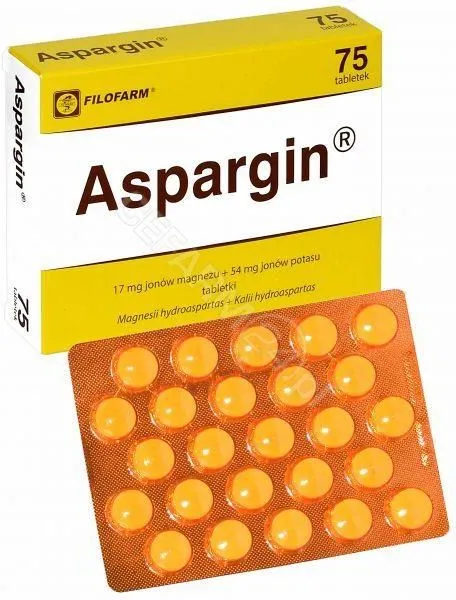
Table of Contents
Package leaflet: Information for the patient
Aspargin
17 mg of magnesium ions + 54 mg of potassium ions, tablets
Magnesii hydroaspartas + Kalii hydroaspartas
Please read this leaflet carefully before using the medicine, as it contains
important information for the patient.
This medicine should always be used exactly as described in this patient leaflet or as directed by a
physician or pharmacist.
- Keep this leaflet, as you may need to read it again.
- If you need advice or further information, please consult your pharmacist.
- If you experience any adverse reactions, including any not listed in this leaflet, inform your physician or pharmacist. See section 4.
- If there is no improvement after 30 days, or if you feel worse, consult your physician.
Table of contents
- What Aspargin is and what it is used for
- Important information before taking Aspargin
- How to take Aspargin
- Possible side effects
- How to store Aspargin
- Contents of the pack and other information
1. What Aspargin is and what it is used for
Aspargin is a medicine containing magnesium and potassium. It contains a well-absorbable mixture of magnesium and potassium salts of aspartic acid, an important structural component of the body.
Magnesium is an activator of numerous enzymes and plays a role in the production and transport of energy in the body. It is essential for the proper function of the heart muscle, nervous system, smooth muscle of blood vessels, and striated muscles. Magnesium deficiency increases the risk of coronary artery disease, myocardial infarction, and cardiac arrhythmias. Symptoms of magnesium deficiency include:
- Hyperexcitability,
- Difficulty concentrating and sleeping,
- Increased susceptibility to stress,
- Skeletal muscle disorders manifested by tremors, cramps, and tics.
Potassium participates in the function of the nervous and cardiovascular systems and in neuromuscular conduction. Potassium deficiency poses a risk to normal functioning of:
- The nervous system, nerve conduction, and neuromuscular transmission (movement, heart function, functioning of other internal organs),
- The transport system moving various substances into and out of the body's cells (nutrition, respiration, and excretion),
- The circulatory and excretory systems in regulating water-electrolyte balance (responsible for maintaining proper blood pressure and blood pH).
Aspartic acid participates in the transmission of stimuli in the central nervous system.
Indications:
Aspargin is indicated for the supplementation of magnesium and potassium deficiencies:
- In heart function disorders caused by magnesium and potassium deficiency;
- Prophylactically in ischemic heart disease and in cases at risk of myocardial infarction;
- As supportive therapy in patients after myocardial infarction (during recovery);
- After infectious diseases or surgical procedures that have led to decreased magnesium and potassium levels;
- During prolonged use of cardiac glycosides and diuretics (e.g., thiazides, furosemide).
If there is no improvement after 30 days, or if you feel worse, consult your physician.
2. Important information before using Aspargin
When not to use Aspargin
- if the patient is allergic to magnesium aspartate, potassium aspartate (the active substances), or to any of the other ingredients of this medicine (listed in section 6);
- if the patient has hypermagnesemia (excess magnesium in the blood);
- if the patient has hyperkalemia (excess potassium in the blood);
- if the patient has severe renal insufficiency (creatinine clearance less than 30 ml/min);
- if the patient has urinary tract infections (bladder, kidneys);
- if the patient has heart rhythm disorders (feeling of abnormally slow, fast or irregular heartbeat);
- if the patient has myasthenia gravis (a rare disease characterized by muscle weakness);
- if the patient has significant hypotension.
Warnings and precautions
Before starting treatment with Aspargin, discuss this with your doctor or pharmacist.
Exercise caution if:
- the patient has acute dehydration,
- the patient has extensive tissue damage (e.g. large surface area burns),
- the patient is taking other medicines containing potassium,
- the patient has peptic ulcer disease,
- the patient has previously been diagnosed with intolerance to certain sugars.
During long-term use, and in case of diarrhea or in patients treated with cardiac glycosides, serum potassium and magnesium levels should be monitored, and if necessary also in erythrocytes (your doctor will recommend appropriate tests).
Do not administer without medical advice in cancerous diseases.
Aspargin and other medicines
Inform your doctor or pharmacist about all medicines the patient is currently taking or has recently taken, as well as any medicines the patient plans to use.
Do not take Aspargin simultaneously with the following medicines:
- tetracycline antibiotics, because magnesium salts reduce absorption of these antibiotics; at least a 3-hour interval should be maintained between administration of these drugs;
- oral anticoagulants (coumarin derivatives), fluoroquinolones, fluoride, because magnesium compounds reduce their absorption;
- medicines and dietary supplements containing phosphates, calcium, or iron, because they reduce magnesium absorption from the gastrointestinal tract;
- atropine or hyoscine, because the risk of intestinal ulceration may increase when potassium salts are taken orally.
Cardiac glycosides (heart medications) used in combination with potassium may lead to cardiac arrhythmias.
Diuretics (amiloride, spironolactone, triamterene) and angiotensin-converting enzyme inhibitors (medicines used in cardiovascular diseases, e.g. captopril and enalapril) may increase potassium levels in the blood.
Aminoglycoside antibiotics, loop diuretics, cisplatin, cycloserine, mitramycin, amphotericin B, and mineralocorticoids enhance magnesium excretion.
Cortisone reduces the effects of potassium. Potassium contained in the medicine reduces the absorption of vitamin B_.
Taking Aspargin with food and drink
The medicine should be taken after a meal, with water. Magnesium absorption is reduced in the presence of dietary phosphates, calcium, lipids, and phytates.
Pregnancy, breastfeeding and fertility
If the patient is pregnant or breastfeeding, suspects she may be pregnant, or plans to become pregnant, she should consult her doctor or pharmacist before using this medicine.
Driving and operating machinery
When taken as directed, this medicine does not affect the ability to drive motor vehicles, operate machinery, or psychomotor performance.
Aspargin contains sucrose (sugar)
One tablet contains 53 mg of sucrose. If the patient has been previously diagnosed with intolerance to certain sugars, the patient should consult a doctor before taking this medicine.
Aspargin contains sodium
The medicine contains less than 1 mmol (23 mg) of sodium per tablet, i.e. the medicine is considered "sodium-free".
3. How to use Aspargin
This medicine should always be taken exactly as described in this patient information leaflet or as directed by your doctor or pharmacist. If in doubt, consult your doctor or pharmacist.
Usually, the medicine is used as described below.
Adults and adolescents over 12 years of age:
The recommended dose is 1 to 2 tablets 2 to 3 times daily after meals, i.e. 2 to 6 tablets per day in 2 or 3 divided doses.
The medicine should be taken after meals, with water.
This medicine should not be used in children under 12 years of age.
Patients with renal or hepatic impairment
Aspargin should not be used in patients with severe renal and/or hepatic impairment due to the risk of hypermagnesemia or hyperkalemia.
Elderly patients
There is no need to change the dosage regimen in patients over 65 years of age.
If you feel that the effect of Aspargin is too strong or too weak, consult your doctor.
Taking more Aspargin than recommended
If you have taken more than the recommended dose of this medicine, seek immediate medical advice from your doctor or pharmacist.
Symptoms of poisoning: atrioventricular conduction disturbances, respiratory disorders, drop in arterial blood pressure, convulsions, muscle weakness, fatigue, drooping eyelids.
If you miss a dose of Aspargin
Do not take a double dose to make up for the missed dose.
Stopping Aspargin
If you have any further questions about the use of this medicine, consult your doctor or pharmacist.
4. Possible adverse effects
Like all medicines, this medicine can cause adverse effects, although not everyone experiences them.
Uncommon (occur in fewer than 1 in 100 patients treated): abdominal pain, nausea,
diarrhea, constipation, vomiting, which usually resolve spontaneously.
Rare adverse effects (occur in fewer than 1 in 1,000 patients treated): atrioventricular conduction disorders (heart rhythm disturbances), muscle weakness, skin redness.
Rarely, especially in patients with renal function disorders: hyperkalemia.
Very rare adverse effects (occur in fewer than 1 in 10,000 patients treated): insomnia.
Reporting of adverse effects
If any adverse effects occur, including any adverse effects not listed
in this leaflet, inform your doctor, pharmacist, or nurse. Adverse effects
can be reported directly to the Department of Monitoring of Adverse Drug Reactions of the Office for Registration of Medicinal Products, Medical Devices and Biocidal Products:
Al. Jerozolimskie 181C
02-222 Warsaw
tel: 22 49 21 301
fax: 22 49 21 309
Website: https://smz.ezdrowie.gov.pl.
Adverse effects can also be reported to the marketing authorization holder.
Reporting adverse effects helps to provide more information on the safety of the medicine.
5. How to store Aspargin
Keep this medicine out of the sight and reach of children.
Do not use this medicine after the expiry date stated on the packaging after: EXP.
The expiry date refers to the last day of the stated month.
Store below 25°C.
Keep in the original packaging to protect from moisture.
Medicines should not be disposed of via wastewater or household waste. Ask your pharmacist how to dispose of medicines no longer required. Such practices help protect the environment.
6. Contents of the packaging and other information
What Aspargin contains
- The active substances in the medicine are: magnesium aspartate hydrochloride and potassium aspartate hydrochloride. One tablet contains 17 mg of magnesium ions in the form of 250 mg of magnesium aspartate hydrochloride; 54 mg of potassium ions in the form of 250 mg of potassium aspartate hydrochloride.
- The excipients are: potato starch, sodium carboxymethyl starch, sucrose, magnesium stearate, talc.
What Aspargin looks like and contents of the pack
Aspargin is an oral tablet.
Available pack sizes:
Tablets in blister packs, in a cardboard box:
25 tablets – 1 blister containing 25 tablets
50 tablets – 2 blisters containing 25 tablets each
75 tablets – 3 blisters containing 25 tablets each
Not all pack sizes may be marketed.
Marketing Authorisation Holder and Manufacturer
Farmaceutyczna Spółdzielnia Pracy FILOFARM
ul. Pułaskiego 39
85-619 Bydgoszcz
For further information about this medicine, please contact the representative of the Marketing Authorisation Holder.
Farmaceutyczna Spółdzielnia Pracy Filofarm
ul. Pułaskiego 39, 85-619 Bydgoszcz
Tel.: (52) 342 67 88
Information for blind and partially sighted people: the package leaflet of Aspargin is available in the Audio Leaflet system via the nationwide freephone number 800 706 848.